


Legal operations management is the discipline of running a legal department like a business: managing its spend, technology, vendors, and data so lawyers can spend their time on legal work.
This guide covers the four pillars of a legal operations strategy, how legal ops supports global growth, practical ways to control legal spend, and a three-phase roadmap for getting started. It is part of our legal operations insights hub.
From cost center to business partner

Traditionally, corporate legal departments were treated as a necessary but expensive cost center: a reactive function, called in after a problem had already surfaced. Legal operations management changes that dynamic. It turns the department into a data-driven business unit that anticipates needs and shows its value in numbers.
I like to think of it this way: imagine your legal department is a high-performance race car. The lawyers are the drivers, with the skill and judgment to navigate complex legal tracks. The legal operations team is the pit crew, chief engineer, and data analyst rolled into one.
They design the engine (your technology stack), manage the fuel and tires (budget and resources), and analyze performance data to find efficiencies and take seconds off each lap.
Without this operational backbone, even the best driver is stuck with an underperforming car.
(I have to confess: since I started working with Mirat, one of my fellow Managing Directors at Swiftwater, I find myself using a lot of race car analogies. Haha!)
Building the legal operations function from scratch?
Assessment, roadmap, and delivery for the operational side of the department: spend, technology, process, vendors, and the data that proves what legal delivers. Advice from operators who ran the function.
See Legal Ops ConsultingThe core mission of legal ops
The goal of legal operations management is to improve how legal services are delivered. Cost savings are part of it, and so is making the legal team a better-integrated partner to the business. By taking ownership of the business side of the department, legal ops professionals free attorneys to focus on legal work. The responsibilities fall into five categories:
- Strategic Planning: Aligning the legal department’s goals with what the business is trying to achieve.
- Financial Management: Overseeing budgets, forecasting costs, and managing outside counsel spend.
- Technology Management: Selecting, implementing, and managing the legal tech stack, from e-billing to contract lifecycle management (CLM) tools.
- Vendor Management: Getting the most value from relationships with law firms and other legal service providers.
- Data Analytics: Tracking key performance indicators (KPIs) to measure efficiency, spot trends, and demonstrate the department’s value.
Strategic planning sets the direction. The other four are the pillars that deliver it, covered in detail below.
How legal operations changes the department
The table below shows the before and after for a department that adopts a legal operations management framework.
| Business Area | Before Legal Ops (Reactive & Manual) | After Legal Ops (Proactive & Optimized) |
|---|---|---|
| Budgeting | Unpredictable, based on past spending with frequent overages. | Data-driven forecasting with predictable costs and clear ROI. |
| Contracting | Slow, manual review processes creating business bottlenecks. | Automated workflows with CLM tools for accelerated cycle times. |
| Vendor Relations | Reliance on traditional hourly billing with limited cost controls. | Strategic sourcing with Alternative Fee Arrangements (AFAs). |
| Decision Making | Based on anecdote and attorney intuition. | Informed by data, metrics, and performance analytics. |
The four pillars of a legal operations strategy
A legal operations strategy works as a system. Each pillar addresses a specific business problem, and together they give the department control over cost, speed, and risk. Improvements made outside this structure tend to stay scattered.
Financial management and cost control
The first pillar is Financial Management: bringing business discipline to legal spending. The goal is to replace unpredictable costs with accountability and foresight, starting with the department’s largest expense, outside counsel. That means building budgets from real data, monitoring spend as it happens, and using Alternative Fee Arrangements (AFAs), covered in the legal spend section below. This pillar is the foundation of legal spend management.
Technology and process automation

The second pillar is Technology Management. Technology automates manual work and produces the data that informed decisions depend on, which makes selecting and implementing the right tools a core legal ops responsibility. The main categories are:
- Front Door: A single entry point where business users submit, triage, and track legal requests, connected to the department’s other legal systems.
- e-Billing and Spend Management: Tracking every dollar spent with outside firms and surfacing spending trends.
- Matter Management: Centralizing the information and workflows for every legal matter in one reliable source of truth.
- Contract Lifecycle Management (CLM): Automating the contract journey from drafting and negotiation to signature and renewal, which speeds up the business.
The hierarchy below shows why the order matters.
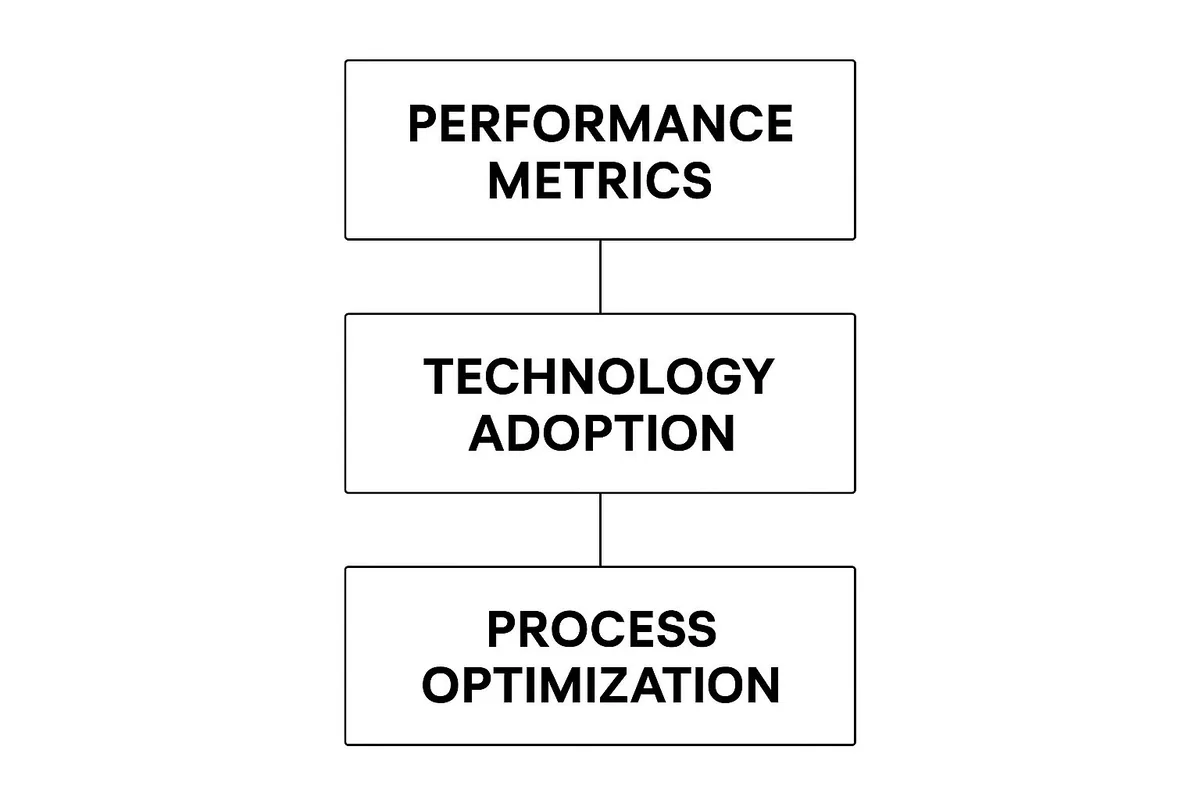
Process improvement comes first, technology second, and meaningful metrics third. Skip the first two and the metrics will not be reliable enough for strategic decisions. Selecting and sequencing these tools is the focus of our legal technology services.
Vendor and law firm management
The third pillar, Vendor Management, is about getting the best value from external partners: choosing, managing, and evaluating outside counsel and other legal service providers, including the growing number of alternative legal service providers (ALSPs). Many departments formalize this through a law firm panel: pre-approved firms working under agreed rates, guidelines, and performance expectations.
The aim is a durable partnership with each key firm. That comes from clear expectations, a law firm scorecard the department can act on, and regular law firm business reviews that keep cost and quality aligned.
A mature legal operations function uses data from its spend management systems to make sourcing decisions, sending work to the firms that consistently deliver the best value. That data strengthens the department’s position in negotiations and builds a competitive, high-quality network of legal support. For how to structure this as a program, see our guide to outside counsel management.
Data analytics and reporting
The fourth pillar, Data Analytics, connects the other three. It is the legal ops team’s job to collect, analyze, and present data that shows how the department performs and what it contributes to the business.
Need the function run, not just advised on?
Swiftwater embeds senior practitioners directly into legal operations, handling bill review, matter management, and program delivery on your behalf.
See Managed ServicesThat focus matters more as workloads grow. The 2025 CLOC State of the Industry Report found that 83% of legal departments expect demand to rise, and 63% named workload and resource bandwidth as their top challenge. AI adoption nearly doubled from 2023, with 30% of legal teams using it and another 54% planning to. Those numbers explain the pressure on legal ops to use analytics and technology to handle more work with the same resources. The full findings are in the CLOC 2025 State of the Industry report.
How legal ops supports global business growth

When a business expands internationally, the legal department is often seen as a source of delays and warnings. A mature legal operations function changes that role, giving the business standardized processes and data it can use to enter new markets with managed risk.
Standardizing cross-border workflows
Signing a supplier in Germany, hiring employees in Brazil, and leasing office space in Japan at the same time can trigger three separate custom legal reviews. Without a standard approach, those reviews become bottlenecks. Legal ops builds the infrastructure that keeps them fast and consistent:
- Contract Approvals: Uniform templates and automated workflows for international agreements, so core company protections are built in regardless of jurisdiction.
- Compliance Checks: Repeatable processes for due diligence and regulatory review, so the business can enter new markets quickly.
- Risk Assessment: A consistent framework for evaluating legal and business risk across countries, giving executives comparable data.
- Self-Service: Low-value, repeatable work converted to self-service, which reduces the legal team’s workload and gives the business faster answers.
Building a global legal network
Managing outside counsel is harder at global scale, where a business may work with dozens of firms across continents, each with its own billing habits and service levels. Legal ops brings order through law firm convergence, consolidating work into a smaller managed panel, and by centralizing the selection, negotiation, and performance review of international firms. The right panel size depends on spend distribution, practice-area coverage, and geography, which our guide to how many law firms a legal department should use walks through.
Data then keeps the network disciplined: identifying the best performers, supporting better fee arrangements, and enforcing billing guidelines and approved rates through eBilling panel configuration. The result is a coherent network of external counsel that works as an extension of the in-house team, plus forward-looking analysis of market-entry risk and compliance cost that leadership can use to plan expansion. For more, see this analysis of how legal ops supports global expansion.
Actionable strategies for managing legal spend
Financial discipline is the foundation of a high-performing legal department, and it starts with transparency: knowing where the money goes, why it is spent, and what the department receives in return. That clarity supports better sourcing decisions, stronger negotiating positions, and credible forecasts, while protecting the quality of legal work.
Moving beyond the billable hour
For decades the billable hour dominated legal billing. It can misalign incentives, rewarding hours logged over efficiency and outcomes. A cornerstone of modern legal spend management is adopting Alternative Fee Arrangements (AFAs).
AFAs restructure the financial relationship with outside counsel to align incentives and add predictability. They move more of the cost risk to the law firm, which gives the firm a reason to resolve matters efficiently.
Common AFA models include:
- Fixed Fees: A set price for a defined project, such as a routine litigation matter or a series of patent applications.
- Capped Fees: Hourly billing with a ceiling on the total cost, which protects the budget from overruns.
- Success-Based Fees: A portion of the firm’s fee tied to achieving a specific, agreed outcome for the business.
Negotiated well, AFAs control cost and build a results-driven relationship with external providers. Fee structure is one lever among several; our guide to law firm value adds covers what else to negotiate beyond rates.
Implementing e-billing and spend management software
Financial control depends on reliable data, and dedicated e-billing and spend management software is the foundational tool for getting it, acting as the central system for the department’s legal spend.
These tools automate the invoice lifecycle from submission and review through approval and payment. They check invoices against billing guidelines automatically, flagging out-of-policy charges, duplicate entries, and other discrepancies that are hard to catch by hand.
The larger benefit is the data. These systems produce detailed analytics on spending patterns, law firm performance, and matter-level costs, which turn raw invoices into business intelligence the department can act on.
That visibility addresses one of the most persistent problems in legal operations: cost transparency. As outside legal costs rise, departments are focusing on AFAs and making e-billing standard practice so every expense can be tracked and analyzed. BDO’s review of legal operations challenges and strategies covers this in more detail. The same visibility shows when work drifts to firms outside the approved panel, which our guide to off-panel legal spend leakage explains how to measure and control.
The same data feeds annual financial planning. Accurate tracking of current spend produces a more credible forecast. For more, see our guide on how to conduct effective legal department annual planning.
Evaluating legal technology but not sure where to start?
We help legal departments cut through the vendor noise, mapping technology to process maturity and building a roadmap that actually gets adopted.
See Legal TechnologyYour practical legal operations roadmap
Moving from theory to practice can feel overwhelming, so start small. The three phases below work for any legal department, wherever it is on its legal ops journey, and each one builds the momentum and support the next phase needs.
Phase 1: Assess your current state
Before you set a new direction, you need to know where you are starting. This phase is about discovery and diagnosis: replacing assumptions with hard data on the problems the department actually faces.
Start with structured interviews with key stakeholders inside and outside the legal team: attorneys and paralegals, and also partners in finance, sales, and procurement. Ask direct questions to find the real pain points.
- Where are the biggest bottlenecks in your day-to-day work?
- Which tasks feel clunky, manual, or just plain slow?
- What’s the single most frustrating thing about working with the legal team?
Listen for patterns. When several people mention slow contract approvals or a lack of visibility into legal spending, you have found your starting line.
Phase 2: Prioritize initiatives and secure buy-in
With a clear picture of the department’s challenges, focus on what will deliver the most impact for a reasonable amount of effort. This is where you build your business case.
Shortlist two or three high-priority initiatives. For each one, define the problem, the proposed solution, and the expected outcome. For example, if slow contract cycles are delaying deals, an illustrative initiative might read: “Implement a Contract Lifecycle Management (CLM) tool with a target of reducing review times by 30%.”
Next, secure executive buy-in. Present your findings as business opportunities, in the language and metrics the C-suite already uses:
- Reducing risk exposure
- Accelerating revenue cycles
- Improving operational efficiency
- Controlling costs
Buy-in comes from showing you have done the homework. A well-researched proposal that connects legal ops improvements to bottom-line business value is hard for leadership to turn down, and it shows you are thinking like a business partner.
Phase 3: Implement and measure success
With approval and resources in place, it is time to execute. For any major initiative, especially one involving new technology, I recommend starting with a pilot program.
A pilot tests the solution on a smaller, controlled scale. You can work out problems, gather feedback, and build a success story. For instance, roll out an e-billing platform with just two of your highest-spend law firms and demonstrate a clear return on investment (ROI) before a department-wide implementation.
Measurement runs through this entire phase. Before you start, establish clear Key Performance Indicators (KPIs) for each initiative.
| Initiative Example | Key Performance Indicators (KPIs) to Track |
|---|---|
| New CLM Tool | Average contract cycle time, number of contracts processed per month, deviation from standard templates. |
| E-Billing System | Percentage of invoices automatically flagged for non-compliance, reduction in spend with non-preferred firms. |
| Process Redesign | Time saved on specific administrative tasks, reduction in error rates, internal client satisfaction scores. |
Continuous measurement creates a feedback loop: it proves the value of completed work and supplies the data needed to keep improving. To build on these early wins, learn how the Head of Legal Operations can implement continuous improvement.
Bottom Line
Legal operations management gives a legal department the business discipline to control spend, adopt the right technology, manage outside counsel on value, and prove its contribution with data. A legal operations strategy organizes that work into four pillars (financial management, technology, vendor management, and data analytics), with strategic planning setting the direction.
The practical path is incremental. Assess where the department stands, prioritize the two or three initiatives with the clearest business case, pilot them, and measure the results. For help choosing where to start, see our guide to prioritizing legal transformation initiatives.
The role is growing. As regulation becomes more complex and AI changes how legal work gets done, legal operations leaders are becoming key advisors to the C-suite, connecting legal risk to business strategy. Start with the pain point your stakeholders mention most, fix it with measurable results, and use that win to build the rest of the function.
Swiftwater and Company helps in-house legal teams assess where their legal operations stand, build the roadmap, and implement it, from eBilling and CLM to managed operations. Most clients start with an assessment, and our legal operations consulting services are where that work begins.
Frequently Asked Questions
What is legal operations management?
Legal operations management is the discipline of running a legal department like a business. It covers the work that lets lawyers focus on legal matters: strategic planning, budgeting and outside counsel spend, legal technology, vendor and law firm relationships, and data analytics. A legal operations team designs the department’s processes, selects and manages its systems, controls its costs, and measures its performance with KPIs. The result is a department that operates predictably, supports the business faster, and can demonstrate its value with data.
What is a legal operations strategy?
A legal operations strategy is the plan that aligns how the legal department runs with what the business needs. It typically rests on four pillars. Financial management brings discipline to budgets and outside counsel spend. Technology management selects and sequences tools such as e-billing, matter management, and contract lifecycle management. Vendor management directs work to the law firms and providers that deliver the best value. Data analytics measures performance and reports the department’s contribution. Strategic planning sets the direction for all four, so each initiative ties back to a business goal such as reducing risk, accelerating revenue cycles, or controlling costs.
What are legal operations best practices?
Start with a structured assessment: interview attorneys, paralegals, and partners in finance, sales, and procurement to find the recurring pain points. Prioritize two or three initiatives with a clear business case, and frame them in terms the C-suite uses, such as risk, revenue cycles, efficiency, and cost. Pilot new technology on a small scale before a department-wide rollout, for example e-billing with your two highest-spend law firms. Improve processes before adding technology, since reliable metrics depend on both. Define KPIs for every initiative before it starts, use Alternative Fee Arrangements where they fit, and review performance regularly so the function keeps improving.
How do you start a legal ops function in a small department?
Start small and target the biggest, most obvious pain point. A small department does not need a large dedicated team at the outset. Find where the most time or money is being lost, whether that is outside counsel spend or disorganized contract management, and pick one. Then roll out a single focused improvement, such as a simple e-billing system to get control of spending or a basic contract repository so lawyers stop searching old emails for agreements. Track the results, such as faster contract turnaround or measurable cost savings. That proof is the strongest case for leadership to expand the function and take on the next challenge.
What skills does a legal operations professional need?
A legal operations professional combines business strategy, project management, and technology. The role does not require a law degree, but it does require a clear understanding of how lawyers think and work. The core skills are financial acumen, to build and manage budgets, forecast costs, and interpret spending data; project management, to run timelines, resources, and stakeholders; technical fluency, to evaluate, implement, and manage legal technology; a data-driven mindset, to turn analytics into strategic decisions; and strong communication, to translate between lawyers, IT, finance, and outside vendors so everyone works from the same understanding.
How do you measure the ROI of legal operations?
Measure both hard and soft returns, because leadership needs both to see the full picture. Hard ROI is financial and countable: savings from better vendor negotiations, lower outside counsel spend through tighter management, and hires the department avoided because new technology or processes made the team more efficient. Soft ROI reflects performance and reduced risk: faster contract cycle times that help the business close deals sooner, and higher satisfaction scores from internal clients. Define the metrics for each initiative before it begins, such as contract cycle time, outside counsel spend, and internal client satisfaction, and track them consistently so the results are credible to leadership.
Disclaimer: This article is provided for educational and information purposes only. Neither Swiftwater and Company nor the author provides legal advice. External links reflect the thinking of their respective authors and are provided for informational purposes only.