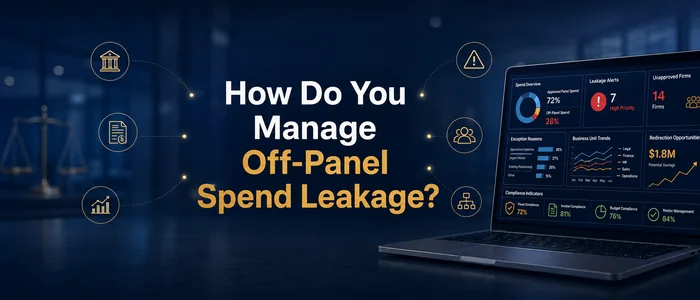

Off-panel legal spend leakage is the gap between the law firms your panel program approved and the firms your organization actually uses, and closing that gap requires measurement, intake controls, and a realistic exceptions process.
Legal departments invest significant effort in building a converged outside counsel panel, negotiating rates, and setting expectations with preferred firms. The return on that work depends on whether the organization’s legal spend actually flows through the panel.
When it does not, rate advantages erode, volume commitments weaken, and the panel becomes weak. This is a solvable problem, but solving it starts with understanding where leakage originates and building the right controls into your legal spend operating model.
It also requires treating panel compliance as an ongoing discipline rather than a one-time project, a point we cover in depth in What Is Outside Counsel Management? The Complete Guide.
What is off-panel legal spend and why does it grow back?
Off-panel legal spend is any outside counsel expenditure directed to firms that are not on your approved panel. It includes new engagements with non-panel firms, legacy matters that predate the current panel, and work routed to specialists outside the panel’s coverage areas.
The reason it grows back is structural. Panel programs are point-in-time decisions. They reflect the organization’s legal needs, preferred firms, and negotiated economics as of the date the panel was set. But the organization keeps moving. New business lines create new legal needs. Acquisitions bring inherited firm relationships. Regulatory shifts demand specialties the panel was never designed to cover. And individual lawyers, both inside and outside the legal department, maintain relationships with firms they trust, regardless of whether those firms made the panel.
None of this is malicious. Leakage is rarely the result of people deliberately ignoring policy. It is the natural consequence of a static program meeting a dynamic organization. The challenge is to make leakage visible, intentional, and bounded so the panel remains a working governance tool.
Is your legal spend data telling you the full story?
We help legal departments build the analytics, rate governance, and reporting infrastructure to move from invoice processing to strategic spend management.
See Legal Spend ServicesWhere does leakage actually come from?
Law firm panel leakage clusters around four sources, and each one calls for a different response.
Business-unit direct engagement. Operating teams engage firms on their own, often for matters they consider operational rather than legal: real estate closings, local employment advice, regulatory filings. The work bypasses legal intake entirely, and the firm never appears in the panel compliance data until the invoices surface months later. Thomson Reuters found that 70% of legal departments face rising matter volumes while budgets remain flat or declining, which means legal teams rarely have bandwidth to proactively police every business-unit engagement.
Inherited matters. Acquisitions, divestitures, and reorganizations bring firm relationships that predate the panel. A portfolio company’s long-standing litigation counsel or a newly acquired division’s regulatory firm are not going to transition mid-matter. These inherited engagements are often the largest single source of off-panel legal spend dollars, and they resist consolidation because switching costs are real and immediate. The pattern is especially common in organizations that are growing through acquisition, as we explore in How Does Law Firm Convergence Actually Work?.
Specialty gaps. Every panel has coverage boundaries. When a matter arises in a jurisdiction, practice area, or industry niche the panel does not cover, someone finds a firm that does. This is a gap in design, and the question is whether those specialty engagements are tracked, evaluated, and either formalized or closed when the need recurs. Specialty gaps that remain unaddressed become permanent off-panel legal service channels, and the spend associated with them contributes to the broader pattern of legal cost management challenges and spend creep.
Partner-follows and relationship hires. When a key partner moves from a panel firm to a non-panel firm, the client relationship often follows. The same happens when a senior in-house lawyer joins from another organization and brings firm preferences. These shadow relationships create de facto panel additions without any of the rate negotiation, conflict clearance, or performance evaluation that the formal panel process provides.
How do you measure legal spend leakage due to off-panel law firm usage?
Measurement starts with a clean classification of every firm whether you configure it in the ebilling system or accounts payable solution as panel or non-panel. This sounds simple, but it requires a current, maintained panel roster and a way to match it against the firms receiving payments.
The core metric is the off-panel legal spend ratio: total dollars paid to non-panel firms divided by total outside counsel spend, expressed as a percentage. Track it quarterly. Break it down by business unit, practice area, and matter type. The aggregate number tells you whether leakage is growing; the breakdowns tell you where.
Three supplemental views make the ratio actionable:
- Firm count by status. How many distinct firms received payments last quarter? How many were panel firms? A panel of 30 firms is hard to justify if 90 firms are billing.
- New-firm velocity. How many non-panel firms were engaged for the first time in the past 12 months? A rising count signals that intake controls are not catching new engagements.
- Concentration within leakage. Is off-panel legal provider spend distributed across dozens of small engagements, or concentrated in a few large matters? Concentrated leakage is easier to address because the conversations are specific.
The ACC 2025 Law Department Management Benchmarking Report found that the median number of outside firms used by organizations declined from 14 to 10 in the most recent reporting period, reflecting a broader trend toward consolidation. If your firm count is moving in the opposite direction, leakage is a likely contributor.
This kind of analysis is exactly what distinguishes legal spend analytics from basic reporting. Reporting tells you how much you spent. Analytics tells you whether your program is working. For teams building the cost justification for better analytics tooling, legaltechcalculator.com provides a framework for modeling the ROI.
What controls keep work on preferred law firm panel?
You need to establish controls to govern your preferred law firm panel and it best works in layers. If controls are not setup properly, then you have compliance leakage when work bypasses the panel entirely, price leakage when non-panel firms bill above negotiated rates, and billing leakage when invoices lack the scrutiny that panel governance provides. The controls below address all three.
Matter intake gating. Every new matter or engagement should pass through a structured intake process that checks the requested firm against the approved panel. If the firm is not on the panel, the request routes to an approval workflow rather than proceeding automatically. This is the single most effective control because it intervenes before the engagement starts, when switching costs are zero. The intake gate does not need to be heavy. A simple check at matter opening, with a dropdown that distinguishes panel from non-panel firms, is enough to flag the exception.
New-firm approval workflow. When a business unit or in-house lawyer wants to use a non-panel firm, they should be able to request an exception through a defined process rather than simply proceeding. The approval workflow captures the justification, applies rate guidelines (including any non-panel premium), and creates a record. Over time, recurring exceptions in the same practice area signal a panel gap that should be addressed at the next review cycle.
Want the review function run for you?
Every outside counsel invoice checked against your guidelines, rates, and matter context, inside the eBilling platform you already own, with the exception handling, vendor coaching, and savings reporting that separate a review program from invoice processing.
See Bill Review ServicesELM configuration. Your enterprise legal management system is where these controls become operational. Firm master data, panel status flags, matter-type mappings, and approval routing rules all live in the ELM. When the system is properly configured, off-panel legal service provider engagements generate alerts, reports surface leakage trends automatically, and the data is available for quarterly reviews without manual assembly. We cover the specifics of how to set this up in How Do You Configure eBilling for Panel Compliance?. Organizations looking at their legal spend management holistically will find that panel compliance is one of several controls that compound when configured together.
When is off-panel legal provider spend the right answer?
Genuine specialty needs are the clearest case. If a patent matter requires a firm with deep expertise in a narrow technology domain, and no panel firm covers it, the responsible decision is to go off-panel. The same applies to bet-the-company litigation where the best available counsel is not on the roster, or to matters in jurisdictions where the panel has no meaningful presence.
The key is to make these exceptions intentional and documented. An honest exceptions process has three features:
- A stated justification. The requesting lawyer explains why the panel cannot cover the need.
- Rate governance. The non-panel firm is still subject to rate guidelines, even if those guidelines include a premium above panel rates.
- Sunset or review. The exception is time-bound or matter-bound. If the same specialty need recurs, it triggers a panel review rather than another exception.
When exceptions are handled this way, they strengthen the program rather than undermining it. They signal that the panel is a working governance tool, and they generate the data needed to evolve the panel’s coverage over time.
Bottom Line
Off-panel legal spend leakage tells you that the organization’s needs have moved and the program’s controls have not kept pace. Measure leakage by firm status, build intake gating and approval workflows into your ELM and ebilling systems, treat exceptions as data rather than violations, and use the pattern to inform your next panel review.
The panel programs that hold are the ones that treat compliance as an operating discipline backed by intake controls, data, and regular review.
Off-panel legal spend leakage is one of several pressure points Swiftwater evaluates in a structured legal spend engagement. If your panel compliance is slipping and you want a clear picture of where the dollars are going and what controls will close the gaps, a legal spend assessment gives you the diagnostic and the roadmap in a single engagement.
Frequently Asked Questions
What legal spend leakage percentage is normal?
Most panel programs carry 15 to 25 percent off-panel legal vendor and law firm spend when measured by total outside counsel dollars. Single digits are achievable but rare, and usually reflect a narrow panel with aggressive intake controls. The better question is whether your leakage percentage is stable, growing, or concentrated in a few business units, because the trend matters more than the number.
How often should you audit preferred provider panel compliance?
Quarterly is the practical minimum. Monthly reports catch new law firm additions early, but quarterly reviews give you enough data to distinguish a one-time exception from a recurring pattern. The audit should compare the active firm list against the approved panel roster, flag new non-panel firms engaged since the last review, and surface any business unit or practice area where off-panel spend is trending upward. Annual audits alone are too infrequent because leakage compounds quickly once intake controls loosen.
Can ELM systems automate legal spend leakage detection?
Yes, most modern enterprise legal management platforms with e-billing systems can flag off-panel engagements automatically if the law firm master data includes panel status. The system checks the firm on a new matter or invoice against the approved roster and routes exceptions to an approval workflow. Automated detection works best when the panel roster in the ELM is kept current and when matter intake requires firm selection at opening rather than after the first invoice arrives.
Does off-panel law firm usage justify a panel refresh?
Persistent leakage above 30 percent, or leakage concentrated in practice areas the law firm panel was supposed to cover, is a strong signal that the panel needs updating rather than just stricter enforcement. Panels should reflect the work the organization actually sends out, not the work it planned to send out three years ago. A targeted refresh that adds coverage for the areas driving leakage is usually more effective than a full reconvergence.
This article is provided for informational purposes and reflects general practices in legal spend management and outside counsel panel governance. It does not constitute legal advice. Specific panel compliance strategies should be evaluated in the context of your organization’s policies, vendor agreements, and regulatory requirements.