


Law firm convergence is the practice of consolidating outside counsel into a smaller, managed panel of preferred firms, concentrating legal spend and relationships where they produce the most value. It is one of the most common legal spend management strategies in corporate law departments, and one of the most frequently misexecuted.
Sixty-four percent of law departments now report having some form of panel or preferred provider network, according to IADC research. But having a panel and running a convergence program that holds are two very different things. The difference comes down to whether the department stops at the roster cut or builds the governance to sustain it.
What is law firm convergence?
Law firm convergence is the process by which a legal department deliberately reduces the number of outside firms it uses and directs work to a select group of preferred providers. The IADC defines it as “the mechanism for creating preferred provider panels,” with the intent that the department sends its legal work to that select group and maintains panel discipline going forward.
The term covers a range of approaches. Some departments run a formal request-for-proposal process, legal panel RFPs, and appoint a fixed panel. Others simply identify their top performers by spend and matter outcomes, stop sending work to the rest, and formalize the result. The common thread is intentional reduction: moving from a long tail of ad hoc firm relationships to a structured, measurable set.
Law firm convergence is distinct from simply having preferred firms. A preferred firm is a relationship. A converged panel is a program, with criteria for inclusion, expectations for performance, and a governance structure that holds over time. Without those elements, a department may have a list of firms it calls “preferred” without any of the spend concentration, rate leverage, or oversight benefits convergence is designed to produce.
What does legal service provider convergence actually save?
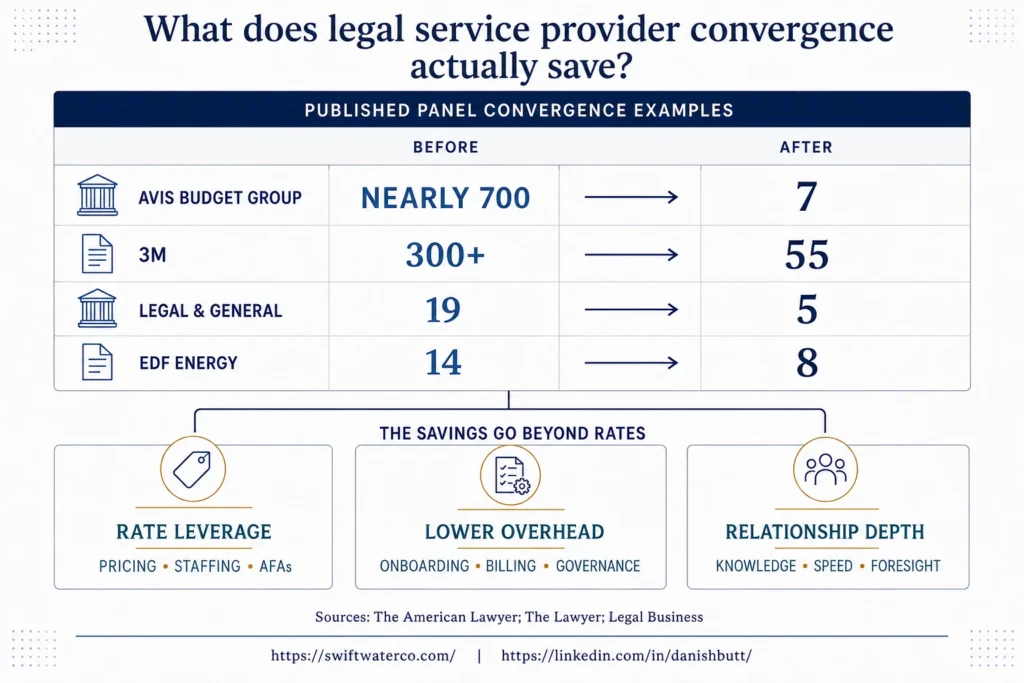
The savings from law firm convergence come from three sources, and rate reduction is only the most visible.
Is your legal spend data telling you the full story?
We help legal departments build the analytics, rate governance, and reporting infrastructure to move from invoice processing to strategic spend management.
See Legal Spend ServicesRate leverage: Concentrating a larger share of spend with fewer law firms gives each firm a larger share of the client’s business, which creates genuine negotiating leverage for the client on rates, staffing, and alternative fee arrangements. Firms that know they hold a meaningful share of a department’s portfolio are more willing to invest in the relationship, including on pricing.
Overhead: A department working with dozens or hundreds of law firms spends significant time onboarding, communicating billing guidelines, reviewing invoices, and managing relationships. Wolters Kluwer’s ELM LegalVIEW Insights report found that the median corporate legal department works with roughly 122 providers. Cutting that number to a managed law firm panel eliminates a large volume of low-value administrative work.
Relationship depth: Law firms on a converged panel develop institutional knowledge of the client’s business, risk tolerance, and internal processes. That familiarity reduces ramp-up time on new matters, improves staffing decisions, and allows the firm to flag issues earlier. These benefits are real but harder to quantify, which is why departments that reduce legal spend without sacrificing quality track relationship outcomes alongside cost.
The published numbers are striking. As reported by The American Lawyer, Avis Budget Group consolidated from nearly 700 firms to a seven-member global panel, and 3M cut from over 300 firms to 55. Legal & General reduced its panel from 19 to five, as reported by The Lawyer. Legal Business reported that EDF Energy moved from 14 to eight. These adjustments are beyond marginal and they represent a fundamental restructuring of how the department sources legal services.
When does law firm convergence fail?
Law firm convergence produced unintended consequences in predictable ways, and most of them trace back to the same root: the department treated it as a procurement event rather than an operating-model change.
The most common failure is dependency risk. A panel that is too small concentrates too much work with too few firms. If a key firm has a conflict of interest, loses a critical partner, or simply underperforms, the department has limited alternatives. Litigation-heavy portfolios are especially vulnerable, because conflicts arise more frequently and can lock out panel firms from entire matter categories.
The second failure is the innovation gap. Law firm convergence theory holds that preferred firms, given more work and a deeper relationship, will invest more in the client. In practice, the evidence is mixed. A Thompson Hine survey cited by Dennis Kennedy found that only 29% of in-house participants said their outside firms had brought them “significant” innovation. Guaranteed volume can reduce a firm’s incentive to differentiate.
The third is expertise gaps. Broad law firm convergence programs sometimes force work into panel firms that lack deep specialization in a given area, simply because the firm is on the panel. The result is higher costs (the panel firm staffs up to learn an area a specialist already knows) or worse outcomes (the panel firm misses nuances a specialist would catch).
Casey Flaherty, writing on convergence and panel programs, put it bluntly: “most convergence initiatives waste considerable time for limited benefit” when they are not paired with robust metrics and governance. The roster cut is the visible event. The governance that follows it is where the value is created or lost.
How do you run a law firm convergence program?
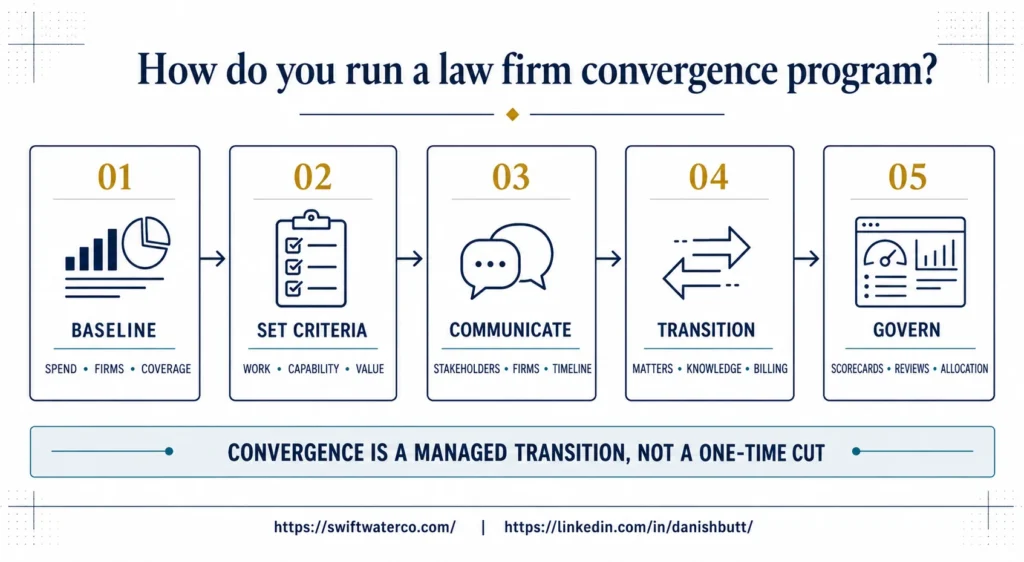
A law firm convergence program that holds follows a sequence: baseline the current state, set criteria, communicate, transition, and then govern.
The budget pressure behind these programs is real. Axiom’s national GC study found that 96% of general counsel had their budgets cut heading into 2024, with 54% seeing cuts greater than 10%. Law firm convergence is one of the few levers that can produce meaningful savings without reducing the scope of legal coverage. But the savings only materialize if the program is run as a structured engagement, not a one-time announcement. A structured legal spend program gives the convergence effort the measurement infrastructure it needs to hold.
The right panel size depends on the portfolio. Chorus Insight research across 121 organizations found the average formal panel includes eight firms, with a range from two to 69. Sixty-five percent of organizations reduced their panel size in their most recent review. Understanding how much a department should spend on outside counsel provides the spend context that shapes the right target. (Note: these are directional benchmarks. I personally welcome them as data points. Some do actually tell you about the trends. The harder part is doing the work that is required for your own organization with your own trends and data.)
Want the review function run for you?
Every outside counsel invoice checked against your guidelines, rates, and matter context, inside the eBilling platform you already own, with the exception handling, vendor coaching, and savings reporting that separate a review program from invoice processing.
See Bill Review ServicesStart with the baseline. The department needs a clear picture of how many firms it uses, how much it spends with each, what practice areas each covers, and how well each performs. Without this, the selection criteria have no foundation and the eventual savings have no benchmark. If the department lacks a legal spend baseline, building one is the prerequisite, not a parallel workstream.
Set criteria before reviewing firms. The selection framework should reflect the department’s actual needs: geographic coverage, practice-area depth, conflict exposure, rate competitiveness, technology capability, and past performance. Weight these before looking at any individual firm, so the process is defensible and consistent. The criteria should also define what “on panel” means operationally: expected share of work, reporting obligations, rate structures, and performance review cadence.
Communicate early and directly. Incumbent firms need to know that a law firm convergence process is underway, what the timeline looks like, and what the evaluation criteria are. Firms not selected need a clear, professional transition with adequate time. The goal is a smaller, stronger set of relationships, without a set of burned bridges.
Manage the transition as a project. Active matters need documented handoffs. Knowledge transfer needs a timeline. Internal stakeholders who have existing firm relationships need to understand the rationale and the process for requesting exceptions. This is where many programs stall: the selection is announced, but the operational transition is left to happen organically, and it does not.
Why do converged law firm panels drift apart again?
Governance decay is the single most common reason converged law firm panels lose their value over time.
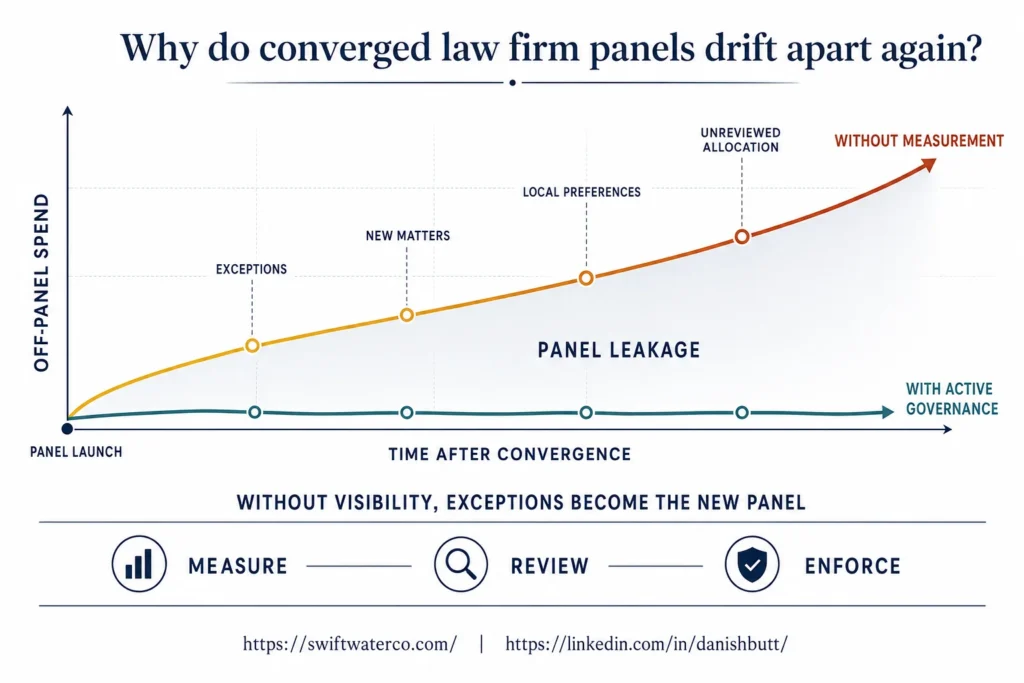
The pattern is consistent. The department runs a rigorous selection process, announces the panel, negotiates new rates, and sees immediate savings. Then the panel is treated as done. No one tracks whether work is actually going to panel firms. No one measures whether the panel firms are meeting the performance expectations that justified their selection. Off-panel legal spend creeps back in as individual lawyers route work to firms they know personally or firms that handled a specific matter type before the panel existed.
This drift is not malicious. It is the natural result of a program without ongoing measurement. If no one tracks panel compliance, there is no feedback loop to catch deviations. If no one reviews firm performance against the criteria that drove selection, there is no mechanism to hold firms accountable or to remove underperformers.
The solution is straightforward but requires commitment: quarterly or semiannual panel reviews that examine spend concentration, off-panel leakage, matter outcomes, and firm performance against the original criteria. The review should produce decisions, not just reports. Firms that underperform should be put on notice or removed. Firms that consistently exceed expectations should be rewarded with a larger share of work.
The Chorus Insight research found that most panels are set for three years, but in practice they often run for four and a half years or more before a formal review. That gap is where the value erodes. The departments that sustain convergence benefits treat the panel as a living program, not a fixed list. Understanding why legal spend keeps creeping up helps explain why this ongoing discipline matters.
Struggling to control outside counsel spend?
We help legal departments build the governance, billing guidelines, panel structure, and rate programs that take back control of what outside counsel costs.
See Legal Spend ServicesBottom Line
Law firm convergence works when it is treated as an operating-model change, not a procurement event. The roster cut is the beginning of the program, not the end. Departments that pair a disciplined selection process with ongoing governance, spend tracking, and firm accountability sustain the savings; departments that stop at the announcement watch the panel drift apart within two years.
Swiftwater helps legal departments design and execute law firm convergence programs that hold, from spend baselining through panel selection to the ongoing governance that prevents drift. If your law department is evaluating or re-running a panel consolidation, our legal spend services provide the structure and measurement to make the results stick.
Frequently Asked Questions
What is a typical law firm convergence target?
Most converged law firm panels land between five and fifteen firms, though the right number depends on the complexity and geographic reach of the legal portfolio. Chorus Insight research across 121 organizations found the average formal panel includes eight firms, with a range from two to sixty-nine. The target should reflect the number of firms needed to cover the department’s practice areas and jurisdictions without overlap or gaps.
How do you exit incumbent firms professionally?
Communicate the decision directly, with a clear timeline and transition plan. Give departing firms adequate notice, typically sixty to ninety days, to wind down active matters. Others that did not make the panel but may still continue to provide services may not need much handholding. Offer to discuss the decision if asked, but keep the rationale consistent: the program is consolidating to improve oversight and performance, not punishing any single firm. Handle transitions of active matters carefully, with documented knowledge transfer, to protect the client relationship and avoid disruption.
Does law firm convergence work for litigation-heavy portfolios?
Law firm convergence for litigation-heavy portfolios requires more careful panel design. Litigation portfolios face conflict-of-interest pressure that transactional work rarely does, so the panel must be large enough to avoid situations where every preferred firm is conflicted out. Many litigation-heavy departments maintain a core panel for routine defense work while keeping a smaller list of approved specialists for high-stakes or niche matters outside the main panel.
How long until law firm convergence savings show up?
Law firm convergence related rate improvements from renegotiation typically appear in the first billing cycle after the new panel takes effect, usually within three to six months. The larger savings from reduced management overhead, better matter staffing, and stronger relationship leverage take twelve to eighteen months to materialize fully. Departments that track savings from the outset, using a clear spend baseline, see results faster because they can measure and reinforce the gains.
This article is provided for informational purposes and reflects general practices in law firm convergence and legal panel management. It does not constitute legal, financial, or procurement advice. Specific convergence decisions should be evaluated in the context of each organization’s legal portfolio, risk profile, and business requirements.