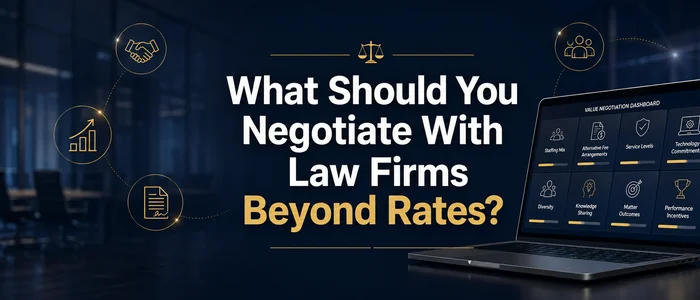

Law firm value adds are the non-rate commitments, from secondments and training to data transparency and alternative fee pilots, that legal departments negotiate alongside hourly rates to extract the full value of a panel relationship.
Beyond the services a firm delivers on invoiced matters, firms can provide structured benefits that strengthen the department without adding cost, or that deepen the relationship in ways both sides gain from.
One of my personal clients, a Fortune 100 manufacturing, built a mentoring program with several of their panel firms where each side designated a group of professionals to be coached over a defined period. The firm invested partner time; the client invested access to its business context. Neither side paid for it in the traditional sense, and both received value that outlasted any single matter.
These commitments are negotiable, definable, and trackable. Yet most departments invest months refining rate cards and seconds defining everything else a firm should deliver. The result is predictable: firms hit their rate targets and treat everything beyond the hourly invoice as optional. For legal spend leaders building or refreshing a panel program, value-adds represent the forgotten half of the deal.
This article builds on the broader framework in What Is Outside Counsel Management? The Complete Guide to lay out what to ask for, how to structure it, and how to make sure firms actually deliver.
Why is rate-only negotiation leaving value on the table?
Rate negotiations receive outsized attention because rates are measurable. Every procurement professional can compare a partner rate at Firm A against a partner rate at Firm B. But the 2026 Thomson Reuters/Georgetown Report on the State of the US Legal Market found that 90% of legal dollars still flow through standard hourly billing arrangements, even as firms deploy technology that accomplishes in minutes what used to take hours. Winning a 3% rate reduction while ignoring the secondments, training, data commitments, and alternative fee structures a firm would have agreed to means the negotiation stopped halfway.
The problem compounds over time. Legal departments that focus exclusively on rates end up with panel agreements that say nothing about what firms owe beyond billable work. When the first business review arrives, there is no baseline for “did the firm deliver what it promised” because nothing beyond the rate card was promised. As the Buying Legal Council’s research on legal procurement metrics found, legal departments are now tracking what law firms offer in terms of value-adds in RFPs against what they actually deliver over the course of the panel period. The departments that do this well negotiate value-adds with the same rigor they bring to outside counsel rate negotiation tactics.
Is your legal spend data telling you the full story?
We help legal departments build the analytics, rate governance, and reporting infrastructure to move from invoice processing to strategic spend management.
See Legal Spend ServicesThe CLOC 2026 State of the Industry Report underscores why this matters now: only 37% of legal departments expect outside counsel spend to increase, down sharply from 58% the prior year, while 62% identify outside counsel and vendor management as a key focus area. When budgets flatten and demand rises, the value a firm delivers beyond its invoiced hours becomes a strategic differentiator.
How should AI efficiency change what you negotiate?
Firms are adopting AI tools at scale, and the economic question for legal departments is straightforward: who captures the efficiency gains? According to Axiom’s research on AI in legal services, 79% of law firms use AI to boost efficiency, but only 6% pass those savings to clients, while 34% charge premium rates for AI-enhanced work. For departments negotiating panel terms today, AI transparency belongs in the value-add conversation alongside secondments and training.
To follow the AI conversation among the in-house leaders and law firms, and where it actually stands right now, read my Linkedin article here, “Ford’s GC Just Reset the AI Conversation. Here Is What In-House Teams Do Next.“
The practical commitments to negotiate fall into three areas.
- Disclosure: require firms to report which matter types and task categories use AI-assisted workflows. This is the baseline. A department that does not know where its firms use AI cannot evaluate whether pricing reflects efficiency gains or ignores them.
- Shared savings: for matter types and/or tasks where AI measurably reduces time (document review, due diligence, contract analysis, regulatory research), negotiate a pricing structure that reflects the lower cost of delivery. This can take the form of reduced task-level rates, fixed fees on AI-eligible tasks, or explicit efficiency credits.
- Quality commitments: AI-assisted work should meet the same supervision and accuracy standards as traditional work. Require the firm to disclose its quality assurance protocols for AI-generated output and to maintain professional responsibility for all deliverables.
Clients at Legalweek 2026 made the expectation concrete, as Thomson Reuters Institute reported: in-house leaders are now asking firms for proof of how AI delivers measurable cost savings on specific matters, including line-item invoice transparency showing whether AI was used and what time or money it saved. Departments that build these commitments into panel agreements today will capture value that departments negotiating only on rates will miss entirely.
What value-adds are firms actually willing to give?
The categories are more concrete than most departments realize. Research from both the Buying Legal Council and Altman Weil identifies a consistent set of value-adds that firms routinely offer, or will offer when asked directly during panel selection. The six categories that matter most sit in two groups: people commitments and knowledge commitments.
People commitments put firm resources inside your operation:
- Secondments. A firm places a lawyer inside the department for a defined period at a negotiated rate well below the firm’s standard billing for equivalent work. The Buying Legal Council found that secondments ranked as the most frequently offered value-add by law firms in RFP responses, yet many departments accept vague promises rather than codified terms. Define the role scope, practice area, seniority, duration, and rate in the panel agreement itself.
- CLE and executive training. Firms agree to deliver a set number of continuing legal education sessions or non-legal executive training workshops (compliance, cybersecurity, regulatory updates) per year. Altman Weil’s research found that firms provide on-site CLE, customized webinars, and non-legal executive training as standard relationship investments. The key is specifying the number, format, and topics in advance rather than leaving it to the relationship partner’s goodwill.
- Hotline hours. Dedicated hours for ad-hoc questions and emergencies, billed at zero or at a reduced rate. The Buying Legal Council found that emergency hotlines have become a common request accepted by law firms in RFP negotiations. Quantify the hours per quarter so the commitment is trackable.
- Mentoring and development programs. Both sides designate professionals for structured coaching over a defined period. The firm invests partner time; the client invests access to its business context. These programs cost neither side in direct fees but build the kind of institutional knowledge that improves staffing decisions and matter outcomes across the entire relationship.
Knowledge commitments give the department access to firm resources it would otherwise pay for:
- Knowledge management and platform access. Access to a firm’s research databases, template libraries, precedent banks, or collaboration tools. The Buying Legal Council found that legal departments ranked innovative technology as the most preferred value-add category, covering everything from contract templates to analytics dashboards.
- Pre-matter planning sessions. Structured meetings to align on staffing strategy, budget parameters, and business objectives before a matter begins. These sessions reduce scope creep and prevent the billing surprises that erode trust mid-engagement.
- “Looking around the corner” briefings. Proactive alerts on regulatory changes, litigation trends, or industry-specific risks that affect the client’s business. Altman Weil describes these as a distinct value-add category where firms demonstrate they understand the client’s industry, not just its legal work.
Each of these is negotiable, definable, and measurable. The mistake departments make is treating them as relationship gestures instead of contract terms.
How do you negotiate AFA pilots into panel terms?
Alternative fee arrangement pilots are one of the highest-value commitments a firm can make, and one of the hardest to extract without structure. The reason is straightforward: AFAs shift financial risk from the client to the firm, and firms will not agree to open-ended risk transfer. They will, however, agree to a bounded pilot.
A well-structured AFA pilot in a panel agreement defines three things.
- Matter type. Pick a category with enough volume and predictability to give the pilot statistical meaning: recurring regulatory filings, standard commercial contracts, routine employment matters.
- Fee structure. Fixed fees, capped fees, or success-based arrangements each work for different matter profiles.
- Evaluation period. Twelve months with a quarterly review cadence is enough to generate data without locking either side into a structure that is not working.
The connection to matter budgets is direct. AFA pilots only succeed when both sides have reliable matter-level cost data to set the fee baseline. If the department cannot produce historical spend by matter type, it cannot propose a credible fixed fee, and the firm will not accept one. Building matter budget discipline first makes AFA negotiation possible. Skipping it makes AFA pilots a source of frustration for both sides.
Include the AFA pilot commitment in the law firm panel agreement itself, not as a side conversation to be revisited later. Specify the matter types eligible, the fee structure for the pilot, the data each side will share, and the review dates. When the pilot runs, both sides learn whether the economics work, and that learning is worth more than any rate concession.
Want the review function run for you?
Every outside counsel invoice checked against your guidelines, rates, and matter context, inside the eBilling platform you already own, with the exception handling, vendor coaching, and savings reporting that separate a review program from invoice processing.
See Bill Review ServicesWhat technology and data commitments should panels include?
Billing data quality and reporting transparency are value-adds that most departments overlook entirely, even though they determine whether the department can manage spend effectively after the panel is signed.
The commitments that belong in a panel agreement fall into three categories:
Billing data quality. Require UTBMS task and activity code compliance on every invoice. Require narrative descriptions that meet a minimum specificity standard (no block billing, no vague entries). These are the baseline for any department that uses e-billing or legal spend analytics. A firm that resists UTBMS compliance is signaling that it does not want its work examined closely.
Budget compliance. Require the firm to submit matter budgets in a defined format before work begins and to flag budget variances above a threshold (typically 10 to 15%) before they hit the invoice. This converts the firm from a vendor that sends invoices into a partner that manages costs collaboratively.
Reporting and analytics access. Require the firm to participate in the department’s reporting cadence: quarterly spend summaries, matter status reports, and accrual estimates. Some firms offer access to their own analytics platforms as a value-add. Where a department is evaluating the ROI of these commitments, tools like legaltechcalculator.com can help quantify the cost impact of billing data quality improvements.
These commitments turn data transparency from an aspiration into a panel term. They also create the infrastructure for meaningful legal spend services and program governance. A department that signs a three-year panel agreement without data commitments will spend the next three years fighting for information it should have negotiated upfront.
How do you make value-adds real instead of forgotten?
Negotiating value-adds means nothing if no one tracks whether they were delivered. The accountability mechanism is the quarterly or annual business review, and it only works if the value-add commitments are specific enough to measure.
Relationship partners should track and report the effort their firms devote to value enhancements and discuss them at annual relationship reviews. That advice applies equally from the client side. The department should maintain a simple scorecard for each panel firm that tracks: what was promised, what was delivered, and what was used.
A practical value-add scorecard covers five questions per commitment:
- Was the commitment defined? (Specific scope, quantity, and timeline in the panel agreement)
- Was it delivered? (Did the firm provide the secondment, training, or data access it committed to?)
- Was it used? (Did the department actually deploy the seconded lawyer, attend the training, or access the platform?)
- What was the impact? (Reduced outside spend, faster matter resolution, better data quality)
- Should it continue? (Renew, modify, or replace with a different commitment for the next period)
This scorecard becomes the backbone of the law firm business review. Instead of reviewing only invoiced spend and matter outcomes, the review covers the full scope of the relationship: rates, value-adds, data quality, and strategic alignment. Firms that consistently deliver on their commitments earn deeper relationships. Firms that do not deliver create a documented basis for panel changes at the next cycle.
The departments that extract the most value from their panels are the ones that negotiate fewer, more specific commitments and then hold firms accountable for delivering them.
Bottom Line
Rate negotiation is necessary but only one lever of value. The legal departments that extract outsized value from their outside counsel are the ones that treat secondments, training, AFA pilots, AI transparency, data commitments, and hotline hours as contract terms with the same specificity and accountability they bring to rate cards.
Struggling to control outside counsel spend?
We help legal departments build the governance, billing guidelines, panel structure, and rate programs that take back control of what outside counsel costs.
See Legal Spend ServicesNegotiate the full deal, codify every commitment in the panel agreement, and track delivery in every business review.
This is the structured panel work Swiftwater will support your legal department in managing complex outside counsel programs. We help define what value-adds to negotiate, how to codify them in panel terms, and how to build the business review process that holds firms accountable. If your next panel cycle is approaching and you want to move beyond rate-only negotiation, legal spend services are where we start.
FAQ
How should corporate legal departments address AI efficiency in law firm negotiations?
Include AI transparency as a panel term. Require firms to disclose which tasks use AI-assisted workflows and how efficiency gains translate to pricing. According to Axiom research, 79% of law firms use AI to boost efficiency but only 6% pass savings to clients. Departments that negotiate AI commitments upfront, including reporting on AI-assisted tasks and shared savings structures, position themselves to capture value that would otherwise remain on the firm side of the relationship.
Do value-adds reduce rate leverage with your legal service providers?
They should not. Value-adds and rates are separate negotiation tracks. A firm that offers strong value-adds such as secondments, training, or data commitments is investing in the relationship, not giving a discount. If a firm tries to justify higher rates by pointing to value-adds, treat that as a signal that the value-adds were never genuinely offered. Negotiate rates on rates and value-adds on value-adds.
Which value-adds do law firms quietly hope you forget?
The most commonly forgotten commitments are CLE training sessions, pre-matter planning meetings, and hotline hours for ad-hoc questions. Firms agree to these during panel selection because they cost relatively little to promise. They become expensive to deliver consistently across a three-year panel period. Tracking delivery in quarterly business reviews prevents these commitments from fading.
How do you value free advice hours from your legal provider?
Multiply the number of committed hours by the firm’s blended rate to establish a notional dollar value. This gives the department a baseline for comparing the offer across firms and for tracking whether hours are actually used. Unused hours represent value left on the table, so include utilization tracking in business reviews and reallocate unused hours to other practice areas if the original scope does not generate demand.
This article is provided for informational purposes and reflects Swiftwater’s experience advising legal departments on outside counsel management. It does not constitute legal advice. Readers should consult qualified legal and procurement professionals for guidance specific to their organizations.