

A legal panel RFP is the structured tender a legal department runs to evaluate outside counsel firms and select the ones it will route work to over a defined term, usually two to three years. Most of them fail on process rather than on firms. The RFP gets designed as a procurement exercise instead of a selection tool, and the panel that comes out of it looks disciplined on paper while changing nothing about how work actually gets done.
A Buying Legal Council survey found that 76% of corporate legal departments use RFPs as part of their spend management strategy, yet research from the GC Thought Leaders Experiment tells a different story about outcomes: across more than 1,400 matters at 28 large companies, panel firms did not outperform non-panel firms on cost, quality, responsiveness, or expertise.
Run properly, the same exercise delivers rate certainty, a shorter bench of firms who understand the business, billing compliance that holds, and genuine leverage at renewal. The difference lies in how the RFP that builds the legal provider panel is designed, scored, and followed through.
This guide walks through the six questions that separate a legal panel RFP that produces a defensible, working result from one that produces binders nobody opens. For a broader view of how panels fit into outside counsel management, start with the pillar guide. For the full topic series, see the Legal Spend hub.
When is a legal service provider panel RFP worth running?
A full legal panel RFP is worth the effort when the current panel no longer reflects how the department actually works, or when there has never been a structured selection process in the first place. That usually means one of three triggers: a meaningful shift in matter mix or geography, a new GC or CLO who needs to reset firm relationships with credibility, or a panel that has grown by accretion rather than design and now includes firms nobody chose deliberately.
When none of those triggers exist, an incumbency review is usually enough. An incumbency review evaluates sitting firms against current performance data, billing history, and stakeholder satisfaction without reopening the field. It is faster, less disruptive, and preserves relationships that are working. The mistake is treating every law firm panel refresh as a full RFP when many of them only need a structured performance conversation.
Is your legal spend data telling you the full story?
We help legal departments build the analytics, rate governance, and reporting infrastructure to move from invoice processing to strategic spend management.
See Legal Spend ServicesThe GC Thought Leaders Experiment underscores why this distinction matters. I could see many of the teams I work with disagreeing with this survey because they do have measurable results. So, even if you do, you can use this as a directional and cautionary publication. Because, their finding that legal service provider panel firms showed no measurable advantage over non-panel firms across cost, quality, and responsiveness suggests that simply having a panel is not enough. The value comes from the rigor of the selection process and the governance that follows it. Running a full RFP without that rigor produces the same result as not running one at all.
A useful litmus test: if your evaluation team cannot articulate, before launching, what a winning response looks like and how it will be scored, you are not ready for a full RFP. You are ready for a scoping conversation. The article on law firm panel design covers how to structure the panel itself before you write the first question.
What does a well-run law firm panel RFP timeline look like?
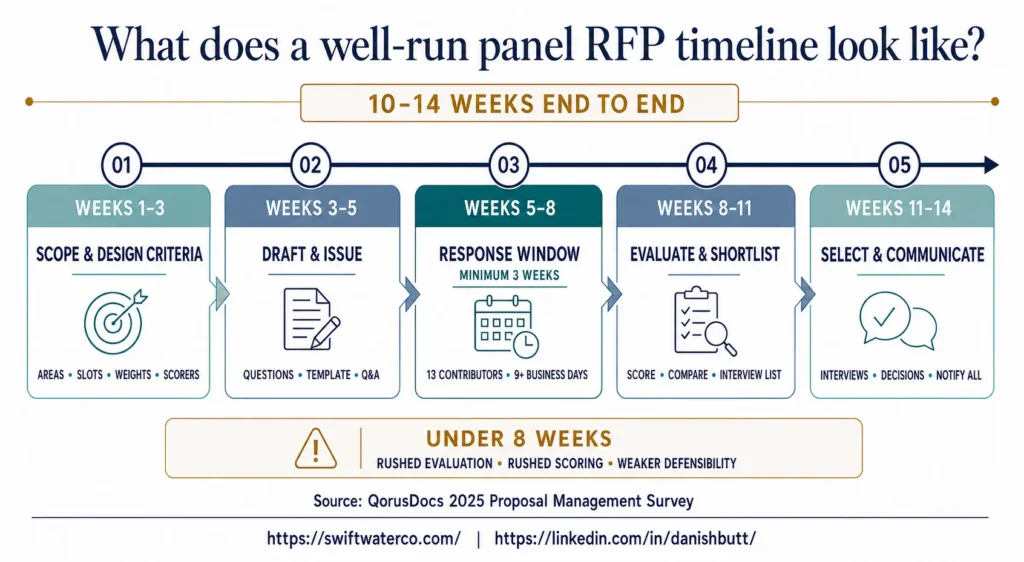
A well-run legal panel RFP takes 10 to 14 weeks from scoping through final selection and communication. Compressing below eight weeks almost always means the evaluation is shallow, the scoring is rushed, and the result is hard to defend internally.
The timeline breaks into five phases:
Weeks 1-3: Scoping and criteria design. This is the most important phase and the one most teams underinvest in. Define the practice areas, the number of slots per area, the evaluation criteria and their weights, and the stakeholders who will score. Align the GC, business-unit leads, and Legal Ops on what “good” looks like before a single question is drafted. If you skip this, every downstream decision becomes a negotiation instead of a calibration.
Weeks 3-5: RFP drafting and issuance. Write the questions, build the response template, and issue to your target list. Give firms a clear submission deadline, a single point of contact for questions, and a brief Q&A window so every respondent works from the same information.
Weeks 5-8: Response window. Three weeks is the minimum for a serious response. QorusDocs’ 2025 Proposal Management Survey found that legal RFP responses involve a median of 13 employees per law firm and take more than nine business days to complete, up from six days in 2022. A two-week window may rush the whole process affecting quality of the responses.
Weeks 8-11: Evaluation and shortlisting. Score responses against your pre-defined rubric. Shortlist two to four finalists per slot for interviews. The scoring model section below covers how to do this without drowning.
Weeks 11-14: Interviews, selection, and communication. Conduct structured interviews with shortlisted firms. Make selections. Then do the part most teams skip: communicate clearly with every firm that responded, including those not selected. Firms that receive a professional rejection are more likely to compete honestly in your next cycle. Firms that hear nothing remember it.
What should the RFP actually ask?
The questions should produce information that maps directly to your scoring criteria and nothing else. Every question that does not feed a scored category is a question that creates work on both sides without improving the decision.
Thomson Reuters’ RFP guidance recommends four core question categories: team experience, legal strategy for handling your matters, staffing strategy, and project management approach. These four categories work because they are scorable, differentiating, and directly relevant to how the firm will actually serve you.
What to leave out: firm bios pulled from the website, generic diversity statements with no data behind them, and open-ended “tell us about your firm” prompts. Copies of lawyer bios belong in the exclusion pile, because they generally contain very little information that matters for scoring. The same applies to any question whose answer you could find on the firm’s website in five minutes. Plus, there is a likely chance you pulled these firms in because of the partner or the lawyer you saw.
Want the review function run for you?
Every outside counsel invoice checked against your guidelines, rates, and matter context, inside the eBilling platform you already own, with the exception handling, vendor coaching, and savings reporting that separate a review program from invoice processing.
See Bill Review ServicesLaw firms receive significant RFP volume, and a concise, differentiated RFP gets better responses because it signals that you have done the work to know what you need. A 40-page questionnaire signals the opposite.
Practical guidance for question design:
- Use closed-ended or structured questions where possible. “Describe your experience with cross-border IP litigation in the pharmaceutical sector in the last three years, including matter count and outcomes” is scorable. “Tell us about your IP practice” is not.
- Limit the RFP to 15-25 substantive questions. Beyond that, response quality drops and evaluation burden rises without improving selection quality.
- Include a scenario or case study relevant to your actual matter mix. How a firm approaches a realistic problem tells you more than how it describes its capabilities in the abstract.
- Request proposed team rosters with timekeeper classifications and roles, not just partner names.
How do you score law firm panel selection RFP responses without drowning in them?
Build the scoring model before you write the legal panel RFP, not after responses arrive. If criteria and weights are set after the fact, the process is reverse-engineered to justify a decision already made, and every stakeholder who was not in the room knows it.
Note: I am purposefully being prescriptive here. This is hard work especially if you are doing this for the first few times. So, I want you to be successful and not get burnt out.
A workable scoring model has four components:
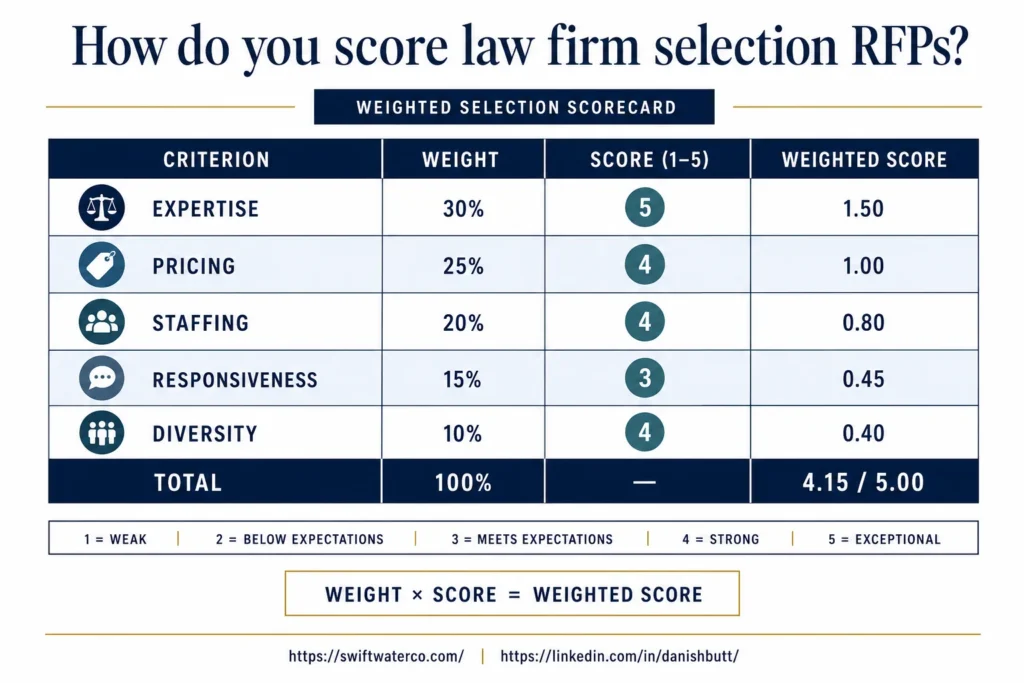
Defined criteria tied to business priorities. Typical categories include relevant expertise, proposed staffing and team composition, pricing structure and competitiveness, responsiveness and project management approach, and diversity. This is like filling a sports team roster, define what positions do you need in your legal panel firm roster.
Five to seven criteria is the practical range. Fewer than five is too blunt to differentiate. More than seven dilutes the weight of each category to the point where scores converge.
Explicit weights. Every criterion should carry a weight that reflects what the General Counsel, the managing counsel and business actually care about. If controlling cost is the primary driver, pricing should carry the highest weight. If specialized expertise in a niche area is the trigger for the RFP, expertise should lead. Publish the weights in the RFP itself so firms know what you prioritize.
A consistent scoring scale. A 1-5 scale with defined anchors works for most legal panels. Define what a 1, 3, and 5 look like for each criterion so that evaluators are calibrating against the same standard, not their own interpretation of “good.” A 5 in expertise should mean something specific and consistent across every evaluator.
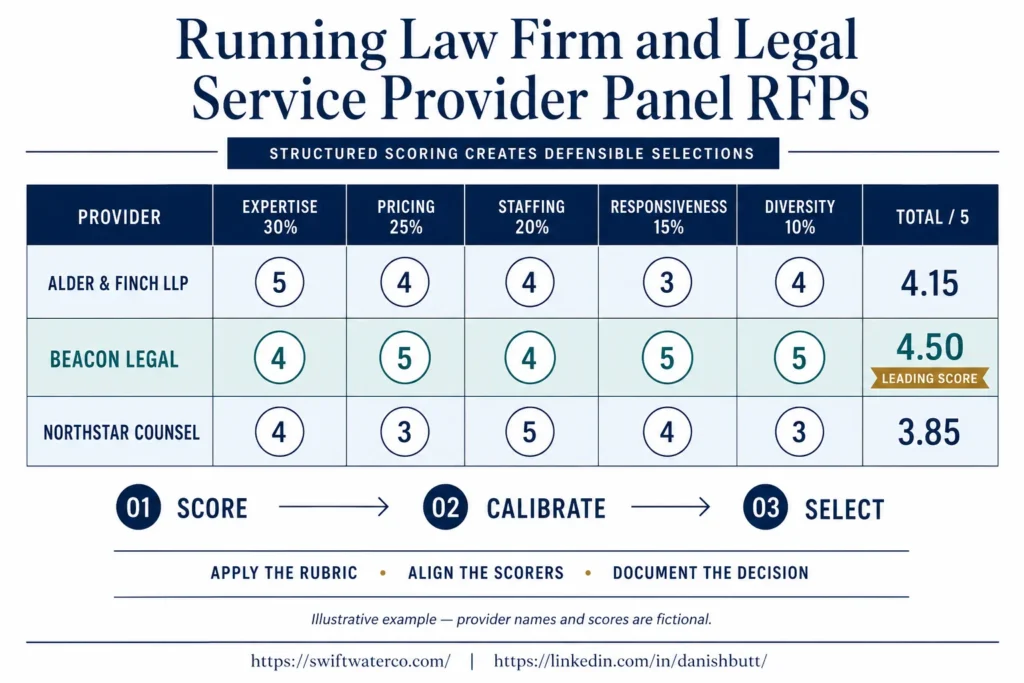
Independent scoring with calibration. Assign sections to evaluators with relevant domain knowledge. Have them score independently before any group discussion. Then normalize and review together, focusing the discussion on score divergences rather than re-scoring from scratch. This process catches bias, surfaces assumptions, and produces a result the team can defend. Document the final rationale, including trade-offs, so the decision is auditable.
The goal is a structured, transparent process that produces a defensible result and earns the confidence of the GC, business-unit leaders, and the firms on the other side of it. Mathematical precision matters less than consistent calibration across evaluators.
How do you collect and compare law firm rates?
Rate collection is where most legal panel RFPs lose their rigor. Teams that run a disciplined process through question design and scoring often revert to unstructured rate negotiations at the end, comparing numbers that are not comparable because they were not collected in a consistent format.
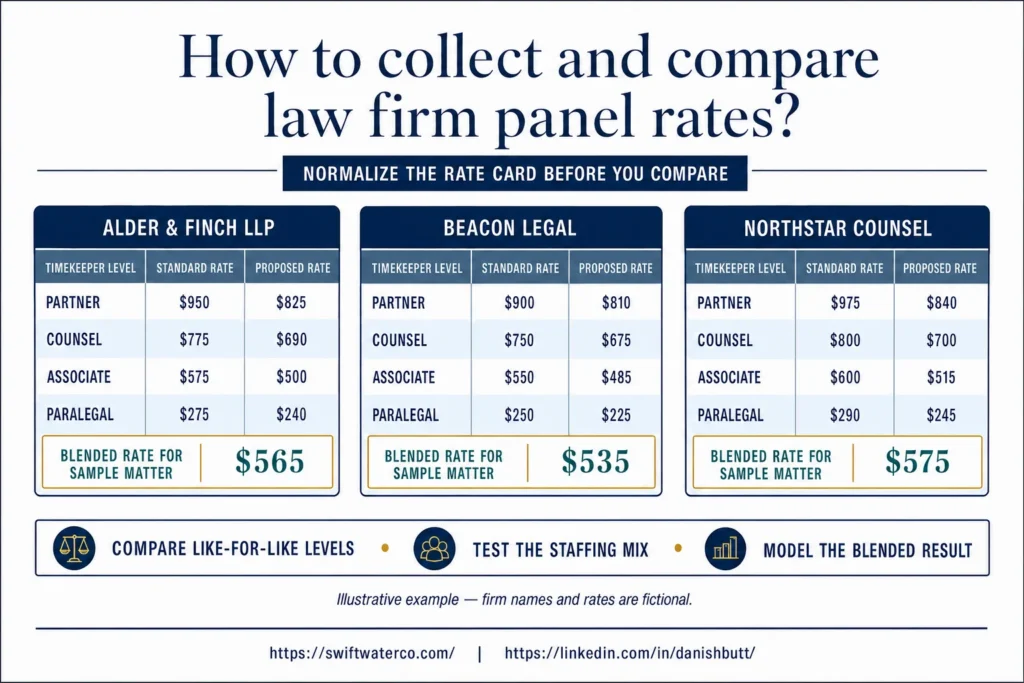
Start with a structured rate card template that every responding firm completes in the same format. The template should capture: timekeeper level (using standardized timekeeper classifications), standard rack rate, proposed panel rate, and any blended or fixed-fee options. Without a common format, you end up comparing a partner rate from one firm against a blended rate from another and drawing conclusions that do not hold.
Struggling to control outside counsel spend?
We help legal departments build the governance, billing guidelines, panel structure, and rate programs that take back control of what outside counsel costs.
See Legal Spend ServicesCollect three pricing structures and compare them side by side: fixed fees for defined matter types, blended rates, and discounted hourly rates.
You can even go a step further, for example, when we are helping teams do this we create an advanced matrix using the practice area/matter specific codes to get a further breakdown, you can get these from the UTBMS code lookup tool here.
Request a rate freeze by attorney for the duration of the (defined) leagl panel effective period, anchored to historical spend data and market benchmarks. A rate freeze without a baseline is a ceiling nobody enforces. A rate freeze tied to your actual billing history and market data is a governance tool.
To make rate comparisons meaningful, you need your own spend data organized by practice area, matter type, and timekeeper level. If you do not have that data, the RFP is the wrong starting point. The starting point is getting visibility into what you are spending now. Tools like legaltechcalculator.com can help quantify the ROI case for that visibility investment, and a structured legal spend program provides the framework to collect and maintain the data over time.
For rate negotiation tactics beyond the RFP itself, including how to handle mid-cycle rate increases and annual rate review cycles, the dedicated article in this outside counsel series covers the mechanics in detail.
What happens after selection?
The real work begins after legal panel selection. The firms you select need to be onboarded with clear expectations, documented guidelines, and defined performance metrics. The firms you do not select need a professional, timely communication explaining the decision at a level appropriate to the relationship.
For selected firms, the transition from RFP to working relationship should cover:
- Engagement terms and billing guidelines. Document rate agreements, staffing expectations, billing requirements, and matter management protocols before the first matter is assigned. These are not boilerplate. They are the operational translation of the commitments the firm made in its RFP response.
- Performance KPIs. Define how you will measure the relationship going forward. Practical KPIs include fee predictability against budgets, communication responsiveness, staffing consistency against the proposed team, and quality of work product. These should map back to the criteria you scored during evaluation. If you scored on expertise and responsiveness, measure on expertise and responsiveness.
- Review cadence. Set a schedule for formal performance reviews, typically quarterly for high-volume relationships and semi-annually for lower-volume ones. The review should reference actual data, not impressions.
The article on law firm onboarding after legal panel selection covers the full onboarding process, including how to structure the first 90 days and what to put in outside counsel guidelines.
For firms not selected, as a result of the legal panel RFP exercise, communicate directly and promptly. A brief explanation of the decision criteria, without ranking or detailed scores, preserves the relationship for future cycles and demonstrates the professionalism the process was designed to reflect.
Bottom Line
A legal panel RFP works when it is designed as a selection tool with defined criteria, structured scoring, and real follow-through, and it fails when it is treated as a procurement checkbox. The market data and our experience shows that without process rigor there is no measurable advantage. The process is the product. Design the scoring model before you write the first question, collect rates in a format you can actually compare, and treat selection as the midpoint of governance rather than the finish line.
This is the kind of legal panel design, preferred provider panel design and outside counsel governance work Swiftwater does with legal departments. If you are preparing for a panel refresh and want a structured approach to scoping, scoring, and rate architecture, start with a conversation about your legal spend program.
FAQ
How long does a legal panel RFP take end to end?
A well-run legal panel RFP typically takes 10 to 14 weeks from scoping through final selection and communication. The largest time investment is in the upfront scoping and criteria design, which usually takes two to three weeks. Compressing the timeline below eight weeks risks shallow evaluation and poorly calibrated scoring.
Should incumbents be treated differently?
Incumbents should go through the same legal panel RFP process as new firms, but you can supplement their responses with performance data you already have. This includes billing history, matter outcomes, and stakeholder feedback. Giving incumbents a pass undermines the panel’s credibility and removes the competitive pressure that keeps pricing honest.
How many firms should you invite per slot?
Three to five firms per practice area slot is a workable range. Fewer than three limits real competition. More than five creates evaluation burden without meaningfully improving selection quality. If you are running a broad legal panel refresh across multiple practice areas, cap total invitations at a number your evaluation team can realistically score within the timeline.
Do you need a legal panel RFP tool or is a spreadsheet enough?
A spreadsheet works for small panels with a limited number of practice areas and fewer than ten responding firms. Once you exceed that scale, a structured RFP or sourcing platform reduces manual scoring errors, enables blind evaluation, and makes it easier to normalize responses across categories. The tool matters less than the scoring model and criteria design behind it.
This article is provided for informational purposes and reflects general practices in legal panel management and outside counsel sourcing. It does not constitute legal, procurement, or consulting advice. Specific panel RFP decisions should be made in consultation with qualified professionals who understand your organization’s circumstances, regulatory environment, and strategic objectives.