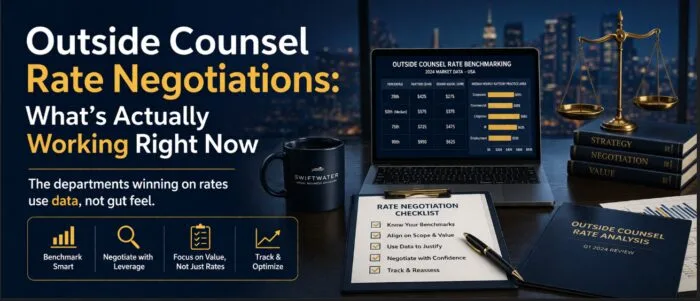

Outside counsel rate negotiations are the structured process by which in-house legal teams establish, challenge, and renegotiate the billing rates charged by their law firms, covering hourly rates by timekeeper level, alternative fee arrangements, rate increase caps, and rate freeze agreements.
Most negotiations achieve less than desired results not because law firms push back, but because in-house teams negotiate without data. The firms arrive with rate proposals anchored to internal cost structures and market positioning. In-house teams respond with budget constraints and relationship history. It results in both parties agreeing to the rate increases by meeting in the middle.
What is currently working in outside counsel rate negotiations:
- Matter-type benchmarking comparing rates within specific practice areas, not across total spend
- Rate proposal windows that control the timing of firm submissions rather than reacting to annual letters
- Multi-year rate agreements that lock in predictability in exchange for volume commitment
- Timekeeper-level rate analysis identifying where rate increases are concentrated by seniority level
- Operationalized delivery models that define staffing expectations before negotiation begins
This article builds on the broader framework in What Is Outside Counsel Management? The Complete Guide to lay out what to ask for, how to structure it, and how to make sure firms actually deliver.
Why do most rate negotiations produce little to no savings?
Many in-house legal teams rely on negotiating on instinct using fragmented processes while the firm is negotiating using hard data.
Law firm billing rates increased an average of 9.6% year-over-year in 2025, with Am Law 50 firms seeing increases of 10.4%, according to LegalBillReview.com’s 2026 benchmarking analysis. Wolters Kluwer’s LegalVIEW Insights report, based on more than $200 billion in anonymized legal invoice data, found that the average partner billing rate at Am Law 25 firms reached $1,349 per hour in 2025, with blended rates across all timekeeper roles hitting $1,027, a 7.5% increase in Q1 2025 alone. In some sectors, matter counts actually declined while rates jumped, meaning departments paid significantly more for less work.
Proprietary PERSUIT data reported in Above the Law reveals that even where legal teams negotiate aggressively and achieve apparent wins, net year-over-year increases frequently remain in the high single to double digits. The negotiation produces a concession on the proposed increase while the underlying rate trajectory continues.
Is your legal spend data telling you the full story?
We help legal departments build the analytics, rate governance, and reporting infrastructure to move from invoice processing to strategic spend management.
See Legal Spend ServicesThe shift that changes outcomes is moving from reactive negotiation, responding to what firms propose, to proactive pricing design, setting guardrails before rates are proposed. PERSUIT’s 2026 outlook found a measurable shift in GC sentiment, with CFOs increasingly asking: if we have a legal team plus AI, why are we still sending this volume of work out at these rates? That question is starting to change the negotiating dynamic.
Why is benchmarking the foundation of rate negotiation?
Law firms know their rates relative to market. They know where they are positioned by practice area, by geography, by timekeeper level. In-house teams that lack equivalent benchmarking data cannot challenge a rate increase credibly. They can accept it, delay it, or request a discount without a data basis for the request.
Benchmarking closes that gap by providing three things:
- Practice area rate context – what the market is paying for comparable work in litigation, M&A, employment, and IP, broken down by timekeeper level
- Firm-specific rate positioning – where each panel firm sits relative to market for the specific matter types they handle for your department
- Rate increase trend data – how proposed increases compare to market movement, allowing cap negotiations to be anchored to data rather than preference
DHL’s legal operations team provides a practical example. As Wolters Kluwer’s Legal Leaders Exchange documented, DHL compiles data on the rates they pay, compares against industry benchmarks, and shares that data transparently with firms during negotiations. That approach, showing firms exactly where their rates sit relative to market, converts the negotiation from an opinion exchange to a data conversation.
Sources for rate benchmarking data include the CLOC State of the Industry Report, the Wolters Kluwer Real Rate Report, and PERSUIT’s pricing intelligence data. All provide practice-area-level rate data that can be used directly in negotiation.
For the spend baseline that makes matter-type benchmarking possible, see Swiftwater’s guide to building a legal spend baseline.
How do you implement rate benchmarking before a negotiation?
Step 1: Pull current rate data by timekeeper level Extract all timekeeper rates from your eBilling system for the prior 12 months. Segment by firm, practice area, and seniority level: partner, senior associate, associate, paralegal. This is your baseline. Most in-house teams negotiate against firm proposals without knowing what they are currently paying at the timekeeper level.
Step 2: Obtain market benchmarking data Use CLOC State of the Industry data, the Wolters Kluwer Real Rate Report, or PERSUIT’s pricing intelligence to establish market rate ranges for each practice area and seniority level. These are the comparables you need before any rate conversation begins.
Step 3: Identify your highest-variance timekeepers Compare current rates against market data at the timekeeper level. Flag timekeepers where rates are materially above market range for their seniority level and practice area. These are your primary negotiation targets, not the firm’s blended rate.
Step 4: Control the timing Wolters Kluwer’s research backs up the approach Swiftwater & Company team recommends i.e. that effective legal ops teams establish specific windows during which they will accept rate proposal submissions, for example November for the following year’s rates. Any firm requesting an increase outside that window must make a compelling case for an exception. This shifts the negotiation calendar from the firm’s timeline to the department’s.
Step 5: Enforce agreed rates in your eBilling system Negotiated rates have no value if they are not enforced at invoice submission. Platforms such as Onit, TeamConnect, and LexisNexis CounselLink allow agreed rate schedules to be embedded directly in the system, flagging any invoice line that bills above the agreed rate before it reaches human review. For a full guide to making eBilling enforce governance rather than process invoices, see Swiftwater’s article on outside counsel billing guidelines.
What tactics are working beyond rate levels?
Rate is only one variable in the cost equation, and negotiating-first approaches often create a false sense of control. The rates may look better on paper while the real cost drivers continue to play out during delivery.
The departments seeing the most sustainable results treat outside counsel cost management as an operationalized program, not a series of ad hoc negotiations. The distinction matters. Most legal departments do some version of the tactics below. Very few run them as a structured, repeatable program with defined standards and consistent measurement. Mature organizations build the program first, then negotiate from within it.
Want the review function run for you?
Every outside counsel invoice checked against your guidelines, rates, and matter context, inside the eBilling platform you already own, with the exception handling, vendor coaching, and savings reporting that separate a review program from invoice processing.
See Bill Review ServicesBuilding a delivery model before you negotiate The most powerful pre-negotiation work is defining your staffing expectations for standard matter types before any rate conversation begins. If you do not have a defined staffing model for a standard pre-trial litigation matter, for example, you will get varying mileage across firms and matters regardless of what rates you negotiate. One firm staffs two partners and four associates. Another staffs one partner and two associates. The rate differential means nothing without knowing what work is actually being done and by whom.
Mature programs define expected timekeeper mix by matter type, set resourcing guardrails, and build those expectations into outside counsel guidelines and eBilling enforcement before the rate review begins. The rate negotiation then happens inside a framework that controls the variables that actually drive cost.
Multi-year rate agreements Wolters Kluwer’s research found several in-house teams achieving two or three year agreements with no increases, providing cost predictability and removing the annual rate letter from the relationship dynamic entirely. In exchange, the firm gets volume commitment and relationship continuity. This requires the data to demonstrate the volume credibly, which is why the baseline matters.
Rate bands and position-level pricing Instead of negotiating rates for individual timekeepers, some in-house teams are moving toward rate bands based on years of experience or position level. This simplifies administration, addresses the challenge of associate progression, and prevents firms from routing work to higher-billed timekeepers within an approved seniority level.
Staffing mix negotiation If a partner is spending 30% of their time on document review, that is a resourcing problem, not a rate problem. Negotiating for an associate to handle routine tasks within a matter reduces average hourly cost without requiring the partner to reduce their rate. Cathleen Anderson, CLO of CrowdStrike, noted in a PERSUIT interview that AI has made her lawyers significantly better prepared for discussions with outside counsel because early case assessment is now fast and accessible. That preparation changes staffing conversations before matters begin.
Volume discounts and early payment arrangements For firms receiving significant volumes of work, volume discounts, early payment terms, and blended rate arrangements provide cost reduction without requiring rate reduction. These require matter tracking data to quantify the volume commitment credibly.
What happens when in-house teams negotiate without data?
Here are the three unintended yet predictable outcomes when you negotiate rates without data and a stringent framework.
Rate increases become self-authorizing. Without a benchmarked counter-position, a firm’s rate increase proposal has no data to negotiate against. The in-house team can delay or request a smaller increase but cannot credibly challenge the rate level itself. Over time, annual increases compound without a market anchor.
High-cost timekeepers go unchallenged. Without timekeeper-level rate analysis, above-market billing rates at the individual level are invisible inside blended firm totals. The negotiation targets the wrong number: overall spend rather than the specific timekeepers driving it.
Panel consolidation leverage is lost. Departments that cannot demonstrate rate performance data across their panel cannot make a credible case for consolidating work to better-performing firms. The panel persists by relationship inertia rather than value evidence.
As Conventus Law observes, the smarter approach is not to squeeze firms harder. It is to manage external work more actively: clear scoping, budget control, resourcing discipline, and performance oversight alongside rate governance.
For broader context on how rate negotiations connect to the full outside counsel spend management framework, see Swiftwater’s legal spend management resources.
Bottom line
Outside counsel rate negotiations are won or lost before the conversation starts, in the preparation, the data, and the decision about who sets the agenda.
Better preparation makes for better negotiations. Departments that benchmark by practice area and timekeeper level, control the timing of rate submissions, define their delivery model before negotiating, and enforce agreed rates through their eBilling system are better prepared. That preparation is the entire advantage.
If you are ready to build a data-driven approach to outside counsel rate negotiations, explore how Swiftwater’s legal spend management services approach rate benchmarking, eBilling enforcement, and outside counsel governance.
Struggling to control outside counsel spend?
We help legal departments build the governance, billing guidelines, panel structure, and rate programs that take back control of what outside counsel costs.
See Legal Spend ServicesFrequently Asked Questions
What are outside counsel rate negotiations?
Outside counsel rate negotiations are the process in-house legal teams use to review, challenge, and agree billing rates with their law firms. They can cover hourly rates, rate increases, timekeeper levels, rate caps, multi-year agreements, volume commitments, and alternative fee structures.
What makes outside counsel rate negotiations more effective?
Outside counsel rate negotiations are more effective when the legal department prepares with data before the discussion begins. Useful preparation includes current rate data, timekeeper-level analysis, practice-area benchmarks, matter volume, staffing expectations, and a clear position on which increases are acceptable.
Why is benchmarking important in rate negotiations?
Benchmarking gives the legal department a market-based reference point for rate discussions. It helps the team compare proposed rates by practice area, geography, firm, and timekeeper level. This makes the negotiation more specific and allows the department to focus on the rates and roles that have the greatest cost impact.
What data should legal teams review before a rate negotiation?
Legal teams should review current approved rates, proposed rate increases, prior-year rates, timekeeper seniority, matter type, practice area, firm usage, invoice history, budget performance, and any prior rate agreements. This gives the department a complete view of both pricing and actual usage.
What is a rate proposal window?
A rate proposal window is a defined period when law firms submit rate increase requests for the next year. It helps the legal department review all proposals at the same time, compare firms consistently, and avoid handling rate requests one by one throughout the year.
How do multi-year rate agreements help legal departments?
Multi-year rate agreements help legal departments create cost predictability over a longer period. In exchange for a clearer work commitment or relationship stability, the firm may agree to hold rates, cap increases, or follow agreed pricing terms for two or three years.
What are rate bands in outside counsel management?
Rate bands are approved rate ranges based on timekeeper level, experience, matter type, or practice area. They help legal departments manage pricing more consistently without negotiating every individual timekeeper rate separately. They also make rate review easier as associates progress in seniority.
How does staffing mix affect outside counsel cost?
Staffing mix affects outside counsel cost because the same matter can cost very different amounts depending on who performs the work. A matter handled mostly by partners will have a different cost profile from one staffed with an appropriate mix of partners, associates, and support professionals. Rate negotiations should therefore include staffing expectations, not only hourly rates.
How should negotiated rates be enforced?
Negotiated rates should be entered into the eBilling system or invoice review workflow so invoices are checked against the agreed rate schedule. This helps the legal department confirm that approved rates are applied consistently before invoices move through review and payment.
Who should own outside counsel rate negotiations?
Legal operations usually owns the rate negotiation process, with input from the GC, finance, and the responsible in-house attorneys. Legal operations can manage benchmarking, data analysis, proposal windows, and eBilling updates, while legal leadership sets the commercial position and relationship strategy.
How should legal departments measure rate negotiation success?
Legal departments should measure rate negotiation success by looking at approved rate changes, avoided increases, rate compliance, matter-level cost movement, staffing mix, budget variance, and firm performance. The goal is not only to reduce rates, but to create more predictable and better-managed outside counsel spend.
Disclaimer: This article is provided for educational and informational purposes only. Neither Swiftwater and Company nor the author provides legal advice. This content does not constitute professional legal, financial, or operational advice and should not be relied upon as such. Readers are encouraged to consult a qualified professional before making decisions based on the information provided. External links are included for reference only and reflect the views of their respective authors. Swiftwater and Company takes no responsibility for third-party content.