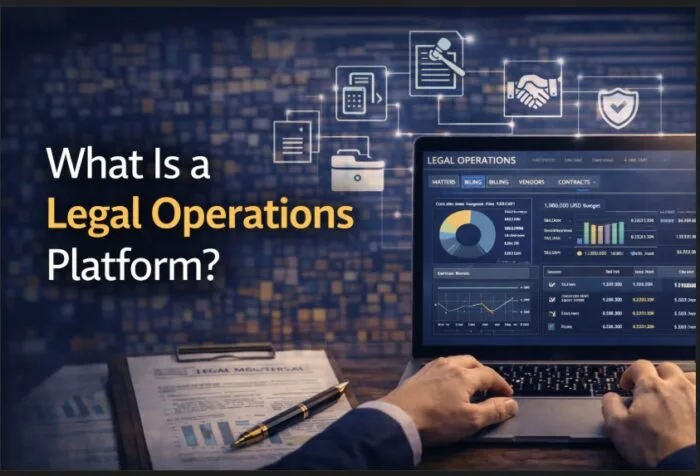

A legal operations platform is the integrated technology solution that a corporate legal department uses to manage its operations, including matter management, outside counsel billing, spend analytics, workflow automation, and legal service requests. The desired outcome of adopting a legal operations platform is to get a unified view of workload, intake, internal client history, risks, spend, relationships, etc. The distinction from individual point solutions is integration: a platform connects these functions in one data environment rather than across separate tools that do not share data.
That distinction matters more than most buying teams appreciate. A legal department can acquire separate tools for matter management, eBilling, contracts, and intake. Once those tools sit in different systems, operations remain fragmented. Data is duplicated. Reporting requires manual assembly. Handoffs stay manual. The result is more technology without better operations. So, the solution is either buying a platform and adding point solutions to it or architect a strategy so the data (the gold) can flow through different systems seamlessly.
For foundational context on the category, see what is enterprise legal management.
Components of a legal operations platform
A complete legal operations platform typically spans the following components. Not every platform covers all of them natively. Some deliver certain components through native modules, others through structured integrations with specialist tools.
| Component | What It Does |
| Matter management | Tracks every piece of legal work as a structured record with ownership, status, budget, outside counsel assignment, and outcome data |
| eBilling and invoice management | Receives, validates, and processes invoices from outside counsel against billing guidelines and rate cards before payment |
| Legal spend management | Provides real-time visibility into outside counsel costs by matter, firm, practice area, and timekeeper across the full portfolio |
| Legal service requests (LSR) | Captures legal work requests from the business, routes them to the right team, and connects them to matter creation |
| Workflow automation | Automates approvals, escalations, routing, and recurring processes without manual handoffs |
| Outside counsel management | Manages firm relationships, rate card governance, panel management, and performance tracking |
| Contract lifecycle management (CLM) | Manages contract requests, drafting, negotiation, approvals, execution, and post-signature obligations, either natively or through integration |
| Reporting and analytics | Provides dashboards and structured reports on workload, spend, cycle time, matter status, and operational performance |
| Document management | Stores and organizes matter and contract documents, either natively or through integration with a dedicated DMS |
| Board solutions | Manages board meeting preparation, board packs, director communications, and governance workflows |
| Corporate secretarial solutions | Handles entity management, statutory compliance, corporate records, and annual filing obligations across jurisdictions |
| Information governance and records management | Governs the retention, classification, and disposition of legal records and information assets across the enterprise |
| eDiscovery | Manages legal hold notices, custodian tracking, data preservation, and collection workflows for litigation and investigations |
| Legal hold management | Issues, tracks, and releases legal holds across custodians and data sources with audit trail documentation |
| IP management | Tracks intellectual property portfolios including patents, trademarks, and renewals across jurisdictions |
| Claims management | Manages insurance claims, incident tracking, reserves, and claims resolution workflows |
| Integration layer | Connects the legal platform to finance, HR, procurement, e-signature, and document management systems across the enterprise |
What does a legal operations platform actually do?
A legal operations platform connects the main operational components of an in-house legal function into one system, giving leadership a single view of demand, cost, workload, and process performance.
In practice that means matter management for tracking active work across owners, status, budgets, and outside counsel assignments; outside counsel management for assigning firms, controlling rates, and monitoring performance; eBilling and spend analytics for validating invoices, enforcing billing guidelines, and reporting on legal spend; workflow automation for routing intake, approvals, escalations, and recurring processes; legal service requests for structuring how work enters the team from the business; and reporting and dashboards for giving legal leadership visibility into workload, cost, cycle time, and risk.
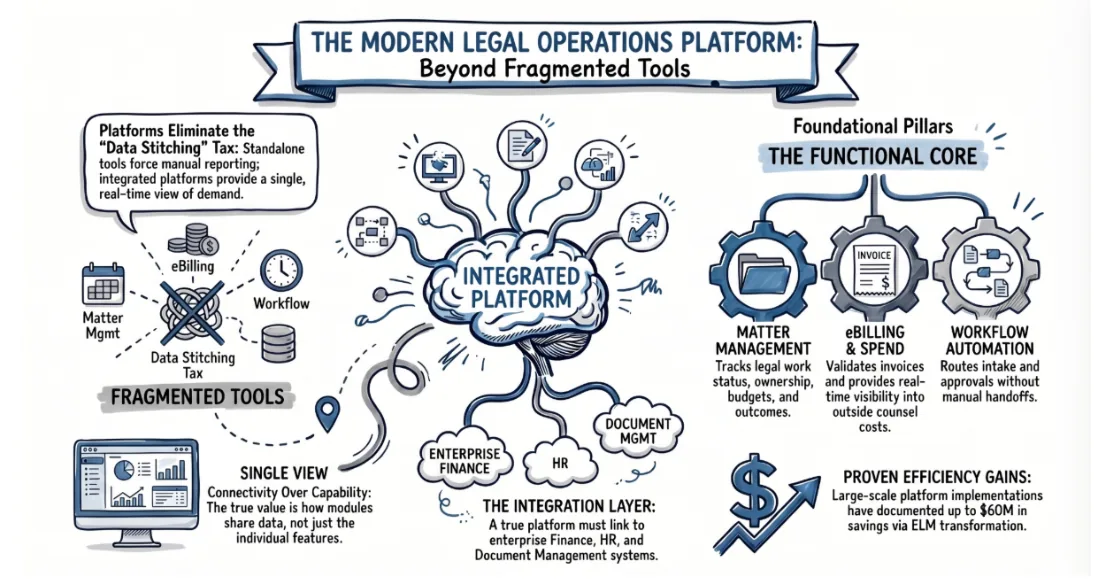
The value is not in the modules individually. Every module is available as a standalone tool. The value is in how those modules share data to support one operating model, which is what makes a legal operations platform meaningfully different from a collection of legal software.
Running an ELM or eBilling implementation?
Swiftwater has three Level 4 Onit-certified practitioners. If you are evaluating, implementing, or rescuing an ELM program, let us talk about what that actually takes.
See ELM ServicesFor a detailed breakdown of what each module delivers and how the leading platforms compare on each, see the ELM software buyer’s guide.
According to the 2026 CLOC State of the Industry Report, technology strategy, financial management, and outside counsel management are the top operational priorities for legal departments globally. A genuine legal operations platform is the infrastructure that allows a legal department to execute on all three from a single environment rather than three separate ones.
How does a legal operations platform differ from standalone ELM or CLM software?
A legal operations platform is broader than a standalone ELM system or a standalone CLM system, and the difference is architectural rather than just a question of feature count.
An enterprise legal management system is primarily focused on legal department operations: matters, outside counsel, billing, spend, and reporting. A contract lifecycle management system is primarily focused on the contract process: drafting, negotiation, approvals, execution, and obligations. A legal operations platform either combines these capabilities directly or integrates them tightly enough to function as one operational environment.
A department using separate point solutions may have decent matter tracking and reasonable contract workflows. But if those systems do not share data, legal leadership still lacks a unified view of demand, spend, workload, and process performance. Intake happens in one tool. Matter tracking in another. Billing in another. Reporting becomes an exercise in stitching exports together.
A legal operations platform is designed to eliminate that fragmentation. That is why legal teams often confuse having legal software with having a legal operations platform. They are not the same thing.
For the distinction between ELM and CLM specifically, see ELM vs CLM. For a deeper view of what matter management covers as the foundational layer, see what is matter management.
What should a legal operations platform integrate with?
A legal operations platform should connect to the systems that affect how legal work is initiated, approved, paid, documented, and reported. At a minimum, most mature environments need integration with finance and ERP systems for invoice processing, accruals, and payment data; HR systems for employee-related workflows and organizational data; document management systems for matter and contract documentation; e-signature platforms for contract execution; procurement and vendor systems for outside counsel onboarding; and business intake channels such as forms or portals used by internal stakeholders.
Legal work does not happen in isolation. Legal sits inside broader business processes. If the platform does not connect to those systems, the legal team ends up duplicating work manually, which undermines the entire value case.
Integration is also where projects consistently become more complex than the evaluation phase suggests. A platform can look strong in a demo and still underperform if it cannot connect reliably to finance, HR, and document management systems in the specific enterprise environment it is being deployed into. This is one reason implementation quality matters as much as platform selection.
For a detailed guide on what integration planning requires, see ELM systems integration.
How do you evaluate legal operations platforms?
The evaluation dimensions that consistently predict whether a legal operations platform delivers are operational fit, integration strength, workflow capability, data and reporting structure, and implementation complexity.
Want the review function run for you?
Every outside counsel invoice checked against your guidelines, rates, and matter context, inside the eBilling platform you already own, with the exception handling, vendor coaching, and savings reporting that separate a review program from invoice processing.
See Bill Review ServicesOperational fit asks whether the platform reflects how the legal team actually works, or whether the team will be forced to reshape its operating model around the software. Integration strength asks whether the platform can connect to finance, HR, document management, and signature systems without long-term workarounds. Workflow capability asks whether the platform can support intake, approvals, routing, and escalations in a way that matches the department’s real processes. Data and reporting structure asks whether leadership can get reliable visibility into matters, spend, workload, and cycle time. Implementation complexity asks what it will actually take to configure, migrate, integrate, and adopt.
That last dimension is consistently underestimated. A legal operations platform should be judged not only by what it can do in theory but by what it can realistically deliver in a specific environment after implementation, given the department’s data quality, process maturity, and organizational capacity for change.
For a practical readiness checklist before committing to a platform evaluation, see the ELM buyer’s readiness checklist in the ELM software guide. The Legal Tech ROI Calculator is also useful for modeling the cost of current fragmented operations against the investment required to consolidate onto a platform, including the cost of doing nothing.
Which legal operations platforms lead the market?
The platforms that appear most consistently in legal operations platform evaluations are Onit, Mitratech, Thomson Reuters Legal Tracker, and Wolters Kluwer ELM Solutions. Each supports core legal operations needs but approaches the problem differently.
Onit is one of the most well-regarded platforms on the market currently for workflow flexibility, platform configurability, and broader extensibility. It operates across OnitX for enterprise deployments, SimpleLegal for mid-market teams, and Onit Unity as the next-generation unified architecture. For a full view of why legal departments choose Onit and when it is the right fit, see why do legal departments choose Onit ELM. For a detailed view of the Onit product family including CounselGO, BillingPoint, and Apptitude, see what is Onit ELM.
Swiftwater has delivered Onit implementations at significant scale, including a deployment across 90,000 employees in eight languages covering ELM, CLM, eBilling, and LSR simultaneously, and has achieved $60M in documented savings for a global technology company through ELM and eBilling transformation on the Onit platform.
Mitratech is often the more natural fit in compliance-heavy environments where governance structure and deep customization are the primary requirements. Thomson Reuters Legal Tracker is the most widely deployed platform in the market and a credible entry point where eBilling and spend management are the primary use case. Wolters Kluwer brings benchmarking depth through its LegalVIEW dataset alongside strong spend analytics in TyMetrix and the modern Brightflag product.
Swiftwater holds three Onit Level 4 certified practitioners and has implemented across all major platforms in the market. That cross-platform depth is what makes genuine platform recommendations possible rather than vendor-driven ones. For an independent assessment of how these platforms compare in practice, see the platform comparison section of the ELM software guide. For a detailed evaluation framework on choosing the right implementation partner, see what to look for in an Onit implementation partner.
Bottom Line
A legal operations platform is the integrated system that allows a legal department to run as an operational function rather than a collection of manual processes and disconnected tools. The real value is not in having more software. It is in having one environment where matters, spend, workflows, and reporting connect in a way that leadership can actually act on.
The best legal operations platform is the one that fits the department’s operating model, integrates with the enterprise systems around it, and can be implemented without creating more complexity than it removes.
Is your legal spend data telling you the full story?
We help legal departments build the analytics, rate governance, and reporting infrastructure to move from invoice processing to strategic spend management.
See Legal Spend ServicesLegal departments that operate from a single integrated platform consistently outperform those managing the same workload across disconnected tools because the data it produces is reliable enough to make decisions from.
If you are ready to evaluate a legal operations platform, explore how Swiftwater’s legal technology implementation services approach platform selection, implementation, and operational design. For the operating model around the platform, see our legal operations consulting services.
Frequently Asked Questions
What is a legal operations platform?
A legal operations platform is an integrated technology solution used by in-house legal teams to manage all aspects of legal operations, including matter management, outside counsel billing, spend analytics, workflow automation, and legal service requests. It centralizes these functions to provide better visibility, efficiency, and control across the legal department.
What are the components of a legal operations platform?
A complete legal operations platform typically includes modules for matter management, eBilling and invoice management, legal spend management, legal service requests, workflow automation, outside counsel management, contract lifecycle management (CLM), reporting and analytics, and document management. These components work together to streamline and automate the full spectrum of legal operations.
How does a legal operations platform differ from standalone ELM or CLM software?
While ELM and CLM software focus on specific areas, a legal operations platform integrates all functions into one system. This integration eliminates data silos, improves visibility, and enables real-time insights across legal workflows—from matter management and outside counsel oversight to contract approval and billing.
What modules should a legal operations platform include?
A comprehensive legal operations platform should include modules for matter management, legal spend management, eBilling, legal service requests, workflow automation, outside counsel management, and reporting and analytics. Some platforms may also offer CLM, document management, and corporate governance features.
What is the importance of integration in a legal operations platform?
Integration is critical because it connects the different functions and systems used by the legal department, such as finance, HR, document management, and e-signature platforms. This enables seamless data flow, reduces manual work, and ensures consistency in reporting and compliance.
What should a legal operations platform integrate with?
A legal operations platform should integrate with finance systems for invoicing, HR systems for employee data, document management systems for storing legal documents, e-signature platforms for contract execution, and other enterprise systems like procurement and vendor management. Integration ensures that legal work is managed holistically across departments.
Why is a legal operations platform more effective than a collection of point solutions?
A legal operations platform is more effective than a collection of point solutions because it unifies all legal operations functions into a single system. This eliminates data silos, streamlines processes, improves reporting, and gives legal departments a holistic view of operations for better decision-making.
How do you evaluate a legal operations platform?
When evaluating a legal operations platform, key considerations include operational fit, integration capabilities, workflow support, reporting and analytics, and implementation complexity. It is important to ensure the platform aligns with the legal department’s operational needs, integrates with existing systems, supports automation of key workflows, and provides real-time reporting and analytics.
Disclaimer: This article is provided for educational and informational purposes only. Neither Swiftwater and Company nor the author provides legal advice. This content does not constitute professional legal, financial, or operational advice and should not be relied upon as such. Readers are encouraged to consult a qualified professional before making decisions based on the information provided. External links are included for reference only and reflect the views of their respective authors. Swiftwater and Company takes no responsibility for third-party content.