


A legal operations maturity model rates a corporate legal department’s capability across a defined set of functional areas, on a scale from early to advanced, so the General Counsel can see where the department stands, decide where it needs to be, and sequence the work in between. Two models dominate: the CLOC Core 12, the Corporate Legal Operations Consortium’s framework of twelve functional areas with a maturity assessment playbook built on it, and the ACC Legal Operations Maturity Model 2.0, the Association of Corporate Counsel’s fourteen-area model rated at early, intermediate, and advanced stages. They cover the same territory from slightly different angles, and most departments end up using one as a map and the other as a check.
The model is worth more than its score. Used well, it gives a General Counsel, a Director of Legal Operations, and a CFO a common language for a conversation that otherwise runs on anecdote, and it turns “we should be better at this” into a list of specific areas, a current rating for each, a target rating, and a gap. Used out of the box, it becomes a job description for one person or a checklist that reads the same for every department regardless of where the business is. This guide covers what each model contains, how they compare, how the two map onto the six components of a legal operating model, how to assess honestly, what each stage looks like in practice, the pitfalls, and what to do with the result.
Why use a legal operations maturity model?
A legal operations maturity model is worth using because it gives a young function the same kind of reference finance and IT have had for decades, gives a General Counsel, a Director of Legal Operations, a CFO, and an IT leader one set of areas and one scale to agree on, and turns a budget conversation into a target state and a gap.
Legal operations is still a young function. Some days the people running it feel like pioneers; other days it seems likely that someone, somewhere, has already found a better answer to the problem in front of them. Finance and IT went through the same stage decades ago and came out of it with their own maturity comparisons, and it is prudent for legal operations to have the same: a reference that lets a department place itself against a defined scale.
The second reason is consensus. A General Counsel, a Director of Legal Operations, a CFO, and an IT leader each see the legal department from a different angle, and a maturity model gives them one set of areas and one scale to argue about. In our experience the frameworks are most useful as a way of looking at the same information differently, so that a group that disagreed about priorities can agree about a rating and then about a gap. The third reason is the conversation upstairs: a CFO who is handed a maturity assessment with a target state and a gap can fund a roadmap, and one who is handed a list of tool requests cannot.
Two cautions from twenty-plus years of using these tools. The first: benchmarks show directionality. They tell a department which way the market is moving and roughly where the middle sits, and that is what they are for. A median is a reference point, never a target.
The second: the frameworks need an experienced hand, an external consultant or a veteran in-house legal operations leader who has seen enough variations to know where the published definitions land and where they miss. The misses are largest at the two ends. A department four or five years in that has checked the boxes will rate advanced on an out-of-the-box model and still have real gaps; it needs an expert eye to calibrate. A department in its first year will find its indicators all over the place, and the model is better read as aspirational guidance than as a score.
Building the legal operations function from scratch?
Assessment, roadmap, and delivery for the operational side of the department: spend, technology, process, vendors, and the data that proves what legal delivers. Advice from operators who ran the function.
See Legal Ops ConsultingThe timing favors the exercise. The Blickstein Group’s 18th Annual Law Department Operations Survey finds the build-out phase of legal operations largely over, with only 4.8% of functions launched in the past year, 58.5% expecting their team to stay the same size, and 10.8% expecting to shrink. Departments are now working with the function they have, which makes the question where to focus that function rather than how to grow it, and that is the question a maturity model answers.
One further option for departments inside technology or manufacturing companies. Procurement and sales functions in those organizations often already run on CMMI-style capability models, with defined levels and defined evidence for each, and legal operations can be assessed on the same scale the rest of the enterprise uses. The CLOC and ACC areas fold into that structure without difficulty, and the advantage is that the CFO and the COO already understand the scale.
What are the CLOC Core 12 functional areas?
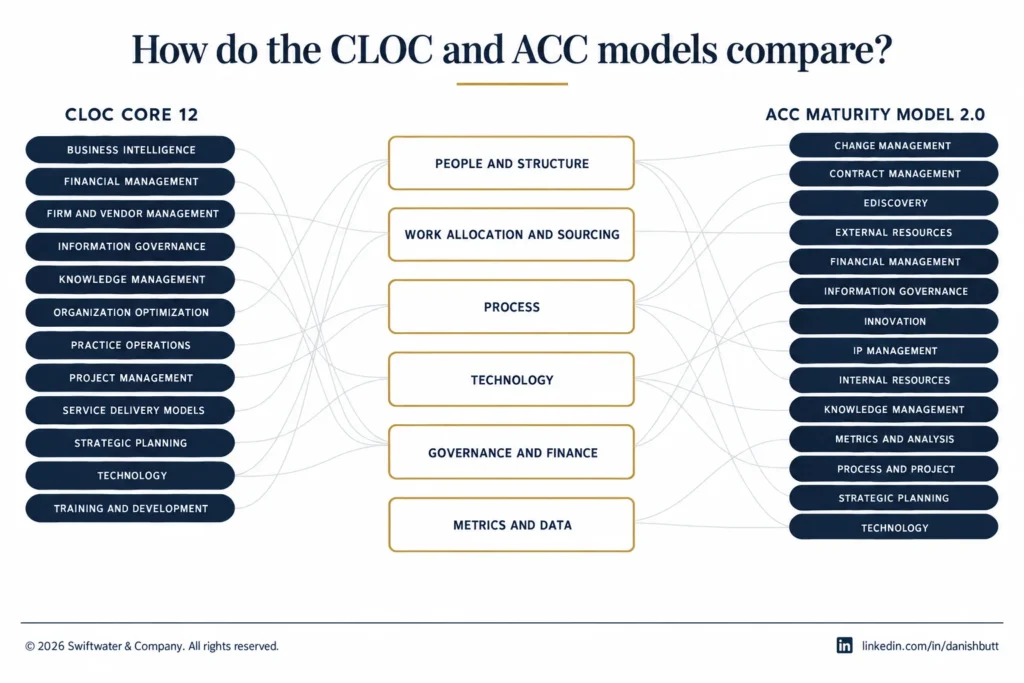
The CLOC Core 12 functional areas are business intelligence, financial management, firm and vendor management, information governance, knowledge management, organization optimization and health, practice operations, project/program management, service delivery models, strategic planning, technology, and training and development.
The Core 12 is CLOC’s description of what a legal operations function covers, revised in 2020 to reflect the role as it had grown. In May 2024 CLOC released the Core 12 Maturity Assessment Playbook, a structured guide for assessing and improving operational maturity across the twelve areas through four maturity stages, with a companion online assessment tool that benchmarks respondents against each other. The twelve areas, as CLOC names them:
| CLOC Core 12 area | What it covers | Swiftwater component |
|---|---|---|
| Business intelligence | Metrics, dashboards, reporting, and the data behind decisions | Metrics and data |
| Financial management | Budgeting, forecasting, accruals, spend analysis, and the financial relationship with the business | Governance and financial management |
| Firm and vendor management | Outside counsel and vendor selection, panels, performance, rates, and relationships | Work allocation and sourcing |
| Information governance | Records, retention, privacy, data handling, and legal holds | Process |
| Knowledge management | Templates, playbooks, precedents, and how know-how is captured and reused | Process |
| Organization optimization and health | Structure, roles, culture, and the wellbeing and development of the team | People and structure |
| Practice operations | The day-to-day running of practice areas: intake, matter management, workflow | Process |
| Project/program management | Scoping, planning, delivering, and governing initiatives | Governance and financial management |
| Service delivery models | Who does what: in-house, outsourced, managed services, self-service, and the design behind the mix | Work allocation and sourcing |
| Strategic planning | The department’s goals, the annual plan, and alignment with the business | Governance and financial management |
| Technology | The platforms that carry the work, their selection, implementation, and administration | Technology |
| Training and development | Skills, onboarding, and career development across the department | People and structure |
The mapping in the third column is ours, and it is where the model becomes usable. Twelve areas is the right number for describing a function and the wrong number for designing one; folded onto six components, the same twelve areas become decisions a General Counsel can make.
CLOC is also building a credential on the Core 12, the Legal Operations Certified Professional (LOCP), and CLOC Academy teaches the twelve areas in short courses. Our guide to legal operations certifications covers both.
What is the ACC Legal Operations Maturity Model 2.0?
The ACC Legal Operations Maturity Model 2.0 rates fourteen functional areas of a legal department at early, intermediate, or advanced, with a written description of what the department looks like at each stage. It takes a different cut from CLOC: the department rather than the function.
Version 2.0 updated the original 2017 model to reflect how far departments had advanced, so every stage is set higher than before. The fourteen areas: change management and communication; contract management; eDiscovery; external resources management; financial management; information governance; innovation management; intellectual property management; internal resources management; knowledge management; metrics and analysis; process and project management; strategic planning and legal operations leadership; and technology management.
Its value is in the stage descriptions, which are concrete. In contract management, early means no contract management tool and contracts scattered across locations with ad hoc legal review; intermediate means a CLM with some automation, a central repository, and assigned ownership; advanced means the tool is used enterprise-wide and integrated with other systems, with a single repository holding all buy-side and sell-side contracts and renewals fully automated. In financial management, early means no standard processes or metrics and budgets absent or set by accounting; intermediate means standard processes that exist but are not documented, with legal and finance collaborating on budgets; advanced means documented and published processes, scheduled reports and dashboards, and KPIs tracked and benchmarked. A department can read those descriptions and place itself without a consultant in the room, which is the point.
How do the CLOC and ACC models compare?
The CLOC Core 12 describes the legal operations function in twelve competencies rated across four stages; the ACC Maturity Model 2.0 describes the whole department in fourteen areas rated at three stages with plain-language evidence for each. CLOC is the better map of what the function should cover; ACC is the better scale for placing the department. They are complementary.
| Dimension | CLOC Core 12 | ACC Maturity Model 2.0 |
|---|---|---|
| Functional areas | Twelve, framed as competencies of the legal operations function | Fourteen, framed as areas of the legal department as a whole, including contract management, IP, and eDiscovery as their own areas |
| Maturity stages | Four, defined in the 2024 Maturity Assessment Playbook | Three: early, intermediate, advanced, each with a written description per area |
| Unit of assessment | The legal operations function and its competencies | The department’s operations, including practice-area capabilities |
| Benchmarking | Companion online tool benchmarks respondents against other respondents | Published stage descriptions; benchmarking against other departments through ACC’s separate benchmarking report |
| Best used for | Defining what a legal operations function should cover and how mature it is | Placing the whole department on a scale, area by area, with plain-language evidence |
| Watch for | Twelve competencies read as one job description | Fourteen areas rated advanced as the goal, when the business needs advanced in four of them |
They are complementary. CLOC describes the function; ACC describes the department. A department that rates itself on the ACC stages and then asks which CLOC competencies its legal operations team actually owns has done most of an assessment already.
How do you assess legal operations maturity?
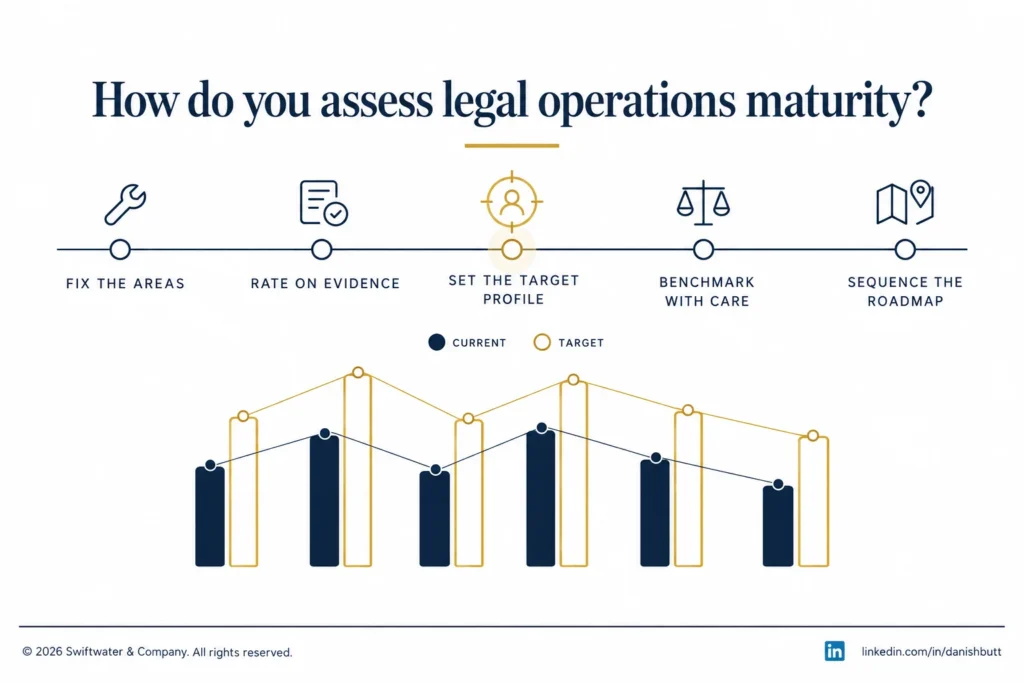
Legal operations maturity is assessed in five steps: fix the list of areas, rate each on evidence that exists rather than on intent, set a target profile with different stages in different areas, benchmark cautiously against the published surveys, and turn each gap into a sequenced roadmap. The discipline is in the second step.
- Pick the frame and fix the areas. Use one model as the primary and the other as a check, or fold both onto the six components. Decide the list before anyone rates anything, so the rating cannot be gamed by redefining the area.
- Rate on evidence rather than intent. For each area, the rating is justified by something that exists: a document, a system configuration, a report that runs on a schedule, a process the business actually uses. A billing guideline that exists as a PDF nobody enforces is early in financial management, whatever the department expects to see. This is where an experienced assessor earns the fee: calibrating the published definition to the department in front of them, which matters most for departments four or five years in that have checked the boxes, and for departments in their first year whose indicators point in every direction.
- Set the target by what the business needs, area by area. Advanced everywhere is neither achievable nor desirable. A department with low litigation volume does not need advanced eDiscovery; a department with half its spend in three firms needs advanced firm and vendor management before anything else. The target is a profile, with different stages in different areas, chosen by where the business’s risk and money sit.
- Benchmark with care. The ACC benchmarking report, the Law Department Operations Survey, and CLOC’s State of the Industry Report all describe small populations, a few hundred departments at most, that under-represent startups creating the function and the largest departments too busy to respond. Use them for direction, and treat a median as a reference point rather than a target.
- Turn the gap into a sequenced roadmap. Each gap between current and target becomes a move; the moves are ordered by dependency and by the department’s capacity to absorb change; and the first move is the one the department will feel soonest. The redesign sequence in the legal operating model guide picks it up from here.
What does each maturity stage look like in practice?
In practice, early means the artifact does not exist, intermediate means it exists and is partly used, and advanced means it is used fully, governed, and integrated. The ACC descriptions are the reference; the table shows early and advanced in the four areas where we most often find the gap, in the language a General Counsel would use.
Need the function run, not just advised on?
Swiftwater embeds senior practitioners directly into legal operations, handling bill review, matter management, and program delivery on your behalf.
See Managed Services| Area | Early | Advanced |
|---|---|---|
| Legal spend and outside counsel | Invoices approved by the lawyer who engaged the firm; no guidelines enforced; the department cannot say what it spent by matter type last quarter | Guidelines enforced in the e-billing system; a governed panel with rates and performance reviewed on a cycle; spend reported by matter type, firm, and business unit, forecast against budget |
| Intake and process | Requests arrive by email to whichever lawyer the requester knows; no record of volume; nothing self-served | A single front door with triage rules, self-service for standard requests, and a tracked record for every request, measured on cycle time and deflection |
| Technology | Systems bought one at a time, administered by IT or a lawyer’s spare time, adopted partially, with data that does not reconcile | A system of record for matters, contracts, and spend, integrated, owned by a named administrator or managed team, adopted fully, feeding the department’s reporting |
| Data and reporting | Numbers assembled by hand before a budget meeting; no agreed KPIs; different answers from different people | A defined KPI set on a reporting rhythm, with a data model underneath it, and a General Counsel who reports to the CFO from the same numbers every quarter |
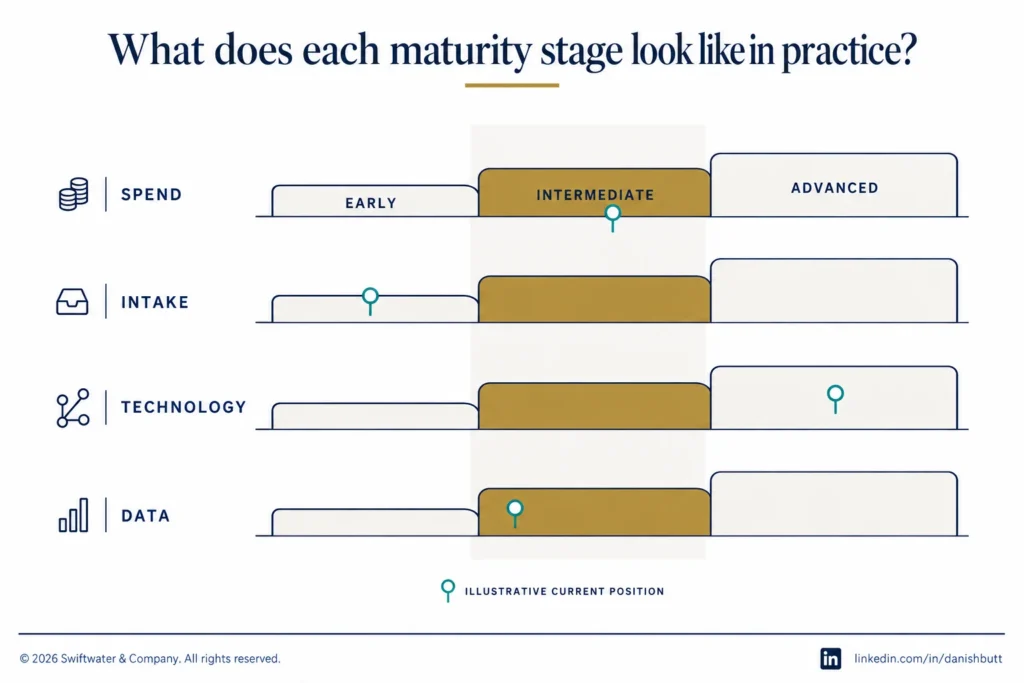
Intermediate, in each row, is the stage most departments are actually at: the artifact exists and is partly used. The e-billing system is live and the guidelines are in it, but the lawyers approve around them. The intake form exists and a third of requests use it. The dashboard was built and is refreshed when someone remembers. Intermediate is where maturity models earn their keep, because the difference between intermediate and advanced is adoption and governance rather than investment, and that is the gap a department can close without buying anything.
What are the pitfalls of using a maturity model?
The pitfalls of a maturity model are using the framework as a job description, pursuing advanced in every area, applying the model out of the box without calibration, mistaking technology ownership for maturity, and treating a benchmark median as the target. Each has a simple correction.
- The framework becomes a job description. Twelve or fourteen areas describe a function. A posting that lists all of them is hiring for a function and calling it a job, and the person who takes it will be set up to fail in whichever area mattered most. Skills belong to roles; the framework is the map of what the roles between them should cover.
- Advanced everywhere becomes the goal. The target is a profile set by where the business’s risk and money sit. A department that pursues advanced in all fourteen ACC areas will reach intermediate in all of them and advanced in none.
- The model is used out of the box. The published definitions land in some areas and miss in others, and the miss is largest at the two ends: the department that has checked every box and rates advanced with real gaps remaining, and the department in its first year whose indicators scatter. An experienced assessor, external or a veteran in-house leader, calibrates the model to the department; without that, the rating describes the model more than the department.
- Technology is mistaken for maturity. Owning a CLM is intermediate at best. Using it enterprise-wide, integrated, with a single repository and automated renewals, is advanced. The stage is defined by what the department does with the tool, which is why ACC’s descriptions are written in terms of behavior.
- The benchmark becomes the target. Medians from a few hundred responding departments describe the middle of a self-selected population. A department can be above the median and still early in the area that matters most to its business.
What comes after the assessment?
After the assessment come three things: a roadmap, a decision about who executes it, and a date to re-rate.
The roadmap sequences the gaps into moves across one to three years, with the first move chosen for visibility: the change the department feels within a quarter and the General Counsel can point to in the next CFO conversation. The execution decision is the one the legal operations consultant guide covers in full: scoped moves fit a consultant, continuous operation fits a Director of Legal Operations or a managed team, and the gap between the two is usually covered fractionally. The re-rate is annual, on the same areas and the same evidence standard, so the department can show movement.
The assessment itself should be inexpensive relative to what it decides. Swiftwater’s entry points are a free spend or technology consult, an AI-supported legal spend assessment or legal technology health check from $5,000, and the full diagnostic at $15,000 to $75,000 over four to eight weeks when the department’s size or complexity calls for stakeholder interviews and multiple reviews. The output in every case is a rating the department can defend, a target it chose, and a roadmap it owns.
Bottom Line
A legal operations maturity model rates the department across defined areas and stages so the gap between where it is and where the business needs it to be becomes a list of moves. The CLOC Core 12 describes the function in twelve competencies with a four-stage playbook; the ACC Maturity Model 2.0 describes the department in fourteen areas with written early, intermediate, and advanced descriptions. Folded onto six operating model components, both become decisions a General Counsel can make.
Assess on evidence with an experienced hand to calibrate, set the target as a profile rather than a blanket, read the benchmarks for direction, and remember that most departments sit at intermediate, where the gap to advanced is adoption and governance rather than spend. Rate on evidence, target by what the business needs, and re-rate on the same evidence a year later.
Maturity assessment is the first step in every Swiftwater engagement. Our legal operations consulting practice rates the department against the CLOC and ACC frameworks with an experienced hand on the calibration, and the roadmap is yours whether or not we deliver it.
Frequently Asked Questions
What is a legal operations maturity model?
A legal operations maturity model rates a corporate legal department’s capability across a defined set of functional areas on a scale from early to advanced, so the General Counsel can see where the department stands, set a target for each area, and sequence the work between the two. The two dominant models are the CLOC Core 12 and the ACC Legal Operations Maturity Model 2.0.
What are the CLOC Core 12?
The twelve functional areas CLOC uses to describe a legal operations function: business intelligence, financial management, firm and vendor management, information governance, knowledge management, organization optimization and health, practice operations, project/program management, service delivery models, strategic planning, technology, and training and development. CLOC’s 2024 Maturity Assessment Playbook rates them across four stages.
What is the ACC Legal Operations Maturity Model?
The Association of Corporate Counsel’s model rates fourteen functional areas of a legal department at early, intermediate, or advanced, with a written description of each stage. Version 2.0 updated the 2017 original so that every stage reflects how far departments have advanced since.
What is the difference between the CLOC Core 12 and the ACC maturity model?
CLOC describes the legal operations function in twelve competencies and rates them across four stages through its playbook and online tool. ACC describes the whole department in fourteen areas, including contract management, IP, and eDiscovery, and rates each at three stages with plain-language evidence for each. Most departments use one as the map and the other as the check.
How do you assess legal operations maturity?
Fix the list of areas first, rate each one on evidence that exists rather than on intent, set a target profile with different stages in different areas according to where the business’s risk and spend sit, benchmark cautiously against the published surveys, and turn each gap into a sequenced roadmap. An experienced assessor matters most at the rating step, to calibrate the published definitions to the department in front of them.
Should a legal department aim to be advanced in every area?
No. The target is a profile set by the business. A department pursuing advanced in all fourteen ACC areas reaches intermediate in all of them and advanced in none. Advanced belongs in the three or four areas where the department’s risk and money concentrate.
Can a legal department use a CMMI-style maturity model?
Yes. Technology and manufacturing companies often already run procurement and sales on CMMI-style capability models with defined levels and evidence, and legal operations can be assessed on the same scale, with the CLOC and ACC functional areas folded into it. The advantage is that the CFO and COO already understand the scale.
How much does a legal operations maturity assessment cost?
Swiftwater offers a free spend or technology consult, an AI-supported legal spend assessment or legal technology health check from $5,000, and a full diagnostic at $15,000 to $75,000 over four to eight weeks when size or complexity calls for stakeholder interviews and multiple reviews. The output is a defensible rating, a chosen target, and a roadmap the department owns.
This article is provided for informational purposes and reflects Swiftwater’s experience assessing legal operations maturity for corporate legal departments. It does not constitute legal advice. The CLOC Core 12 and the ACC Legal Operations Maturity Model 2.0 belong to their respective organizations; area names and stage descriptions are quoted from their published materials.