


A legal operations certification is a credential that tests the skills of running a legal department as a business: spend, technology, process, and data. In 2026 there is one announced discipline credential, CLOC’s LOCP, plus adjacent and platform credentials already live. It is early days. Several programs were announced in the last few months, more are coming, and the profession is still working out which credentials employers will ask for by name.
Swiftwater is a proponent of continuous learning, and our professionals hold several of the credentials below. If you are spending money and time on one, do the homework first. This guide sets out what exists as of October 2026, what each costs in money and time, and the questions to ask before you pay.
What legal operations certifications exist in 2026?
Legal operations credentials fall into three groups. Discipline credentials test legal operations itself, and the main one, CLOC’s Legal Operations Certified Professional (LOCP), is announced but not yet examinable. Adjacent credentials cover a neighboring discipline such as legal management, project management, or e-discovery. Platform credentials certify skill on one vendor’s system, and they are the ones employers most often ask for by name.
Alongside the credentials, the profession gathers in a handful of communities and associations, and that is where new education is appearing:
- CLOC (Corporate Legal Operations Consortium) runs CLOC Academy and is building the LOCP.
- ACC (Association of Corporate Counsel) publishes the Legal Operations Maturity Model 2.0, runs a legal operations conference, and offers on-demand legal operations programs. We found no standalone ACC legal operations certification.
- Legal Operators is a long-running community for in-house legal operations professionals. We found no certification program.
- Our Legal Community (OLC) is a global network that launched in February 2026. Its site lists an in-person OLC AI Certification Course (Mountain View on November 2, 2026, then Atlanta, Melbourne, and Sydney in early 2027). It is an AI course, and pricing is not published.
Several of these groups are developing programs, so check details directly with each one.
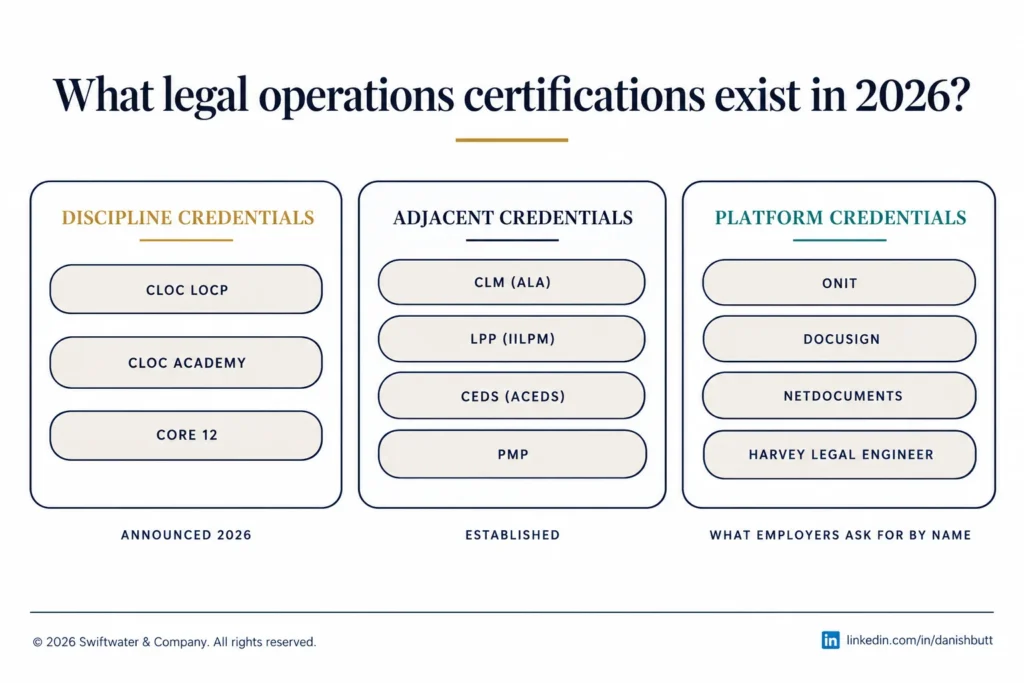
| Credential | Provider and format | Cost and time |
|---|---|---|
| Legal Operations Certified Professional (LOCP) | CLOC. Exam grounded in the CLOC Core 12, for professionals with three or more years in legal operations. First candidates sit in May 2027 | Cost and renewal not yet published |
| Core 12 courses (Levels 100 and 200) | CLOC Academy. In-person courses at CLOC Academy Days and CLOC events, with a certificate and digital badge per course | Per course; one-day formats |
| Harvey Legal Engineer, Level 1 | Harvey. Self-paced online course and assessment, open to non-customers | Free; about two hours |
| Certified Legal Manager (CLM) | Association of Legal Administrators. Proctored exam, spring and fall windows | $550 members, $675 non-members; $60 a year to maintain |
| Legal Project Practitioner (LPP) | International Institute of Legal Project Management, through accredited training providers | Varies by provider; a multi-day course |
| Certified E-Discovery Specialist (CEDS) | ACEDS. Proctored exam at testing centers | About $1,495 for the prep and exam package |
| Platform certifications | Onit, Docusign, NetDocuments, and other vendors | Varies; often through partner programs |
What is the CLOC LOCP and who qualifies?
The Legal Operations Certified Professional (LOCP) is CLOC’s credential for experienced legal operations professionals, announced in September 2026. Candidates need three or more years in legal operations, ownership of a functional area in a legal department, experience leading strategy or cross-functional work, and a record of managing stakeholders. CLOC says the exam will measure judgment built in practice across the Core 12.
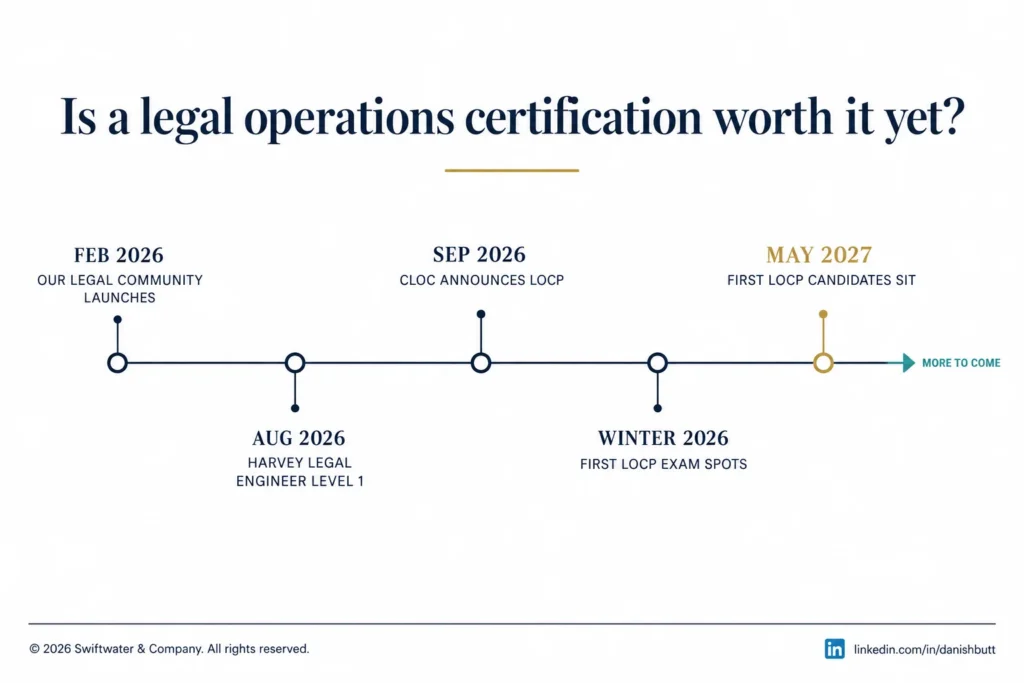
The timeline on CLOC’s LOCP page runs in three steps: initial exam spots for eligible candidates in winter 2026, the credential opening at the CLOC Global Institute in Las Vegas in spring 2027, and the first candidates sitting the exam on May 10 at the CLOC Academy pre-event program. CLOC Academy is the first authorized learning provider. A Certification Advisory Committee of legal operations leaders defines what the exam covers.
Building the legal operations function from scratch?
Assessment, roadmap, and delivery for the operational side of the department: spend, technology, process, vendors, and the data that proves what legal delivers. Advice from operators who ran the function.
See Legal Ops ConsultingWhat is not published yet matters as much: the cost, the renewal terms, the exam length, and the pass mark. Anyone planning for the LOCP should sign up for CLOC’s updates and budget for it once the numbers are out.
What does CLOC Academy’s Core 12 curriculum offer?
CLOC Academy teaches the Core 12, the twelve competency areas CLOC uses to define legal operations, in short in-person courses. Level 100 is a foundations course for people new to the field, Level 200 covers single competencies in practice, such as financial management, technology, and firm and vendor management, and Level 300 is listed as coming soon. Each course earns a certificate and a digital badge.
CLOC Academy runs at CLOC Academy Days and as pre-event programs at CLOC’s summits, and the courses are open to legal operations professionals. A Core 12 badge records a completed course. The exam-based credential CLOC is building on top of the curriculum is the LOCP. Our legal operations maturity model guide explains how the Core 12 maps to a department’s stage of development.
What is Harvey’s Legal Engineer certification?
Harvey’s Legal Engineer, Level 1 is a free, self-paced certification from the legal AI vendor Harvey, launched in August 2026. It takes about two hours, is open to people who do not use Harvey, and requires 80% on a final assessment. It covers four areas: legal expertise, AI and technology fluency, process design, and supporting adoption across an organization.
As LegalTech.ca reported, the credential is aimed at lawyers, legal operations professionals, and legal technology specialists. It is a useful, low-cost introduction to how AI work gets designed and adopted in a legal team. It is also a vendor credential, so it describes the role in one company’s terms. For what a legal engineer does day to day, see legal engineer vs legal technologist and our guide to the forward deployed engineer in a legal department.
Which adjacent credentials matter (CLM, LPP, CEDS, PMP, Lean Six Sigma, platform certifications)?
Adjacent credentials matter when they match the program you run. The ALA’s Certified Legal Manager suits law firm administration and management, the LPP suits legal project management, CEDS suits e-discovery and litigation support, PMP suits large programs and implementations, and Lean Six Sigma suits process redesign. Platform certifications matter most to employers who run that platform.
- Certified Legal Manager (CLM). The Association of Legal Administrators offers the exam twice a year. It costs $550 for members and $675 for non-members, with $60 a year to maintain and $225 to recertify every three years. Its roots are in law firm administration.
- Legal Project Practitioner (LPP). Awarded by the International Institute of Legal Project Management through accredited trainers. It suits people who run matters and projects with lawyers.
- Certified E-Discovery Specialist (CEDS). ACEDS’s exam for e-discovery and litigation support professionals.
- PMP and Lean Six Sigma. General project and process credentials, valued where the seat runs large implementations or redesigns intake and workflow.
- Platform certifications. Vendor certifications on ELM, e-billing, CLM, and document management systems. Swiftwater holds formal partnerships with Onit, NetDocuments, and Docusign, including three Onit Level 4 certifications, and this kind of credential is the one employers name in postings when they run that system.
Is a legal operations certification worth it yet?
A legal operations certification can be worth it today when it teaches something you will use in the next year, or when an employer asks for it by name. A broad credential that signals the discipline is still a bet, because the main one, the LOCP, is not examinable until 2027 and its cost is not published. Early adopters will help shape what the credential comes to mean.
Our view is simple. Keep learning, because the field is changing faster than any credential can track. Spend money and time where the return is clear: a platform certification for the system you run, a Core 12 course in your weakest competency, or a free course such as Harvey’s to build AI fluency. Watch the LOCP closely and decide when its cost and exam are published.
We are gathering what we hear from the market as programs launch, and we will pass it along personally. If you are weighing a program for yourself or your team, reach out to us and we will share what we know.
How should you evaluate a program before paying?
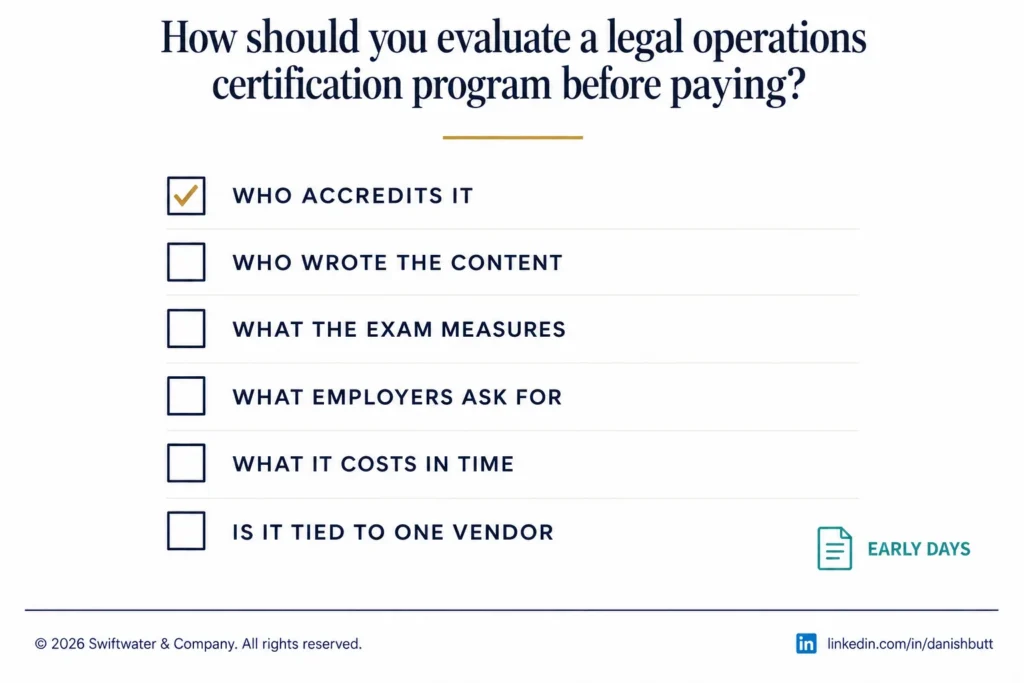
Before paying for a legal operations program, ask six questions. Who accredits it, and is that body independent of the seller? Who wrote the content, and have they run legal operations? What does the exam measure: recall, or judgment on real situations? Do employers ask for it by name? What does it cost in time as well as money? Is it tied to one vendor?
- Who accredits it. An association credential with an advisory committee and a published exam process carries more weight than a certificate of attendance.
- Who wrote the content. Look for practitioners who have run the programs being taught.
- What the exam measures. Scenario questions test judgment. Multiple-choice recall tests reading.
- What employers ask for. Search the postings in your market for the credential’s name. Platform certifications appear far more often than discipline credentials today.
- What it costs in time. Add study hours, travel, exam days, and renewal to the fee.
- Whether it is tied to one vendor. A vendor credential is valuable on that vendor’s platform and says less about the discipline.
To see what employers are hiring for, our legal operations job market report breaks down 914 postings by discipline, level, and posted pay.
What should a department fund for its team?
A department should fund the credentials that match the programs its team owns. Fund platform certifications for the people who administer the department’s systems, Core 12 courses where a competency is weak, and a free AI course for everyone. Hold the budget for the LOCP until CLOC publishes its cost, then fund it for the senior people who own a function.
A few practical rules help:
Need the function run, not just advised on?
Swiftwater embeds senior practitioners directly into legal operations, handling bill review, matter management, and program delivery on your behalf.
See Managed Services- Tie each credential to a program. The person running e-billing gets the e-billing platform certification. The person leading intake redesign gets process training.
- Write it into the role. If a credential matters, name it in the legal operations manager job description and in the development plan, so it is earned for a reason.
- Share what is learned. A team member who completes a course should bring one change back to the department.
The legal operations roles guide sets out the skills each seat needs, from analyst to Director. Where a department needs a skill faster than training can deliver it, Swiftwater’s legal operations consultants can bring it in while the team builds its own.
Bottom Line
Legal operations is getting its own credentials. CLOC’s LOCP is announced for 2027, CLOC Academy’s Core 12 courses are live, Harvey has a free AI-focused certification, and adjacent and platform credentials already have track records. Communities such as Legal Operators, OLC, and ACC are where much of the new education is appearing.
It is early days, so learn continuously and spend carefully. Choose credentials that match the work in front of you, ask the six questions before paying, and revisit the LOCP once its cost and exam are published. Treat a certification as an investment in the work you will do next, and do the homework before you buy one.
We will keep publishing on legal operations credentials as more data points come in. If you want what we have gathered on a specific program, reach out and we will pass it along personally. See the legal operations hub for the rest of the function.
Frequently Asked Questions
What is a legal operations certification?
A legal operations certification is a credential that tests the skills of running a legal department as a business: spend, technology, process, and data. In 2026 there is one announced discipline credential, CLOC’s LOCP, plus adjacent and platform credentials already live.
Does CLOC offer a certification?
Yes. CLOC announced the Legal Operations Certified Professional (LOCP) in September 2026. It is for professionals with three or more years in legal operations, and the first candidates sit the exam in May 2027. CLOC Academy also offers Core 12 courses that award a certificate and digital badge.
How much does the CLOC LOCP cost?
CLOC has not published the cost or the renewal terms for the LOCP. Initial exam spots open to eligible candidates in winter 2026, and the credential opens at the CLOC Global Institute in spring 2027, so check CLOC’s LOCP page for pricing as it is released.
Is the Harvey Legal Engineer certification free?
Yes. Harvey’s Legal Engineer, Level 1 is free, self-paced, and takes about two hours. It is open to people who do not use Harvey, and a score of 80% on the final assessment earns the credential.
Is a legal operations certification worth it?
It is worth it when it teaches something you will use soon or when employers ask for it by name, which today mostly means platform certifications. The LOCP is not examinable until 2027, so it is early days for a discipline credential. Do the homework before you pay.
What is the best training for legal operations?
The best training matches the program you run. CLOC Academy’s Core 12 courses cover the discipline, platform certifications cover the systems, and adjacent credentials such as CLM, LPP, CEDS, PMP, and Lean Six Sigma cover neighboring skills.
Do Legal Operators, OLC, or ACC offer a legal operations certification?
We found no published legal operations certification from Legal Operators, OLC, or ACC as of October 2026. They are communities and associations where the profession gathers. OLC lists an AI certification course and ACC offers legal operations programming, so check each directly.
This article is provided for informational purposes and reflects Swiftwater’s experience as legal operations consultants and managed services providers to corporate legal departments. It is not an endorsement of any program, provider, or credential. Credential details, costs, and dates were checked against each provider’s public information in October 2026, and this is an area that is moving quickly, so please check details with the providers before enrolling. Swiftwater holds platform partnerships with Onit, NetDocuments, and Docusign. If you find omissions or errors, or believe any material on this page should be corrected or removed, let us know through the contact form.