

A legal technology consultant selects, configures, implements, and drives adoption of ELM, CLM, e-billing, and legal AI. The consultant works for the legal department, which owns the outcome, and stays with the project from the first requirements session until the system is the place the department’s work is recorded. Most corporate legal departments have nobody whose full-time job is that. The 2026 ACC Law Department Management Benchmarking Report puts the median number of legal operations professionals at zero for companies under $5 billion in revenue, and legal operations is 5% of legal headcount at every size.
This guide covers what a legal technology consultant does, how the role differs from a legal operations consultant, what an engagement delivers from selection to adoption, how a consultant carries a platform through IT’s stage gates, which platforms the work covers, when a department needs one, and what it costs.
What does a legal technology consultant do?
A legal technology consultant turns a legal department’s need into a working system. The consultant defines what the system has to do, selects the platform against those requirements, configures it to the department’s workflows, migrates the data, builds the integrations, and runs the adoption program until a named owner takes over. The client is a General Counsel, a Head of Legal Operations, or a legal technology lead, and the result is measured by use.
The demand sits with legal operations. In the Blickstein Group’s 18th Annual Law Department Operations Survey, 83.1% of legal operations functions are responsible for technology selection and procurement, 75.4% for technology deployment, and 63.1% for AI deployment. The CLOC 2026 State of the Industry Report found technology strategy is the top focus area for legal operations, named by 80% of departments. With a median of zero legal operations staff below $5 billion in revenue, that work goes to whoever has time, or to a consultant.
| Role | What it does | Where it stops |
|---|---|---|
| Vendor implementation team | Configures its own product to its standard method | At go-live, inside one platform |
| Legal technology consultant | Defines requirements, selects, configures, migrates, integrates, and drives adoption across platforms | When a named owner runs the system and the data lives in it |
| Department’s own administrator | Runs the system day to day after go-live | Ongoing, with the configuration the consultant documented |
The vendor’s team knows its product. The consultant knows the department, the other systems the platform has to connect to, and the IT process the project has to clear, and is paid by the department.
How is a legal technology consultant different from a legal operations consultant?
A legal technology consultant owns the platform, and a legal operations consultant owns the operating model the platform serves. The legal operations consultant designs structure, process, spend programs, and reporting, and the deliverable is a roadmap the department runs. The legal technology consultant takes one part of that roadmap, the system, and is done when the system is the department’s record. Many engagements need both, and one firm often provides both.
| Legal operations consultant | Legal technology consultant | |
|---|---|---|
| Scope | The operating model: structure, process, spend, data, and technology strategy | The platform: selection, configuration, migration, integration, and adoption |
| Deliverable | An assessment, a sequenced roadmap, and the programs that carry it out | A configured system with clean data, working integrations, and measured adoption |
| Done when | The department runs the function itself | The system is the record and a named owner runs it |
The order matters more than the label. A platform configured before the operating model is defined reproduces the old process in new software. That is why the first step of a good technology engagement looks like legal operations work: request types, intake and triage rules, matter taxonomy, and billing guidelines.
Evaluating legal technology but not sure where to start?
We help legal departments cut through the vendor noise, mapping technology to process maturity and building a roadmap that actually gets adopted.
See Legal Technology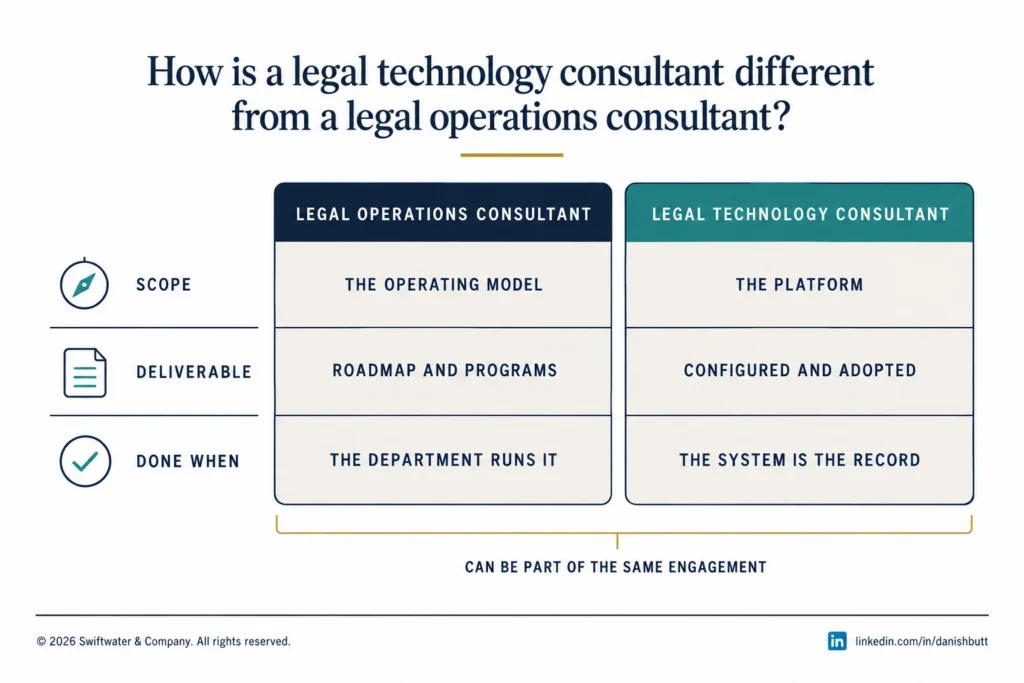
What does a legal technology engagement deliver?
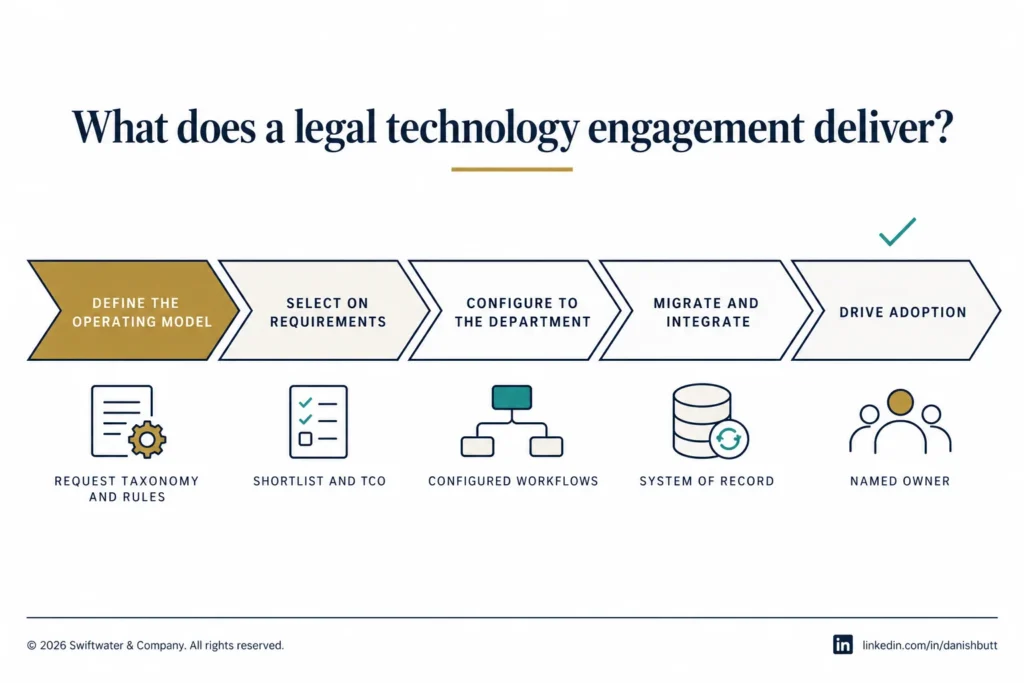
A legal technology engagement delivers five things in sequence: the operating model the tool has to serve, a selection made on requirements and total cost of ownership, a configuration built to the department’s workflows, migrated data and working integrations, and adoption handed to a named owner. Each step produces an output the department keeps, and the first step is the one departments skip when they buy without help.
| Step | What gets done | What the department keeps |
|---|---|---|
| Define the operating model | Request types, triage and routing rules, matter taxonomy, billing guidelines, reporting needs | The request taxonomy and rules, written down |
| Select on requirements | A short weighted requirements set, scripted demos on the department’s own scenarios, reference calls at comparable scale | A shortlist and a total cost of ownership that includes administration and adoption |
| Configure to the department | Workflows, fields, approval paths, roles, and templates built to the operating model | Configured workflows and a configuration record |
| Migrate and integrate | Legacy data assessed, cleaned, and loaded; finance, procurement, HR, and e-signature connections built | One system of record |
| Drive adoption | Training by role, redirecting work that arrives by email, weekly adoption measures | A named owner, or a managed team, running the system |
Selection is where the money is decided. A platform’s license is the visible cost. Administration, integrations, and the rebuild that follows a poor configuration are the larger ones, and the Legal Tech ROI Calculator exists so the business case starts from the department’s own numbers. Adoption is where the money is recovered or lost; legal technology change management covers that step in depth.
How does a consultant carry a platform through IT’s stage gates?
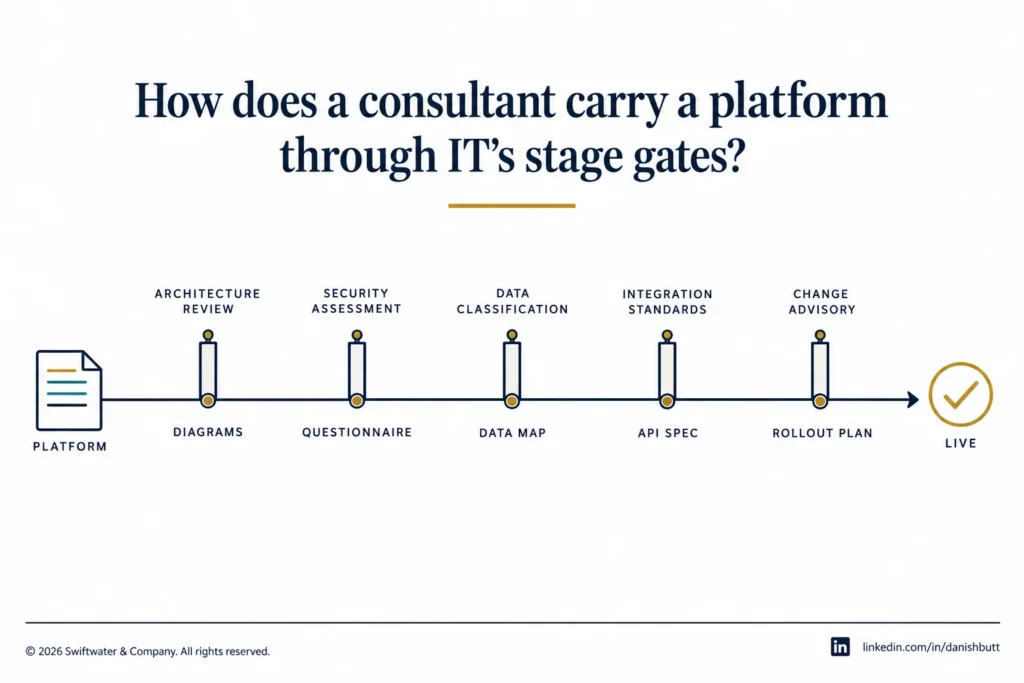
A consultant carries a platform through IT’s stage gates by preparing each gate’s evidence in the form IT expects: architecture diagrams for the architecture review, a completed questionnaire for the security assessment, a data map for data classification, an API specification for integration standards, and a rollout plan for the change advisory board. Most legal departments have nobody who has been through these gates, and a project that arrives unprepared waits in the queue.
| Gate | What IT asks | What the consultant brings |
|---|---|---|
| Architecture review | Where the platform sits, what it connects to, how it is hosted | Architecture diagrams and the system-of-record decision |
| Security assessment | Access control, encryption, vendor certifications, incident handling | The completed security questionnaire with the vendor’s evidence |
| Data classification | What data the platform holds, how sensitive it is, where it lives | A data map covering matters, invoices, contracts, and personal data |
| Integration standards | How data moves, through which middleware, with what monitoring | An API and integration specification |
| Change advisory | When the change goes live, who is affected, how it is rolled back | A rollout plan with cutover and rollback steps |
The legal operations team is the department’s operational face to IT, and on a technology project the consultant extends it. For an American-Asian global technology company, Swiftwater connected Onit with finance, procurement, accounts payable, HR, and reporting systems across multiple entities and tax treatments, building proprietary middleware so vendor, employee, cost center, and invoice data moved between systems without manual workarounds. Swiftwater’s forward deployed engineers do this work alongside the department through go-live.
Which platforms does legal technology consulting cover?
Legal technology consulting covers the platforms a corporate legal department runs on: enterprise legal management and e-billing, contract lifecycle management, document management, e-signature, intake and request management, IP management, and legal AI. A consultant who works across them can settle which system owns each record, which is the decision that prevents the most expensive rework.
| Platform category | What the consultant does | Platforms Swiftwater’s practitioners have delivered |
|---|---|---|
| Enterprise legal management and e-billing | Matter management, e-billing, legal holds, rate and guideline enforcement, migration from legacy systems | Onit, Mitratech, Wolters Kluwer, LexisNexis, Thomson Reuters |
| Contract lifecycle management | Selection, contract migration, templates and playbooks, adoption | Docusign, Onit CLM, Agiloft, Conga |
| Document management and e-signature | Matter-centric workspaces, migration off shared drives, signature governance | NetDocuments, Docusign |
| Legal AI | Use case selection, governance, and deployment inside the systems the department already owns | Within the platforms above |
Swiftwater holds formal partnerships with Onit, NetDocuments, and Docusign, including three Onit Level 4 certifications, and its practitioners have run one of the largest e-billing data migrations in the industry. Beyond those formal company partnerships, our professionals have worked across the breadth of platforms in every category, so if you need expertise in a specific system, reach out and we will confirm it. Partnership gives clients certified implementation depth and direct escalation paths. Selection is a separate step scored against the department’s requirements. For ELM buyers, the ELM software buyer’s guide and when Onit is the right choice cover the platform comparison.
Legal AI now sits inside every one of these decisions. The Law Department Operations Survey found 57.7% of legal operations leaders cite executive pressure as a primary driver of their AI strategy, while about a third can show tangible cost savings from generative AI. A consultant’s job is to tie each AI use case to a workflow that already runs in a system of record, where the result can be measured.
When does a legal department need a legal technology consultant?
A legal department needs a legal technology consultant when it is selecting or replacing a platform, when a system is live but underused, when data has to move off a legacy or homegrown system, or when a project has to clear enterprise IT and nobody in the department has done it before. The common factor is a defined project with a start and an end, which the department will run itself afterward.
- Selecting or replacing a platform. A first ELM or CLM, a move off a legacy e-billing system, or consolidation after an acquisition.
- A live system nobody uses. Requests still arrive by email, invoices are approved outside the tool, and the reports nobody trusts are built by hand.
- A data migration. Matters, invoices, contracts, or documents moving off a legacy or homegrown system.
- An enterprise IT process. A security review, an integration with finance or HR, or a change board the department has never faced.
- An AI program. Executive pressure to deploy AI, with no agreed use cases or governance.
Continuous work points elsewhere. A department that needs the system administered every week, after go-live, needs a named internal owner or a managed services arrangement, and the consultant should plan that handover from the first month. The legal operating model covers how that ownership is structured.
How much does legal technology consulting cost?
Legal technology consulting starts free at Swiftwater: the technology consult is free, a legal technology health check starts at $5,000, and single-platform implementations run $20,000 to $150,000 for small and mid-size departments and $150,000 to $750,000 at enterprise scale. Implementations take 90 days to nine months, and adoption work adds three to six months.
| Engagement | What it covers | Fee and duration |
|---|---|---|
| Technology consult | A working session with a practitioner on a defined question, and a written view of where the department stands | Free |
| Legal technology health check | An AI-supported review of the department’s current platforms, configuration, data, and adoption, with practitioner review | From $5,000 |
| Single-platform implementation, small and mid-size departments | Selection through go-live and adoption for one ELM, CLM, e-billing, intake, or document management platform | $20,000 to $150,000 over 90 days to nine months, with adoption work adding three to six months |
| Single-platform implementation, enterprise | The same scope across business units or regions, with integrations, data migration, and IT stage gates | $150,000 to $750,000 over 90 days to nine months, with adoption work adding three to six months |
The comparison a General Counsel should run is the full cost of the alternative. A platform configured without help costs its license plus the rebuild that follows when the configuration does not fit, and a stalled project costs the outside counsel savings and capacity the system was bought to deliver. A good consultant shows how the implementation pays for itself before asking for it.
Bottom Line
A legal technology consultant takes a legal department from a need to a working system: requirements, selection, configuration, migration, integration, and adoption, with IT’s stage gates cleared along the way. The role differs from a legal operations consultant in scope, and the two often work in the same engagement, because the operating model has to be defined before the platform is configured.
Hire one for a defined project, plan the handover to a named owner from the start, and judge the work by use. The entry point should be inexpensive, and the larger investment should be shown paying for itself. A legal technology project is finished when the system is the department’s record and someone inside the department runs it.
Building the legal operations function from scratch?
Assessment, roadmap, and delivery for the operational side of the department: spend, technology, process, vendors, and the data that proves what legal delivers. Advice from operators who ran the function.
See Legal Ops ConsultingSwiftwater’s legal technology practitioners hold Onit, NetDocuments, and Docusign partnerships and work as named practitioners from requirements through adoption. Our legal technology consulting starts with a free technology consult. For how the platform fits the wider function, see the legal operations hub.
Frequently Asked Questions
What does a legal technology consultant do?
A legal technology consultant selects, configures, implements, and drives adoption of ELM, CLM, e-billing, and legal AI. The work runs from defining requirements through selection, configuration, data migration, and integration, and ends when the system is the department’s record and a named owner runs it.
How is a legal technology consultant different from a legal operations consultant?
A legal operations consultant designs the operating model: structure, process, spend programs, and reporting. A legal technology consultant delivers the platform that model runs on, from selection through adoption. Many departments need both, often from the same firm.
How is a legal technology consultant different from the vendor’s implementation team?
The vendor’s implementation team configures its own product. A legal technology consultant works for the department, starts earlier with requirements and selection, connects the platform to the department’s other systems, carries it through IT’s stage gates, and stays through adoption.
How much does legal technology consulting cost?
Swiftwater’s technology consult is free, and a legal technology health check starts at $5,000. Single-platform implementations run $20,000 to $150,000 for small and mid-size departments and $150,000 to $750,000 at enterprise scale, over 90 days to nine months, with adoption work adding three to six months.
When should a legal department hire a legal technology consultant?
A legal department should hire one to select or replace a platform, to fix a live system that people do not use, to migrate data off a legacy system, to clear an enterprise IT process, or to put AI use cases into the systems it already owns.
Does a legal technology consultant recommend specific vendors?
A good legal technology consultant scores platforms against the department’s requirements and total cost of ownership. Swiftwater holds formal partnerships with Onit, NetDocuments, and Docusign for certified implementation depth, and its practitioners have delivered on many other platforms, including Mitratech, Wolters Kluwer, LexisNexis, Thomson Reuters, Agiloft, Conga, and Dilitrust.
How long does a legal technology implementation take?
A single-platform implementation takes 90 days to nine months from selection to go-live, depending on scale, integrations, and data migration. Adoption work adds three to six months, and it is the part that decides whether the system is used.
This article is provided for informational purposes and reflects Swiftwater’s experience as legal technology and legal operations consultants to corporate legal departments. It does not constitute legal advice. Pricing ranges are Swiftwater’s own and are indicative; engagement fees are confirmed in writing after a discovery call. If you believe any material on this page should be corrected or removed, contact us through the contact form.