


A legal operating model defines how a corporate legal department sources, structures, delivers, governs, and measures its work across in-house lawyers, legal operations, outside counsel, and alternative providers. It is the design underneath everything the department does. Every legal function has one, whether anyone drew it or not; the question is whether it was designed for the business the company is today or inherited from the one it was ten years ago.
Most operating model problems show up as something else first. Outside counsel spend that will not come down. A technology rollout that stalled. Lawyers in one region underwater while another is quiet. A General Counsel who cannot answer the CFO’s question about what the department costs per unit of work. Each of these gets treated as its own project, and each is a symptom of a model that was never set deliberately. This guide covers what a legal operating model includes, the structures departments use, what drives the size of the legal operations team, what organizational design involves, where change management fits, and how to redesign the model when it no longer fits the business.
Why does the legal operating model matter now?
The legal operating model matters now because demand for legal work is rising while headcount and outside counsel budgets are flat, so the only lever left is how the department is designed: how work is sourced, structured, delivered, governed, and measured. Pulling the levers one at a time produces new systems on an old model; pulling them together is operating model work.
The pressure on the model comes from both directions at once. Demand for legal work is rising and the resources to meet it are flat. The CLOC 2026 State of the Industry Report found only 32% of departments expect attorney headcount to increase and only 37% expect outside counsel spend to rise, down from 58% the year before. The two traditional release valves, hire more lawyers and send more to firms, are both closing.
The function carrying that load is broad and flat. In the 18th Annual Law Department Operations Survey from the Blickstein Group, 89.2% of legal operations functions are responsible for outside counsel and vendor management, 83.1% for technology selection, 81.5% for budgeting, 78.5% for matter management, and 61.5% for legal service request and work intake. Asked about team size over the next twelve months, 58.5% expect it to stay the same, 30.8% expect growth, and 10.8% expect to shrink, up from roughly 4% the year before. Only 4.8% launched the function in the past year; the build-out phase is over and the question has become what the existing function should own and how it should be structured. Each item on that responsibility list is a lever inside the operating model. Pulling them one at a time, as separate initiatives, is how departments end up with a new e-billing system and the same cost structure. Pulling them together, against a designed target state, is operating model work.
What are the components of a legal operating model?
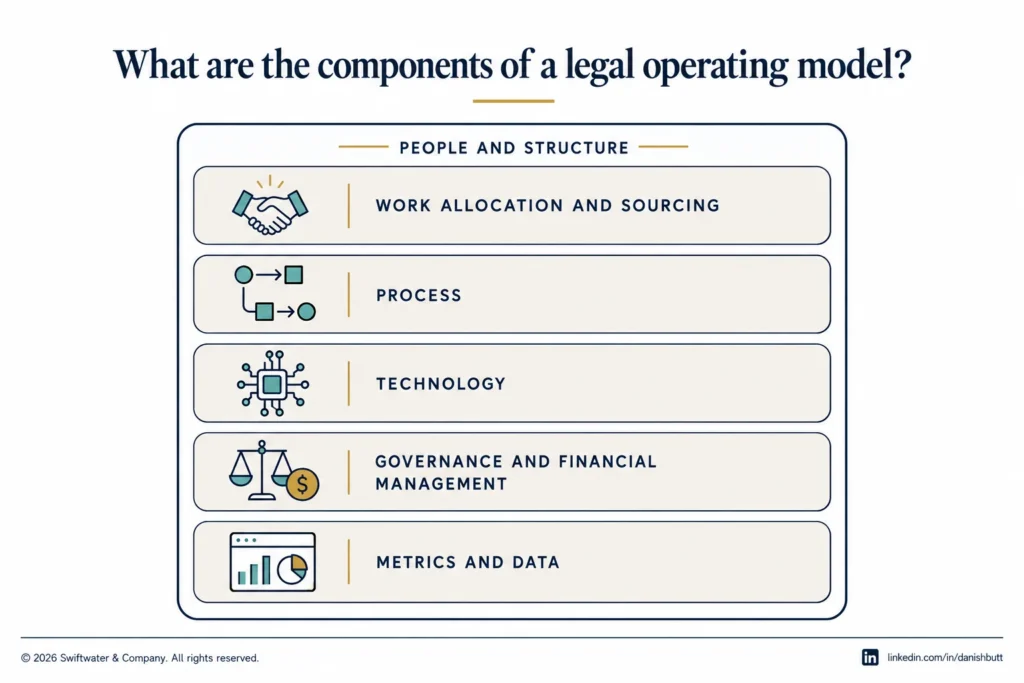
A legal operating model has six components: people and structure, work allocation and sourcing, process, technology, governance and financial management, and metrics and data. They map onto the five areas of legal operations covered on this site, with people and structure as the layer that holds the other five together. The CLOC Core 12 competencies and the ACC Legal Operations Maturity Model cut the same territory into finer pieces; the six below are the level at which a General Counsel makes design decisions.
| Component | What it decides | The questions it answers |
|---|---|---|
| People and structure | How the department is organized, who reports to whom, where legal operations sits, and the mix of lawyers, legal ops, paralegals, and contract talent | Centralized or embedded? Who owns legal operations? What is the span of each leader? |
| Work allocation and sourcing | Which work is done by in-house lawyers, legal operations, self-service, outside counsel, or alternative providers, and by what rule | What never leaves the building? What always goes out? What does the business do for itself? |
| Process | How work enters, moves, and exits: intake, triage, matter workflow, playbooks, approvals, templates | How does the business ask for help? Who decides what a request becomes? Where does it get stuck? |
| Technology | The platforms that carry the process: ELM, CLM, e-billing, document management, intake, and legal AI, and who administers them | What is the system of record for matters, contracts, and spend? Who owns configuration? |
| Governance and financial management | Budget ownership, rate governance, billing guidelines, panel programs, decision rights, and the operating rhythm of planning and review | Who approves spend? What is the annual cycle? What does the department owe the CFO each quarter? |
| Metrics and data | What is measured, how it is reported, and to whom: legal department KPIs, benchmarks, dashboards | What does the department cost per unit of work? Where is the time going? What changed since last year? |
Departments that have done serious work on process and technology but never on people and structure or work allocation are the most common pattern we see. They have a configured ELM and a CLM and the same lawyers doing the same work through better software. The model has not changed; its tooling has.
Building the legal operations function from scratch?
Assessment, roadmap, and delivery for the operational side of the department: spend, technology, process, vendors, and the data that proves what legal delivers. Advice from operators who ran the function.
See Legal Ops ConsultingHow are legal departments structured?
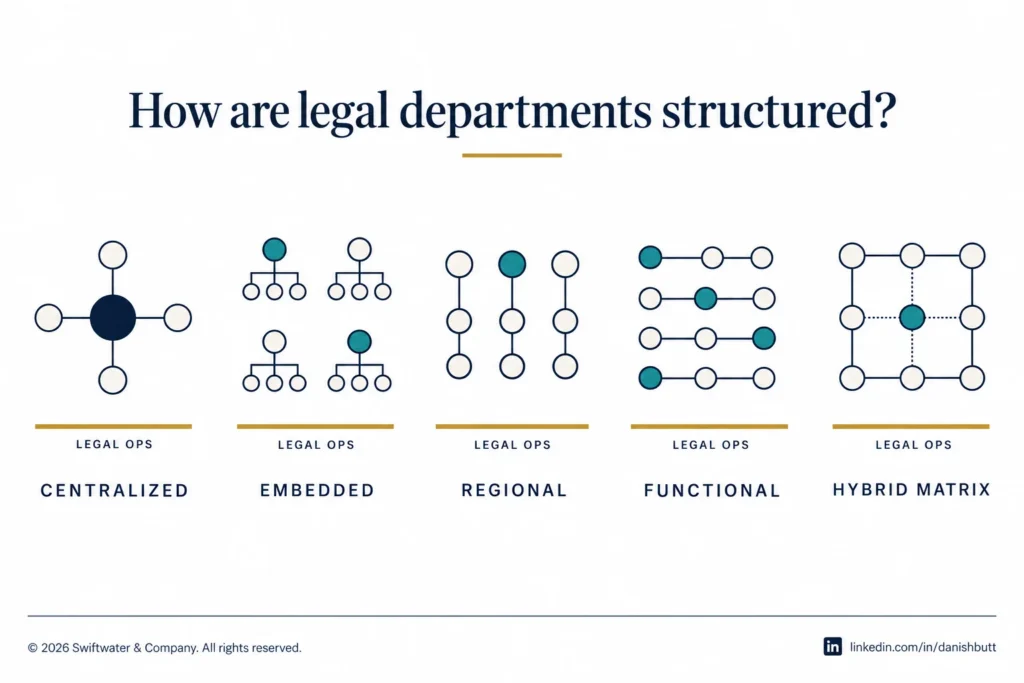
Corporate legal departments are structured in one of five ways: centralized, business-aligned or embedded, regional, functional by practice area, or a hybrid matrix that combines business or regional reporting lines with global practice leads. Structure follows how the business is organized and where legal risk concentrates, and large global departments usually run the hybrid.
| Structure | How it works | Fits when |
|---|---|---|
| Centralized | All lawyers report into the General Counsel through practice or functional leads; the business comes to legal | One dominant business, one geography, or a department small enough that specialization matters more than proximity |
| Business-aligned (embedded) | Lawyers are assigned to, and often sit with, business units or product lines; a central team handles corporate, litigation, and shared services | Several distinct businesses with different risk profiles that need a lawyer who knows their market |
| Regional | Lawyers report through regional heads of legal, with global practice leads for litigation, IP, employment, and compliance | Multi-jurisdiction operations where local law, language, and regulators dominate the work |
| Functional (practice-based) | Organized by legal discipline: commercial, litigation, employment, IP, privacy, corporate | Risk is concentrated in a few disciplines and depth of expertise is the scarce resource |
| Hybrid matrix | Business-aligned or regional lawyers with dotted lines to global practice leads, and a legal operations function serving all of them | Large global departments; the most common end state and the hardest to govern without a designed operating rhythm |
Legal operations sits differently in each. In a centralized department it is often one person reporting to the General Counsel. In a hybrid matrix it is a team with its own leader, serving every lawyer regardless of their reporting line, and it is usually the only function with a view across the whole department. That cross-cutting view is why the Head of Legal Operations seat matters more as structure gets more complex.
How large should a legal operations team be?
A legal operations team is small by every published benchmark: eight lawyers per legal operations professional, 5% of legal department headcount, and a median of zero dedicated professionals below $5 billion in revenue, one between $5 billion and $20 billion, and six at $20 billion and above. Where a specific department should sit depends on the five drivers below.
The source is the 2026 ACC Law Department Management Benchmarking Report, drawn from 576 legal departments across 45 countries, which also puts the ratio against 3.7 lawyers per paralegal and seven per administrative staff member, and finds the 5% share has held since 2022 and is identical across every revenue bracket. The median department has six lawyers, eight total legal staff, and no dedicated legal operations professional at all.
Size tracks company revenue closely, which is why a peer’s headcount only helps if the peer is the same size:
| Company revenue | Median lawyers | Median legal operations professionals |
|---|---|---|
| Under $1 billion | 2 | 0 (mean 0.3) |
| $1 billion to under $5 billion | 8 | 0 (mean 1.1) |
| $5 billion to under $20 billion | 22.5 | 1 (mean 2.7) |
| $20 billion or more | 83.5 | 6 (mean 9.5) |
The same report puts the median workload at 367 employees per lawyer, up from 300, with 3 lawyers per $1 billion of revenue and total legal spend at 0.43% of revenue, a six-year low. It also found 42% of departments using contract or temporary staff, 27% of companies under $1 billion and 74% of those over $20 billion. Read together: fewer lawyers per unit of business, a legal operations function that stays proportionally tiny while its responsibility list grows, and a sourcing mix that leans harder on flexible talent as departments scale.
Where a department should sit relative to those medians depends on five things, and a department sizing the function should start from these rather than from the 8:1 ratio:
- Spend under management. Outside counsel spend, e-billing volume, and the number of firms and vendors to govern. Spend programs are the first thing most legal operations teams are hired to run, and the responsibility 89% of them hold.
- Matter and request volume. How much work enters the department and how much of it needs intake, triage, and tracking rather than a lawyer.
- Geography and entities. Jurisdictions, languages, local billing rules, and the number of legal entities to administer.
- Technology estate. Each platform (ELM, CLM, DMS, intake, e-signature, AI) needs an owner for configuration, administration, data, and adoption. Departments routinely underestimate this and leave it to IT or to a lawyer’s spare time; it is the most common reason a one-person function is actually a two-person job.
- Sourcing mix. How much of the function is delivered in-house, through managed services, or through contract and fractional talent. The contract talent finding applies to legal operations as much as to lawyers, and at the 8:1 ratio a managed services partner is often how a two-person function behaves like a six-person one.
The composition of the function changes with scale more than its headcount does. A one-person legal operations function, the norm below $5 billion in revenue, owns spend and the e-billing system and acts as the General Counsel’s chief of staff. A small team adds technology ownership, intake, and reporting, and usually splits along spend and technology lines. A full function, the six-person median at $20 billion and above, has named owners for spend, technology, process, data, and vendor management, a leader who sits on the General Counsel’s leadership team, and often a managed services partner behind it for bill review, system administration, or reporting. Which of those a department needs is a work allocation decision, which is why team size belongs to the operating model design before it reaches a headcount request.
What does legal department organizational design involve?
Organizational design is the people and structure component made specific: the roles, the reporting lines, the spans, and the allocation of work to each seat. It answers who does what, and it is the part of operating model work that departments most often skip because it is the part that involves people’s jobs.
A complete design covers five decisions. The structure model from the table above. The role architecture: which lawyer roles exist, what each owns, and what the career path between them looks like. The legal operations seat: whether there is a dedicated Head of Legal Operations, what the function owns, and who it reports to. Work allocation rules: what stays with in-house lawyers, what goes to legal operations and paralegals, what the business self-serves, what goes to outside counsel and on what terms, and what goes to a managed services provider. And spans and governance: how many people each leader runs, and the decision rights that go with each seat.
We did this work as part of a multi-year engagement with a global technology company, where legal operations strategy and organizational design sat alongside managed legal operations, bill review, and Onit ELM administration. The design decisions and the services that followed from them are described in the legal operations strategy and org design case study. The pattern that carried across was that the structure decision and the sourcing decision had to be made together: deciding where legal operations sits is only half an answer until the department has also decided which of its work the function will do itself and which it will run through a partner.
How does change management fit a legal operating model?
Change management fits a legal operating model as the step that turns the designed model into the one the department actually runs. Operating model change is change to how lawyers work, and lawyers are trained to find the flaw in any proposal put in front of them, so change management here is lawyer-centric by necessity: it starts from the problem each lawyer already has (workload, visibility, the business routing around them) and shows how the new model addresses it, rather than starting from the design and asking for compliance.
The two failure modes are familiar. Technology-led change, where the system goes live and the model is expected to follow, is covered in legal technology change management. Announcement-led change, where the new structure is published and adoption is assumed, is the subject of our guide to user adoption and change management. Both end the same way: the official model on the org chart and the real model in people’s inboxes diverge, and the department runs two of them.
Need the function run, not just advised on?
Swiftwater embeds senior practitioners directly into legal operations, handling bill review, matter management, and program delivery on your behalf.
See Managed ServicesThe gap the change plan has to close is measurable. In the Law Department Operations Survey, nearly nine in ten legal operations professionals report being comfortable or very comfortable with generative AI, while only 44% are confident in their attorneys’ abilities with it. The function designing the new model and the lawyers who have to work inside it start from different places, and an operating model that assumes otherwise will be adopted by the people who designed it and nobody else.
The adoption standard for an operating model is the same one we apply to a system rollout. Partial adoption produces two models, and two models produce no usable data about either. The target is that the designed model is the one the department actually runs.
How do you redesign a legal operating model?
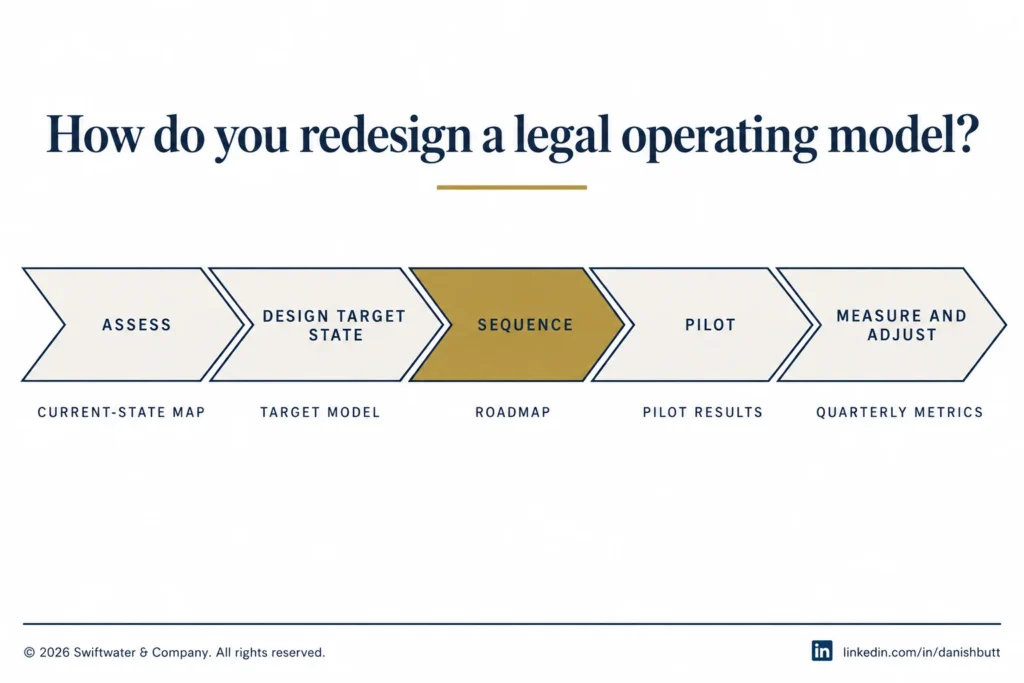
A legal operating model is redesigned in five steps: assess the current model against a maturity reference, design the target state across the six components with structure and sourcing decided together, sequence the moves by dependency and capacity, pilot where the model is most broken, and measure and adjust on a quarterly rhythm. The order matters because each step constrains the next.
- Assess the current model. Document how work actually flows, where it is sourced, what the structure really is as opposed to what the chart says, and where the department sits against a maturity reference. The ACC Legal Operations Maturity Model 2.0 rates each functional area as early, intermediate, or advanced and is a useful common language for the assessment conversation. This is the step Swiftwater’s fixed-fee assessment covers.
- Design the target state. The six components, set deliberately, for the business as it will be in three to five years rather than as it is today. Structure and sourcing decided together. Legal operations seat and scope defined.
- Sequence the moves. Everything cannot change at once. Prioritize the initiatives by dependency and by the department’s capacity to absorb change, and fit them into the annual planning cycle so each year has a defined set of moves and a defined set of things left alone.
- Pilot where the model is most broken. One business unit, one region, or one work type, with disciplined scoping, so the design is tested against real work before it is rolled across the department.
- Measure and adjust. The metrics component is built into the design, so the department knows within a quarter whether the model is doing what it was designed to do. Continuous improvement is then the operating rhythm, with the model reviewed once a year.
Bottom Line
A legal operating model is the designed answer to how legal work is sourced, structured, delivered, governed, and measured. Its six components have to be set together, structure and sourcing above all, because a department that changes its technology or its process without changing its people and work allocation ends up with the old model running on new software.
The benchmarks say the pressure is only going one way: fewer lawyers per unit of business, a legal operations function held at 5% of headcount while its responsibilities widen, more flexible sourcing, and more weight on that small function to make the model work. Design the model on purpose, make the structure and sourcing decisions together, and run only one of them.
Operating model design is the work Swiftwater does with legal departments, from structure and sourcing decisions to intake, governance, and the metrics that prove the model runs. Our legal operations consulting practice starts with a free consult.
Frequently Asked Questions
What is a legal operating model?
A legal operating model defines how a corporate legal department sources, structures, delivers, governs, and measures its work across in-house lawyers, legal operations, outside counsel, and alternative providers. It has six components: people and structure, work allocation and sourcing, process, technology, governance and financial management, and metrics and data.
What is the difference between a legal operating model and legal operations?
Legal operations is the function that runs the business side of the legal department. The legal operating model is the design the whole department runs on, including the lawyers, outside counsel, and alternative providers. Legal operations usually owns the operating model work, but the model covers far more than the legal operations team.
How are corporate legal departments structured?
Five models cover most departments: centralized, business-aligned or embedded, regional, functional by practice area, and a hybrid matrix that combines business or regional reporting lines with global practice leads. Large global departments most often run the hybrid matrix with a legal operations function serving every lawyer.
How big should a legal operations team be?
The 2026 ACC Law Department Management Benchmarking Report puts the ratio at eight lawyers per legal operations professional, with legal operations at 5% of legal department headcount across every company size. The median count is zero below $5 billion in revenue, one between $5 billion and $20 billion, and six at $20 billion and above. Where a specific department should sit depends on spend under management, matter and request volume, geography and entities, the technology estate to administer, and the sourcing mix between in-house, managed services, and contract talent.
What does legal department organizational design cover?
The structure model, the role architecture for lawyers, the legal operations seat and its scope, work allocation rules across in-house lawyers, legal operations, self-service, outside counsel, and managed services, and the spans and decision rights of each leadership seat.
Where does legal operations sit in the department structure?
In most mid-to-large departments the Head of Legal Operations or Legal Operations Director reports directly to the General Counsel and serves every lawyer regardless of their reporting line. In smaller departments it is often one person who also acts as the General Counsel’s chief of staff, and in departments without the seat the work is split across legal, finance, and IT.
How often should a legal operating model be reviewed?
Reviewed annually as part of the planning cycle, with metrics watched quarterly, and redesigned when the business changes materially: a merger, a new region, a shift in the sourcing mix, or a General Counsel mandate that the current model cannot deliver.
This article is provided for informational purposes and reflects Swiftwater’s experience designing legal operating models for corporate legal departments. It does not constitute legal advice. Benchmark figures are quoted from the reports cited and describe the populations those reports surveyed.