

A legal eBilling administrator is the person who runs a legal department’s eBilling system day to day: law firms, rates, billing rules, invoice flow and reporting. Done well, the role makes outside counsel spend predictable. Invoices are checked against billing guidelines and agreed rates before they are paid, budgets and accruals hold up when finance relies on them, the data behind spend decisions is clean, and approvals move faster with fewer disputes.
The role sits in legal operations and works with law firms, in-house lawyers, finance and accounts payable. This guide covers what the administrator does, the day-to-day tasks, the skills the role needs, who it reports to, how it varies by platform, how to size it, and what happens when the administrator leaves.
What does a legal eBilling administrator do?
A legal eBilling administrator keeps the department’s eBilling platform working for everyone who uses it: law firms submit invoices, in-house lawyers approve them and finance pays them. The administrator sets up firms and matters, keeps rates and timekeepers current, maintains the billing rules that apply the department’s guidelines, moves invoices through approval and produces spend reports. The return is control: invoices checked before payment, budgets and accruals that hold, and fewer disputes with firms.
Employers hire for this work in volume. Swiftwater’s legal operations job market report (October 2026 edition, 914 postings from 648 employers) counts 207 postings in e-billing and bill review, 22.6% of the total and second only to generalist legal operations at 209. Three of the four leading titles as posted belong to the discipline: Billing Specialist (27), Billing Coordinator (23) and Legal Billing Specialist (19). Staffing agencies post e-billing and billing roles more than any other discipline; without agency postings the count is 183 of 864. The report counts public postings, which describe what employers ask for and fall short of a statistical sample. Read the counts as directional.
In many departments, the rules and rate cards the administrator maintains are the main check an invoice meets before payment. The 2025 LegalBillReview.com and In-House Connect survey found that 55% of legal departments handle bill review entirely in-house without third-party services or tools, and 60% have no formal outside counsel guidelines in place. Read both figures as directional. For how the platform itself works and what it records, see our legal eBilling guide.
What are the day-to-day tasks?
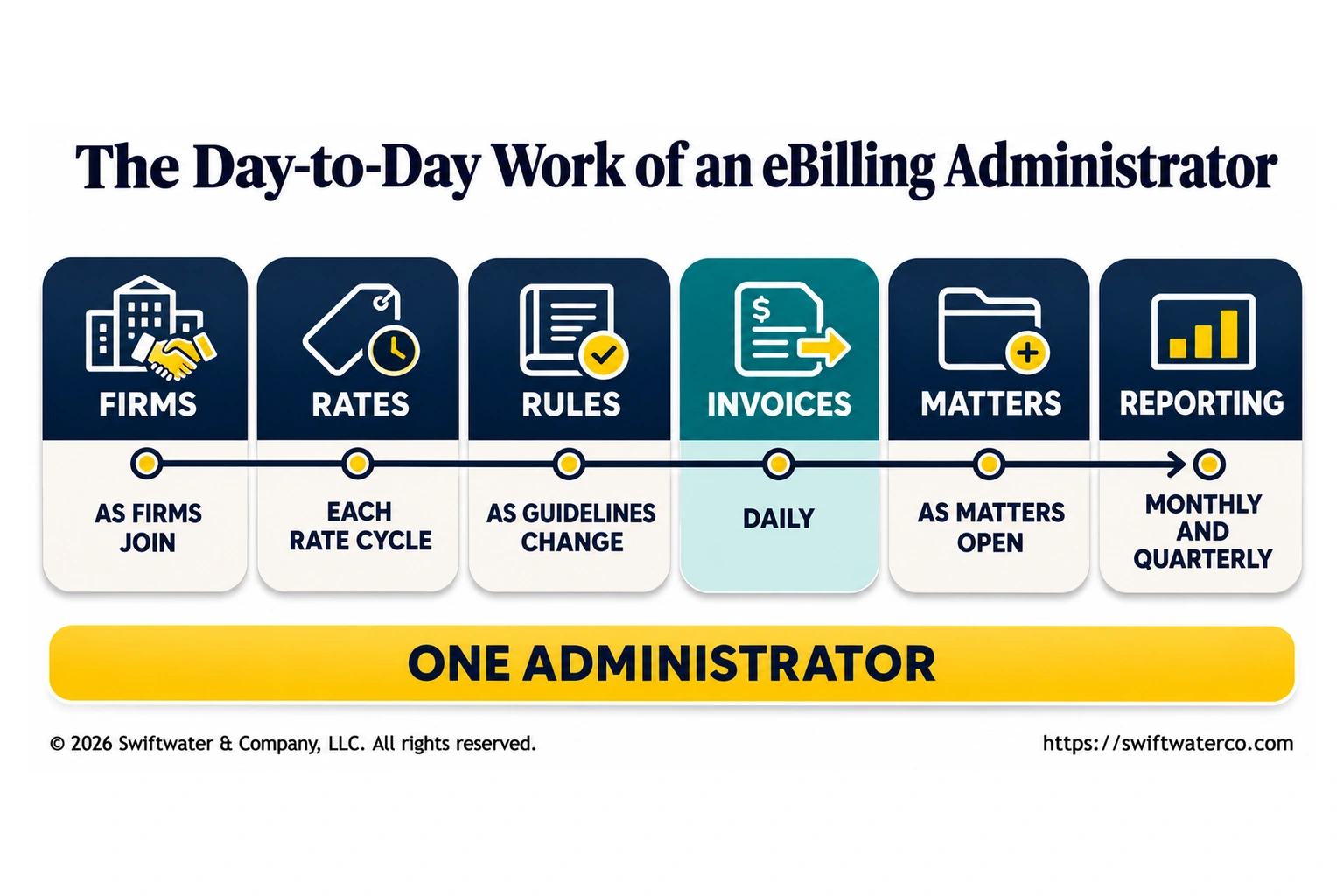
The day-to-day tasks fall into six groups: law firm onboarding and support, rates and timekeepers, billing rules and configurations, invoice flow, matter setup and reporting. Some run every day, such as invoice routing and firm questions. Others follow a calendar, such as the annual rate cycle and the year-end close. Together they cover the path from the first invoice a new firm submits to the report leadership reads at quarter end.
- Law firm onboarding and support: new firms set up in the platform, billing contacts trained, and first invoices followed through until they pass. How firms and their rates are organized in the platform is covered in our guide to eBilling panel configuration.
- Rates and timekeepers: rate requests worked through approval, rate cards loaded, and timekeeper records kept current as firms add and promote people.
- Billing rules and configurations: the rules that apply the department’s outside counsel billing guidelines kept in step with each change to the guidelines.
- Invoice flow: routing, approvals, rejections and resubmissions managed, with stuck invoices chased before they age.
- Matter setup: matters opened with the right codes, firm assignments and budget approvals in place.
- Reporting: regular reports on outside counsel spend, invoice status and law firm activity.
| Task | How often | Who it touches |
|---|---|---|
| Law firm onboarding and support | As firms join; billing questions daily | Law firm billing contacts, legal operations |
| Rates and timekeepers | Each rate cycle, often yearly; new timekeepers as they appear | Law firms, the approving lawyer or legal operations lead, Procurement where involved |
| Billing rules and configurations | Whenever the guidelines change; reviewed at least once a year | Legal operations, law firms |
| Invoice flow | Daily | In-house approvers, law firms, accounts payable |
| Matter setup | As matters open | In-house lawyers, law firms, finance for cost codes |
| Reporting | Monthly and quarterly, plus year end | The General Counsel, legal leadership, finance |
The calendar matters as much as the daily queue. Rate requests tend to arrive together at the start of the year, and year end brings accruals, late invoices and a push to approve everything in the period. An administrator who plans for both keeps invoices moving when volume peaks.
Running an ELM or eBilling implementation?
Swiftwater has three Level 4 Onit-certified practitioners. If you are evaluating, implementing, or rescuing an ELM program, let us talk about what that actually takes.
See ELM ServicesWhat skills does the role need?
The role needs four kinds of skill: platform configuration, billing knowledge, process discipline and clear communication with law firms. An eBilling administrator should be able to set up rules and routing in the platform, read an invoice against billing guidelines and rate cards, keep records accurate across hundreds of timekeepers, and explain a rejection to a firm so the resubmission passes. Reporting skill rounds it out, from the platform’s report builder to a clean spreadsheet.
- Platform configuration: users, roles, approval routing, billing rules and rate cards, set up and tested.
- Billing knowledge: billing guidelines, task and activity codes, rate structures and budget tracking.
- Process discipline: clean records, a calendar for recurring work and a log of every rule change and why it was made.
- Law firm communication: clear, prompt answers to billing contacts, with the department’s position stated the same way every time.
- Reporting: spend, accrual and invoice status reports built so leadership can read them without help.
- Discretion: rates, spend and matter details handled as confidential.
Who does the eBilling administrator report to?
The eBilling administrator usually reports to legal operations: the legal operations manager or director where there is one, or the General Counsel’s chief of staff where there is none. The role also works closely with finance and accounts payable, which pay the approved invoices and rely on the platform for accruals and cost codes. IT supports access and integrations, and Procurement may join rate negotiations. In-house lawyers are the approvers the administrator supports every day.
Invoice work sits squarely inside the legal operations remit. In the Blickstein Group’s 18th Annual Law Department Operations Survey, billing and invoice approval was a legal operations responsibility at 80.0% of the 68 companies surveyed, with matter management at 78.5% and reporting and analytics at 76.9%. Read the figures as directional. Our guide to legal operations roles lists e-billing and outside counsel billing compliance among the domains a legal operations specialist owns end to end, reporting to a manager or Head of Legal Operations. In departments from US$1 billion to US$5 billion in revenue, it describes one person, often titled manager, owning spend and the e-billing system.
Does the role differ by platform?
The day-to-day tasks are the same on every eBilling platform: firms, rates and timekeepers, rules, invoice flow, matters and reporting. What changes is where each setting lives, how billing rules and approval routing are configured, and which reports come standard. An administrator moving between platforms keeps the method and relearns the screens. For platform detail, see what is Legal Tracker, Onit administration and support and SimpleLegal administration; as of November 2026, Onit lists SimpleLegal among its ELM products.
Should the role be full time, fractional or managed?
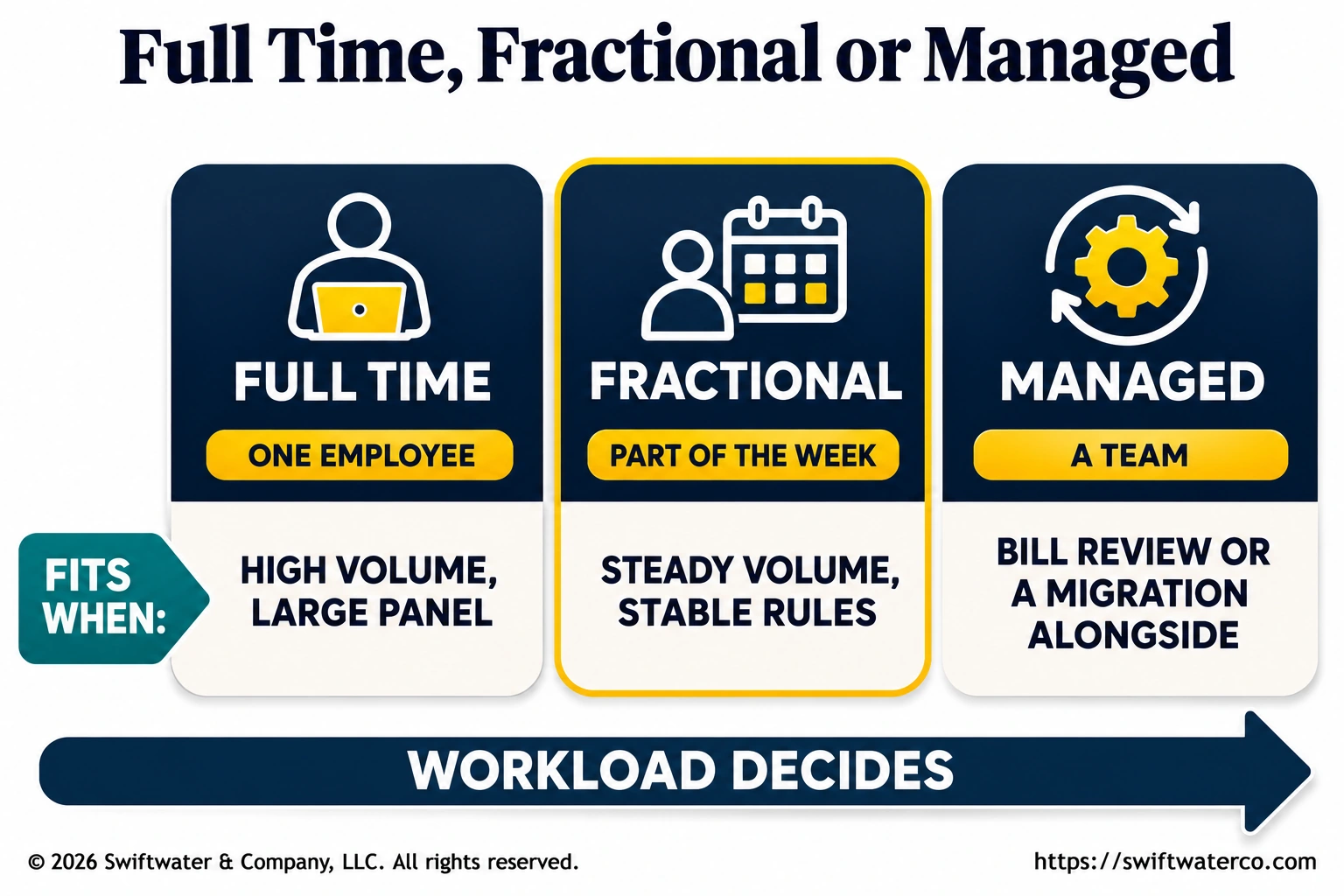
The right model follows the workload. A full-time administrator fits a department with high invoice volume, a large panel and frequent guideline or rate changes. A fractional administrator fits a platform with steady volume and stable rules, working a set schedule each week with more hours at year end and during rate cycles. A managed service fits when administration runs alongside bill review, or when a migration adds a project to the daily work.
- Full time: one employee whose whole job is the platform.
- Fractional: an experienced administrator for part of the week, on a set schedule.
- Managed: a team that runs administration, and often invoice review, under the department’s governance.
Many departments are too small to justify a full-time hire. The ACC 2026 Law Department Management Benchmarking Report, which covers 576 legal departments in 45 countries, puts the median number of legal operations staff at zero for companies under US$5 billion in revenue, and at one for companies from US$5 billion to US$20 billion. Treat the figures as directional. Where there is no legal operations team, eBilling work tends to fall to a paralegal, an assistant or someone in accounts payable, on top of a full job.
A fractional administrator is one answer. A large private equity group needed end-of-year support to manage timely processing of its legal bills. Our team provided a fractional system administrator to help route invoices and get them approved. Our professionals also helped evaluate the system and reporting, and helped with ongoing management and report writing. For how Swiftwater provides the role, see our fractional legal eBilling administrator service.
What happens when the administrator leaves?
When an eBilling administrator leaves, invoices slow down first. Approvals stall, firms lose their contact for rejections, rate requests queue up and billing rules stop keeping pace with the guidelines. Much of the platform knowledge often lives in one person’s head: why a rule exists, which firm has a special arrangement, which report finance expects each month. A planned handover and interim cover keep the platform running while the department decides how to fill the role.
A handover should capture, at a minimum:
- Administrator access, transferred through IT before the last day.
- The firm list with billing contacts and any open onboarding.
- The rate cycle calendar and every pending rate request.
- The billing rules in force, with the reason for each.
- Approval routing, including delegates and thresholds.
- The report schedule and who receives each report.
- Open issues: stuck invoices, disputed rejections and pending firm questions.
Interim cover can bridge the gap while the department hires, or become the permanent arrangement. Swiftwater provides administrator backfill as part of its eBilling administrator service, and for Legal Tracker through Legal Tracker support.
Bottom Line
A legal eBilling administrator runs the eBilling platform day to day: law firm onboarding and support, rates and timekeepers, billing rules and configurations, invoice flow, matter setup and reporting. The role usually reports to legal operations, works closely with finance and accounts payable, and gives the department checked invoices, reliable accruals and clean spend data.
The tasks are the same on every platform, and the workload decides whether the role is full time, fractional or managed. Whichever model fits, the work needs a named owner, a calendar and a written handover. Every dollar the department pays its law firms passes through this role. When it runs well, spend stops being a surprise.
Swiftwater provides a fractional legal eBilling administrator for corporate legal departments: law firms onboarded and supported, rates and timekeepers kept current, billing rules maintained, invoices moved through approval, and reporting delivered, inside the eBilling platform you already own and under your governance. Engagements are full managed, co-managed or project-based, with no minimum commitment. See fractional legal eBilling administrator.
Want the review function run for you?
Every outside counsel invoice checked against your guidelines, rates, and matter context, inside the eBilling platform you already own, with the exception handling, vendor coaching, and savings reporting that separate a review program from invoice processing.
See Bill Review ServicesFrequently Asked Questions
Is an eBilling administrator the same as a legal operations manager?
A legal eBilling administrator is the person who runs a legal department’s eBilling system day to day: law firms, rates, billing rules, invoice flow and reporting. A legal operations manager has a wider remit, covering budgets, technology, vendors, process and reporting across the department. In a small team one person may hold both jobs. See our legal operations manager job description.
How do corporate legal departments enforce billing guidelines?
Corporate legal departments enforce billing guidelines by turning them into rules in the eBilling platform, so invoices that break a rule are flagged or rejected at submission and returned for resubmission. Our article on outside counsel billing guidelines covers what the guidelines contain and how they are enforced.
Do small legal departments need an eBilling administrator?
Small legal departments need the work done, even when the volume is too low for a full-time hire. Someone still has to onboard firms, load rates, keep the billing rules current and move invoices through approval. In a small team that is often a paralegal or legal operations generalist for a few hours a week, or a fractional administrator on a set schedule.
Can an eBilling administrator be fractional?
Yes. A fractional eBilling administrator works a set schedule each week inside the department’s platform, with more hours at year end and during rate cycles. The model suits platforms with steady invoice volume and stable rules. Swiftwater provides a fractional legal eBilling administrator for corporate legal departments.
What does the administrator do during a migration?
During a migration the administrator prepares and checks the data that moves: firms, billing contacts, rates, timekeepers, open matters and billing rules. They help test routing and rules in the new platform, onboard firms to it, and manage invoices still in flight on the old one until it closes. For selection, implementation and adoption, see legal eBilling.
This article is for general information and education and is not legal advice; consult your own counsel on any contract or compliance question. Figures cited are from the sources named and are presented to show direction, not as targets. If you believe any material on this page should be corrected or removed, contact us through the contact form.