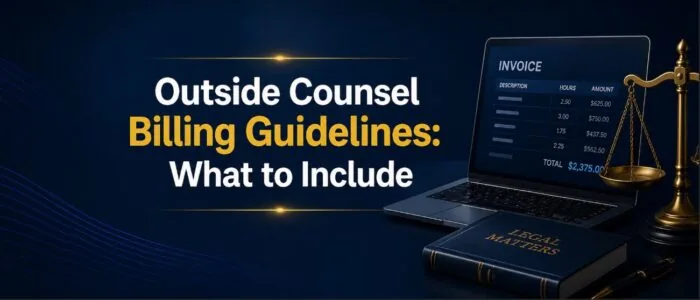

Outside counsel billing guidelines are the contractual rules that govern how outside law firms submit invoices to a corporate legal department, covering timekeeping standards, rate approval requirements, billing code usage (LEDES and UTBMS), staffing restrictions, expense policies, and invoice format requirements. Without automated enforcement through an eBilling platform such as CounselGO, BillingPoint, Collaborati, or Passport’s Collaboration Portal, guidelines exist on paper but rarely get enforced consistently at scale.
Most legal departments have billing guidelines. Few enforce them properly. That gap is where cost leakage happens, and where the strongest legal departments separate themselves from the rest. For broader context, see the enterprise legal management hub and how legal eBilling works.
What are outside counsel billing guidelines?
Outside counsel billing guidelines are formal contractual rules agreed between a legal department and its law firms that define how time is recorded, what rates are approved, what expenses are allowed, how invoices must be submitted, and what billing codes must be used. They are typically part of engagement letters or vendor agreements.
In most corporate legal departments, the OCGs sit as one leg of a three-legged stool that defines the outside counsel relationship: the engagement letter (defining the scope of the representation), the billing guidelines (defining how the firm bills), and the eBilling platform (enforcing both at line-item level). Each leg has a different function. Together they form a coherent governance framework that turns outside counsel from a fragmented set of vendor relationships into a managed portfolio.
Without structured billing guidelines, firms apply their own practices, producing inconsistency, cost escalation, and difficulty comparing across firms or matter types.
What should billing guidelines cover?
Effective outside counsel billing guidelines cover timekeeping standards, rate approval, billing codes and formats, staffing rules, expense policies, and invoice submission requirements. Larger legal departments often layer practice-specific addendums on top of a general baseline; smaller departments typically operate with a single consolidated set.
The standard areas that strong OCGs address:
Struggling to control outside counsel spend?
We help legal departments build the governance, billing guidelines, panel structure, and rate programs that take back control of what outside counsel costs.
See Legal Spend ServicesTimekeeping standards
- Minimum billing increments
- Restrictions on block billing
- Specific narrative requirements describing the work performed
Rate approval
- Pre-approved hourly rates by role and timekeeper
- Annual rate increase rules and approval requirements
- Treatment of alternative fee arrangements
Billing codes and formats
- Required UTBMS task and activity codes
- LEDES file format standards (1998B, 1998BI, or LEDES XML 2.0)
- Standardized invoice structure and supporting documentation
Staffing rules
- Limits on number of timekeepers per matter
- Restrictions on junior staffing or duplicated work
- Pre-approval requirements for staffing changes
Expense policies
- Disallowed cost categories (administrative time, secretarial work, local meals)
- Limits on travel and disbursements
- Documentation thresholds for reimbursable expenses
Financial management
- Matter-level budget submission and approval at the start of an engagement
- Phase-based budget tracking aligned to UTBMS task codes
- Monthly accrual submission and forecast updates
- Early case assessment requirements for matters above defined cost or risk thresholds
- Variance reporting when actuals exceed forecast
Larger organizations routinely add matter-type addendums for litigation, IP, M&A, and regulatory work, where each practice has different staffing patterns and billing realities. Most departments aim for a general baseline with practice-area addendums layered on top. The objective is consistency without rigidity. According to the LEDES Oversight Committee, structured billing formats improve consistency and enable automated invoice validation, which is the foundation of enforceable guidelines and the basis for analytics that turn billing data into management insight. See how LEDES format enhances legal billing metrics and analytics for the analytics dimension.
How do billing guidelines tie to broader spend governance?
Outside counsel billing guidelines are one component of broader legal spend governance, alongside matter budgeting, rate negotiation, vendor consolidation, and structured analytics. Guidelines define the rules. The broader governance framework defines the strategy those rules support.
Standalone billing guidelines without a broader spend strategy drift toward administrative compliance rather than financial impact. Persuit’s outside counsel management framing places OCGs and eBilling within a broader discipline that begins at matter inception, well before any invoice is submitted. The GC roadmap to building a legal spend program walks through how guidelines, rate management, vendor consolidation, and analytics fit together. For the broader strategic frame, see legal spend management or the legal spend hub.
According to the 2025 ACC Chief Legal Officers Survey, cost containment and operational efficiency continue to rank among the highest priorities for legal department leaders, and structured outside counsel guidelines are one of the most direct levers a General Counsel has to act on those priorities.
How should billing guidelines be enforced through an eBilling system?
Billing guidelines are enforced through an eBilling system by encoding each rule as machine-enforceable logic that validates invoices at the line-item level, flagging or rejecting non-compliant entries before they reach a human reviewer. This is the core difference between guidelines that exist on paper and guidelines that operate as financial controls.
Outside counsel billing guideline enforcement happens in two layers. Law firms first submit invoices through a firm-side portal such as CounselGO (Onit SimpleLegal), BillingPoint (Onit OnitX), Collaborati (Mitratech TeamConnect), Collaboration Portal (Wolters Kluwer Passport), or Legal Tracker (Thomson Reuters). The portal performs initial rule monitoring and validation, flagging structural issues like missing LEDES fields, unapproved timekeepers, rate card mismatches, and disallowed expense categories at the point of submission.
The invoice then flows into the corporate eBilling system, where additional scrutiny is applied by legal operations, managed bill reviewers, and the responsible attorney for each matter. This is where narrative quality, staffing appropriateness, matter budget context, and exception handling get reviewed before final approval and payment. The two layers together do the work the platform’s enforcement engine is designed to do:
Want the review function run for you?
Every outside counsel invoice checked against your guidelines, rates, and matter context, inside the eBilling platform you already own, with the exception handling, vendor coaching, and savings reporting that separate a review program from invoice processing.
See Bill Review Services- Automatically validate invoices against rules at submission
- Flag or reject non-compliant entries before they enter manual review
- Apply rate, staffing, and expense checks at the point of submission
- Standardize invoice formats for consistent downstream processing
Many eBilling platforms also support OCG publication and acknowledgment workflows that allow legal departments to automate annual circulation and firm-side approval, eliminating the manual paper-chase that traditionally accompanied OCG updates.
Manual enforcement happens after the work has been billed and the cost has already accrued. Automated enforcement prevents non-compliant items from entering the approval workflow at all.
What does enforcement failure cost?
When outside counsel billing guideline enforcement is weak, the cost shows up as overbilling on non-compliant entries, inconsistent invoice review across firms, missed visibility into spend patterns, and steadily growing administrative workload as manual review tries to compensate. Each of these is measurable, and the effect compounds over time.
Common impacts include:
- Overbilling on entries that should have been flagged at submission
- Inconsistent treatment of similar charges across different firms
- Lack of visibility into emerging spend patterns and rate creep
- Increased manual workload that often defeats the original automation case
According to Apperio’s research on the pursuit of control in legal spending, 74% of legal departments report that fixed fees exceed the agreed price at least some of the time, and 39% are routinely surprised by the size of law firm invoices. Both data points reflect what happens when guideline enforcement is weak. Without enforcement, billing guidelines remain symbolic. For a deeper look at what happens when governance breaks down across an eBilling program, see the cost of eBilling governance failure.
How often should billing guidelines be updated?
Outside counsel billing guidelines should be updated at least annually, and more frequently when major firm relationships change, legal work shifts materially, or cost benchmarking surfaces patterns the current rules do not address.
The triggers that typically prompt an update:
- Annual review aligned with the firm rate-review cycle
- Onboarding or offboarding of a major firm relationship
- Material changes in the legal department’s practice mix or matter types
- Cost trend or benchmarking data showing that current rules miss material categories
- Feedback from invoice reviews surfacing recurring exception patterns
Most legal departments time the annual update to the firm rate-review cycle. A structured acknowledgment cycle typically follows publication, increasingly automated through the eBilling firm portal so every firm formally accepts the current rules each year. According to the Blickstein Group Law Department Operations Survey, continuous improvement of legal operations processes is one of the consistent markers of mature legal departments.
Bottom Line
Outside counsel billing guidelines define how law firms bill and how legal departments control costs. They sit alongside the engagement letter and the eBilling platform as the three legs of a structured outside counsel relationship.
Strong OCGs are clearly defined, properly structured, automatically enforced through an eBilling platform, periodically updated and acknowledged, and tied to a broader spend governance strategy. Weak OCGs exist on paper but produce no financial discipline.
Our professionals have implemented eBilling and ELM platforms across complex enterprise environments and have helped legal departments translate their OCGs into machine-enforceable rules at scale.
Is your legal spend data telling you the full story?
We help legal departments build the analytics, rate governance, and reporting infrastructure to move from invoice processing to strategic spend management.
See Legal Spend ServicesStrong outside counsel billing guidelines deliver financial discipline only when they are enforced through technology, refreshed on a cadence, and connected to a broader spend governance program.
If you are designing or modernizing your outside counsel billing guidelines, explore how Swiftwater’s legal technology implementation services and legal spend management practice support enterprise programs end to end.
Frequently Asked Questions
What are outside counsel billing guidelines (OCGs)?
Outside counsel billing guidelines (OCGs) are formal rules that define how law firms submit invoices to corporate legal departments, including timekeeping standards, rate approval, billing code usage, and expense policies.
Why are outside counsel billing guidelines important?
OCGs are important because they ensure consistency in billing, control costs, and provide legal departments with the tools to manage outside counsel spend effectively, reducing the potential for overbilling and inefficiencies.
What should billing guidelines cover?
Billing guidelines should cover timekeeping standards, rate approval processes, required billing codes, staffing rules, expense policies, and invoice submission formats, among other things.
How do billing guidelines relate to broader spend governance?
Billing guidelines are part of a broader legal spend governance strategy that includes rate negotiations, matter budgeting, vendor consolidation, and structured analytics to ensure cost control and efficient operations.
How are billing guidelines enforced through an eBilling system?
Billing guidelines are enforced through an eBilling system by translating rules into machine-enforceable logic that flags or rejects non-compliant entries at the line-item level before invoices reach human reviewers.
What happens if billing guideline enforcement fails?
Weak enforcement can lead to overbilling, inconsistent invoice reviews, missed spend patterns, and increased administrative workload, which undermines the cost-control benefits of the eBilling system.
How often should billing guidelines be updated?
Billing guidelines should be reviewed and updated at least annually, or more frequently when significant firm relationships change, or when new cost trends or feedback from invoice reviews surface recurring issues.
What does a strong outside counsel billing guideline system look like?
A strong OCG system is clearly defined, properly structured, enforced through an eBilling platform, updated periodically, and tied to a broader spend governance strategy that includes matter budgeting and vendor management.
Disclaimer: This article is provided for educational and informational purposes only. Neither Swiftwater and Company nor the author provides legal advice. This content does not constitute professional legal, financial, or operational advice and should not be relied upon as such. Readers are encouraged to consult a qualified professional before making decisions based on the information provided. External links are included for reference only and reflect the views of their respective authors. Swiftwater and Company takes no responsibility for third-party content.