
An ELM system administrator is the person responsible for running a legal department’s enterprise legal management platform: users, configuration, matters, eBilling and reporting. The seat keeps the system the department relies on for matters, invoices and outside counsel spend accurate and in use. This guide covers what the role does, the skills it needs, where it sits in the legal operations team and a free job description template you can adapt.
The seat is easy to miss in the hiring market. Swiftwater’s legal operations job market report (October 2026 edition) counts 914 postings from 648 employers. ELM and legal technology systems roles account for 51 of them (5.6%), while eBilling and bill review, the second-largest discipline, accounts for 207 (22.6%), and much of that work runs through an ELM. The postings were not drawn as a statistical sample, so read the figures as directional.
What does an ELM system administrator do?
An ELM system administrator runs the enterprise legal management platform day to day. The work covers legal service intake, user access and roles, configuration as guidelines, workflows and vendors change, matter records and data quality, the eBilling flow from law firm submission to approval, and the reports legal leadership reads. The administrator is the person lawyers, law firms and finance call when something in the system looks wrong, and the person who fixes it.
The administrator is first the business owner of the system and then its technical owner. The business side decides how the platform should work for the department: which requests come in through it, how matters are set up, which invoices need which approvals and what leadership needs to see. The technical side turns those decisions into configuration. In larger organizations, other technical roles support that side, such as IT for infrastructure and security, integration specialists and the vendor’s support team for upgrades, and the administrator coordinates their work.
The platform varies by department. Common examples of ELM platforms include Mitratech TeamConnect, Onit, SimpleLegal and Thomson Reuters Legal Tracker, and the core duties are similar on each. Titles vary even more: the 914 postings in the job market report use 629 distinct titles, so ELM administration appears as ELM administrator, legal systems administrator, legal technology specialist, legal operations administrator and more. Only 6.8% of those postings state remote work. The job description should name the platform, the modules the person will own and the work arrangement.
What are the responsibilities?
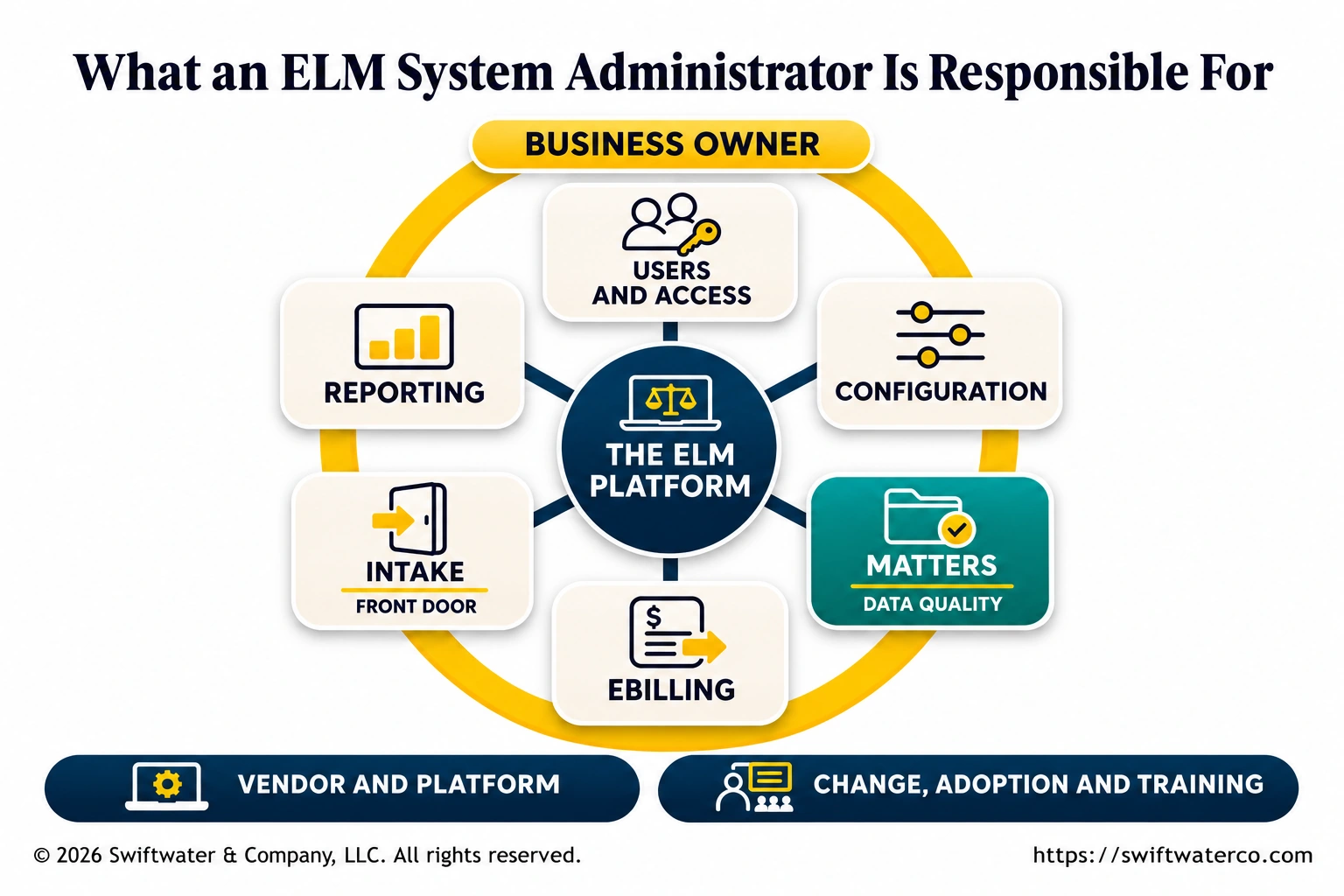
The responsibilities of an ELM system administrator fall into eight groups: legal service intake; users and access; configuration and workflow; matters and data quality; eBilling and invoice flow; reporting; the vendor and platform relationship; and change management, adoption and training. Some run daily, such as new requests, invoice exceptions and access requests. Others follow the calendar, such as rate cycles, year-end reporting and platform releases. A job description that names all eight tells candidates the seat owns the whole system.
- Legal service intake and front door: request intake forms and request types, triage and routing rules, matter creation from intake, and service levels and reporting on requests.
- Users and access: adding, changing and removing users, roles and permissions, in line with the department’s security rules.
- Configuration and workflow: approval chains, matter types, fields, rules and templates, kept current as guidelines, workflows and vendors change.
- Matters and data quality: matter setup, status, budgets and closure, plus the clean-up that keeps reports trustworthy.
- eBilling and invoice flow: law firm onboarding, rates and timekeepers, billing rules, invoice routing and exceptions, in step with accounts payable.
- Reporting: standard and ad hoc reports on matters and outside counsel spend, and support for budgets and accruals.
- Vendor and platform relationship: support tickets, release notes, renewal input and the department’s requests to the vendor, with IT and integration teams handling upgrades, infrastructure and security under the administrator’s coordination.
- Change management, adoption and training: testing and announcing releases, training lawyers, paralegals and law firms, running a super-user network, tracking adoption, and feeding user requests back into configuration.
| Responsibility | Frequency | Works with |
|---|---|---|
| Legal service intake | Daily, with request types reviewed quarterly | Business requesters, lawyers, legal operations |
| Users and access | Weekly, and as people join, move or leave | Lawyers and staff, IT and security |
| Configuration and workflow | As guidelines, workflows and vendors change | Legal operations manager, IT |
| Matters and data quality | Daily checks, with a monthly review | Lawyers, paralegals, legal operations |
| eBilling and invoice flow | Daily, with peaks at month end and year end | Law firms, accounts payable, finance |
| Reporting | Monthly and quarterly, plus requests | Legal leadership, finance |
| Vendor and platform relationship | Each release, and quarterly reviews | Platform vendor, procurement, IT |
| Change management, adoption and training | Each release, each new user group, monthly adoption checks | Lawyers, paralegals, law firms, super users |
Each group maps to work that legal operations functions report owning. In the Blickstein Group’s 18th Annual Law Department Operations Survey of 68 companies, billing and invoice approval (80.0%), matter management (78.5%) and reporting and analytics (76.9%) were each named by more than three quarters of respondents. In many departments all three run through the ELM. The sample is small, so read the figures as directional.
Running an ELM or eBilling implementation?
Swiftwater has three Level 4 Onit-certified practitioners. If you are evaluating, implementing, or rescuing an ELM program, let us talk about what that actually takes.
See ELM ServicesWhat skills and experience does the role need?
An ELM system administrator needs hands-on administration of an ELM or eBilling platform, a working grasp of how matters and law firm invoices move, comfort with data and reporting, and patience with lawyers and law firms who use the system only occasionally. It is recommended that the posting name the platform the department runs, because experience on that system shortens the first months more than general legal experience does.
- Platform administration: users, roles, workflows and configuration on at least one ELM or eBilling platform.
- eBilling knowledge: LEDES invoices, UTBMS codes, rates and timekeepers, and how billing guidelines become rules in the system.
- Data and reporting: building reports, spotting the records that distort them, and strong spreadsheet skills for the rest.
- Process sense: turning a guideline, an approval policy or an intake rule into configuration, then testing it before release.
- Change and adoption: clear release communications, patient training for lawyers, staff and law firm billing teams, and follow-up until new habits hold.
- Vendor coordination: logging, tracking and escalating issues with the platform vendor.
Credentials help when they match the system. A platform certification for the ELM the department runs is the one employers tend to name in postings, and a CLOC Academy course in technology or financial management adds legal operations context. Our guide to legal operations certifications compares the options and what each costs.
Where does the role sit in the legal operations team?
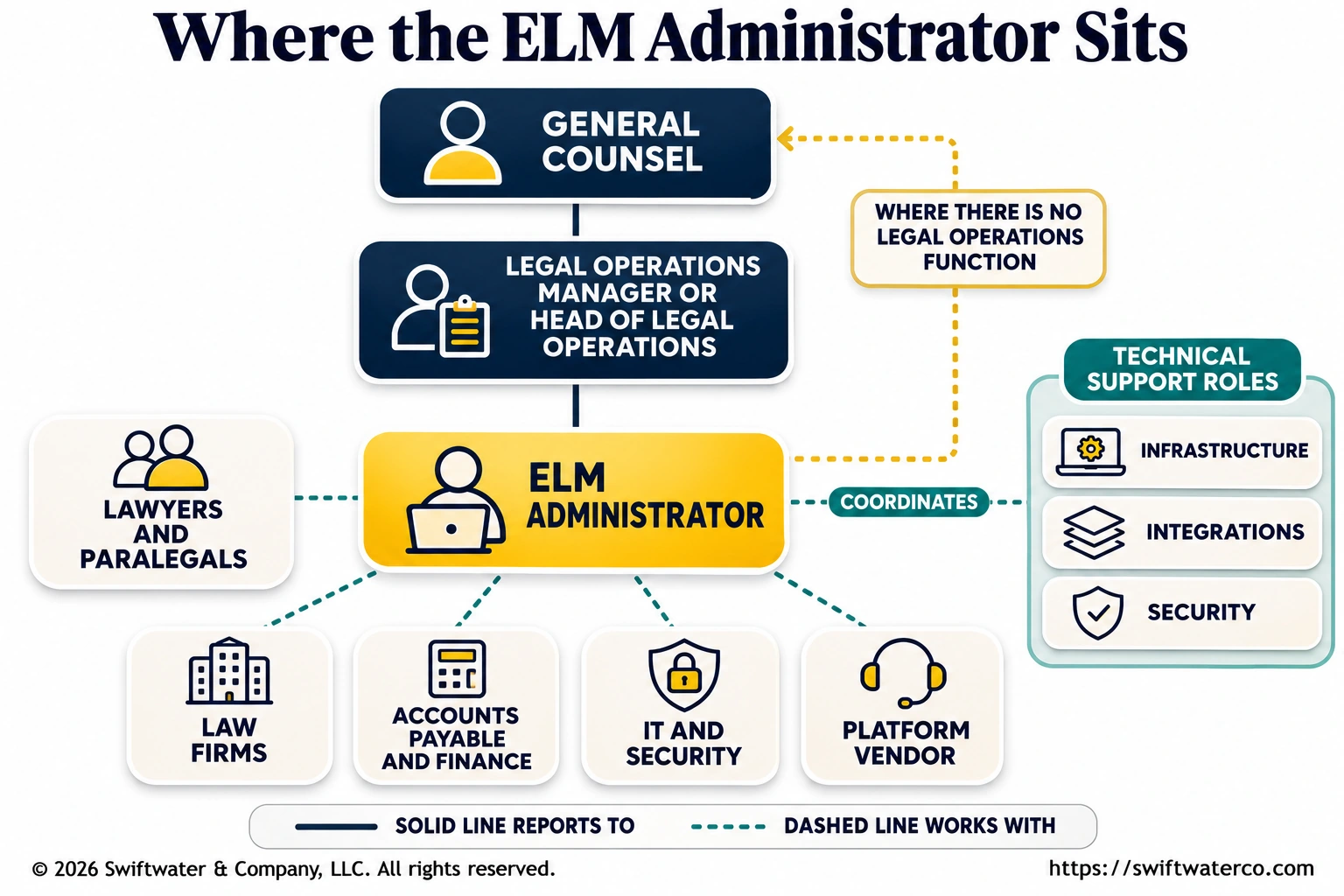
An ELM system administrator usually sits in legal operations and reports to the legal operations manager or the head of legal operations. Where the department has no legal operations function, the seat reports to a deputy General Counsel, the General Counsel’s chief of staff or the person who owns outside counsel spend. Day to day, the administrator works with lawyers, paralegals, law firms, accounts payable, finance and IT.
In the legal operations roles ladder, the administrator is a specialist seat that owns one system in depth. A legal operations manager owns programs, a budget and vendor relationships, and relies on the administrator to make those programs run inside the platform. Our legal operations manager job description covers that seat. As the business owner of the system, the administrator also sets the priorities for the technical roles around it, which in larger organizations include IT and security, integration teams and the vendor’s support desk.
In smaller departments there may be no dedicated administrator at all. The role is shared across people, often a paralegal, a lawyer, someone in finance and whoever set the system up, whether the department runs an ELM platform or a spreadsheet. The ACC 2026 Law Department Management Benchmarking Report supports the point: across 576 legal departments, the median department at companies under US$5 billion in revenue has no legal operations professional. Read that figure as directional. A job description still helps there, because it names the work each person holds.
Job description template
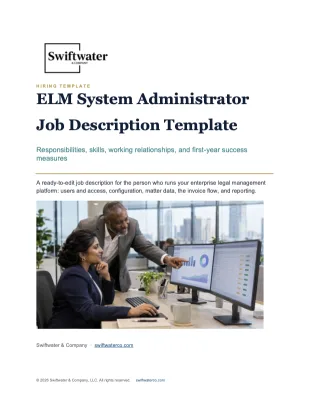
The template is a ready-to-edit ELM system administrator job description. It covers the role summary, the reporting line, key responsibilities in the eight groups above, required skills and experience, preferred qualifications, working relationships and success measures for the first year. Replace the bracketed text, name your platform and modules, and delete any group the seat will not own. It closes with a short note on fractional and managed cover.
Role summary (from the template): [Company] is hiring an ELM System Administrator to run [platform], the enterprise legal management system the legal department uses for intake, matters, eBilling and outside counsel spend. The role is first the business owner of the platform and then its technical owner. It owns intake, users and access, configuration, matter data quality, the invoice flow and reporting, and is the day-to-day contact for lawyers, law firms, finance and the platform vendor.
When is a fractional or managed administrator the better fit?
A fractional or managed administrator is the better fit when the platform needs expert attention for part of the week, when the department is between administrators, or when no one inside has run the system before. A stable instance often needs fewer hours than a full-time seat, with peaks during rate cycles, reorganizations, releases and year end. Covering those hours from outside keeps the system current while the department decides on a permanent hire.
Swiftwater provides ELM system administration inside the platform you already own: administration and users, configuration as your guidelines, workflows and vendors change, matter tracking, status reporting and data hygiene, reporting on matters and outside counsel spend, and cover when your administrator leaves or is out. The work runs inside your systems, against agreed service levels, in three engagement models (full managed, co-managed or project-based) with no minimum commitment.
Bottom Line
An ELM system administrator keeps the department’s enterprise legal management platform accurate and in use: intake, users, configuration, matters, eBilling and reporting. The seat owns the system first as its business owner and then as its technical owner, and coordinates the IT, integration and vendor roles that support it.
Want the review function run for you?
Every outside counsel invoice checked against your guidelines, rates, and matter context, inside the eBilling platform you already own, with the exception handling, vendor coaching, and savings reporting that separate a review program from invoice processing.
See Bill Review ServicesWrite the job description around the platform and the eight groups of work, state the reporting line, and agree the success measures before the posting goes out. Where the hours do not justify a full-time seat, a fractional or managed administrator can cover them. Every legal request, matter and invoice in the department passes through this seat. Hire for that responsibility.
Swiftwater provides ELM system administration for the platform you run: administration, reporting and continuous improvement, inside your systems and under your governance, against agreed service levels. Engagements are full managed, co-managed or project-based, with no minimum commitment. See ELM system administrator services.
Frequently Asked Questions
What is an ELM system administrator?
An ELM system administrator is the person responsible for running a legal department’s enterprise legal management platform: users, configuration, matters, eBilling and reporting. The role is first the business owner of the system and then its technical owner. It keeps requests routed, matter records clean, invoices moving and reports reliable, and it supports the lawyers, staff and law firms who use the system. Common titles for the seat include ELM administrator, legal systems administrator and legal technology specialist.
Is an ELM administrator a full-time role?
It depends on the size of the instance and how often it changes. A department with many users, matters and law firms, or one in the middle of an implementation, can justify a full-time administrator. A stable instance can often be run part time on a set schedule, with more hours during rate cycles, releases and year end. A fractional or managed administrator is one way to cover that pattern.
What is the difference between an ELM administrator and a legal operations manager?
An ELM administrator owns one system in depth: its intake, users, configuration, data, eBilling flow and reports. A legal operations manager owns programs, such as outside counsel spend or legal technology, with a budget, vendor relationships and often a small team. In many departments the administrator reports to the manager. Our legal operations manager job description covers that seat.
Which certifications help?
The certification that helps first is the platform certification for the ELM the department runs, where the vendor or its partners offer one. CLOC Academy courses in technology or financial management add legal operations context, and a project management credential helps an administrator who leads implementations or upgrades. Our guide to legal operations certifications compares the options.
Who does an ELM system administrator report to?
An ELM system administrator usually reports to the legal operations manager or the head of legal operations. In a department without a legal operations function, the seat reports to a deputy General Counsel, the General Counsel’s chief of staff or the person who owns outside counsel spend. The reporting line belongs in the job description, because it tells candidates who sets their priorities.
What should an ELM system administrator job description include?
An ELM system administrator job description should include a role summary, the reporting line, the platform and modules the seat owns, responsibilities grouped by area, required skills and experience, preferred qualifications, working relationships and success measures for the first year. Naming the platform matters, because candidates search on it and experience on that system shortens the first months in the seat.
This article is for general information and education and is not legal advice; consult your own counsel on any contract or compliance question. Figures cited are from the sources named and are presented to show direction, not as targets. Job posting figures come from Swiftwater’s legal operations job market report, a research project developed in conjunction with Swiftwater AI Labs; they describe public postings and are directional. If you believe any material on this page should be corrected or removed, contact us through the contact form.