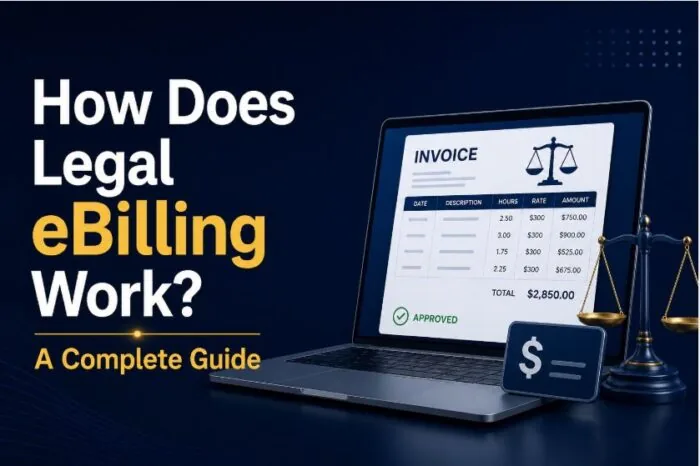

Legal eBilling is the electronic submission, validation, and management of law firm invoices to corporate legal departments through a structured platform that enforces billing guidelines, validates LEDES-formatted invoice data, tracks matter budgets, and feeds outside counsel spend reporting. It replaces manual invoice review with automated compliance checking, rate enforcement, accrual tracking, and structured analytics. For most large legal departments, it is the operational foundation that makes outside counsel spend visible, comparable, and controllable.
Legal departments did not always operate this way. Invoice review used to be manual: paper or PDF invoices arrived from law firms, internal teams reviewed them line by line, and approvals moved through email and finance systems. That approach does not scale. Legal eBilling brings structure, automation, and data to that work.
For broader context on where eBilling sits in the legal technology stack, see the enterprise legal management hub.
What is legal eBilling and why does it matter?
Legal eBilling is the platform-based system through which law firms submit invoices electronically and corporate legal departments review, approve, accrue, allocate, and report on those invoices. It matters because outside counsel spend is one of the largest and most spread out categories on the legal department’s ledger, and the platform’s data becomes the basis for nearly every spend, vendor, and rate decision the department makes.
Without an eBilling system, legal teams typically face limited visibility into outside counsel spend, inconsistent billing practices across firms, manual line-by-line invoice review, difficulty enforcing billing guidelines, and no reliable way to benchmark rates or matter outcomes. According to the 2025 ACC Chief Legal Officers Survey, cost containment and operational efficiency continue to rank among the highest priorities for legal department leaders, and structured spend data is the only way to act on either at scale.
Legal eBilling addresses both. It produces the data, enforces the rules, and creates the visibility legal departments need to manage outside counsel as a portfolio rather than process invoices one at a time.
For the General Counsel, the program is also a direct lever in the relationship with the CFO and finance leadership: spend visibility, accrual accuracy, and forecasting reliability are the currencies of credibility in those conversations, and eBilling is where they get produced. A well-run eBilling program is one of the clearest ways for the GC to demonstrate financial discipline and business acumen to finance.
Running an ELM or eBilling implementation?
Swiftwater has three Level 4 Onit-certified practitioners. If you are evaluating, implementing, or rescuing an ELM program, let us talk about what that actually takes.
See ELM ServicesHow is legal eBilling different from typical corporate eBilling?
Legal eBilling differs from typical corporate eBilling because legal billing is reviewed at the line-item level rather than the invoice level. A single law firm invoice may contain hundreds of time entries from dozens of timekeepers across multiple matters, each with its own rate, task code, activity code, and narrative. Procurement eBilling captures vendor invoices, matches them to purchase orders, routes them through approval, and pushes them to ERP for payment, all at the invoice level. The vast majority of corporate spend fits that pattern. Legal spend does not.
Several characteristics make legal billing unique:
- Time-and-materials structure. Most legal work is billed in tenths of an hour by named timekeepers at individually approved rates, not as flat-priced deliverables.
- Standardized data format. LEDES and UTBMS create a structured grammar for legal invoices that procurement systems do not recognize.
- Matter-centric allocation. Costs are assigned to matters and to the entities that own them, not to cost centers in the conventional procurement sense.
- Multi-firm matters. A single matter may involve several firms billing in parallel, requiring matter-level aggregation rather than vendor-level review.
- Budget and accrual rigor. Legal forecasting is built around matter-level budgets and monthly accruals that have direct general-ledger consequences.
- Rule-driven compliance. Outside counsel billing guidelines define dozens to hundreds of rules that have to be enforced at the line-item level.
A general procurement platform can technically receive a legal invoice, and many companies start that way. The problems show up immediately: there is no place for timekeeper data, no way to apply rate cards, no understanding of LEDES task codes, no matter-level budget context, and no ability to reject specific time entries while approving others on the same invoice. That is why dedicated legal eBilling platforms exist.
What are the core components of a legal eBilling system?
The core components of a legal eBilling system are matters, timekeepers, LEDES format, UTBMS task and activity codes, billing guidelines, budgets, accruals, and allocations. Each one represents a distinct structural element the platform has to handle natively to deliver outside counsel spend control at scale.
Matters. Work containers that every invoice line item is allocated to, with ownership, status, jurisdiction, associated firms, budgets, and accruals attached.
Timekeepers. Named individuals at outside firms who record billable time at approved hourly rates that may vary by matter or jurisdiction.
LEDES format. The structured file format used for electronic invoice submission, governed by the LEDES Oversight Committee. See the LEDES billing format explainer for depth.
UTBMS codes. Task and activity codes that classify what work was done and what activity it involved, making spend comparable across matters and firms. Maintained by the UTBMS Codes Working Group.
Billing guidelines. Rules that define what firms can and cannot bill for, encoded as machine-enforceable logic that flags or rejects non-compliant entries.
Budgets. Expected cost of a matter or phase of a matter, often phase-based under UTBMS task codes so that overruns become visible where they occur.
Accruals. Estimated unbilled work-in-progress at month-end that finance needs in order to close the books.
Allocations. Splitting a single invoice or matter cost across multiple owning entities, business units, cost centers, or geographies.
These components have to work together. A platform that handles four brilliantly and four poorly creates more downstream pain than the four strong areas can offset.
Want the review function run for you?
Every outside counsel invoice checked against your guidelines, rates, and matter context, inside the eBilling platform you already own, with the exception handling, vendor coaching, and savings reporting that separate a review program from invoice processing.
See Bill Review ServicesHow does a legal eBilling system work in practice?
A legal eBilling system processes outside counsel invoices through eight steps from law firm submission to payment in finance systems, with validation and review built into each step.
- Law firms submit invoices electronically through the platform’s law firm portal in a LEDES-formatted file with timekeeper, task code, activity code, and rate data attached.
- The platform validates the invoice automatically against billing guidelines, rate cards, matter budgets, and timekeeper approval status.
- Non-compliant line items are flagged or rejected based on the rule configuration. Some rules block submission entirely, others flag for review, others adjust automatically.
- Legal teams review flagged items and approve, reduce, or reject specific line items rather than the whole invoice.
- Approved invoices route through approval workflow based on amount, matter type, owner, or other rules.
- The platform creates accrual entries at month-end for work-in-progress that has not yet been billed.
- Approved invoices feed finance systems for payment through ERP integration.
- Spend, rate, vendor, and matter data flow into reporting for legal operations, finance, and leadership.
The compounding benefit of this structure is that every step generates clean, structured data. Spend reporting, rate benchmarking, budget variance analysis, and outside counsel performance scoring all depend on the platform doing each step consistently across thousands of invoices.
For a side-by-side view of how this fits into the broader matter management workflow, see legal matter management software.
What are the two sides of a legal eBilling system?
Every legal eBilling platform has two sides: a corporate side where the legal department reviews, manages, and reports on invoices, and a law firm side where outside counsel submits, tracks, and gets paid for their bills. Both sides matter, and law firm-side user experience often determines how well the system performs in production.
The major law firm portals in the market today include:
- CounselGO is the law firm portal for Onit’s SimpleLegal mid-market platform, used by firms to submit invoices, manage timekeeper rates, and track matter status. See what CounselGO is for the full breakdown.
- BillingPoint is the firm portal for Onit’s OnitX platform, supporting LEDES submission, billing guideline collaboration, and accrual exchange between firms and corporate legal departments. See what BillingPoint is for the deeper view.
- Collaborati is Mitratech’s law firm portal, used across TeamConnect, Acuity, and Casecloud deployments.
- Legal Tracker has its own integrated firm portal as part of the Thomson Reuters platform.
- TyMetrix 360 and Passport are Wolters Kluwer’s platforms, each with their own firm-side experience.
- CounselLink is the LexisNexis platform, with a firm portal used widely across the AmLaw 200.
Law firms typically work with multiple corporate legal departments, each on a different platform. That means a single firm’s billing operations team is logging into Collaborati for one client, BillingPoint for another, and Legal Tracker for a third. Firm-side usability and submission speed matter directly to corporate departments, because friction there translates into late invoices, accrual gaps, and adoption complaints that land back in the legal operations queue.
How does eBilling integrate with accounts payable?
Legal eBilling integrates with accounts payable through either a real-time API or a scheduled batch file exchange that connects the eBilling platform to the corporate ERP system, transmitting approved invoice data, vendor master records, GL coding, cost center and entity allocation, currency conversion, withholding tax, payment terms, and 1099 or VAT reporting fields. Most enterprise programs run batch by default for control and auditability.
Three areas consistently require careful design: vendor master alignment (because law firms have multiple legal entities globally and AP needs a clean canonical record per payee), multi-currency handling (because invoices may be submitted in local currency, approved against functional-currency budgets, and paid from regional accounts), and allocation logic (because eBilling thinks in matters and AP thinks in GL accounts).
The biggest design decision is the system-of-record question: whether eBilling is the source of truth with AP receiving an approved feed, or AP stays as master with eBilling acting as a pre-processor. Most enterprise legal departments run the first pattern. The boundary between eBilling and AP responsibilities should be defined before the first integration is designed, not after.
How does eBilling enforce outside counsel billing guidelines?
Legal eBilling enforces outside counsel billing guidelines by translating each rule into machine-enforceable logic that operates at the line-item level, automatically flagging or rejecting non-compliant entries before they reach a human reviewer. Common rules cover rate ceilings, unapproved timekeepers, disallowed expense categories, block billing, partner-to-associate ratios, and travel and technology charges. According to Wolters Kluwer’s LegalVIEW Insights, legal departments that apply structured controls demonstrably improve cost discipline and benchmarking accuracy over time.
AI is changing how rules get applied. Modern platforms increasingly use machine learning to detect non-compliant patterns that rule-based engines miss, including narrative quality, staffing inefficiencies, and outlier billing relative to peer firms. See outside counsel billing guidelines and how GCs are using AI to reduce outside counsel spend for depth on each.
Rules are only as good as the guidelines themselves. Departments that inherit aging guidelines tend to find their platform either over-rejects or under-flags. Regular guideline review is part of mature governance.
How does eBilling fit within enterprise legal management?
Legal eBilling sits inside enterprise legal management as one of three interlocking workstreams alongside matter management and legal service request intake, which together form the operational base of the modern legal department. Matter management is the system of record for legal work. Legal service request (LSR) is the structured intake mechanism through which the business asks the legal department for help. eBilling is how outside counsel work gets paid, controlled, and analyzed.
On a unified platform, a service request becomes a matter, the matter gets staffed to outside counsel, and invoices flow back against the original budget without re-keying or reconciliation. On separate platforms, each handoff requires either an integration or a manual bridge, both of which generate operational risk and data quality erosion.
Most enterprise ELM evaluations now treat eBilling as a feature of a broader platform rather than a standalone tool. Mid-market departments are the exception, where eBilling alone is the immediate priority and the other components can be added later. See what enterprise legal management is and the ELM software guide for the broader category view.
Is your legal spend data telling you the full story?
We help legal departments build the analytics, rate governance, and reporting infrastructure to move from invoice processing to strategic spend management.
See Legal Spend ServicesWhat are the leading ELM and eBilling platforms?
The leading ELM and eBilling platforms are Brightflag, CounselLink, LawVu, Legal Tracker, OnitX, Passport, SimpleLegal, TeamConnect, and TyMetrix 360. The market has consolidated into a small group of established platforms with a steady stream of newer entrants focused on AI-powered invoice review and analytics. The list below is alphabetical and not a ranking. Fit depends on legal department size, complexity, geographic footprint, and operational ambition.
| Platform | Vendor | Market | Notes |
|---|---|---|---|
| Brightflag | Wolters Kluwer | Mid-market and enterprise | AI-driven invoice review, modern interface |
| CounselLink / CounselLink+ | LexisNexis | Enterprise and mid-market | Long-established, integrated with LexisNexis ecosystem |
| LawVu | LawVu | Mid-market | Unified workspace combining intake, matter, and spend |
| Legal Tracker | Thomson Reuters | Mid-market and enterprise | Largest installed base in eBilling specifically |
| OnitX | Onit | Enterprise | Configurable workflow, BillingPoint firm portal |
| Passport | Wolters Kluwer | Enterprise | Mature ELM, broad capability set |
| SimpleLegal | Onit | Mid-market | Faster time-to-value, CounselGO firm portal |
| TeamConnect | Mitratech | Enterprise | Deep customization, Collaborati firm portal |
| TyMetrix 360 | Wolters Kluwer | Enterprise | Long history, strong benchmarking dataset |
For deeper views of two of these platforms specifically, see what Legal Tracker is and the Onit ELM guide. For a structured framework on evaluating these and other platforms against department requirements, see how to evaluate legal spend software.
What does a legal eBilling implementation involve?
eBilling implementation is an operational change program. The software install is the smallest part of the work. The bigger pieces are billing guideline definition, rule configuration, finance integration, law firm onboarding, historical data migration, and training. Across enterprise programs, our professionals have implemented eBilling deployments for departments handling tens of thousands of invoices annually and have measured cumulative outside counsel savings exceeding $60M from the combination of guideline enforcement, rate compliance, and structured analytics.
A complete implementation typically includes:
- Defining and documenting outside counsel billing guidelines that translate cleanly into platform rules.
- Configuring validation rules, rate cards, timekeeper hierarchies, and matter taxonomies.
- Integrating with finance and ERP systems so that approved invoices route to AP without manual handoff.
- Onboarding law firms to the platform, training their billing teams, and validating the first invoice cycles.
- Migrating historical invoices, matters, timekeepers, and rate data into the new platform.
- Training internal legal operations, attorneys, and reviewers on workflow and exception handling.
- Running structured change management across attorneys, legal operations, finance, and law firms.
Change management is consistently the most underestimated dimension. The discipline that separates strong implementations from struggling ones is structured communications and tone from the top: a visible General Counsel sponsor, clear mandates from finance, and consistent messaging to outside counsel about what is changing and why. The platform touches attorneys learning new approval routines, legal operations owning rules and reporting, finance reconciling data, and law firms aligning to LEDES requirements, rate card formats, and platform-specific submission rules. Law firm adoption in particular is the most reliable single point of friction, and teams that underestimate firm onboarding consistently miss go-live dates.
Swiftwater’s senior experts bring perspective from both seats, having run legal operations inside corporate legal departments and advised on dozens of ELM and eBilling implementations. That dual experience is what allows us to design change management, communications, and executive-sponsorship programs that work at the General Counsel, legal operations, finance, and law-firm levels simultaneously. According to McKinsey’s research on operational transformation, combining technology change with explicit process design is what separates programs that deliver value from those that deliver only new tools. See legal technology change management for the full discipline.
For organizations evaluating the financial case for eBilling investment, legaltechcalculator.com is a public tool that models cost, savings, ROI, and the cost of doing nothing across legal technology investments. For the broader implementation methodology that applies across ELM platforms, see the ELM implementation guide. To support delivery directly, see Swiftwater’s legal technology implementation services.
What does good eBilling governance look like post-implementation?
Good eBilling governance covers regular updates to billing guidelines, ongoing monitoring of compliance rates by firm and matter type, structured review of exception patterns, periodic spend trend analysis, and active law firm performance management informed by platform data. After implementation, governance determines whether the platform compounds value or quietly degrades.
Departments that govern actively gain better cost predictability, stronger vendor management leverage, more credible reporting to leadership, and a defensible basis for outside counsel rationalization. The CLOC State of the Industry Report identifies financial management maturity as one of the strongest correlates of legal operations program effectiveness, and active eBilling governance is the operational expression of that maturity. For what happens when governance breaks down, see the cost of eBilling governance failure.
Bottom Line
End-to-end legal eBilling delivers four outcomes when implemented and governed well: line-item visibility into outside counsel spend, automated guideline enforcement that scales without adding review headcount, accruals accurate enough for monthly close, and a clean data foundation for benchmarking, vendor management, and rate negotiation.
The requirements are concrete. A platform configured to the department’s operating model. Billing guidelines that translate into machine-enforceable rules. A clean LEDES and UTBMS data foundation. A tested AP integration. Active law firm onboarding. Disciplined change management across attorneys, legal operations, finance, and outside counsel. A governance cadence that maintains the system as the business evolves.
Our professionals have implemented eBilling and ELM platforms across complex enterprise environments, including multi-region rollouts, large-scale platform migrations involving millions of records, and unified deployments combining eBilling with matter management and legal service request intake. For organizations building a broader spend program around their eBilling foundation, see the GC roadmap to building a legal spend program and the legal spend management hub.
Strong eBilling programs rest on three pillars: a fit-for-purpose platform, billing guidelines the system can enforce, and disciplined governance that keeps the program healthy as the business changes.
If you are evaluating, implementing, or modernizing a legal eBilling platform, explore how Swiftwater’s legal technology implementation services, legal spend management practice, and managed services capability support enterprise programs end to end.
Frequently Asked Questions
What is legal eBilling?
Legal eBilling is the electronic submission, validation, and management of law firm invoices through a structured platform that enforces billing guidelines, validates LEDES-formatted data, tracks matter budgets, and provides visibility into outside counsel spend.
Why is legal eBilling important for legal departments?
Legal eBilling provides visibility into outside counsel spend, enforces billing rules, improves cost control, ensures budget compliance, and enables data-driven decision-making at scale.
How is legal eBilling different from standard corporate eBilling?
Legal eBilling operates at the line-item level with timekeeper rates, task and activity codes, and matter-level allocation, while standard corporate eBilling typically processes invoices at a high-level vendor or purchase order basis.
What are the core components of a legal eBilling system?
Core components include matters, timekeepers, LEDES file format, UTBMS task and activity codes, billing guidelines, matter budgets, accruals, and cost allocations.
How does a legal eBilling system work in practice?
Law firms submit invoices electronically through the platform, which validates entries against rules and budgets, flags or rejects non-compliant line items, routes approvals based on matter and workflow rules, and integrates approved invoices into finance systems for payment and reporting.
How does legal eBilling enforce billing guidelines?
eBilling enforces guidelines by applying machine-readable rules to invoice line items, automatically flagging or rejecting non-compliant entries, such as rate violations, disallowed expenses, staffing ratios, or incorrect task coding.
How does legal eBilling integrate with accounts payable?
eBilling integrates with accounts payable via APIs or batch processes, transferring approved invoice data, vendor master records, general ledger codes, cost allocations, and payment instructions into ERP systems for accurate processing.
What does a successful legal eBilling implementation require?
A successful implementation requires clearly defined billing guidelines, system configuration, finance and ERP integration, law firm onboarding, historical data migration, user training, and structured change management across attorneys, legal operations, finance, and outside counsel.
Disclaimer: This article is provided for educational and informational purposes only. Neither Swiftwater and Company nor the author provides legal advice. This content does not constitute professional legal, financial, or operational advice and should not be relied upon as such. Readers are encouraged to consult a qualified professional before making decisions based on the information provided. External links are included for reference only and reflect the views of their respective authors. Swiftwater and Company takes no responsibility for third-party content.