


An alternative legal service provider (ALSP) is a company other than a traditional law firm that delivers legal or legal support services, often with its own process and technology. This guide covers the types of ALSP, the delivery models they use, the work they take on, how they compare with law firms and legal managed services, the new business structures and competitors arriving, and where the market is heading.
I have watched this market develop from the inside. At Huron, I saw the ALSP market grow alongside eDiscovery and technology-assisted review (TAR), which from the early 2000s moved work once done only by law firm associates, billing at traditional rates, into process and technology. I was then part of the founding team at Morae, when the ALSP movement was still early and had started to reach beyond legal process outsourcing and offshoring into contracts, due diligence, real estate, cybersecurity and more.
What is an alternative legal service provider?
An alternative legal service provider is a company outside the traditional law firm model that delivers legal work or legal support work for corporate legal departments and law firms. ALSPs usually sell capacity, process and technology for defined pieces of work, such as document review, contract review or discovery support. Many are staffed with lawyers, paralegals and review teams, and their pricing follows the hour, the day, the seat, the task or the volume of work.
ALSPs and law firms often work on the same matter: the firm advises, and the ALSP handles the high-volume work underneath. The useful question for a legal department is which work belongs with which provider.
What types of ALSPs are there?
There are four main types of ALSP. Independent ALSPs are stand-alone providers built around a bench of lawyers, paralegals and review teams. Captive ALSPs are owned by law firms and deliver work at price points below the partner-led practice. Legal process outsourcers run defined, high-volume tasks, often offshore. The legal arms of the Big Four accounting firms deliver legal work inside wider advisory programs.
- Independent ALSPs. Flexible lawyer and paralegal capacity, priced by the hour or the day.
- Captive ALSPs. Law firm-owned arms that take the high-volume workstreams inside a firm engagement.
- Legal process outsourcers. Process-defined tasks, often offshore, priced per task or per volume.
- Big Four legal arms. Legal work alongside audit, tax and consulting, inside a wider program fee.
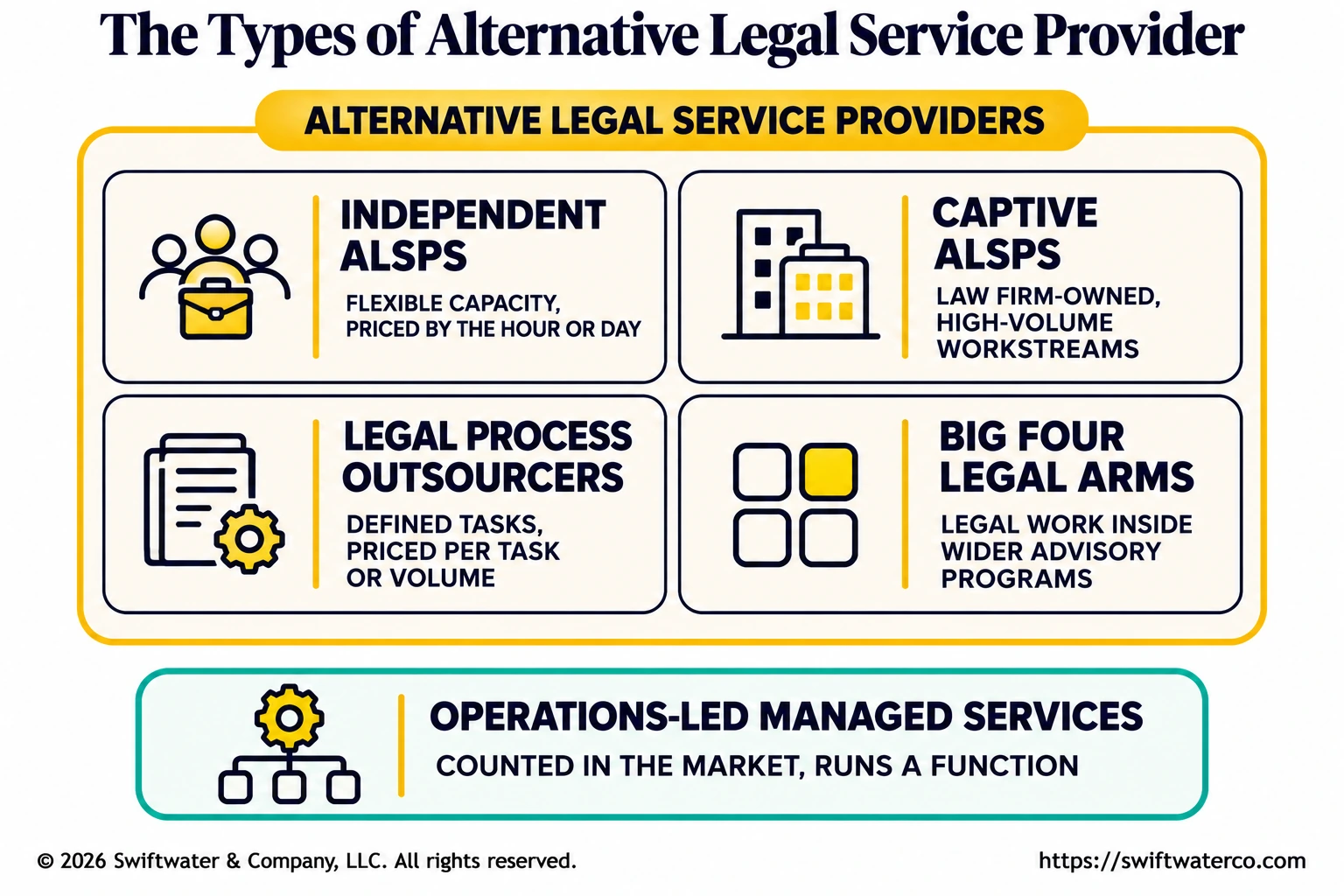
Market reports also count operations-led managed services within the alternative legal services market; that model has its own section below. For a fuller map of the categories, see our guide to legal outsourcing companies, and for the offshore, task-based model, legal process outsourcing.
Which delivery models do ALSPs use?
Within those types, providers present a handful of delivery models. Some place lawyers inside the in-house team. Some take a portfolio of business-as-usual legal work and run it at scale. Some describe themselves as law companies, combining lawyers, consultants and technologists. Others build long-term enterprise partnerships around data and technology, or run work through global delivery centers. Many large providers combine several of these models under one brand.
Need the function run, not just advised on?
Swiftwater embeds senior practitioners directly into legal operations, handling bill review, matter management, and program delivery on your behalf.
See Managed Services- Flexible talent and secondments. Lawyers placed inside the legal department for a set period, supervised by the in-house team and billed by the hour, day, week or month.
- Integrated legal services. The provider runs a portfolio of run-the-company work, the middle band between routine tasks and bet-the-company matters, often in contracting, with its own people, process and technology.
- Law company. Lawyers, consultants and technologists in one business, selling services, software and consulting, sometimes with an affiliated law firm where the rules allow it.
- Enterprise partnerships. Multi-year relationships pairing subject matter expertise with data and technology across litigation, IP, eDiscovery and contracts.
- Global delivery centers. Legal, compliance and administrative work run through onshore and offshore centers, priced by task or volume.
What work do corporate legal departments send to ALSPs?
Corporate legal departments usually send ALSPs work that is repeatable, high in volume or driven by a defined process. The common categories are document review and eDiscovery, contract review at scale, due diligence support, litigation support, legal research, compliance support around regulatory deadlines, and flexible lawyer capacity for surges, secondments and leave cover. The in-house team keeps the judgment calls and the relationship with the business.
Respondents to the Blickstein Group’s 18th Annual Law Department Operations Survey (68 companies) cite flexibility, cost savings, scalability and experience with technology-enabled workflows as their main reasons for engaging ALSPs.
How is an ALSP different from a law firm?
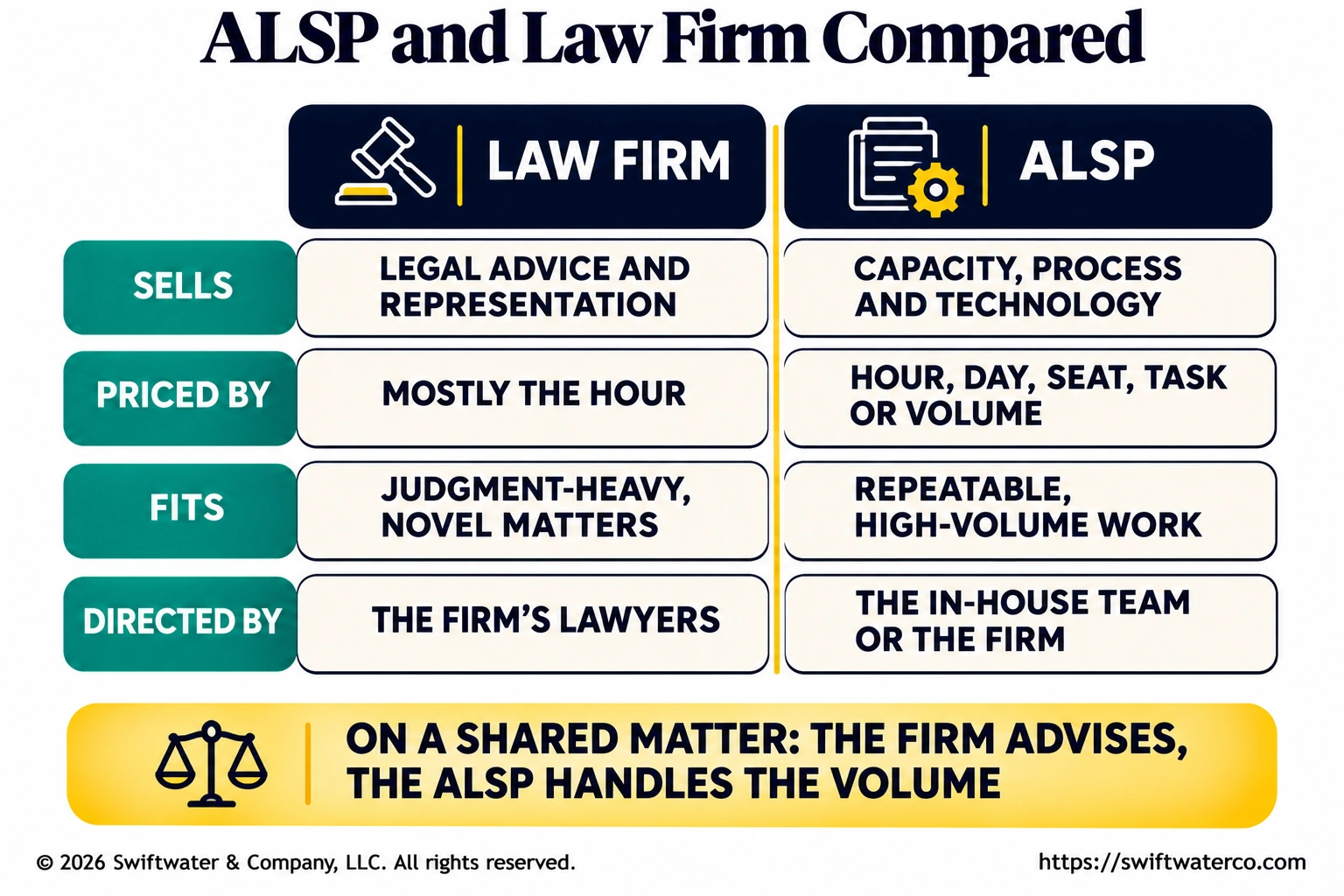
A law firm is a regulated legal practice that sells legal advice and representation, usually billed by the hour. An ALSP sells capacity, process and technology for defined work, priced by the hour, day, seat, task or volume, and it can be independent, owned by a law firm or part of an accounting network. On a shared matter, the law firm carries the legal judgment and the ALSP handles the volume work beneath it.
| Question | Law firm | ALSP |
|---|---|---|
| What does it sell? | Legal advice and representation | Capacity, process and technology for defined work |
| How is it priced? | Hourly rates for the bulk of the work, with some alternative fee arrangements | By the hour, day, seat, task or volume |
| Who owns it? | Its lawyers, under the rules for legal practices | An independent company, a law firm or an accounting network |
| What work fits? | Judgment-heavy, high-stakes and novel matters | Repeatable, high-volume and process-driven work |
| Who directs the work? | The firm’s lawyers, for the client | The in-house team, or the law firm on the matter |
| How is it measured? | Matter outcome and cost against budget | Turnaround, accuracy and cost per unit of work |
For how the law firm side is run, see our guide to outside counsel management.
How is an ALSP different from legal managed services?
An ALSP traditionally provides a resource the legal department would otherwise have procured from a law firm: seconded lawyers, FTEs, seats and capacity on matters. Legal managed services provide a managed program. The provider runs the operations of a function, including the process and the reporting that supports departmental decision making, in addition to the legal resources. Many providers now offer both under the ALSP umbrella, which is why the two are easy to confuse.
The scope of work shows which one you are buying. A resource scope names people, hours and seats. A managed program scope names the function, the service levels and the decisions it supports. Our guide to what legal managed services are has the full comparison. For the functions Swiftwater runs for corporate legal departments, see legal managed services.
What are law companies and alternative business structures?
A law company is a business that combines lawyers with consultants, technologists and outside investors, and in some places it can own a law firm or deliver legal services directly. That depends on regulators allowing nonlawyer ownership. In the United States, Arizona and Utah opened that door, and Washington and Puerto Rico have since adopted their own rules. England and Wales has licensed alternative business structures under the Legal Services Act 2007.
- Arizona. The Arizona Supreme Court eliminated its Rule 5.4 effective January 1, 2021, allowing alternative business structures with nonlawyer owners and managers, each with at least one Arizona-licensed compliance lawyer. The court’s ABS committee reported 114 active licensed ABSs as of December 31, 2024.
- Utah. The Utah Supreme Court’s regulatory sandbox, open since August 2020 and overseen by the Office of Legal Services Innovation, allows approved entities to use nonlawyer ownership and new service models. It is authorized through August 2027.
- Washington. A December 2024 Washington Supreme Court order authorized a timebound entity regulation pilot, run with the Washington State Bar Association, under which approved entities may offer legal services.
- Puerto Rico. Revised conduct rules adopted in 2025 allow nonlawyers to hold up to 49% of a law firm.
- England and Wales. Licensed bodies, known as ABSs, may have nonlawyer owners; the Solicitors Regulation Authority must approve any material interest, generally a holding of 10% or more.
This is an active and changing area. Programs end or are extended, rules are amended, and what a provider may do depends on where it is licensed and where the work is done. It is recommended that readers check the current position with the regulator, do further research and consult their own counsel before relying on any structure.
How are AI-native law firms changing the picture?
AI-native law firms are a newer competitor to both law firms and ALSPs. They are regulated law firms built around AI systems from the start, with lawyers supervising the work and accountable for its output. Because they pair a law firm’s license with an ALSP’s process and technology, they are absorbing parts of both models. The category is young, moving quickly and deserves its own article; here it is one more option to weigh.
Regulators are already approving them. In May 2025 the Solicitors Regulation Authority authorised the first purely AI-based firm to provide regulated legal services in England and Wales, with named solicitors accountable for every output. In the United States, firms describing themselves as AI-native have launched for corporate clients.
How do you evaluate an ALSP?
Start with the work, then judge the provider against it. Define the unit of work, the volume, the quality standard and who will direct the work. Then assess how the provider trains and keeps its people, how it hands work between your team and your law firms, which systems it works in, how it reports, and how its pricing and exit terms are written. A provider that fits one type of work can be a poor fit for another.
Check what the provider is built to do. Many ALSPs have expanded beyond their core remit into pure staffing, IT development, or selling and reselling ELM and other legal software. Buying a service that sits outside a provider’s core competency can lead to delivery problems later, so ask which part of the business the proposed team sits in, how long it has delivered that exact service, and for references for that work.
Our guide on how to evaluate a legal managed services provider includes an evaluation checklist across four dimensions (operational capability, talent model, delivery integration and commercial structure) and six warning signs to check before signing. The same questions apply to an ALSP.
Want the review function run for you?
Every outside counsel invoice checked against your guidelines, rates, and matter context, inside the eBilling platform you already own, with the exception handling, vendor coaching, and savings reporting that separate a review program from invoice processing.
See Bill Review ServicesHow big is the ALSP market?
The Thomson Reuters Institute’s Alternative Legal Services Providers 2025 report estimates the ALSP market at $28.5 billion as of 2023, after 18% compound annual growth from 2021 to 2023. For scale, the US Census Bureau’s Service Annual Survey puts 2022 revenue for US offices of lawyers (employer firms) at about $343 billion. The figures cover different scopes and years, global ALSP revenue against US law firm revenue, so read the comparison as proportion only.
Inside corporate budgets the share is smaller still. The ACC 2026 Law Department Management Benchmarking Report, covering 576 legal departments, found that ALSPs account for 3% of outside spend, against 93% for outside counsel.
Where is the ALSP market heading?
The benchmarks point in two directions at once. Legal departments that already use ALSPs report rising spend and expect more, while ALSP spend remains a small share of the typical outside legal budget and sits mainly with larger companies. Benchmarks are directional: they take work to participate in, and many smaller companies that run on fractional and cost-effective resources lack the time to take part, so ALSP use by smaller companies is probably under-reported.
In the Blickstein Group survey of 68 companies, three quarters of respondents reported using ALSPs, which accounted for an average of 9% of their outside legal spend. Over the past year, 30.4% had increased their ALSP spend and 6.5% had reduced it, and 43.5% expected ALSP spend to rise over the next year.
The ACC report, with a larger base of 576 departments, shows a smaller footprint. The median number of ALSPs engaged has stayed at zero since 2021, which the report reads as more than half of participating departments using none. Among companies with US$5 billion to US$20 billion in revenue the median is one ALSP, and among those with US$20 billion or more it is two.
Bottom Line
An alternative legal service provider is a company other than a traditional law firm that delivers legal or legal support work, usually priced by the hour, day, seat, task or volume. The main types are independent ALSPs, captive ALSPs owned by law firms, legal process outsourcers and the legal arms of the Big Four, each using one or more delivery models, from secondments to integrated legal services.
ALSPs are becoming mainstream and less “alternative”. Law companies, alternative business structures, regulatory sandboxes and AI-native law firms are blurring the line between a law firm and a provider, and many providers now sell managed programs alongside resources. For a legal department, the starting point stays the same. Name the work first and then the right kind of provider options become clear.
Swiftwater runs legal department functions for corporate legal departments as legal managed services, including bill review, vendor management, contract operations, reporting and analytics, and platform administration. The work runs inside your systems, against agreed service levels, in three engagement models (full managed, co-managed or project-based) with no minimum commitment. See legal managed services.
Frequently Asked Questions
What does ALSP stand for?
An alternative legal service provider (ALSP) is a company other than a traditional law firm that delivers legal or legal support services, often with its own process and technology. ALSP stands for alternative legal service provider. The plural, ALSPs, is often used for the market as a whole, which reports also call alternative legal services.
Is an ALSP a law firm?
Usually no. A law firm is a regulated legal practice that gives legal advice and representation, while an ALSP delivers defined legal or legal support work, often alongside a law firm or under the direction of the in-house team. The line is moving: captive ALSPs are owned by law firms, and where nonlawyer ownership is allowed, as in Arizona or England and Wales, a law company can own a law firm.
What are examples of alternative legal service providers?
Examples are best described by type: independent ALSPs built around a bench of lawyers and review teams, captive ALSPs owned by law firms, legal process outsourcers running high-volume tasks offshore, and the legal arms of the Big Four accounting firms. Our guide to legal outsourcing companies compares the categories, with how each prices and where each fits.
What is the best alternative legal service model for in-house teams?
It depends on the need. For surge capacity on lawyer-led work, flexible talent and secondments. For tiered pricing inside an existing firm engagement, a captive ALSP. For high-volume defined tasks where cost leads, a legal process outsourcer. For a portfolio of business-as-usual work, integrated legal services. For the ongoing running of a defined legal function, with the process and reporting included, legal managed services.
Are legal managed services a type of ALSP?
Broad market reports count legal managed services within alternative legal services, and many providers offer both under the ALSP umbrella. The difference is what you buy: an ALSP traditionally provides resources, such as seconded lawyers, FTEs and seats, while legal managed services run the operations of a function, including the process and the reporting that supports decisions. Our guide to what legal managed services are has the full comparison.
Do smaller legal departments use ALSPs?
Less often, on the available benchmarks. In the ACC 2026 Law Department Management Benchmarking Report (576 departments), the median number of ALSPs engaged was zero for companies under US$5 billion in revenue, one for companies with US$5 billion to US$20 billion, and two for companies with US$20 billion or more. Benchmarks are directional: they take work to participate in, and many smaller companies that run on fractional and cost-effective resources lack the time to take part, so their use is probably under-reported.
This article is for general information and education and is not legal advice; consult your own counsel on any contract or compliance question. Figures cited are from the sources named and are presented to show direction, not as targets. If you believe any material on this page should be corrected or removed, contact us through the contact form.