


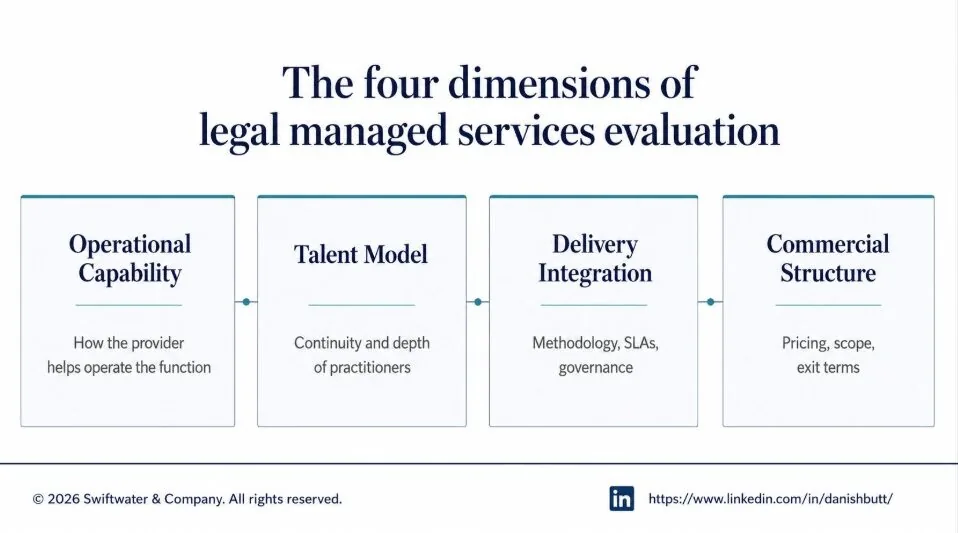
Evaluating a legal managed services provider comes down to four dimensions: operational capability, talent model, delivery integration, and commercial structure. Buyers who score providers across all four make better procurement decisions than those who score on bench size and rate card alone.
Most legal services procurement frameworks were built for hiring law firms. The relevant questions in that template are bench depth, partner track record, conflicts, and rate card. Legal managed services need a different evaluation. The provider is not being hired to deliver lawyer hours. The provider is being hired to help operate a function, and the questions that determine engagement value sit outside the traditional procurement template. This gap (between the procurement template most departments default to and the evaluation that this category of vendor requires) is the consistent reason in-house teams report mismatched managed services engagements after the fact.
The four dimensions below are the ones that separate a managed service that delivers operational outcomes from one that delivers staff augmentation under a managed-service label. The six warning signs that follow are the operational signals general counsel can use to spot a staffing-only model before signing. Together, they give an in-house team a procurement framework that works for this category of vendor, not the law firm category it sits next to.
The four dimensions of evaluation that matter most
| Dimension | What it measures | Why it matters |
|---|---|---|
| Operational capability | Process discipline, platform fluency where relevant, change management methodology | Predicts whether the provider can help operate a function, not just staff one |
| Talent model | Practitioner retention, badging, training, attrition reporting | Predicts continuity of operator and quality of service over time |
| Delivery integration | Transition methodology, SLAs, governance cadence, escalation paths | Predicts how quickly the engagement starts producing value and how it adapts |
| Commercial structure | Pricing model, scope definition, exit terms, IP and data ownership | Predicts whether the commercial alignment supports the operational outcome |
The four dimensions are not independent. A weak talent model undermines operational capability. A weak commercial structure undermines delivery integration. The combined score across all four is what matters.
Operational capability
Operational capability is the practitioner-level discipline a provider brings to operating a defined legal function. It is the layer most often skipped in evaluation because it is harder to assess than headcount or rate card. Three questions get at it.
- How are your practitioners trained for legal operations and legal project management, beyond the credentials they hold for lawyer-led work? A provider that cannot answer this question with specifics (named methodology, training curriculum, certification path) is selling capacity, not operations.
- What is your methodology for change management when transitioning a function from in-house to managed delivery? Operations work touches every workflow in the legal department. A provider without a methodology will either disrupt the in-house team or quietly fail to deliver because the workflows never integrate.
- How do you handle technology operation as part of the service? Many managed service functions sit on top of eBilling, matter management, CLM, or intake platforms. The provider should be able to administer the platform, configure workflow, and report at the platform level. If the answer is “we work alongside your IT team,” the provider is selling lawyer hours next to a platform someone else operates.
Talent model
Talent model is the structural answer to a single question: when the engagement starts producing real value six months in, will the practitioners delivering it still be there? Three signals matter.
Need the function run, not just advised on?
Swiftwater embeds senior practitioners directly into legal operations, handling bill review, matter management, and program delivery on your behalf.
See Managed Services- Retention rate of the practitioners assigned to the engagement. Industry-leading managed services firms track and disclose practitioner retention. Staffing-only models do not, because the practitioners rotate between clients as marketplace utilization shifts.
- Whether the practitioners are badged as part of the firm or pulled from a marketplace for the engagement. Badged operators have firm-paid training, firm-paid benefits, and a career path inside the operations function. Marketplace operators have hourly contracts that end with the statement of work. The difference shows up in quality consistency over time.
- Whether the engagement uses dedicated or shared resources, and how the firm handles attrition. Dedicated resources sit with one client and know the client’s workflows. Shared resources rotate across multiple clients. Both models have legitimate uses, but the distinction must be transparent in the proposal, and the attrition handling must be defined. An undisclosed shared-resource model that does not survive the first attrition event is the most common quality failure in this category.
Delivery integration
Delivery integration is the methodology and machinery for getting from contract signature to a function operating at full capability. Many managed services engagements underperform because the transition was treated as informal handover rather than a structured methodology. Four checkpoints belong in the evaluation.
- Transition methodology and timeline. A credible provider has a named transition methodology with phase gates, knowledge transfer milestones, and acceptance criteria. The timeline should be measured in weeks for narrow scopes and months for broader functions, with explicit deliverables at each phase gate.
- Service level agreements that match the function being delivered. An SLA for a managed bill review service should specify review turnaround, dispute defensibility standards, and savings reporting cadence. Those are the terms Swiftwater’s legal bill review services are scoped against. An SLA for managed intake should specify routing accuracy and cycle time. SLAs that read like generic uptime guarantees do not protect the operational outcome.
- Governance cadence and escalation paths. A managed services engagement needs governance the same way an in-house function does. Weekly operational reviews, monthly stakeholder reviews, quarterly business reviews with the general counsel. Escalation paths to the partner or executive sponsor at the provider firm. Without these, performance issues compound silently until they become contract issues.
- Reporting infrastructure and data ownership. The provider should deliver operational reporting at the cadence the in-house team needs, and the underlying data should remain owned by the client. If the reporting only exists in the provider’s proprietary dashboards and cannot be exported, the in-house team is renting visibility rather than owning it.
Commercial structure
Commercial structure is where the alignment between provider incentives and operational outcomes either holds or breaks. The pricing model alone tells the buyer most of what they need to know about how the engagement will run. Four elements need scrutiny.
- Pricing model. The two structures that align with operational outcomes are fixed fee (a defined scope at a defined price) and outcome-tied (price varies with measurable savings, throughput, or quality metrics). The structure that does not align is pure hourly or pure FTE billing, where the provider’s revenue grows when the function takes longer or requires more bodies. Hourly is appropriate for ALSP staff augmentation. It is not appropriate for managed services.
- Scope definition. A well-defined managed services scope describes the function the provider operates, the inputs the function consumes, the outputs the function produces, and the volume range over which the price holds. A poorly defined scope describes hours, FTE allocations, or seats. The first commits the provider to outcomes. The second commits the buyer to time.
- Exit terms and data portability. Every managed services contract should define what happens if the in-house team brings the function back in-house or moves to a different provider. Knowledge transfer obligations, data return, system access removal, transition support. Engagements without exit terms create switching costs that exceed the cost of switching.
- Intellectual property and methodology ownership. Process documentation, SOPs, playbooks, and operational artifacts produced during the engagement should belong to the client, not the provider. A provider that retains methodology ownership has locked the client into perpetual engagement, regardless of performance.
Six signs that signal a staffing-only model rather than an operations service
Not all legal operations managed services are equal. The presence of these signs (or lack thereof) is a signal to ask more questions. The presence of three or more indicates the need to expand the shortlist before continuing. A general counsel running a managed services procurement should treat any of the following as a signal to ask harder questions or to expand the shortlist.
- Pricing presented only in hours, FTE, or seats. A managed services provider that cannot price by scope or outcome is selling staff augmentation. Both models have a use, but they are different products. The buyer should know which one is on the table.
- A generic “we have lawyers” pitch with no discussion of operations methodology. The pitch should describe how the function is operated, not just who staffs it. If the provider’s deck does not include a transition methodology, an operational framework, or a governance model, the model underneath is staffing.
- No defined transition methodology with phase gates and acceptance criteria. A provider that proposes to “ramp up over the first quarter” without specifying what ramping means is improvising the transition. Improvised transitions are the single largest source of engagement value loss in the first year.
- No retention or attrition reporting. A provider that cannot or will not disclose practitioner retention is signaling that retention is not a metric they manage. The buyer absorbs the cost of attrition through quality fluctuation and re-onboarding cycles.
- Shared resources across multiple clients without disclosure. Shared-resource models can work for some functions, but the buyer needs to know which resources are shared, how attrition is handled, and what happens when peak demand collides across clients. Undisclosed sharing is the most common reason an engagement that looked good in year one degrades in year two.
- No exit clause or unclear data and methodology ownership. A managed services contract without exit terms or with provider-owned process artifacts creates a vendor lock-in that the buyer did not knowingly accept. The right time to negotiate exit terms is before the engagement starts, when the buyer has leverage.
How to structure the procurement conversation
The order of questions in the procurement conversation matters as much as the questions themselves. A well-structured conversation lets the buyer triangulate consistency across the provider’s answers. A poorly structured one lets the provider control the narrative.
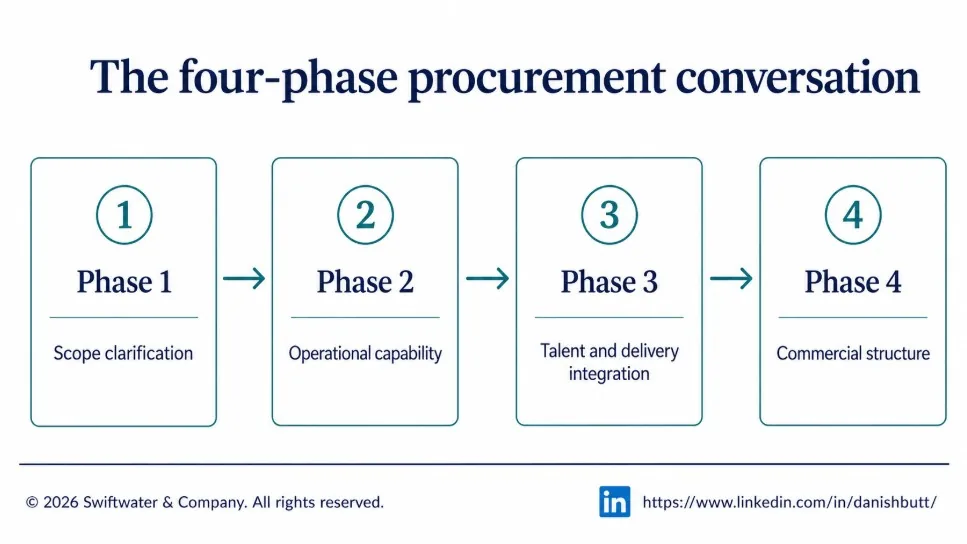
The recommended sequence has four phases.
Phase one is scope clarification. Before any commercial discussion, the buyer and the provider should agree on what function is being operated, what inputs and outputs define the function, and what success looks like. If the conversation moves to pricing before scope is clear, the pricing is meaningless.
Phase two is operational capability. The buyer should ask the operational capability questions in this sequence: methodology, technology operation, change management, then specific reference examples of the function being operated for clients of comparable size and complexity. A provider that cannot produce comparable references should not be on the shortlist.
Phase three is talent and delivery integration. This phase confirms that the operational capability is staffed and delivered by people who will be there over time. The questions on retention, badging, dedicated versus shared resources, transition methodology, and governance belong here.
Phase four is the commercial structure. Pricing, scope, exit terms, IP ownership, and SLAs come last because they are only meaningful once the operational and talent answers are confirmed. A strong commercial structure on top of a weak operational capability is the worst engagement to sign because the contract holds the buyer to a function the provider cannot deliver.
The CLOC 2026 State of the Industry Report shows demand for legal services growing while outside counsel spend grows much more slowly, with 83% of departments expecting demand growth and only 37% expecting outside counsel spend to rise. The gap between demand and traditional spend has to be absorbed somewhere, and the structured outsourcing strategy that fills the gap depends on getting the managed services procurement right at the start.
Where Swiftwater positions itself on these dimensions
Swiftwater’s managed services model is built around the four dimensions above. The legal operations consultancy arm and the managed services arm are deliberately separate inside the firm because the work is different, and most client engagements involve both arms operating in sequence: consulting designs the operating model and the function; managed services helps operate it.
Want the review function run for you?
Every outside counsel invoice checked against your guidelines, rates, and matter context, inside the eBilling platform you already own, with the exception handling, vendor coaching, and savings reporting that separate a review program from invoice processing.
See Bill Review ServicesOn operational capability, the managed services team is staffed with practitioners trained in legal operations and legal project management, not generalists deployed against a statement of work. The firm holds three Onit Level 4 certifications on the senior team, with combined experience operating ELM, eBilling, CLM, and intake platforms across global in-house legal departments.
On talent model, Swiftwater’s practitioners are typically badged employees of the firm, retained as part of long-term operations careers. The firm also maintains a deep roster managed by senior leaders who average more than 20 years in legal operations, allowing Swiftwater to bring in a resource at the right level and with the right experience when an engagement calls for capability beyond the core team. Practitioner retention is tracked and discussed with clients during quarterly governance reviews.
On delivery integration, every managed services engagement begins with a defined transition methodology, phase gates, and acceptance criteria. Governance cadence is established at contract signature: weekly operational reviews, monthly stakeholder reviews, and quarterly business reviews with the general counsel and the executive sponsor at Swiftwater.
On commercial structure, Swiftwater typically prices managed services as fixed fee, fixed FTE, or outcome-tied arrangements anchored to measurable results: sustained cost savings, recovered attorney time, defensible bill review outcomes, maintained governance cadence. Pricing structure is matched to the function and the client’s procurement preferences rather than a single in-house pricing template. Exit terms, data ownership, and IP terms are defined at contract signature.
Swiftwater currently helps operate the legal spend management function for a global company with millions of dollars in annual outside counsel spend. The engagement covers matter setup with financial approvals determined before work begins, review of global tax and payment nuances at intake, first-level invoice review across the full outside counsel portfolio, end-to-end eBilling platform administration, vendor onboarding into the eBilling system, dedicated reporting on demand, and real-time data cleansing as business conditions change. Operating that function with discipline contributes materially to the client’s 20% legal spend savings target, and monthly invoice rejections have dropped by hundreds since the engagement began. Results vary by client based on starting baseline, scope, and engagement maturity.
As Jeannine Puello, who leads Swiftwater’s legal managed services practice after running operations at AT&T and Verizon, puts it: a good procurement conversation in this category leaves the buyer with three things: confidence in how the function will be operated, clarity on who will operate it day after day, and a contract that holds the commercial side accountable to the outcomes the operations side was hired to deliver.
For the broader context of how legal managed services fit alongside ALSPs, BPOs, Big Four legal arms, and consultancies, see what are legal managed services and how the legal outsourcing market is structured for in-house teams.
Bottom Line
A legal managed services evaluation that scores providers on lawyer bench size and rate card alone will buy capacity instead of operations. The four dimensions that predict engagement value are operational capability, talent model, delivery integration, and commercial structure. The six warning signs above signal a staffing-only model wearing managed services language. The four-phase procurement sequence keeps the buyer in control of the conversation and lets the answers triangulate against each other.
Building the legal operations function from scratch?
Assessment, roadmap, and delivery for the operational side of the department: spend, technology, process, vendors, and the data that proves what legal delivers. Advice from operators who ran the function.
See Legal Ops ConsultingScore across all four dimensions, sequence the procurement conversation, and the right partner becomes visible before the commercial terms are on the table.
If your legal department is preparing to evaluate a managed services provider, explore how Swiftwater’s Legal Managed Services practice operates outside counsel management, legal spend, matter intake, contract operations, and eBilling functions for in-house teams through trained operations and legal project management practitioners and outcome-tied engagement structures.
Frequently Asked Questions
What key factors should I consider when evaluating a legal managed services provider?
Legal departments should evaluate providers across four dimensions: operational capability (including methodology, technology operation, and change management), talent model (practitioner retention, badging, and dedicated versus shared resources), delivery integration (transition methodology, SLAs, governance cadence, escalation), and commercial structure (pricing, scope, exit terms, and data/IP ownership). Strong scoring across all four predicts engagement value.
What are the key differences between a staffing company and a legal operations managed services company?
A company that leads with staffing services may base pricing only on hours, FTE, or seats; items such as operational methodology, a transition framework with phase gates, retention transparency, shared resources, and exit or data/methodology ownership may not be the focus of the proposal. If you are looking for a legal operations managed services team, a lack of these may mean you need to expand your provider selection criteria.
How is evaluating a legal managed services provider different from evaluating a law firm?
Law firms are evaluated based on legal expertise, partner track record, conflicts, and bench strength. Managed services providers are evaluated on operational capability, talent retention, delivery integration, governance, and measurable outcomes. The focus shifts from buying hours to buying the operational outcome of a legal function.
What pricing models are typical for legal managed services providers?
Managed services providers commonly use fixed fees for a defined scope, fixed FTE for ongoing capacity, or outcome-based pricing that varies with measurable savings, throughput, or quality metrics. Pure hourly or per-seat models indicate staff augmentation, not managed services.
How should the procurement conversation be structured?
Procurement should follow four phases: 1) scope clarification, 2) operational capability assessment (including methodology, technology operation, and change management), 3) talent model and delivery integration review, and 4) commercial structure evaluation (pricing, scope, exit terms, and IP/data ownership). Sequencing ensures triangulation and prevents providers from controlling the narrative.
What should a managed services contract include beyond price and scope?
A strong contract should include SLAs tailored to the function being operated, governance cadence (weekly operational reviews, monthly stakeholder reviews, quarterly business reviews), reporting obligations, transition methodology with phase gates, exit terms with knowledge transfer, and IP/data ownership protections.
Disclaimer: This article is provided for educational and informational purposes only. Neither Swiftwater and Company nor the author provides legal advice. External links are included for reference only and reflect the views of their respective authors. Swiftwater and Company takes no responsibility for third-party content.