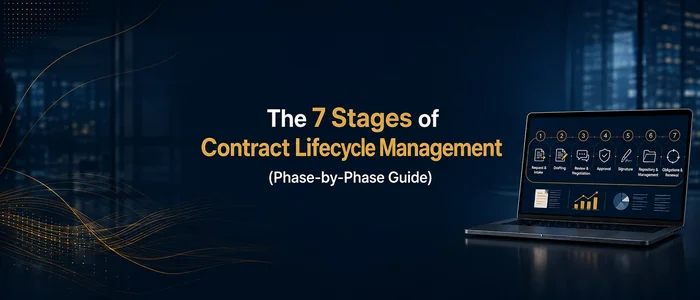

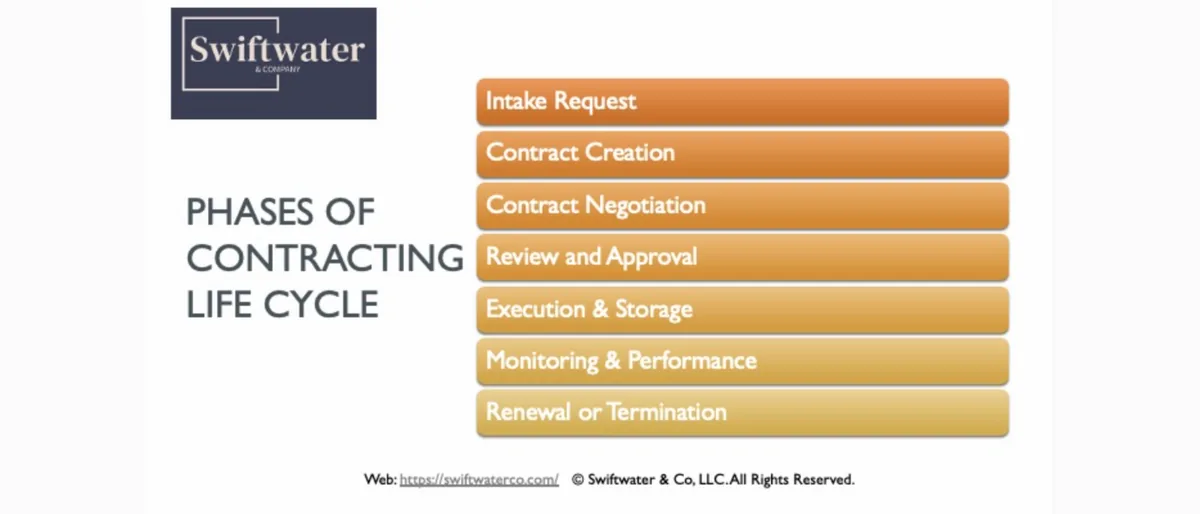
Contract lifecycle management has seven stages: intake request, contract creation, negotiation, review and approval, execution and storage, monitoring and performance, and renewal or termination. Each stage has its own owners, its own failure modes, and its own best practices. Organizations that manage the stages well protect real money: WorldCC’s Contract Management Performance Study puts the average contract value lost to poor contract management at 8.6 percent, and more than 20 percent for underperformers. The same study cites, 78 percent of organizations having invested in CLM over the past five years, the differentiator is no longer whether you have a system. It is whether each stage of the lifecycle is actually designed, owned, and measured.
This guide walks through all seven stages: what happens in each, who owns it, and what separates a stage that works from one that quietly leaks value.
Key takeaways
- The contract lifecycle runs through seven stages: intake, creation, negotiation, review and approval, execution and storage, monitoring, and renewal or termination.
- Every stage has a distinct owner and a distinct failure mode. Most CLM problems trace back to one specific stage, not to the platform.
- Stage discipline, not software, determines whether a CLM program delivers. Technology amplifies a well-designed stage and automates the chaos of a poorly designed one.
What is contract lifecycle management?
Contract lifecycle management (CLM) is the end-to-end process of managing a contract from the moment a business need is identified through to expiry, renewal, or termination. This guide focuses on the stages inside that process; for the full program view, including implementation and platform considerations, start at the CLM hub.
What are the 7 stages of contract lifecycle management?
The seven stages below apply whether contracts are managed in a dedicated CLM platform, an enterprise system, or a spreadsheet. The terms “stages” and “phases” are used interchangeably across the industry.
Stage 1: Contract Intake Request
Contract intake is the stage where a business need becomes a contract request. It is the front door of the lifecycle, and it sets the quality of everything downstream. WorldCC research indicates that roughly a quarter of enterprise employees touch the contracting process in some form, which means intake cannot depend on people knowing the right person to email.
Evaluating or implementing a CLM platform?
We have guided legal departments through selection, implementation, and adoption, without the vendor bias. Let us talk about where you are and what you actually need.
See CLM ServicesA working intake stage has three properties. First, a standardized intake form that captures the necessary information upfront: counterparty, contract type, value, timing, and risk flags. Second, defined routing: self-service for low-risk, high-volume requests, and triage into legal, procurement, or sales operations for everything else. Third, visibility, so requesters can see status without chasing. Automated tools such as legal service request portals handle all three properties at volume.
The failure mode at this stage: requests arriving by email with half the information, then bouncing between teams while the business waits.
Stage 2: Contract Creation
Contract creation is the stage where the first draft is produced, ideally from pre-approved templates rather than from scratch. Standardized templates, supported by clause libraries and contract playbooks that define approved language, fallback positions, and escalation rules, make drafting fast and consistent while keeping risk inside agreed boundaries.
Two practices keep this stage healthy. Refresh the template and clause library on a defined cadence so they reflect current law and current business terms, and train the people who use them so self-service drafting does not drift into freelancing. A template that nobody updates, or that nobody trusts, sends every draft back into legal’s queue and defeats the purpose of the stage.
The failure mode: ten versions of the “standard” NDA circulating in ten shared drives.
Stage 3: Contract Negotiation
Negotiation is the stage where internal stakeholders and the counterparty converge on final terms. Input typically comes from finance, insurance, and compliance internally, and from the counterparty and outside counsel externally, usually through rounds of redlined drafts exchanged until the language settles.
Three things consistently separate strong negotiation stages from weak ones: clear communication channels agreed at the start, a collaborative rather than positional mindset on the terms that matter less, and technology that keeps versions, comments, and approvals in one place instead of scattered across inboxes. AI contract review has moved this stage furthest in recent years: Gartner predicts that by 2029, roughly half of contract reviews will be delegated to self-service systems that escalate only one in ten contracts for human review, and first-pass review of standard paper is already a routine AI use case.

The failure mode: negotiation-by-attachment, where nobody can say which version is current or who approved the fallback.
Stage 4: Review and Approval
Review and approval is the stage where the negotiated contract is formally checked and signed off internally. Enterprise contracts typically route through several functions: legal for terms and risk, finance for commercial exposure, compliance for regulatory fit, and, depending on the contract, HR, insurance, facilities, or customer service.
The best practices here are structural. Define the review path by contract type and value, so a routine renewal does not travel the same road as a nine-figure master agreement. Assign named roles in the approval chain so accountability is unambiguous. Automate the workflow: reminders, escalations for stalled approvals, and a visible audit trail of who approved what and when. Review discipline built in earlier stages pays off here; contracts drafted from approved templates with pre-negotiated fallbacks clear review in a fraction of the time.
The failure mode: the contract that sat for eleven days because one approver was on vacation and nothing escalated.
Stage 5: Execution and Storage
Execution is the stage where authorized signatories formally bind the organization, and storage is where the signed contract becomes a managed asset rather than a lost file. A delegation of authority (DOA) process should govern who may sign what; integrating the CLM with the system where DOA and staffing hierarchies live routes contracts to the right signatory automatically.
Most execution now runs through e-signature integrations such as DocuSign and Adobe Sign, though certain jurisdictions and document types still require a wet signature, so the stage has to handle both. After signature, contracts belong in a centralized repository with a data model that reflects how the business actually retrieves them: by counterparty, by obligation, by renewal date. In practice this is where many programs stumble; repositories get over-engineered or under-engineered, and AI-based extraction is increasingly used to recover structured data from legacy agreements. Access controls and encryption are non-negotiable, since the repository concentrates the organization’s most sensitive commercial terms.
Evaluating legal technology but not sure where to start?
We help legal departments cut through the vendor noise, mapping technology to process maturity and building a roadmap that actually gets adopted.
See Legal TechnologyThe failure mode: an executed contract that exists only as a PDF attached to an email thread.
Stage 6: Monitoring and Performance
Monitoring is the stage where the organization tracks whether both parties are doing what the contract says. Obligations, milestones, service levels, and compliance requirements all need owners and dates, with automated alerts well before deadlines rather than after them.
Strong monitoring stages run periodic contract audits, track performance metrics that reveal trends before they become disputes, and fold contract risk into broader risk assessment frameworks, including cyber and vendor risk. This is also the stage that produces the data leadership actually wants: which counterparties underperform, where value leaks, and which terms keep causing friction.
The failure mode: obligations that nobody tracked until the penalty clause did it for them.
Stage 7: Renewal or Termination
Renewal or termination is the stage where the organization decides, deliberately, whether a contract continues. The operative word is deliberately: auto-renewals that nobody reviewed are among the most common and most avoidable sources of contract value leakage.
Best practice is to program reminders weeks or months ahead of renewal windows, then use the runway for a structured look at existing terms, counterparty performance from Stage 6, and future need. Long-term relationships governed by a master service agreement deserve particular attention, since MSA renewals are the natural moment to renegotiate pricing and terms accumulated across years of amendments. Organizations with well-run lifecycles see compounding returns at this stage; A Forrester Consulting Total Economic Impact study commissioned by LinkSquares modeled a 30% reduction in sales-contract processing time and 40–50% productivity improvements for ancillary and complex contracts by Year 3.
The failure mode: discovering the renewal after it happened.
Where do best practices fit across the stages?
Beyond stage-level discipline, a set of overarching practices applies across the whole lifecycle: process standardization, technology and automation choices, cross-functional collaboration, record hygiene, and periodic contract reviews. Those are covered in depth, with 2026-specific guidance, in 10 Contract Lifecycle Management Best Practices for 2026.
What are the common challenges across the stages?
Here are common challenges (and causes for heartburn) related to contract management in organizations:
Standardization. Departments running their own templates, processes, and storage magnify errors at every stage.
Visibility. When stage handoffs happen in email, nobody can see where a contract is, and deadlines surface only when missed. Well-designed stages have checkpoints and status visible to every stakeholder.
Resources. Understaffed teams tend to skip the monitoring and renewal stages first, which is precisely where leakage concentrates. Lean programs should protect Stages 6 and 7 before adding sophistication elsewhere.
Resistance to change. New stage disciplines change how people request, draft, and approve contracts, and adoption fails without deliberate change management. See Is Your Team Ready for CLM? Readiness and Change Management for a readiness self-check before rolling out stage changes.
Bottom line
The seven stages are as useful as a diagnostic as they are a process. Walk any contract through intake, creation, negotiation, approval, execution, monitoring, and renewal, and the stage where work slows down or value leaks announces itself quickly. That is good news, because stage problems respond to focused fixes: a sharper intake form, a refreshed clause library, a defined approval path, a renewal calendar with a named owner.
The approximately 9 percent of contract value that the average organization loses each year is simply the accumulated cost of leaving those small gaps unattended. The organizations that get the most from contract lifecycle management treat every stage as a designed system, with an owner, a measure, and a failure mode someone is watching for.
Not ready to pick a CLM platform yet?
A four to six week diagnostic that maps your current contract lifecycle, sets requirements themes, and tells you what to buy before you sit through another vendor demo.
See the CLM Discovery SprintIf you suspect one of your seven stages is leaking value, Swiftwater’s contract management practice begins with a process and readiness assessment that maps your lifecycle stage by stage and shows where the recovery is.
Frequently asked questions
What are the 7 stages of contract lifecycle management?
The seven stages are: intake request, contract creation, negotiation, review and approval, execution and storage, monitoring and performance, and renewal or termination. The first five stages cover a contract from request to signature; the last two govern the contract after execution, where obligations are tracked and renewal decisions are made. Some frameworks compress these into five or six stages by combining creation with negotiation or execution with storage, but the underlying activities are the same, and each needs a defined owner.
What happens during the contract intake stage?
Intake converts a business need into a structured contract request. A standardized form captures counterparty, contract type, value, timing, and risk flags; routing rules then send low-risk, high-volume requests down a self-service path and everything else to the right team for triage. Done well, intake gives requesters visibility into status and gives legal a clean queue instead of a scattered inbox. Because a large share of enterprise employees touch contracting at some point, intake design matters more than any other single stage decision.
Which stage of the contract lifecycle causes the most delays?
Review and approval is the most common bottleneck, because it involves the most people with the least structure: legal, finance, compliance, and other functions all touching the same document, often without defined paths or escalation rules. The fix is structural rather than heroic: route by contract type and value, name the approvers, automate reminders and escalations, and push standardization upstream so contracts arrive at review already inside approved boundaries. Negotiation is the second most common source of delay, usually from version chaos.
Who owns each stage of the contract lifecycle?
Ownership is distributed, which is why it has to be explicit. Business teams typically own intake requests; legal owns templates, creation standards, and legal review; the negotiating business unit owns commercial terms with legal support; finance and compliance own their approval gates; signatories are governed by a designation of authority; and contract managers or legal operations own monitoring and renewal tracking. The programs that struggle are usually the ones where post-execution stages have no named owner at all.
How long does each contract lifecycle stage take?
It varies by contract type and organization, but the pattern is consistent: intake and creation should take hours to days when templates are healthy, negotiation and approval take days to weeks depending on complexity, and monitoring spans the contract’s whole term. Industry research associates well-implemented CLM programs with 30 to 50 percent reductions in overall cycle time, and most of that gain comes from three places: template-driven creation, structured approval routing, and renewal windows managed ahead of deadlines rather than after them.
What is the difference between contract lifecycle stages and the CLM process?
The stages are the seven phases a single contract moves through from request to renewal or termination. The CLM process, or program, is the organization-wide system that manages every contract across those stages: the policies, owners, templates, technology, and metrics that make the stages repeatable at scale. In short, stages describe the journey of one contract; CLM describes how the organization runs thousands of those journeys consistently. For the program-level view, see the contract lifecycle management hub.
This article is provided for informational purposes only and does not constitute legal, financial, or technology advice. Consult qualified professionals for guidance specific to your situation.