

A managed legal operations team runs the recurring operational functions of a corporate legal department, such as invoice review, enterprise legal management (ELM) administration, vendor coordination, reporting, and workflow management, under an operating model the department owns. The legal department keeps the decisions: priorities, policy, budget, and outside counsel relationships. The managed team carries the daily execution and is accountable for it.
Demand on legal departments keeps rising while budgets stay tight. The CLOC 2026 State of the Industry Report found that 83% of departments expect demand for legal services to grow and only 37% expect outside counsel spend to rise. The ACC 2025 Chief Legal Officers Survey found that 41% of legal departments are under active cost-cutting mandates. That work has to be absorbed inside the department, usually without new headcount. This guide covers what a managed legal operations team does, how it differs from staffing and consulting, the operating model behind it, the cost case, and a worked example.
What functions does a managed legal operations team cover?
A managed legal operations team covers the recurring functions that keep a legal department running, and in a mature engagement that means six of them. In the engagement described later in this article, the work began as strategic advisory and grew into all six:
- Legal operations strategy and organizational design. The operating model, decision rights, governance, and roadmap, kept current through every reorganization.
- Program and workflow management. Initiative tracking, escalations with one owner, law firm and vendor support, and coordination with Finance, Procurement, Accounts Payable, and IT.
- Matter administration and invoice review. Every step from matter setup to invoice payment and reconciliation: billing guideline compliance, rejection and resubmission, and substantive review of complex invoices.
- ELM implementation and administration. Users, workflows, approval structures, reporting, and data integrity on the department’s platform.
- Specialized programs such as investigations. One global framework for intake, triage, and reporting, built into the department’s systems.
- Systems integration. Connections between the ELM platform and finance, procurement, accounts payable, and HR systems, so vendor, cost center, and invoice data moves without manual workarounds.
A department can start with one function, such as bill review or platform administration, and add others as the model proves itself.
How is managed legal operations different from legal staffing?
Managed legal operations differs from legal staffing in three ways: how experience is matched to the work, who is accountable for results, and what happens when people change. Swiftwater also provides fractional staffing, so this is a practical comparison.
- Experience matched to the work. A staffing placement is one person at one experience level, doing every task in the role. A managed team assigns each task to the experience level it needs. Senior people spend their time on senior work, and routine work costs less. Each person also brings the provider’s frameworks and has the broader team behind them.
- Accountability for results. A managed team owns service levels, reporting, and the results of the function. The department sees what is happening through agreed reporting and governance.
- Continuity. Knowledge of the platform configuration, approval structures, firm relationships, and past decisions stays with the function when individuals change.
For a fuller comparison with ALSPs, legal BPOs, and staffing models, see What are legal managed services?
How is managed legal operations different from legal operations consulting?
Legal operations consulting is project work with a defined end, and managed legal operations is recurring work that continues every week. A consulting engagement assesses the current state, designs the operating model, selects technology, and hands over a roadmap. A managed team runs that model: it reviews the invoices, administers the platform, chases the escalations, and produces the reports.
Need the function run, not just advised on?
Swiftwater embeds senior practitioners directly into legal operations, handling bill review, matter management, and program delivery on your behalf.
See Managed ServicesMany departments use both. Legal operations consulting designs the model, and a managed team operates it. The wider market for outside operational help is large: the Thomson Reuters Institute’s Alternative Legal Services Providers 2025 report places alternative legal services at $28.5 billion globally, with 57% of corporate law departments using ALSPs in some form.
What does the operating model look like?
A managed legal operations team works inside an operating model with five layers: strategic, operational, technology, control, and global coordination. Swiftwater calls this the Legal Operations Infrastructure Model.
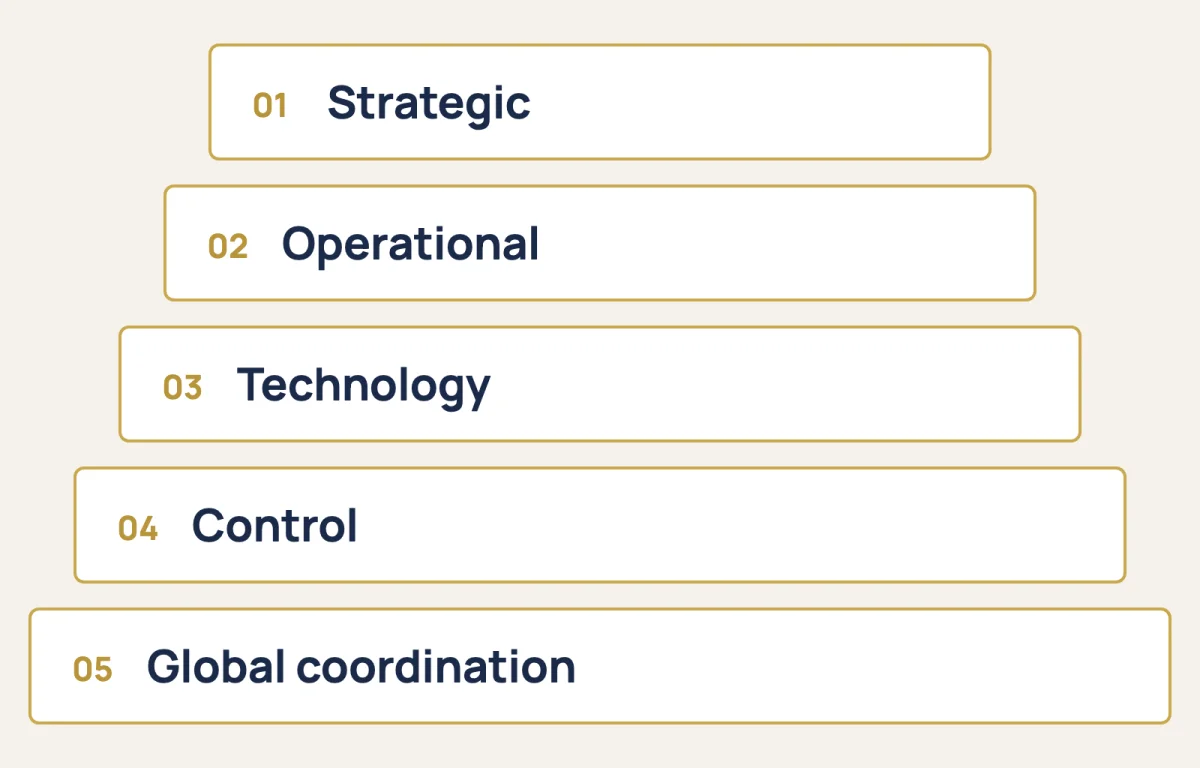
| Layer | What it covers |
|---|---|
| Strategic | Strategy, organizational development, governance, roadmap, operating model, executive advisory |
| Operational | Invoice lifecycle, vendor coordination, workflow, issue resolution, reporting, managed services |
| Technology | ELM administration, workflow configuration, platform governance, integration, middleware |
| Control | Billing governance, process standards, approval controls, data integrity, reporting continuity |
| Global coordination | Regional alignment, global standards with local variation, law firm coordination, cross-time-zone delivery |
The department owns the model. Legal leadership sets policy and decision rights at the strategic layer, and the managed team runs the other four layers under governance the department can see. The model is described in full in the American-Asian global technology company case study.
What does managed legal operations cost compared with hiring?
The cost of managed legal operations compared with hiring comes down to the headcount it avoids: one managed team delivers capability that would otherwise take several permanent hires, and the department pays for the experience level each task needs. A fair comparison counts the full cost of the hires the department would otherwise make:
- Salaries and benefits at each experience level the work needs, from administrator to senior operations leader
- Recruiting time, onboarding, and the months before a new hire is productive
- Coverage for leave, turnover, and time zones
- The management time to supervise and develop the team
Then add the value the function produces. Bill review is usually the clearest example, because savings from enforcing billing guidelines show up on outside counsel invoices. The Legal Tech Calculator models the cost justification for this kind of program.
When does a managed legal operations model make sense?
A managed legal operations model makes sense when the department needs operational capability faster than it can hire, or across more regions and time zones than a small internal team can cover. It fits well for:
- Departments that need legal operations capability now and cannot hire fast enough
- Global departments that need cross-time-zone coverage
- Departments whose ELM or eBilling platform is live but under-administered or under-enforced
- Departments that reorganize often and keep losing operational knowledge with each change
- General Counsel who want the right level of experience at the right cost, backed by a team and a method
A department with a stable, fully staffed operations team that needs a one-time redesign is usually better served by a consulting project.
What did a managed legal operations team do for a global technology company?
For an American-Asian global technology company, Swiftwater’s managed legal operations team ran six recurring functions across North America, Europe, and Asia-Pacific, and the engagement produced $60M in outside counsel savings. The legal department managed thousands of active matters and hundreds of outside counsel firms, billed in multiple currencies and tax regimes, and ran on an aging eBilling system. Ownership of legal operations overlapped across Legal, Procurement, Finance, Accounts Payable, and IT, and the company operated from two headquarters.
Within the wider engagement, a dedicated seven-person matter administration and invoice review (MAIR) team ran bill review from matter setup to invoice payment and reconciliation, and its operating procedure grew from one page to forty as the program matured. Alongside the MAIR team, Swiftwater migrated the department from its aging eBilling system to Onit across four continents and then administered the platform. Swiftwater also deployed a global investigations playbook through a proprietary tool built within Onit, and connected Onit to finance, procurement, accounts payable, and HR systems through proprietary middleware.
The department gained enterprise-scale capability without equivalent growth in permanent headcount, and the model held through changes in legal operations leadership. Read the full case study.
Bottom Line
A managed legal operations team takes the recurring work of a legal department, from invoices to platforms to reporting, and runs it to a standard under an operating model the department owns. It differs from staffing in accountability and continuity, and from consulting in that the work continues every week.
The departments that benefit most are the ones that need capability faster than they can hire, across more regions than they can staff. The test of a managed legal operations team is whether the function runs the same way after the next reorganization as it does today.
Swiftwater runs legal operations for corporate legal departments as one accountable team, from bill review and ELM administration to reporting and integration, and our managed legal operations services start with the functions your team cannot staff today.
Want the review function run for you?
Every outside counsel invoice checked against your guidelines, rates, and matter context, inside the eBilling platform you already own, with the exception handling, vendor coaching, and savings reporting that separate a review program from invoice processing.
See Bill Review ServicesFrequently Asked Questions
Does a managed legal operations team replace the in-house legal operations team?
A managed legal operations team works alongside the in-house team, which keeps ownership of priorities, policy, budget, and outside counsel relationships. Departments choose how much to hand over: a fully managed function, a co-managed model with shared responsibilities, or a defined project. In a co-managed model, the in-house team often keeps vendor strategy and stakeholder management while the managed team runs invoice review, platform administration, and reporting. The split can change over time as the department hires, reorganizes, or adds functions to the engagement.
Can a managed legal operations team work on our existing ELM or eBilling platform?
A managed legal operations team works inside the platform the department already runs, such as Onit, Legal Tracker, or another ELM or eBilling system. The team administers users, workflows, approval structures, and reporting on that platform, and it enforces billing guidelines through the platform’s own rules. Where the platform needs to change, the same team can migrate or extend it. In the case study above, Swiftwater administered Onit after migrating the department to it from an aging eBilling system across four continents.
What should we look for in a managed legal operations provider?
A managed legal operations provider is best judged on four things: operational capability, the talent model, how the provider integrates with your team, and the commercial structure. Operational capability covers methodology, platform experience, and change management. The talent model covers retention and whether people are dedicated or shared. Integration covers transition, service levels, governance, and escalation. The commercial structure covers pricing, scope, exit terms, and data ownership. Our guide on how to evaluate a legal managed services provider covers each one.
Is managed legal operations the same as legal process outsourcing?
Managed legal operations and legal process outsourcing cover different work. Legal process outsourcing usually delivers high-volume legal work, such as document review, at a lower cost per unit. Managed legal operations runs the operational functions of the department: bill review, platform administration, reporting, vendor coordination, and workflow. The two can sit side by side in the same department. A managed legal operations team can also coordinate outsourcing providers as part of vendor management, so their work is tracked, billed, and reported consistently.