

Legal process outsourcing (LPO) is the transfer of defined legal support work, such as document review, contract processing or research, to an outside provider that performs it at volume. The provider runs the work to the client’s written rules, and the legal department keeps every decision that needs a lawyer. This guide covers the work usually sent out, how an engagement runs, how LPO compares with an ALSP and with managed services, and when another model fits better.
What is legal process outsourcing?
Legal process outsourcing is the practice of sending defined, repeatable legal support tasks to an outside provider that performs them at volume under the client’s instructions. LPO is the acronym. The work is usually priced per task or per volume and is often delivered from lower-cost locations. The client sets the rules, approves the quality thresholds and keeps every decision that calls for legal judgment. The provider supplies the people, the process and the throughput.
Demand follows the pressure on legal budgets. The CLOC 2026 State of the Industry Report found regulatory compliance (63%) and cybersecurity (58%) driving workload increases across the 135 law departments surveyed, while only 37% expect outside counsel spend to increase, down from 58% a year earlier. More work against flatter outside spend has to go somewhere. The population is small, so read the figures as directional.
What work is sent to an LPO provider?
The work sent to an LPO provider is high in volume, governed by written rules and checkable against a standard. Typical examples are first-pass document review, contract processing and metadata extraction, legal research and summaries, due diligence triage, invoice processing and data work in legal systems. Each task can be described in instructions, sampled for quality and counted, which is what lets a provider price it per unit and run it at scale.
- Document review: first-pass review for litigation or investigations, coded to the client’s review protocol.
- Contract processing: abstraction, metadata extraction and first review of standard agreements against the department’s playbook.
- Legal research and summaries: research notes and case summaries prepared for a lawyer to review.
- Due diligence triage: sorting and flagging documents in a data room against a checklist.
- Invoice processing: checking law firm invoices against billing guidelines and agreed rates.
- Data and records work: matter records, entity data and contract repository clean-up.
For the options specific to contract work, see our guide to contract management outsourcing.
How does legal process outsourcing work?
An LPO engagement runs in five steps: scope, rules, delivery, quality check and reporting. The department defines the work and the volumes, writes the rules the provider will follow and hands the work over through an agreed channel. The provider performs the tasks, checks a sample against the agreed quality threshold and escalates anything outside the rules. Reports on volume, turnaround and error rates go back to the department on a set schedule.
- Scope. Which tasks, what volumes, what turnaround, and which decisions stay with the department.
- Rules. Written instructions, review protocols and escalation triggers, approved by the department before work starts.
- Delivery. The provider’s team performs the work through an agreed handover and controlled access.
- Quality check. Sampling against an agreed error threshold, with exceptions sent to a named reviewer.
- Reporting. Volume, turnaround, error rates and open escalations, reviewed by the department’s owner on a calendar.
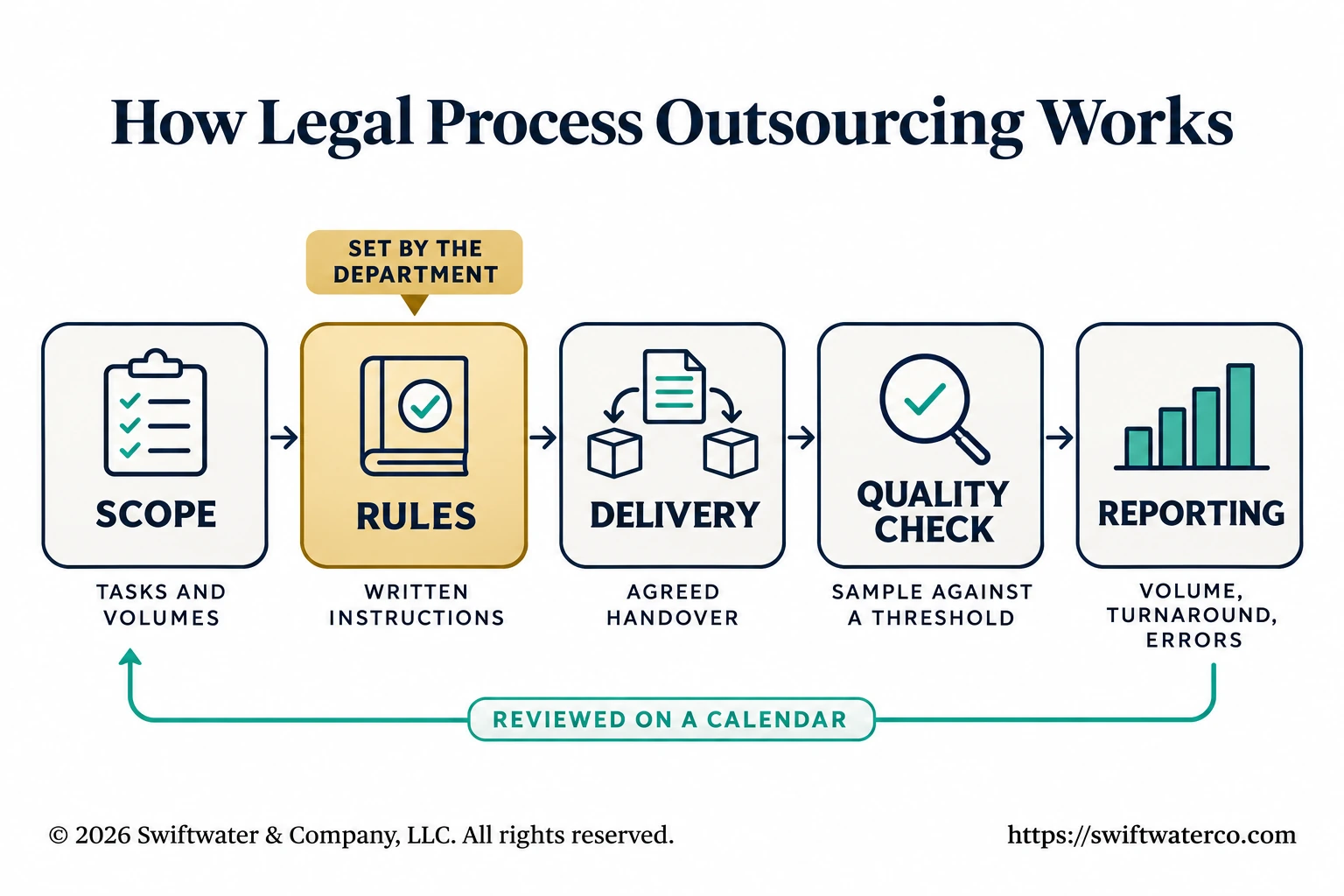
The rules step decides whether the rest works. A provider can only be as consistent as the instructions it receives, and work handed over without them tends to come back uneven. Before a pilot, it is recommended that the department write down the process as it runs today, including the exceptions its own team handles from memory.
Need the function run, not just advised on?
Swiftwater embeds senior practitioners directly into legal operations, handling bill review, matter management, and program delivery on your behalf.
See Managed ServicesWhat is the difference between LPO, an ALSP and managed services?
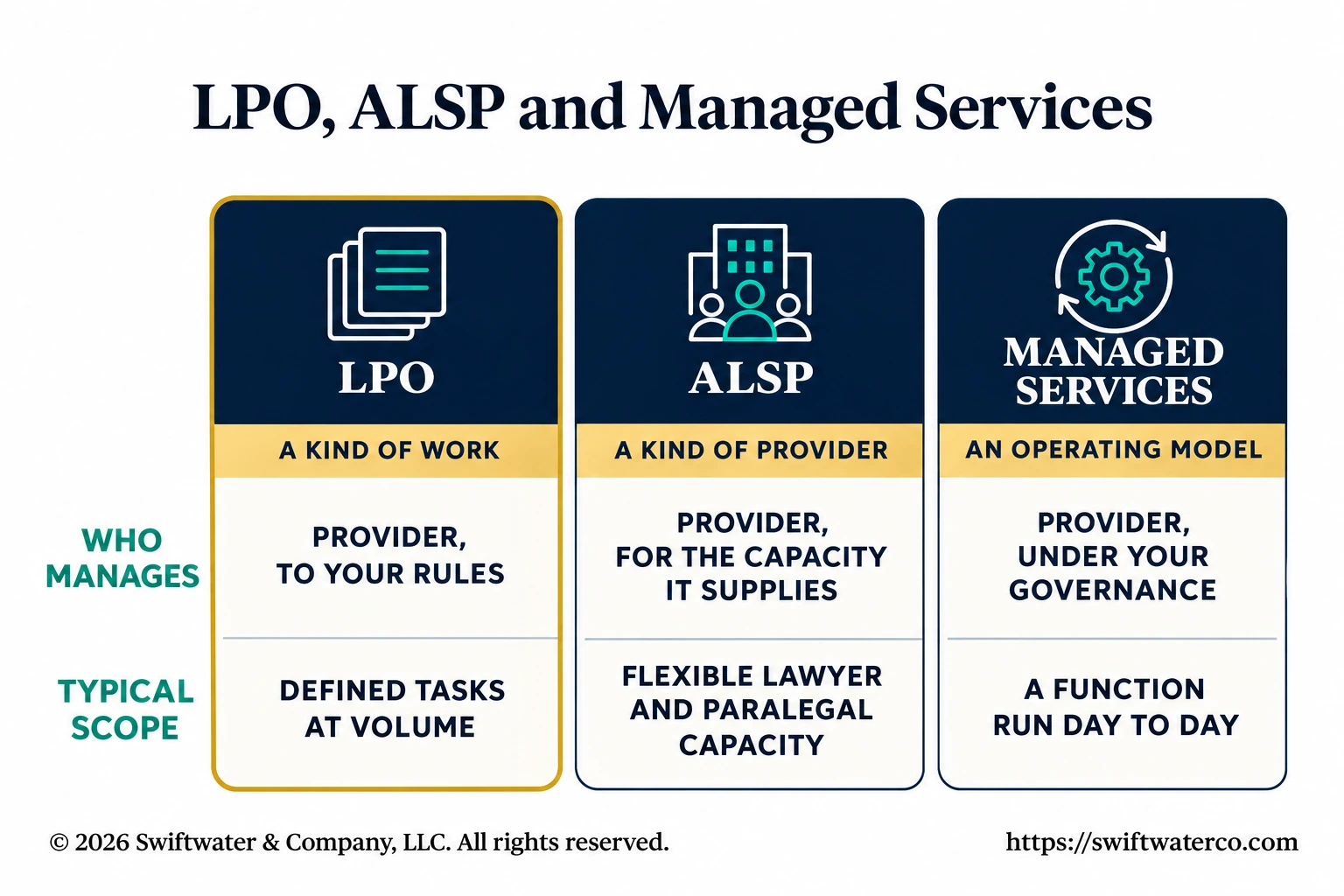
LPO describes a kind of work: defined tasks performed at volume. An ALSP is a kind of provider: a company other than a traditional law firm that delivers legal or legal support services, and many ALSPs offer LPO among other services. Legal managed services describes an operating model: a provider runs a defined legal department function on an ongoing basis, under the client’s governance and against agreed service levels.
| Model | Who manages the work | Typical scope |
|---|---|---|
| Legal process outsourcing (LPO) | The provider manages its team against the client’s written rules; the client owns the rules and the legal decisions | Defined, high-volume tasks priced per task or per volume: document review, contract processing, research |
| Alternative legal service provider (ALSP) | The provider manages the capacity it supplies; the client directs the matter and the legal judgment | Flexible lawyer and paralegal capacity, legal support services and LPO-type work |
| Legal managed services | The provider runs the function day to day under the client’s governance and agreed service levels | Ongoing operation of a defined function, such as bill review, contract operations or vendor management |
Spend on alternative providers is still a small share of the external budget. The ACC 2026 Law Department Management Benchmarking Report, which covers 576 legal departments in 45 countries, puts ALSPs at 3% of external spend. The same report found that 42% of departments use contract or temporary staff. Treat both figures as directional.
For the provider side in full, see our guide to alternative legal service providers. For how managed services compare with ALSPs, BPOs and consulting, see what are legal managed services.
Which legal process outsourcing companies serve in-house teams?
Legal process outsourcing companies that serve in-house teams fall into five categories. Legal BPOs run process-defined tasks at volume, typically from offshore centers. Independent ALSPs offer LPO alongside flexible lawyer and paralegal capacity. Captive ALSPs owned by law firms take high-volume workstreams inside a firm engagement. Big Four legal arms include managed delivery within wider advisory programs. Operations-led managed services run whole functions, which can include LPO-type tasks.
The category that fits depends on the unit of work: tasks with clear rules point to a legal BPO or an ALSP, and a function that needs an owner points to a managed service. Our guide to legal outsourcing companies maps each category and how it prices. The Thomson Reuters Institute’s Alternative Legal Services Providers 2025 report describes a market in which forward-looking law firms and corporate legal departments are expanding their use of outsourced delivery, while traditional buyers stay with law firm-only delivery.
What are the risks and how are they governed?
The main operational risks in LPO are uneven quality, data security and confidentiality, loss of process knowledge inside the department, scope creep into work that needs judgment, and weak visibility into what the provider is doing. Each is governed through the engagement itself: written rules, quality sampling against agreed thresholds, access controls and data handling terms, a named owner on each side, escalation paths and regular reports reviewed on a calendar.
Governance is operational work. Someone in the department owns the rules, reads the reports, approves changes to scope and decides what happens when a threshold is missed. Without that owner, the department loses sight of how well the work runs. Contract terms, privilege and regulatory questions belong with the department’s own counsel.
When is LPO the wrong model?
LPO is the wrong model when the work needs judgment, when the process has never been written down, or when the need is an ongoing function that needs its own owner. Work that depends on context, negotiation or a lawyer’s call loses quality when it is broken into units. Work with no written rules produces uneven output. And a function such as bill review, contract operations or vendor management needs an owner accountable for the whole of it.
In those cases the options are to keep the work in house, bring in a fractional practitioner, or have a managed team run the function under the department’s governance. A managed model can still include volume work. In Swiftwater’s legal managed services, volume work can run onshore or offshore, whichever suits the function and its data, with a managed, trained offshore bench available for round-the-clock coverage. The work stays inside functions our practitioners run in your systems against agreed service levels. For contract work run as a function, see contract operations.
Bottom Line
Legal process outsourcing is the transfer of defined legal support work, such as document review, contract processing or research, to an outside provider that performs it at volume. It works when the tasks are repeatable, the rules are written down and the department governs quality, access and reporting on a calendar.
Want the review function run for you?
Every outside counsel invoice checked against your guidelines, rates, and matter context, inside the eBilling platform you already own, with the exception handling, vendor coaching, and savings reporting that separate a review program from invoice processing.
See Bill Review ServicesLPO describes the work, an ALSP describes the provider, and legal managed services describes an operating model in which a provider runs a whole function. Choose LPO for volume tasks with clear rules, and a managed model when the department needs a function owned and run. LPO works as well as the rules behind it, so write the rules before sending the work.
Swiftwater runs defined legal operations functions for corporate legal departments, including managed bill review, contract operations, vendor management and reporting, inside your systems and against agreed service levels. Engagements are full managed, co-managed or project-based, with no minimum commitment. See legal managed services.
Frequently Asked Questions
What does LPO stand for?
Legal process outsourcing (LPO) is the transfer of defined legal support work, such as document review, contract processing or research, to an outside provider that performs it at volume. LPO stands for legal process outsourcing. The term borrows from business process outsourcing and applies it to legal support tasks that can be written as rules, priced per unit and checked against a quality standard.
Which legal process outsourcing companies are top-rated?
Ratings depend on the work being sent. Legal process outsourcing companies fall into categories: legal BPOs for high-volume defined tasks, independent ALSPs for LPO alongside lawyer and paralegal capacity, captive ALSPs owned by law firms, Big Four legal arms, and operations-led managed services for whole functions. Compare providers within the category that fits, against your own rules and volumes. Our guide to legal outsourcing companies maps each category.
What are the advantages of legal process outsourcing for corporate legal teams?
The main advantages are capacity, cost and focus. A provider absorbs volume the in-house team has no headcount for, prices it per task or per volume, and often delivers from lower-cost locations. Lawyers spend more of their time on work that needs judgment. The advantages hold when the tasks are defined, the rules are written and the department reviews quality and reports on a schedule.
Is LPO the same as an ALSP?
The two overlap. LPO is a kind of work: defined legal support tasks performed at volume. An ALSP is a kind of provider: a company other than a traditional law firm that delivers legal or legal support services, often with its own process and technology. Many ALSPs offer LPO, and some LPO providers offer other services too. See our guide to alternative legal service providers.
Is legal process outsourcing always delivered offshore?
Legal process outsourcing is often delivered offshore, where labor costs are lower, and it can also be delivered onshore or nearshore. The choice depends on the work, the data involved, the time zones to be covered and any rules on where data may be handled. Our guide to offshore vs onshore legal services covers the trade-offs.
This article is for general information and education and is not legal advice; consult your own counsel on any contract or compliance question. Figures cited are from the sources named and are presented to show direction, not as targets. If you believe any material on this page should be corrected or removed, contact us through the contact form.