

Law firm onboarding to a panel comprises of five steps – guideline acceptance, rate loading, timekeeper approval, eBilling enrollment, and communication of review expectations – that determine how your outside counsel management program delivers on the governance you designed.
Every decision made during panel selection, from rate structures to billing guidelines to staffing expectations, either becomes an enforceable default during onboarding or sits unread in a PDF attachment.
For legal departments managing legal spend across a growing panel, onboarding is where policy becomes protocol. When it is done well, firms bill cleanly from day one. When it is done loosely, the program you spent months building produces billing disputes, unapproved timekeepers, and invoices that bear no resemblance to the terms you negotiated.
Why does onboarding determine whether your outside counsel management program works?
Onboarding is the first step in operationalizing the outside counsel management program. It is the only moment when the legal department and the law firm jointly confirm the operating rules before work begins. Everything that follows, every invoice, every staffing decision, every rate applied to every timekeeper, traces back to what was established during this window.
Thomson Reuters’ 2025 Legal Department Operations Index found that 79% of corporate law departments experienced rising legal matter volumes over the past year, while nearly two-thirds reported flat or declining attorney headcount. When legal teams are handling more work with the same or fewer people, there is no room for an onboarding process that creates rework downstream. Every unvalidated rate card, every unapproved timekeeper, and every misconfigured eBilling enrollment turns into a manual problem that a lean team has to resolve after the fact.
The ACC 2025 Law Department Management Benchmarking Report, covering 395 departments across 34 countries, found that the median number of panel firms used by companies declined from 14 to 10 in the past year. Departments are consolidating their panels, which means each remaining firm relationship carries more weight. A smaller panel with stronger governance outperforms a large panel with informal onboarding. But consolidation only delivers value if the firms that remain are onboarded into a consistent, enforceable operating framework.
A structured legal spend program treats onboarding law firms as a governed process. The firms that bill cleanly from day one are the ones that are better onboarded.
Is your legal spend data telling you the full story?
We help legal departments build the analytics, rate governance, and reporting infrastructure to move from invoice processing to strategic spend management.
See Legal Spend ServicesWhat must happen before the first matter is billed by the outside counsel?
Three things must be complete before a matter opens: engagement terms and outside counsel guideline acceptance, conflicts clearance, and administrative enrollment.
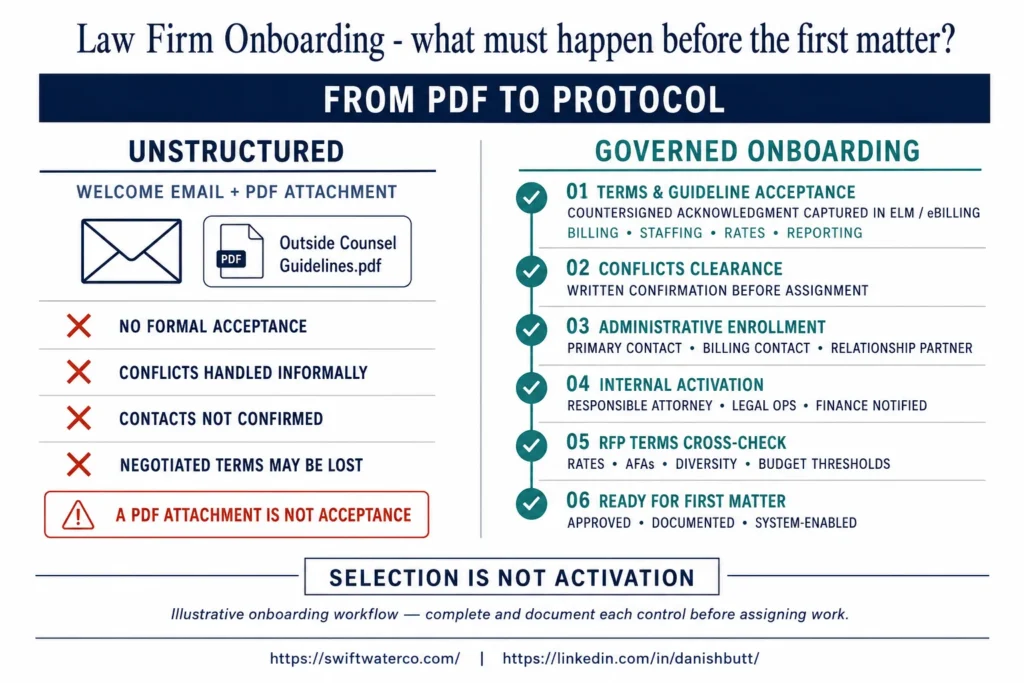
Engagement terms and guideline acceptance. The firm must receive, review, and formally acknowledge your outside counsel guidelines. A PDF attachment to a welcome email says FYI. Acceptance means a countersigned acknowledgment, ideally captured in your matter management or eBilling system, confirming that the firm agrees to your billing rules, staffing expectations, rate structures, and reporting requirements. If your guidelines include provisions on alternative fee arrangements, diversity staffing commitments, or matter budgeting thresholds, those provisions need to be addressed explicitly during this step, not discovered by the firm mid-engagement.
Conflicts clearance. The firm runs its standard conflicts check and confirms clearance in writing before any matter assignment. This is non-negotiable and should be documented as part of the onboarding record, not handled informally over email.
Administrative enrollment. The firm’s primary contacts, billing contacts, and relationship partner are identified. Internal stakeholders (the responsible attorney, legal ops, and finance) are notified. If this firm was selected through a formal panel RFP process, the terms negotiated during that process should be cross-referenced against the onboarding setup to confirm nothing was lost in translation between selection and activation.
How do you load rates and approve law firm timekeepers?
Law firm rate loading and timekeeper approval are the administrative steps most likely to be done in a hurry and most likely to cause billing challenges later.
Start with the rate card. Every timekeeper the firm expects to bill must appear on an approved rate card with the correct rate, effective date, and classification. Timekeeper classifications should follow the UTBMS standard your department uses so that rates are comparable across firms and reportable by role. If you negotiated blended rates, capped rates, or volume discounts during the panel selection, those structures need to be reflected in the rate card exactly as agreed, not approximated.
Timekeeper approval should be an affirmative step, not a default. The firm submits its proposed staffing roster with each timekeeper’s classification, rate, and jurisdiction. Legal operations reviews and approves each entry. Any timekeeper not on the approved roster should not be able to bill to the matter without a separate approval.
This is a process that legal departments must formalize. We see delays or corners cut when this process is not well-defined. In a recent eBilling implementation onboarding, the legal operations team realized that all timekeeper rates must be approved by a firm relationship owner. This caused delays and the relationship owners were put under unexpected burden due to deadlines. In a separate outside counsel management rationalization exercise, each managing attorney had to do a one-by-one evaluation of the timekeepers they wanted to continue with.
This is where your eBilling system earns its value: a properly configured system facilitates the rate card and timekeeper intake and management. It rejects invoices that include unapproved timekeepers automatically, before anyone has to review them manually.
Common failures at this step include loading rates without verifying them against the negotiated rate card, approving timekeepers in bulk without confirming classifications, and failing to set rate expiration dates so that last year’s rates carry forward indefinitely. Each of these turns a negotiated agreement into an unmonitored default.
How do you enroll firms in eBilling correctly?
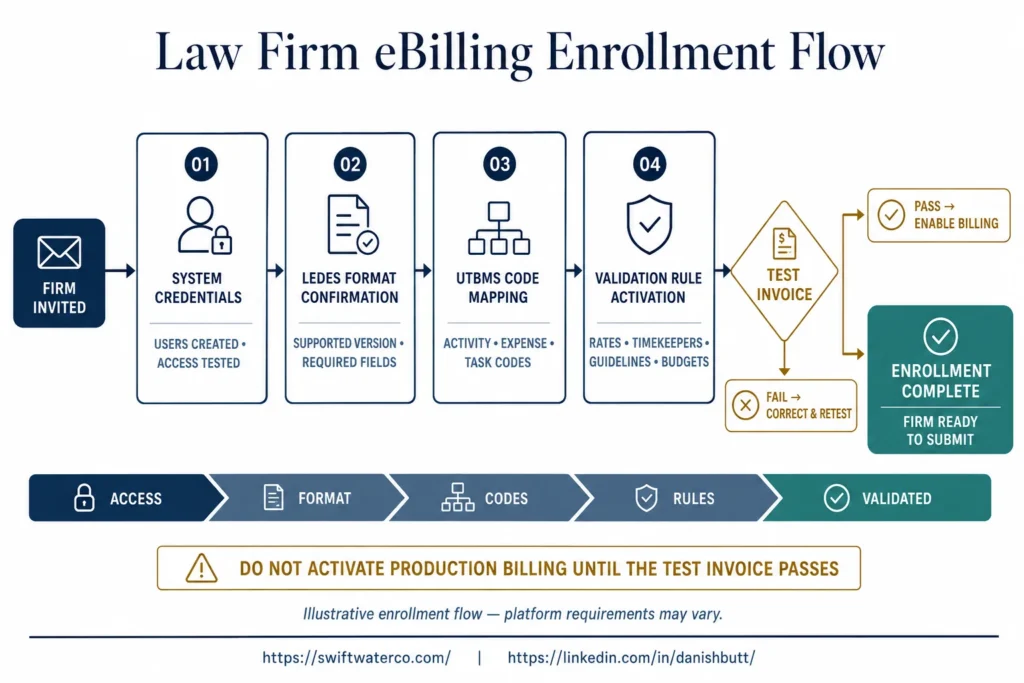
Correct eBilling enrollment means the firm can submit invoices electronically in the correct format, coded to the correct standards, and routed through the correct validation rules. Each of those elements requires explicit setup.
Want the review function run for you?
Every outside counsel invoice checked against your guidelines, rates, and matter context, inside the eBilling platform you already own, with the exception handling, vendor coaching, and savings reporting that separate a review program from invoice processing.
See Bill Review ServicesFormat. Your eBilling platform should require LEDES-format invoices. Confirm which LEDES version your system supports (LEDES 1998B remains the most widely used, though LEDES XML is increasingly adopted) and communicate that to the firm’s billing department before the first invoice is due. If the firm’s own billing system does not natively export in your required format, that needs to be resolved during onboarding, not discovered when the first invoice is rejected.
Coding. Invoices should be coded to the UTBMS standards your department uses for task codes, activity codes, and expense codes. Communicate your coding expectations explicitly. If your department requires phase-level and task-level coding (and it should), say so. If you have blocked certain expense codes or require narrative minimums, communicate that here.
Validation rules. Configure your eBilling system’s validation rules before the firm submits its first invoice. These rules should flag or reject invoices with unapproved timekeepers, rates that exceed the approved rate card, block-billed entries, excessive narrative vagueness, and prohibited expense categories. CLOC’s 2026 State of the Industry Report found that 62% of legal departments now identify outside counsel and vendor management as a key focus area, and eBilling remains one of the most widely adopted legal technologies across departments of all sizes. Adoption, however, is not the same as configuration. A system with weak or default validation rules provides data without governance.
eBilling enrollment is a technical step that most legal departments treat as administrative. In my experience, it is the most underrated activity. Most eBilling tool vendors support with the setup. But, it is also the step where we have traced that most issues have taken place. The outside counsel management and the legal operations teams need to realize that the system setup part is only as good as the process and execution. And, most of the time when implementing a new eBilling system it is hard to anticipate all the challenges. Therefore, I recommend using outside help to ensure that when you get to that step you are well prepared.
If your department is evaluating or implementing legal technology to support outside counsel management, eBilling enrollment is the operational test of whether the technology is configured to enforce your policies or simply digitize them.
What to communicate to your outside counsel about invoice review?
The final onboarding step is the one most departments skip entirely: telling the firm how invoice review will work. After all, law firms should know how billing works. However, when you take into account your billing rules, your AP needs, your outside counsel guidelines, etc. it makes every client a unique one.
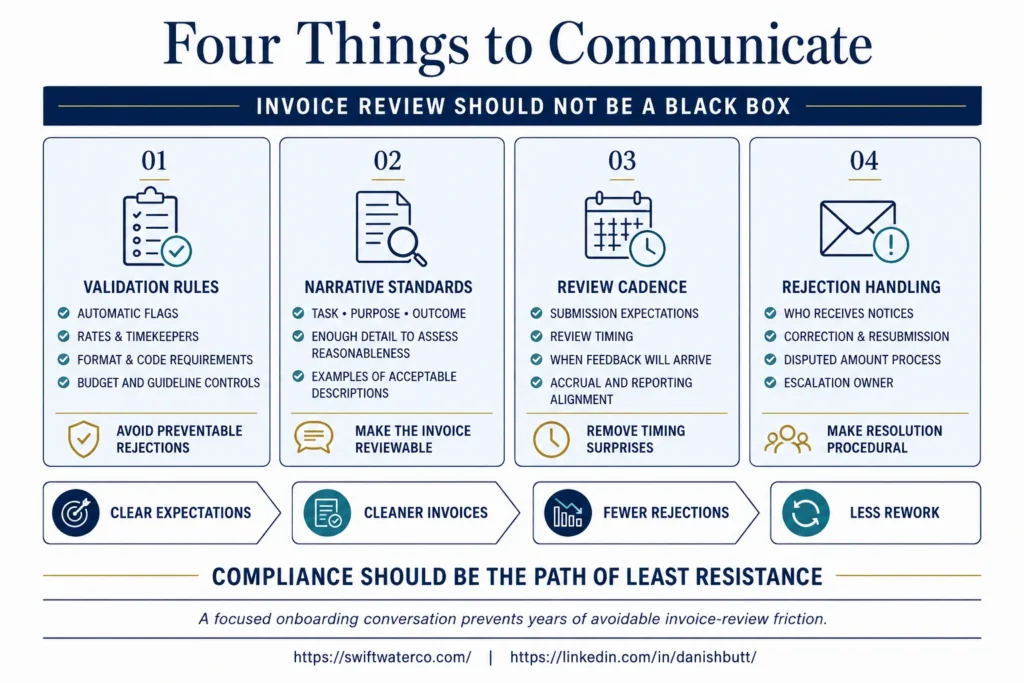
Firms that understand the review process bill more carefully. Firms that do not understand it treat invoice submission as a black box and react to rejections as unexpected rather than procedural. The difference is communication during onboarding, not enforcement after the fact.
Communicate four things explicitly.
- What your validation rules will flag automatically, so the firm can avoid preventable rejections.
- What narrative standards you expect (enough detail that a reviewer can assess reasonableness without calling the billing partner).
- What your review cadence looks like and when the firm should expect feedback.
- Who at the firm should receive rejection notices and how disputed amounts will be handled.
This is the step that prevents the most common failure mode in outside counsel billing: guidelines that exist on paper but are not followed in practice. When firms know the rules are enforced consistently and transparently, compliance becomes the path of least resistance. When enforcement is inconsistent or invisible, firms bill to the edges and the legal department spends review cycles on problems that onboarding should have prevented.
The goal is to make compliance straightforward by making expectations clear – not making it contentious. And, the pre-work ensures that goal is achieved. A focused onboarding conversation about invoice review standards saves hours of back-and-forth on every rejected invoice for the life of the engagement. It also makes your internal team is comfortable enforcing the rules knowing the other side is briefed.
Bottom Line
Law firm onboarding is five steps: guideline acceptance, rate loading, timekeeper approval, eBilling enrollment, and communication of review expectations. Every billing dispute, every unapproved timekeeper charge, and every invoice rejection that follows traces back to one of these steps being skipped or handled passively.
Struggling to control outside counsel spend?
We help legal departments build the governance, billing guidelines, panel structure, and rate programs that take back control of what outside counsel costs.
See Legal Spend ServicesExecute law firm onboarding as a governed checklist, not an administrative courtesy, and the panel you selected will perform the way you designed it to.
This is the kind of operational infrastructure Swiftwater builds with legal departments. If your outside counsel program has the right firms but onboarding is still informal, our legal spend services can help you design a repeatable onboarding protocol, configure your eBilling validation rules, and stand up the governance that makes your panel work as intended.
Frequently Asked Questions
How long should law firm onboarding take?
A structured law firm onboarding process typically takes two to four weeks from panel selection to first-matter readiness. The timeline depends on the complexity of your rate structures, the number of timekeepers requiring approval, and whether the firm has worked with your eBilling platform before. Firms that have never used your eBilling system may need an additional week for technical enrollment and testing.
What causes most eBilling invoice rejections?
The most common causes are incorrect UTBMS task and activity codes, unapproved timekeepers billing to the matter, rates that do not match the approved rate card, and missing or malformed LEDES file formatting. Each of these traces directly to a law firm onboarding step that was either skipped or completed without verification.
Should law firm onboarding differ by firm size?
The core requirements stay the same regardless of firm size: guideline acceptance, rate loading, eBilling enrollment, and communication of review expectations. What changes is the operational complexity. Large firms with hundreds of timekeepers need more rigorous rate card validation and timekeeper approval workflows. Smaller firms may need more hands-on support with eBilling platform setup and LEDES formatting.
Who owns law firm and vendor onboarding in the legal department?
Legal operations typically owns the law firm and vendor onboarding process because it sits at the intersection of technology, finance, and outside counsel management. In departments without a legal ops function, the responsibility usually falls to a paralegal manager or the attorney who manages the outside counsel panel management. The key is assigning a single owner so that no step is assumed to be someone else’s job.
This article is provided for informational purposes only and does not constitute legal, financial, or technology advice. Outside counsel / law firm onboarding requirements vary by organization, jurisdiction, and regulatory context. Consult qualified professionals for guidance specific to your situation.