

Legal spend analytics is the practice of using connected, structured spend data to make decisions that actively control legal costs, not just to describe where money went after it was spent.
The distinction from reporting:
- Reporting describes historical spend data. It is reactive. It tells you what happened.
- Legal spend analytics explains why costs occurred, identifies the drivers, and prescribes what should change. It is operational.
Most legal departments have reporting. Very few have analytics. The gap between the two is where cost control is lost.
The 2024 ACC Chief Legal Officers Survey found that 42% of legal departments received a mandate to cut costs while 59% reported increasing workloads. A 2025 survey by LegalBillReview.com found that 79% of legal departments report pressure to reduce outside counsel costs, yet 57% do not track or quantify any savings they achieve. That gap between pressure and measurement is the reporting trap. For a structured approach to building the data foundation that makes analytics possible, see Swiftwater’s guide to building a legal spend baseline.
Why Do Most Legal Spend Analytics Programs Fail?
Not because of missing data. Most departments have more data than they can use. The failure point is that analytics outputs are not connected to decision-making authority.
The pattern is consistent: a report is generated, reviewed, filed, and forgotten. No one is empowered to act on what it shows. No process exists to convert an insight into a spending decision. Without that connection, legal spend analytics is descriptive. It documents what happened rather than changing what happens next.
True analytics explains why costs occurred and prescribes what should change. Reporting only covers the first half.
Is your legal spend data telling you the full story?
We help legal departments build the analytics, rate governance, and reporting infrastructure to move from invoice processing to strategic spend management.
See Legal Spend ServicesWhat Is the Difference Between Legal Spend Reporting and Analytics?
The practical distinction is not about the tool. It is about what happens after the output is produced.
| Reporting | Legal Spend Analytics | |
|---|---|---|
| Orientation | Backward-looking | Forward-looking |
| Function | Describes what happened | Explains why and prescribes what changes |
| Output | Spend summaries and invoice totals | Decision triggers and cost control actions |
| Value | Audit trail | Operational control |
| Limitation | Reactive by design | Requires connected data and decision authority |
The practical test: if your analytics outputs are reviewed and then filed rather than acted on, they are reporting, regardless of what the platform calls them.
The CLOC 2026 State of the Industry Report found that financial management has become a key priority for 72% of legal operations teams. Achieving that priority requires analytics that inform decisions, not reports that document history.
How Do You Build Legal Spend Analytics That Actually Controls Costs?
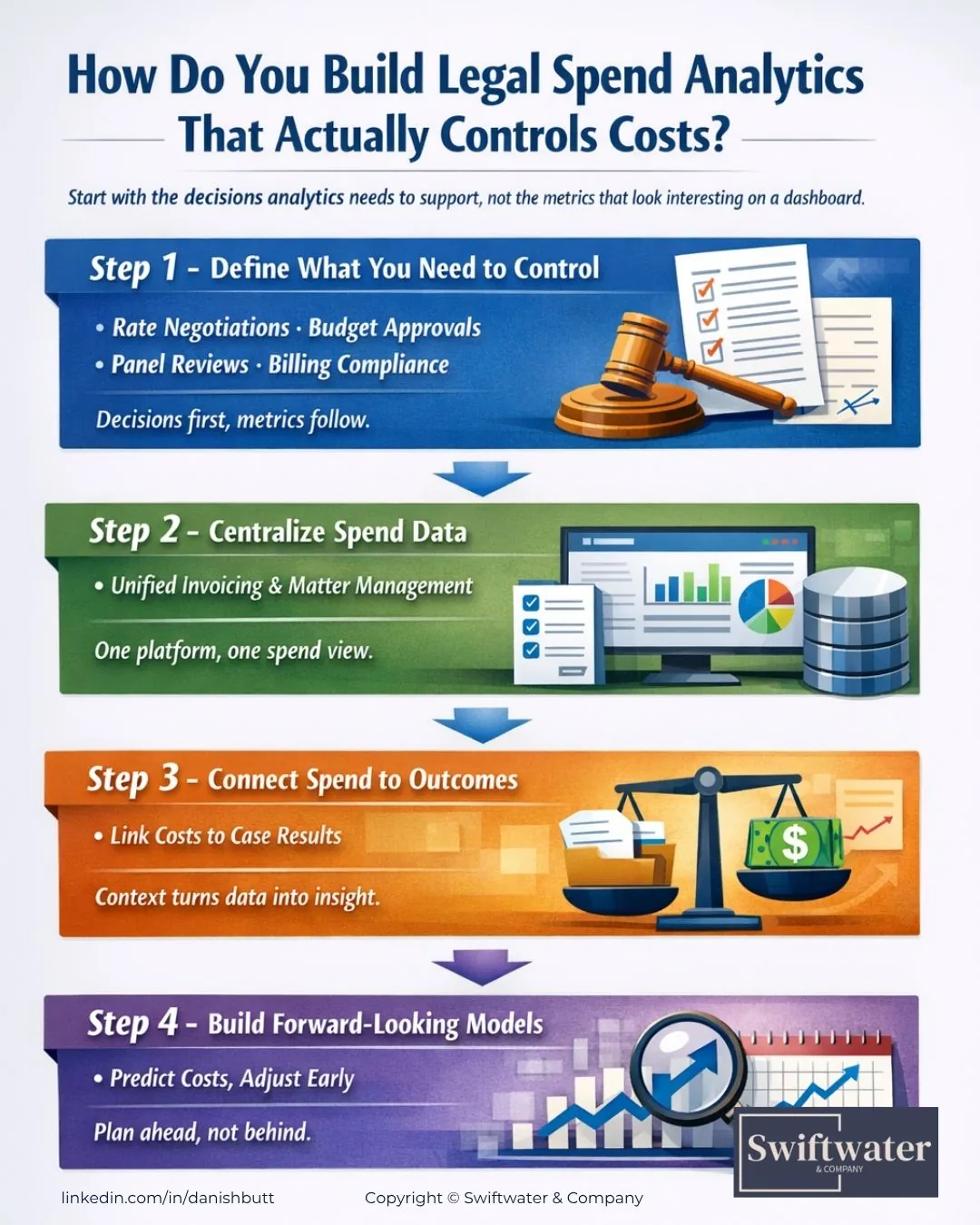
Start with the decisions analytics needs to support, not the metrics that look interesting on a dashboard.
Step 1: Define what you need to control Start with the decisions analytics needs to support: outside counsel rate negotiations, matter budget approvals, panel reviews, or billing guideline enforcement. Metrics follow decisions, not the other way around.
Step 2: Centralize spend data into a single source Analytics built on fragmented data produces fragmented insight. Integrated platforms such as Onit combine invoicing, matter management, and financial reporting into a single spend view, the minimum data architecture for operational analytics.
Step 3: Connect spend to matter outcomes Cost figures without outcome context are just numbers. Analytics becomes operational when litigation spend is connected to matter resolution, M&A costs are connected to deal completion, and employment spend is connected to claim disposition.
Step 4: Build forward-looking models Descriptive analytics tells you what last quarter cost. Predictive analytics tells you what next quarter will cost if current patterns hold, allowing budget adjustments, panel changes, and rate negotiations to happen before costs escalate rather than after.
Why Does Real-Time Data Matter for Legal Spend Analytics?
Most legal departments operate on a reporting lag. Invoices are processed, reports are generated, and by the time the data reaches a decision-maker it reflects a position that no longer exists. Real-time analytics closes that lag, enabling intervention while a cost trend is forming rather than after it has embedded.
PERSUIT reports that law firm rates averaged 9.2% increases in early 2025. Departments operating on quarterly reporting cycles are negotiating rate positions based on data that is already three months stale by the time it reaches them. Real-time visibility changes that dynamic entirely.
Predictive analytics extends this further. By modeling cost patterns across matter types, it allows legal departments to forecast whether a current spend trajectory is sustainable, flag emerging budget variances before they breach thresholds, and prepare rate negotiation positions based on projected rather than historical spend.
Want the review function run for you?
Every outside counsel invoice checked against your guidelines, rates, and matter context, inside the eBilling platform you already own, with the exception handling, vendor coaching, and savings reporting that separate a review program from invoice processing.
See Bill Review ServicesFor a deeper look at how billing enforcement connects to spend control, see Swiftwater’s guide to outside counsel billing guidelines.
What Metrics Should Legal Spend Analytics Actually Track?
Most legal spend dashboards track total spend, spend by firm, and invoice approval rates. These are useful for audit purposes. They are not useful for cost control decisions.
For departments building a KPI architecture from scratch, Mori Kabiri’s Legal Operations KPIs is a widely referenced practitioner handbook covering spend management, budgeting, law firm and vendor management, and invoice quality metrics. For a practical starting set of eight metrics, see our guide to legal department KPIs. It is a useful starting point for understanding which metrics are worth tracking and at what stage of operational maturity they become relevant.
The metrics that support genuine cost control within that framework are:
- Budget variance by matter — which active matters are trending over their approved ceiling and by how much
- Rate realization by timekeeper — which timekeepers are billing above agreed rates and on which matters
- Invoice rejection rate by firm — which firms have the highest non-compliance rates with billing guidelines
- Cost per matter by type — what litigation, M&A, employment, and IP matters are actually costing relative to prior periods and peer benchmarks
- Outside counsel utilization — which panel firms are receiving work, whether that allocation reflects performance data, and where panel consolidation opportunity exists
The difference between these metrics and standard reporting is that each one connects directly to a decision: adjust a budget, renegotiate a rate, enforce a guideline, consolidate a panel relationship. Metrics that do not connect to a decision are reporting, not analytics.
For broader context on how analytics connects to the full spend management framework, see Swiftwater’s legal spend management resources.
Bottom Line
Legal spend analytics is not a reporting upgrade. It is a fundamentally different operational posture, one where data outputs are connected to decisions, not filed after review.
If your analytics are generating reports that no one acts on, the problem is not the platform. It is the governance structure around it. The data is there. The decision authority is missing.
Struggling to control outside counsel spend?
We help legal departments build the governance, billing guidelines, panel structure, and rate programs that take back control of what outside counsel costs.
See Legal Spend ServicesReporting tells you what happened. Analytics changes what happens next. Most legal departments have built the first and skipped the second.
If you are ready to move beyond reporting and build a legal spend analytics capability that actually drives decisions, explore how Swiftwater’s legal spend management services approach spend visibility, from baseline diagnostics through to live reporting infrastructure.
Frequently Asked Questions
What is the difference between legal spend analytics and reporting?
Legal spend reporting shows what the department spent over a past period. Legal spend analytics goes further by explaining what drove the spend, which matters or firms created the pattern, and what decision should follow. Reporting gives the legal team a record. Analytics gives the legal team a management tool.
Why does legal spend analytics matter for a GC?
Legal spend analytics matters because it helps the GC connect legal cost to business activity, risk, and operating decisions. It supports better budget conversations, stronger outside counsel management, more focused matter planning, and clearer explanations to finance and executive leadership.
What makes legal spend analytics effective?
Legal spend analytics is effective when it is connected to decision-making. The data should help the legal department decide where to approve budgets, where to review rates, where to enforce billing guidelines, which firms should receive more work, and which matters need closer management.
How is a legal spend dashboard different from legal spend analytics?
A dashboard is only the display layer. It may show total spend, spend by firm, matter volume, or invoice status. Legal spend analytics begins when those numbers are interpreted and connected to action. A useful dashboard should point the team toward a decision, not just present a summary.
What data is needed for legal spend analytics?
Legal spend analytics needs invoice data, matter data, law firm data, budget data, timekeeper rates, invoice adjustment data, matter type, business unit, and outcome context where available. The most useful analytics view connects financial information with the legal work that created the cost.
What metrics should legal spend analytics track?
Legal spend analytics should track budget variance by matter, spend by matter type, rate performance by timekeeper, invoice adjustment patterns, outside counsel utilization, cost per matter type, and firm performance trends. Each metric should be tied to a practical management decision.
How often should legal spend analytics be reviewed?
Legal spend analytics should usually be reviewed quarterly, with more frequent review for high-spend matters, active litigation, major transactions, or departments under budget pressure. Quarterly reviews help the legal team adjust course before spend issues become year-end surprises.
Who should own legal spend analytics?
Legal operations should usually own the legal spend analytics process, with support from finance, in-house attorneys, and the GC. Finance helps validate cost data, attorneys provide matter context, and legal operations turns the information into reports, controls, and management actions.
How does legal spend analytics support outside counsel management?
Legal spend analytics helps legal departments understand which firms are receiving work, how costs compare across matter types, whether budgets are being followed, and where billing patterns need review. This gives the GC a stronger basis for panel reviews, rate discussions, matter planning, and firm performance conversations.
What is the first step in moving from reporting to analytics?
The first step is to identify the decisions the legal department wants the data to support. Instead of starting with dashboard design, the team should define the management questions first, such as which matters need budgets, which firms need review, which rates need attention, and which spend categories need stronger controls.
Disclaimer: This article is provided for educational and informational purposes only. Neither Swiftwater and Company nor the author provides legal advice. This content does not constitute professional legal, financial, or operational advice and should not be relied upon as such. Readers are encouraged to consult a qualified professional before making decisions based on the information provided. External links are included for reference only and reflect the views of their respective authors. Swiftwater and Company takes no responsibility for third-party content.