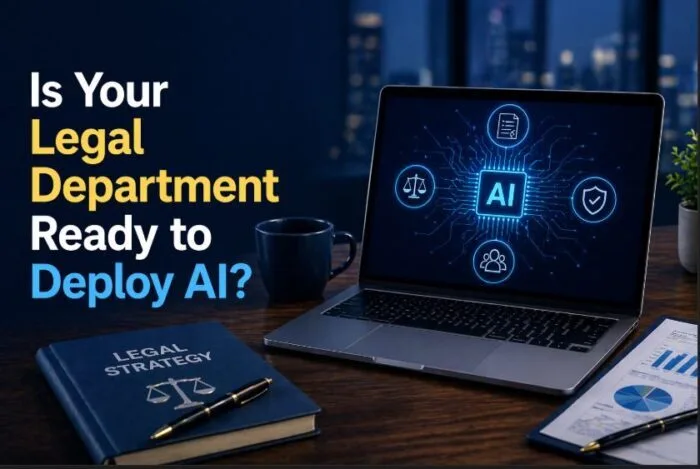

A legal AI readiness assessment is a structured evaluation of whether a legal department has the data, processes, governance, and operational maturity required to successfully deploy AI tools. Most general counsel believe their department is ready because it has access to the tools. In reality, readiness has very little to do with the technology itself. AI fails in legal environments not because of capability, but because the underlying systems, data, and workflows are not prepared to support it.
Experienced general counsel assess readiness across five dimensions: data maturity, meaning structured, accessible, usable legal data; process clarity, meaning defined workflows suitable for automation; governance controls, meaning policies for AI usage, risk, and oversight; technology alignment, meaning integration with existing legal systems; and change readiness, meaning team willingness and ability to adopt AI. A disciplined tool evaluation sits downstream of this assessment, not upstream.
This article is part of the Legal AI hub, a series on legal AI for in-house teams.
Why do most legal teams overestimate AI readiness?
Most teams equate tool availability with operational readiness. The Thomson Reuters Institute’s State of the Corporate Law Department report shows legal departments continuing to increase investment in legal technology while still struggling to extract measurable value from those systems.
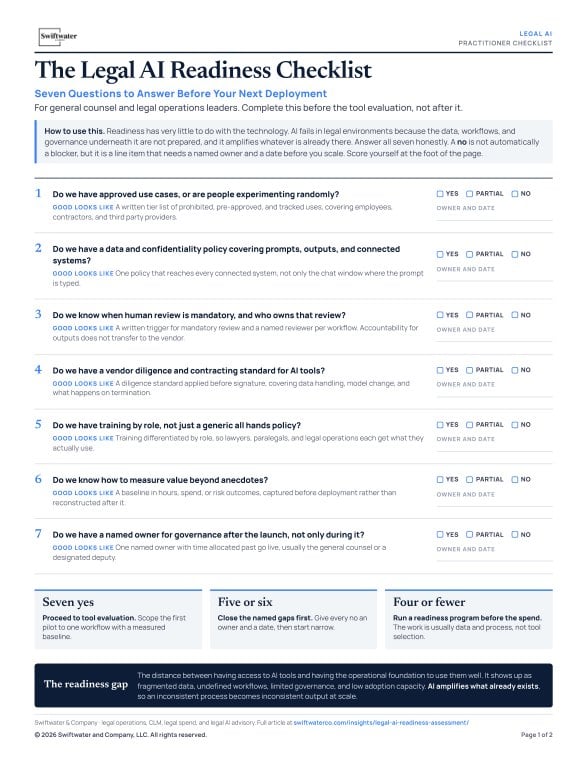
Take the seven questions with you.
The same seven readiness questions from this article, laid out as a working form: what good looks like for each one, Yes, Partial and No boxes, and room to assign an owner and a date to every gap. Page two maps the questions to the five readiness dimensions and to what to run next.
PDF · 2 pages · 0.6 MB · No sign-up required
A legal AI readiness gap is the difference between having access to AI tools and having the operational foundation required to use them well. It typically shows up in four places: fragmented data, with contracts, matters, and billing stored across disconnected systems; undefined workflows, with inconsistent processes across teams; limited governance, with no clear policies for AI usage or risk; and low adoption capacity, with resistance to new tools or workflows. AI amplifies what already exists. If processes are inconsistent, AI scales that inconsistency. That dynamic sits directly on the general counsel’s desk, because accountability for outputs does not transfer to the vendor.
What data conditions are required for legal AI?
AI is only as effective as the data it uses. Legal data readiness is the condition where legal data is structured, standardized, and accessible for analysis or automation. Without this, AI tools produce unreliable or incomplete outputs.
The concrete requirements are straightforward: contracts, invoices, and matters stored in structured formats; consistent naming, tagging, and classification across systems; data centralized rather than siloed; and minimal gaps in historical records. The ACC Chief Legal Officers Survey consistently highlights data visibility and reporting as ongoing challenges for general counsel. This is why many AI initiatives stall: the tool works, but the data underneath it does not support it.
Thinking about AI but not sure what is actually ready to deploy?
Swiftwater's AI Lab helps legal departments separate signal from noise, identifying where AI creates real leverage and building the governance to use it responsibly.
See Legal AI SolutionsIn practice, this is often where a general counsel hits the wall. If the CLM, eBilling, or matter management system has been in place for two or three years without active data hygiene, the data the AI will inherit is almost certainly not clean enough to rely on. That is the point at which a reimplementation, a platform move, or at minimum a structured data remediation program becomes the prerequisite, not the follow-up. Swiftwater’s team has migrated legal data off legacy systems across ELM, CLM, eBilling, and matter management, cleaned and restructured it, and handed back a platform that is actually AI-ready. If your current stack is aging and the data underneath it is in worse shape than the demos suggested, that is the work, and we do it end to end. See Swiftwater’s legal technology solutions for how the engagements are structured.
How important are processes before deploying AI?
AI does not fix broken processes. It exposes them. A legal workflow is a defined sequence of steps used to complete a legal task such as contract approval or matter intake. Before deploying AI, the workflow needs to be standardized so the same process runs across teams, documented so the steps and responsibilities are clear, repeatable so it is consistent enough for automation, and measured so time and cost baselines exist.
If workflows vary by lawyer or matter type, AI cannot operate reliably. This is why readiness often begins with process mapping rather than technology selection.
What governance should be in place before AI deployment?
Governance is what separates controlled AI deployment from unmanaged risk. Legal AI governance is the framework of policies, controls, and oversight mechanisms that regulates how AI tools are used inside a legal department. Every deployment needs usage policies defining what AI can and cannot be used for, data controls for handling confidential information, approval frameworks identifying who authorizes AI usage in which workflows, audit mechanisms capable of reviewing outputs and decisions, and clear accountability for AI-related issues, usually sitting with the general counsel or a designated deputy.
Kevin Fumai, Assistant General Counsel at Oracle and a member of the IAPP AI Governance Center Advisory Board, has described the operating model in practitioner terms: a pro-innovation posture paired with very clear guidelines on when AI can and cannot be used. Recognized frameworks anchor the rest of the work: the NIST AI Risk Management Framework, its Generative AI Profile (AI 600-1), and ISO/IEC 42001:2023 as a certifiable AI management system standard. In the US, ABA Formal Opinion 512 sets the current ethics baseline. DLA Piper has published a useful companion model for the policy itself in Generative AI: framing a business-centric policy to address opportunities and risks, which organizes uses into prohibited, pre-approved, and tracked tiers across employees, contractors, and third-party service providers. Bloomberg Law’s legal operations research continues to put governance and risk at the top of the concerns legal teams flag about AI. Without governance, AI introduces legal and regulatory exposure. The fuller treatment sits in the legal AI governance article.
How do you assess change readiness in legal teams?
Technology adoption in legal is primarily a human challenge. Change readiness is the ability of a legal team to adopt new tools, workflows, and ways of working without disrupting operations. The indicators are leadership alignment, with the general counsel and senior lawyers actively supporting adoption; training capability, with the team able to be trained effectively; user acceptance, with lawyers trusting and willing to use the tools; and workflow integration, with AI fitting naturally into daily work.
AI advisor Allie K. Miller has used the term pilot purgatory to describe the state where organizations run a continuous sequence of proofs of concept that never reach systematic transformation or measurable ROI. Change readiness is what stops a legal department from landing there. Even the most advanced tool fails if lawyers do not use it, which is why adoption is designed into the program rather than assumed.
What happens if you skip readiness assessment?
Skipping readiness creates predictable failure, and the base rate is not abstract. MIT’s NANDA initiative, in its 2025 “GenAI Divide: State of AI in Business” study, found that roughly 95% of enterprise generative AI pilots deliver no measurable P&L impact, with only about 5% crossing into real operational or financial return. The failures were not model-quality failures. They were integration, data, and workflow failures, which is precisely what a readiness assessment is designed to surface before the spend happens.
The pattern inside legal departments mirrors it: low adoption as lawyers revert to manual processes, inaccurate outputs as poor data produces unreliable results, wasted budget as tools fail to deliver expected ROI, and increased risk as ungoverned AI use creates exposure. AI does not create operational maturity. It depends on it.
A seven-point readiness checklist for general counsel
Before the next AI deployment decision, a general counsel should be able to answer yes to all seven of these.
- Do we have approved use cases, or are people experimenting randomly?
- Do we have a data and confidentiality policy covering prompts, outputs, and connected systems?
- Do we know when human review is mandatory, and who owns that review?
- Do we have a vendor diligence and contracting standard for AI tools?
- Do we have training by role, not just a generic all-hands policy?
- Do we know how to measure value beyond anecdotes, tied to hours, spend, or risk outcomes?
- Do we have a named owner for ongoing governance after the launch, not only during it?
A no in any row is not automatically a blocker, but it is a line item that needs a named owner and a date before scale.
Further reading for general counsel
A practical reading order for general counsel getting up to speed fast on legal AI, with Swiftwater reference points interspersed for the in-house operational view.
- ACC Artificial Intelligence Toolkit for In-house Lawyers for the legal department lens, including sample policies and checklists. Pair with Swiftwater’s disciplined tool evaluation framework for the practitioner-level application of that lens.
- ABA Task Force on Law and Artificial Intelligence for lawyer-specific duties and rollout guardrails, anchored to Formal Opinion 512.
- FPF Generative AI for Organizational Use: Internal Policy Considerations for policy drafting and employee-use controls. Read alongside Swiftwater’s legal AI governance article for how the policy translates into an in-house governance model.
- ACC Procuring AI: Key Considerations and Strategies for vendor diligence and contracting.
- CLOC How to Cut Through the Contract AI Hype if contracts, CLM, or contract review AI is on the roadmap. For the implementation side, see Swiftwater’s legal technology solutions.
- NIST AI Risk Management Framework to anchor the enterprise governance model that the legal policy has to live inside.
Take the seven questions with you.
The same seven readiness questions from this article, laid out as a working form: what good looks like for each one, Yes, Partial and No boxes, and room to assign an owner and a date to every gap. Page two maps the questions to the five readiness dimensions and to what to run next.
PDF · 2 pages · 0.6 MB · No sign-up required
Bottom line
Legal AI readiness is a step ahead of having access to tools. It is about whether the general counsel and the legal function are prepared to use them effectively. The most successful general counsel treat readiness as a prerequisite rather than an afterthought. AI transformation has an exponentially higher chance of success in a legal department that is operationally ready to support it – not just aspirationally but with practical steps completed.
Evaluating legal technology but not sure where to start?
We help legal departments cut through the vendor noise, mapping technology to process maturity and building a roadmap that actually gets adopted.
See Legal TechnologyIf you are ready to assess and improve your AI readiness, explore how Swiftwater’s Legal AI Solutions help general counsel and legal teams deploy AI with the right data, governance, and operational foundation.
This article is provided for educational and informational purposes only. Neither Swiftwater and Company nor the author provides legal advice. This content does not constitute professional legal, financial, or operational advice and should not be relied upon as such. Readers are encouraged to consult a qualified professional before making decisions based on the information provided. External links are included for reference only and reflect the views of their respective authors. Swiftwater and Company takes no responsibility for third-party content.