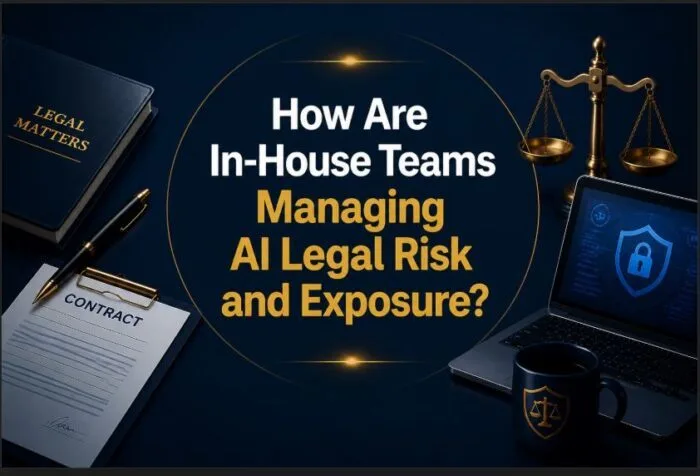

AI legal risk management is the process of identifying, assessing, and controlling legal, regulatory, and operational risks arising from the use of artificial intelligence within a legal department. AI is being adopted faster than it is being governed, which creates a category of exposure most in-house teams have not fully mapped. The risks span data, decision-making, and compliance, and they show up in case law and regulatory enforcement before most legal departments have a chance to set policy.
This article is part of the Legal AI hub and works alongside the legal AI governance framework, which covers the structural answer to the risks identified here.
How in-house legal teams are managing AI risk:
- Identifying risk areas across data, outputs, workflows, and vendor exposure.
- Establishing governance controls including policies, approvals, and oversight.
- Defining accountability for AI-related decisions.
- Implementing safeguards on data protection and tool usage.
- Monitoring ongoing risk through continuous review of AI performance and use.
The teams managing AI risk well are the ones who treated it as a discipline before they had to treat it as a crisis.
What types of legal risks does AI introduce?
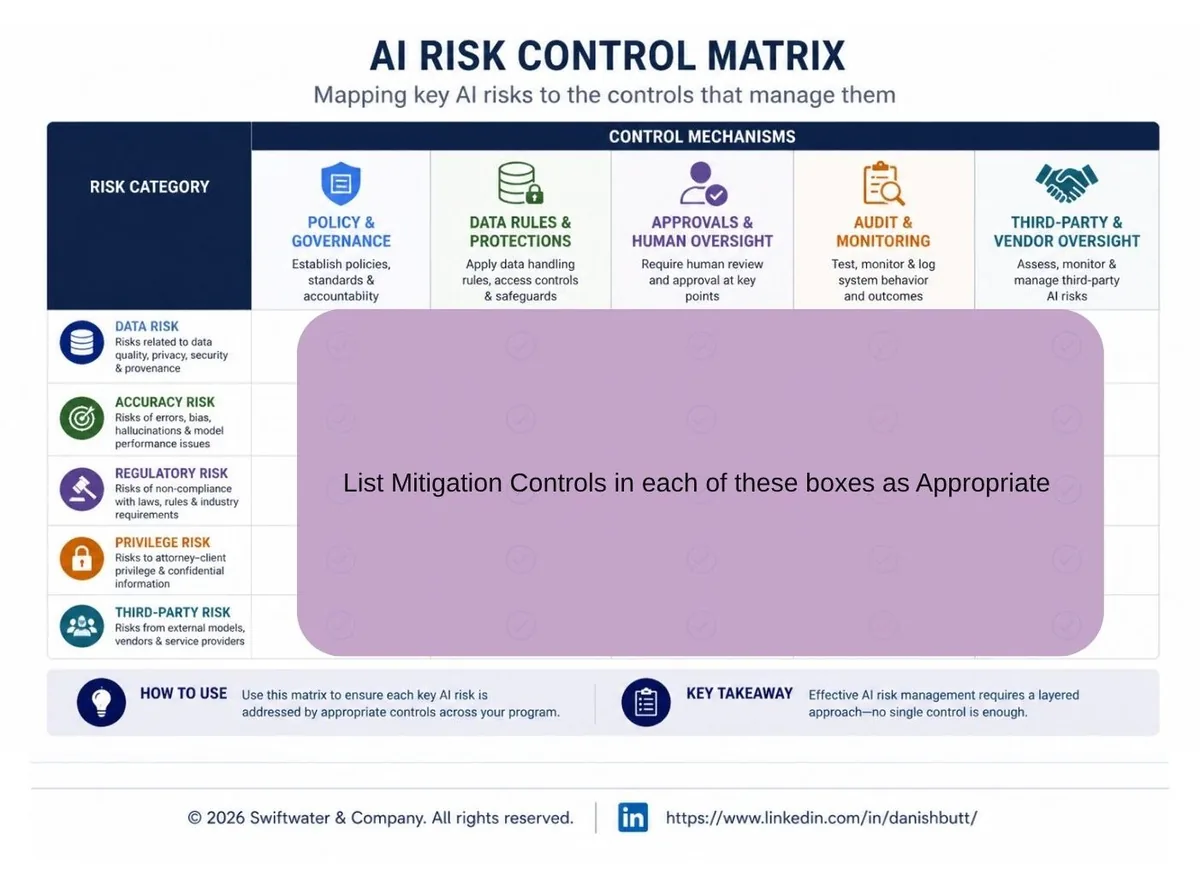
AI introduces five risk categories that differ from traditional legal technology exposure:
- Data confidentiality risk: sensitive legal information shared with AI systems that may retain, store, or train on it.
- Output accuracy risk: incorrect or fabricated legal analysis, including hallucinated citations and misstated authority.
- Regulatory risk: non-compliance with privacy, AI-specific, and sectoral regulations.
- Privilege risk: loss of attorney-client privilege through improper use of consumer-grade AI.
- Third-party risk: dependence on external AI vendors whose terms of service, data handling, and model behavior sit largely outside legal department control.
The Bloomberg Law legal operations survey continues to place data security and accuracy at the top of the concerns legal teams flag about AI. Stanford’s Magesh study, peer-reviewed in the Journal of Empirical Legal Studies in 2025, found leading legal AI research tools hallucinated on 17 to 33 percent of queries. Several of those tools were marketed as “hallucination-free.”
How should legal teams identify AI-related exposure?
Thinking about AI but not sure what is actually ready to deploy?
Swiftwater's AI Lab helps legal departments separate signal from noise, identifying where AI creates real leverage and building the governance to use it responsibly.
See Legal AI SolutionsRisk identification starts with knowing where AI is actually being used. Most in-house teams discover AI usage already underway through informal channels well before any formal procurement.
The mapping exercise covers four areas:
- Tool inventory: every AI tool in use across the legal team and the broader business functions that touch legal data.
- Use case mapping: how each tool is applied, what task it performs, what output it produces.
- Data flow analysis: what data is being input, what is being processed, what is being retained.
- User behavior review: how lawyers are interacting with AI in day-to-day work, including unsanctioned use.
The output of this exercise is usually a clearer picture than the legal team expected, and a list of exposure points that did not exist on the original risk register.
What governance controls are required for AI risk?
Five control categories carry most of the load:
- Usage policies: define permitted and restricted AI activities at the task level.
- Data handling rules: control what information can be input into AI systems, including specific prohibitions on privileged or regulated data.
- Approval processes: require authorization for AI tool adoption, including shadow-use remediation.
- Audit mechanisms: track and review AI outputs and decisions on a defined cadence.
- Vendor oversight: evaluate third-party AI providers against enterprise security and data-handling standards.
The 2026 ACC Chief Legal Officers Survey consistently shows managing risk and compliance as a top priority for legal departments. The legal AI governance framework anchors these controls to NIST AI RMF and ISO/IEC 42001, which is the structural answer most boards now expect to see.
How should AI outputs be validated?
Outputs cannot be treated as final without review. Validation rests on four practices:
- Human-in-the-loop review: every AI output that influences a legal decision passes through licensed counsel before it leaves the department.
- Risk-based validation: higher scrutiny for high-stakes matters, with documented review steps for litigation, regulatory filings, and material contracts.
- Consistency checks: comparing outputs across similar matters to surface drift, bias, or model regression.
- Documentation: recording how each output was validated, by whom, and against what standard.
ABA Formal Opinion 512 places the duty of technological competence under Rule 1.1, the duty of confidentiality under Rule 1.6, the duty of supervision over non-lawyer assistance (which now covers AI tools) under Rules 5.1 and 5.3, and the duty of candor under Rule 3.3 directly on the lawyer. The AI legal assistant article covers the rule-by-rule application in more depth.
How should legal teams manage vendor-related AI risk?
Most AI tools depend on third-party providers, and the contracts written for this category are still catching up to the actual risk. Four areas need contractual and operational attention:
- Data storage practices: where data is stored, how long, under what jurisdictional regime.
- Model training policies: whether the vendor uses customer data to train models, and whether enterprise tier provides contractual exclusion from training.
- Security standards: SOC 2, ISO 27001, and the enterprise security baseline.
- Contractual protections: terms governing data use, indemnification, AI output warranties, and liability allocation when the model is wrong.
The agentic AI article covers an emerging vendor-risk wrinkle: agentic AI products are increasingly drafting terms of service that allocate liability back to the user rather than the vendor. Proskauer’s analysis of contract law in the agentic era walks through where unconscionability challenges are likely to surface as real money moves through these systems.
Swiftwater’s risk and compliance practice, led by Mirat Dave, covers AI vendor diligence, third-party risk, and the broader operational risk picture for legal departments adopting AI at scale.
What does AI legal risk look like when it materializes?
Three reference cases now anchor most board and executive conversations on AI legal risk.
In Mata v. Avianca, Inc., 678 F. Supp. 3d 443 (S.D.N.Y. 2023), Judge Castel sanctioned counsel for filing a brief generated by ChatGPT containing six fabricated cases. The case became the original cautionary tale for AI hallucination in court filings, and the order reads as a checklist of what not to do.
In Ayinde v. London Borough of Haringey and Al-Haroun v. Qatar National Bank, the UK High Court referred barristers and solicitors to disciplinary authorities for filing AI-generated submissions containing fabricated case citations. The court was direct that the duty to verify rests on counsel, regardless of which tool produced the draft.
Evaluating legal technology but not sure where to start?
We help legal departments cut through the vendor noise, mapping technology to process maturity and building a roadmap that actually gets adopted.
See Legal TechnologyIn United States v. Heppner (S.D.N.Y. Feb. 17, 2026), Judge Rakoff ruled that documents a defendant created using a consumer-grade generative AI platform were not protected by attorney-client privilege or the work product doctrine. The reasoning: the tool is not an attorney, the terms of service did not support a reasonable expectation of confidentiality, and the client had acted without counsel’s direction. The practical implication for in-house teams is that inputting privileged material into a free or individual-tier AI product may waive privilege over the underlying communications themselves. The AI legal assistant article covers the doctrinal detail.
The regulatory layer compounds the case-law exposure. The EU AI Act, the Colorado AI Act (SB24-205), New York City Local Law 144, the New York RAISE Act, and the California TFAIA together create a patchwork of obligations that crosses jurisdictional lines for almost every multinational legal department. NIST AI RMF and ISO/IEC 42001 provide the framework anchors regulators are increasingly aligning to.
What happens if AI risk is not managed?
The categories of consequence are familiar, but AI raises the velocity and visibility of each one:
- Data breaches: exposure of confidential legal information through inadequate vendor controls or shadow-use of consumer AI tools.
- Incorrect legal advice: reliance on hallucinated citations, fabricated authority, or confidently wrong summaries.
- Regulatory violations: failure to meet disclosure, transparency, or risk-management obligations under emerging AI regulations.
- Privilege loss: privileged material exposed through improper use of consumer-grade AI tools, as documented in Heppner.
- Loss of stakeholder trust: reduced confidence from the board, the audit committee, regulators, and the business itself.
When AI fails, it tends to fail in front of an audience.
Bottom line
AI introduces a new category of legal risk that does not yield to traditional risk management alone. The legal departments handling it well are doing the same things their best risk programs have always done: mapping exposure, building structural controls, defining accountability, and reviewing performance against the controls on a regular cadence. The legal departments handling AI risk well are practicing established risk management with the specificity AI now requires.
If you are looking to manage AI risk effectively, explore how Swiftwater’s Legal AI Solutions help legal teams implement AI with governance, control, and compliance built in.
Frequently Asked Questions:
What is AI legal risk management?
AI legal risk management is the process of identifying, assessing, and controlling legal, regulatory, and operational risks arising from the use of artificial intelligence within a legal department.
What types of risks does AI introduce for legal teams?
AI introduces risks including data confidentiality issues, inaccurate outputs, regulatory non-compliance, loss of attorney-client privilege, and third-party vendor risks.
How should legal teams identify AI-related risk exposure?
Legal teams should map AI usage by identifying all tools in use, defining use cases, analyzing data flows, and reviewing how lawyers interact with AI in daily workflows.
What governance controls are required to manage AI risk?
Key controls include usage policies, data handling rules, approval processes, audit mechanisms, and vendor oversight aligned with frameworks like NIST AI RMF and ISO 42001.
How should AI-generated outputs be validated in legal work?
AI outputs should undergo human review, risk-based validation, consistency checks, and proper documentation before being used in any legal decision or communication.
How should legal teams manage vendor-related AI risks?
Teams should evaluate vendor data storage, model training policies, security standards, and contractual protections such as indemnification and liability terms.
What happens if AI risk is not properly managed?
Failure to manage AI risk can lead to data breaches, incorrect legal advice, regulatory violations, loss of privilege, and reduced trust from stakeholders and regulators.
Why is AI risk management important for in-house legal teams?
AI risk management is essential because AI adoption is accelerating faster than governance, creating exposure that requires structured controls, accountability, and continuous monitoring.
This article is provided for educational and informational purposes only. Neither Swiftwater and Company nor the author provides legal advice. This content does not constitute professional legal, financial, or operational advice and should not be relied upon as such. Readers are encouraged to consult a qualified professional before making decisions based on the information provided. External links are included for reference only and reflect the views of their respective authors. Swiftwater and Company takes no responsibility for third-party content.