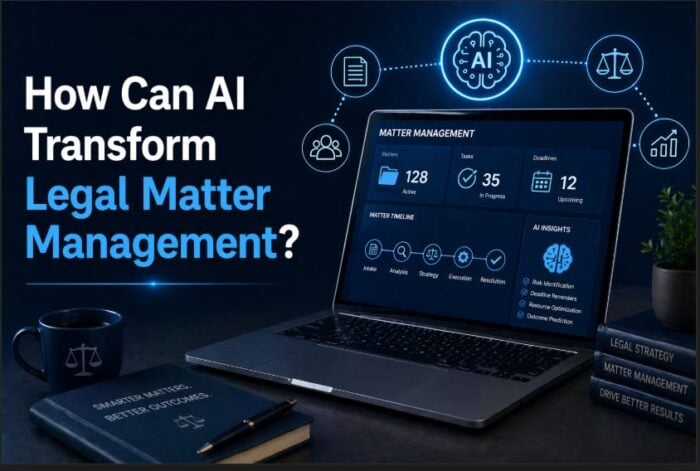

AI for legal matter management is the use of artificial intelligence to automate, structure, and optimize how legal matters are created, tracked, assigned, and resolved within a legal department. Matter management is one of the most operationally complex areas in legal. It sits at the center of everything: intake, allocation, tracking, reporting, and decision-making. When it runs poorly, the entire legal function slows down.
This article is part of the Legal AI hub and builds on the matter allocation discussion in the AI to reduce outside counsel spend article.
How AI is transforming legal matter management:
- Automating intake: structuring incoming legal requests.
- Improving matter routing: assigning work based on complexity and capacity.
- Enhancing visibility: tracking matter status in real time.
- Standardizing workflows: creating consistent matter handling processes.
- Enabling data-driven decisions: using insights to improve performance.
Matter management is the operational backbone of a legal department. AI is what finally makes it scale.
Why is matter management difficult to scale?
Matter management gets harder as volume grows because most of the underlying processes were never built to scale. The common failure points:
- Unstructured intake: requests come through email, Slack, hallway conversations.
- Inconsistent routing: work gets assigned manually or by who is available.
- Limited tracking: no real-time visibility into matter status.
- Fragmented data: information scattered across systems that do not talk to each other.
- External communication gaps: updates to the business and coordination with outside counsel happen through email threads, where billing guidelines and matter expectations get lost before they can be enforced.
The Thomson Reuters State of the Corporate Law Department report continues to show legal teams under pressure to manage higher workloads without proportional resource increases.
How does AI improve matter intake?
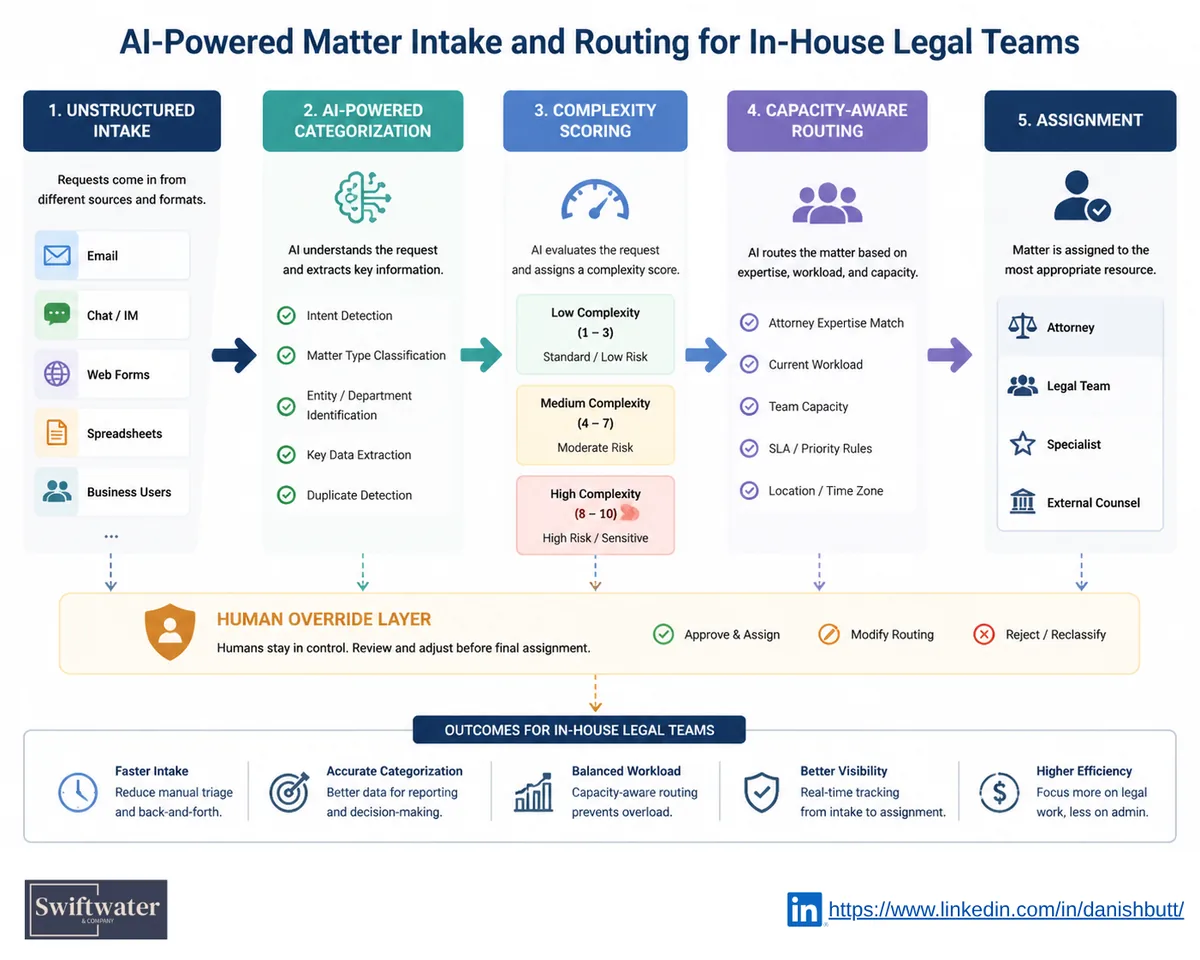
AI turns unstructured legal requests into structured, routable matters. Legal matter intake is the process of receiving, categorizing, and prioritizing legal requests from the business.
The first thing AI does is convert whatever arrives (email, Slack, form submission, forwarded document) into a standardized format with the fields the department actually uses. It then classifies the matter by type, urgency, and complexity, extracts the relevant details without the lawyer having to re-enter them, and reduces the manual triage work that sits between a request landing and a lawyer seeing it.
Managing an internal investigation or regulatory matter?
Swiftwater supports legal and compliance teams with the operational infrastructure, vendor coordination, and program management that complex investigations demand.
Book a Discovery CallThe 2026 ACC Chief Legal Officers Survey consistently highlights workload management as a top challenge, and intake inefficiencies are a major contributor.
What is available within AI for legal matter management?
The market is developing along two opposite directions, and a general counsel should understand both before picking a path.
The first direction comes from the established matter management and ELM platforms. Vendors like Onit, Thomson Reuters, Mitratech, and SimpleLegal are embedding proprietary AI engines that aggregate data from selected fields inside the matter application: status reports, billing data, matter summaries, outside counsel interactions, deadlines.
The outputs these engines produce are familiar to anyone who runs a legal operations team: draft status reports, spend anomalies, workload views, and early warnings. Coverage extends to whatever the platform already captures, which is often deep for operational data but thinner outside it. Swiftwater’s guide to matter management within ELM systems covers the operating model underneath these platforms.
The second direction is coming from the AI platforms themselves. Harvey, for example, is building from the opposite end: provide a powerful AI workspace, invite the legal department to bring its data in, and let teams build applications on top. The advantage is flexibility and AI quality at the core. The trade-off is that the matter-management features are not embedded into the operational system of record, so data has to flow in from elsewhere and outputs have to flow back.
How does AI improve matter routing and allocation?
Routing decisions determine throughput. Matter routing is the process of assigning legal work to the appropriate lawyer, team, or external counsel. AI improves it by:
- Assessing complexity: matching matters to the right level of expertise.
- Evaluating capacity: distributing work based on current availability.
- Recommending assignments: suggesting optimal allocation.
- Balancing workloads: preventing overload of specific team members.
Swiftwater’s Danish Butt is currently leading an AI triage build for a client standing up a new legal service request capability. The system learns from explicit rules and human input in its first weeks, then returns routing recommendations that a human can override. The target is to eliminate the mundane marshalling of matter flow across a globally distributed legal team so recovered time converts directly into capacity. The Swiftwater managed services practice embeds these patterns into its delivery model.
How does AI improve matter visibility and tracking?
Visibility is one of the biggest gaps in legal operations. Matter visibility is the ability to track the status, progress, and outcomes of legal work in real time.
AI keeps matter status current without lawyers having to update it manually, which is where most visibility programs quietly fail. It rolls up trends across matters over time so the department can see which types of work are growing, stalling, or costing more than expected. And it surfaces performance insights like turnaround times and outcome patterns that are nearly impossible to extract from a system of record built around individual matters.
Bloomberg Law legal operations surveys continue to show legal teams prioritizing better data and reporting capabilities. This is also why eBilling tools alone are not enough: invoice data in isolation cannot drive matter-level insight without the matter context AI now makes usable.
How does AI standardize legal workflows?
Consistent workflows are the foundation of measurable legal operations. AI supports standardization by:
- Embedding workflows: ensuring consistent steps are followed across matters.
- Automating approvals: triggering actions based on predefined rules.
- Reducing variation: limiting unnecessary deviations across teams.
- Improving compliance: ensuring defined processes are actually followed.
The agentic AI article covers how these workflow patterns extend into autonomous execution.
Running an ELM or eBilling implementation?
Swiftwater has three Level 4 Onit-certified practitioners. If you're evaluating, implementing, or rescuing an ELM program, let's talk about what that actually takes.
Book a Discovery CallWhat impact does AI have on legal operations performance?
AI turns matter management from a cost center into a measurable operations system.
Throughput increases because the department handles more matters without adding headcount. Cycle times compress because the handoffs that used to sit in someone’s inbox now move through the system automatically. Consistency improves because similar matters are handled the same way by default, not because every lawyer independently applies the same judgment. And decision-making improves because there is finally enough clean data to make resource and staffing decisions based on evidence rather than instinct.
This is the economic case that underpins the business case for AI in the legal department.
What risks should legal teams manage?
AI matter management risk is the potential for incorrect routing, incomplete data capture, or over-reliance on automated decisions. Key risks:
- Incorrect classification: misidentifying matter type or priority, sending work the wrong way.
- Over-automation: reducing the human judgment that should stay in the process.
- Data quality issues: poor inputs producing poor outputs at scale.
- Adoption gaps: teams using the system inconsistently or bypassing it entirely.
- Bias: classification models trained on historical data can propagate the routing biases they were meant to fix.
AI must enhance control, not replace it. The broader risk treatment sits in AI legal risk management in-house and the legal AI governance framework.
Bottom line
Matter management is the operational backbone of a legal department, and AI is what finally lets it scale. The teams that win are those that structure intake, route by capacity and complexity, standardize workflows, and measure the outcomes. None of that works without clean, reliable data underneath it. Dirty matter data produces wrong classifications, wrong routings, and wrong insights at scale, which is why data quality is the precondition for every other gain in this article. AI can truly improve matter management while scaling legal operations, but only on a foundation of clean and reliable data.
If you are looking to improve matter management and operational efficiency, explore how Swiftwater’s Legal AI Solutions help legal teams automate workflows, improve visibility, and scale operations effectively.
Frequently Asked Questions
What is AI for legal matter management?
AI for legal matter management is the use of artificial intelligence to automate, structure, and optimize how legal matters are created, tracked, assigned, and resolved within a legal department.
How is AI transforming legal matter management?
AI is transforming matter management by automating intake, improving routing, enhancing visibility, standardizing workflows, and enabling data-driven decision-making.
Why is legal matter management difficult to scale?
Matter management is difficult to scale due to unstructured intake, inconsistent routing, limited tracking, fragmented data, and poor coordination across systems and teams.
How does AI improve legal matter intake?
AI converts unstructured requests into structured data, classifies matters by type and urgency, and reduces manual triage by automatically extracting key information.
How does AI improve matter routing and allocation?
AI evaluates matter complexity and team capacity to recommend optimal assignments, balance workloads, and improve overall efficiency in handling legal matters.
How does AI enhance matter visibility and tracking?
AI provides real-time tracking of matter status, surfaces trends, and generates performance insights without requiring manual updates from legal teams.
What impact does AI have on legal operations performance?
AI increases throughput, reduces cycle times, improves consistency, and enables better decision-making by providing structured and actionable data.
What risks should legal teams consider when using AI in matter management?
Key risks include incorrect classification, over-automation, poor data quality, inconsistent adoption, and bias in automated decision-making.
Running an ELM or eBilling implementation?
Swiftwater has three Level 4 Onit-certified practitioners. If you're evaluating, implementing, or rescuing an ELM program, let's talk about what that actually takes.
Book a Discovery CallThis article is provided for educational and informational purposes only. Neither Swiftwater and Company nor the author provides legal advice. This content does not constitute professional legal, financial, or operational advice and should not be relied upon as such. Readers are encouraged to consult a qualified professional before making decisions based on the information provided. External links are included for reference only and reflect the views of their respective authors. Swiftwater and Company takes no responsibility for third-party content.