


When you hear “Legal AI,” it’s easy to picture sci-fi robot lawyers arguing in court. But the reality is far more practical and, frankly, more useful. Think of it less like a robot lawyer and more like a super-powered paralegal who works around the clock, handling the most tedious, data-heavy work with incredible speed and accuracy.
What Is Legal AI and Why It Matters Now
At its heart, legal AI is specialized software that uses technologies like machine learning and natural language processing to assist, augment, and sometimes automate tasks that have traditionally bogged down lawyers and their support staff. It’s not here to replace sharp legal minds. It’s here to enhance them.
This technology acts as a powerful amplifier for human expertise. It can sift through millions of documents in an afternoon, pinpoint crucial information, and spot patterns a team of people might miss over weeks.
Imagine this scenario: you need to review 100,000 emails for a single, pivotal piece of evidence in a high-stakes case. That task could tie up junior associates or paralegals for weeks, running up a massive bill for the client. A well-trained legal AI tool can often go through that same dataset in mere hours, and with greater accuracy. This is the core promise of AI in the legal field – shifting from grueling manual labor to intelligent, focused automation.
Selected Latest News
Here is some selected news (fairly fresh) to show how law firms (mostly) & corporations have been announcing their embracing of AI tools.
- DLA Piper continues firmwide use of Microsoft Copilot and legal AI tools like Harvey, CoCounsel, and LexisNexis Protégé, with custom language models for compliance risk detection.
-
Sidley Austin reports growing organic AI adoption among litigators and transactional lawyers, focusing on user feedback and junior lawyer training, including AI hackathons.
-
Ropes & Gray employs Harvey and Hebbia with rigorous vendor risk audits and active involvement of technology leaders in AI product evaluation.
-
Morgan Lewis requires staff certification for AI tool use and collaborates closely with Thomson Reuters on AI product development and reviews.
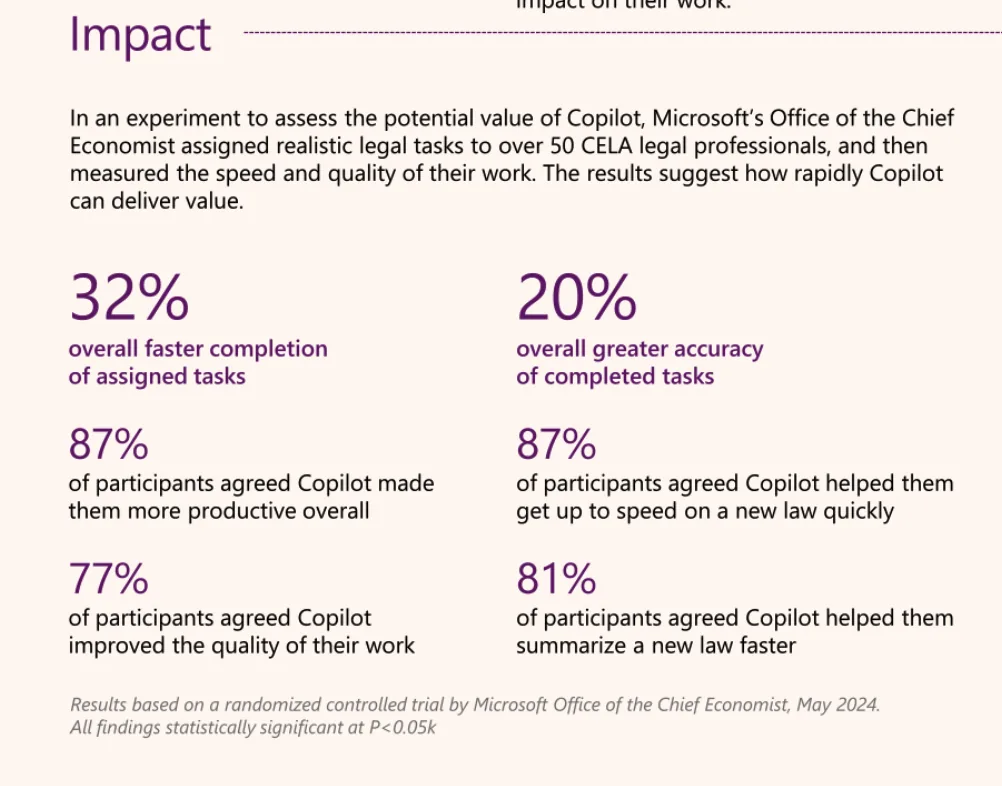
- Microsoft Legal (CELA) Team self-reporting impact of Co-pilot adoption
The Driving Forces Behind AI Adoption
The surge in legal AI isn’t happening in a vacuum. It’s a direct response to two massive pressures squeezing the legal industry. First, the explosion of digital data – emails, texts, contracts, cloud documents – has created a review and discovery challenge that is simply beyond human capacity to manage effectively.
Thinking about AI but not sure what is actually ready to deploy?
Swiftwater's AI Lab helps legal departments separate signal from noise, identifying where AI creates real leverage and building the governance to use it responsibly.
See Legal AI SolutionsAt the same time, clients are smarter and more demanding than ever. They’re pushing back hard on the traditional billable hour for routine work and demanding more value and cost predictability. Legal AI is the answer to that pressure, helping legal teams work smarter, not just harder. It directly helps by:
- Automating repetitive work, which frees up legal professionals to focus on high-value strategic thinking and client counsel.
- Improving accuracy by eliminating the human error that can creep into high-stakes document review and contract analysis.
- Controlling costs by getting work done faster and more affordably, which ultimately improves profitability and client satisfaction.
The market growth tells the story. The global legal AI market, currently valued at around USD 1.45 billion, is on a trajectory to hit approximately USD 3.90 billion by 2030. You can find more details on this explosive growth in reports like this one on the legal AI market from Grandview Research. This isn’t just a niche trend; it’s a fundamental shift in how the industry operates, from eDiscovery and contract management to ensuring regulatory compliance.
This isn’t some far-off, futuristic concept anymore. Explore Swiftwater’s complete Legal AI Resource Center for implementation frameworks, governance guidance, adoption strategies, and legal AI use cases. It’s a practical tool that’s available today, and it’s already changing how legal work gets done. Legal professionals evaluating where to begin should first understand their organization’s current maturity level. A structured legal AI readiness assessment helps identify the governance, data, process, and adoption foundations needed for successful implementation.Firms and legal departments that embrace these tools are building a serious competitive advantage. Those who wait risk falling behind.
Legal AI Capabilities at a Glance
So, what can these systems actually do? Instead of just talking in hypotheticals, let’s break down the core functions. The table below outlines the key capabilities of modern legal AI and the specific problems they solve for legal teams every day.
| AI Capability | Description | Problem Solved |
|---|---|---|
| Document Review | Uses NLP to analyze vast datasets (emails, contracts, records) to find relevant information, keywords, and concepts for litigation or investigations. | Drastically reduces the time and cost of eDiscovery and internal investigations, which are often too large for manual review. |
| Contract Analysis | Extracts key clauses, dates, obligations, and risk factors from contracts. Can compare clauses against a standard playbook. | Speeds up due diligence, identifies non-standard or risky terms, and helps manage contractual obligations post-signature. |
| Legal Research | Scours case law, statutes, and legal precedents to find the most relevant authorities for a specific legal question, often ranking them by relevance. | Accelerates the research process from days to hours, uncovers arguments that might have been missed, and ensures more thorough preparation. |
| Outcome Prediction | Analyzes historical case data to forecast the likely outcome of litigation, potential damages, or a judge’s tendencies. | Informs litigation strategy, helps in setting client expectations, and provides a data-driven basis for settlement negotiations. |
| Compliance Monitoring | Scans regulatory updates and internal communications to identify potential compliance breaches or new requirements. | Reduces regulatory risk, automates the monitoring of changing laws, and helps ensure internal policies are being followed. |
These capabilities are not just about making old processes a little faster. They represent a new way of working – one that empowers legal professionals to make smarter, data-driven decisions and, ultimately, deliver better results for their clients. This guide will explore exactly how.
Swiftwater Partners with AI Leaders in the Industry
Swiftwater’s team of advisors are expert in the field and proponents of AI. We continually, look to develop, partner and invest in solutions that are using AI in a meaningful way.
Here are a few recent partnerships with industry leading legal AI platforms that we have announced:
- Clearlaw.ai – unlocking contracting intelligence.
- Legaldecoder.com – going deeper into legal spend data to uncover where the next level of savings and operational improvements is going to come from.
- Onit.com – a comprehensive legal platform leveraging cutting edge technology and AI for law department management (ELM, CLM, Legal Hold, Corporate Investigations, and more).
We have jointly invested in these partnerships so our clients can receive premium results.
The Core Technologies Powering Legal AI
To really get what makes legal AI tick, you have to pop the hood and look at the technologies driving it. These aren’t some far-off, sci-fi concepts; they’re established fields of computer science that, when pointed at the legal world, create some seriously powerful tools for getting work done smarter and faster. Think of them as the engine, the GPS, and the seasoned co-pilot all working in sync.
At the heart of most legal AI is Generative AI (GenAI) and Natural Language Processing (NLP). This is the tech that gives software the ability to actually read, understand, and interpret human language. In the legal space, GenAI & NLP are like a veteran lawyers who don’t just see the words in a contract but instinctively understands their meaning, nuance, and context. It’s what lets a platform know the massive difference between “terminate for cause” and “terminate for convenience.”
This goes way beyond a simple keyword search. GenAI systems can pick out concepts, sentiment, and the relationships between different parts of the text, making it a game-changer for tasks like eDiscovery and contract analysis.

Machine Learning and Predictive Analytics
The next piece of the puzzle is Machine Learning (ML). This is a branch of AI where systems learn and get better from data without someone having to explicitly code every single rule. Think of a junior associate who gets better at finding relevant case law with every research project. The first time, they need a lot of hand-holding. By the hundredth time, they’ve developed a gut feeling for what’s important. ML does the same thing, just on a huge scale.
You can train an ML model on tens of thousands of past contracts – but, with GenAI and pre-trained models this task requires handful of samples for a fairly good response. Over time, it learns to spot standard clauses, flag weird language, and recognize potential risks. The more data it sees, the sharper its analysis gets. This ability to continuously improve is what makes ML so potent for legal work.
Evaluating legal technology but not sure where to start?
We help legal departments cut through the vendor noise, mapping technology to process maturity and building a roadmap that actually gets adopted.
See Legal TechnologyBuilding on that foundation, Predictive Analytics uses all that historical data to forecast what might happen next. This is like a senior partner’s uncanny knack for guessing the odds of winning a case, built on decades of experience.
Predictive analytics doesn’t offer a crystal ball, but it provides a data-driven edge. It answers critical questions like, “Based on similar cases in this jurisdiction, what is our likely range of damages?” or “What is the probability of a motion to dismiss being granted before this judge?”
It pulls this off by analyzing thousands of past case outcomes, judicial rulings, and settlement amounts to find patterns that can help shape today’s strategy. It gives lawyers hard numbers to back up their professional judgment. Now with GenAI this is faster. With Model Context Protocol (MCP) – a sort of a pipeline/connector – between GenAI and business tools you can access the data in even a faster manner.
The Economic Impact of These Technologies
The rapid growth and adoption of these technologies are fueling some major investment. The total legal technology market, where legal AI is a star player, was valued at around USD 27.32 billion and is projected to more than double to roughly USD 65.51 billion by 2034. In the U.S. alone, that market is expected to hit about USD 27.16 billion by 2034, which shows just how hungry the industry is for these tools. You can dig into the numbers behind these projections and find out more about legal tech market trends on Precedence Research.
This financial momentum makes it clear: the legal industry is shifting toward data-first operations. These core technologies aren’t just buzzwords anymore; they are the fundamental toolkit that’s changing the business of law, each with a specific job:
- Natural Language Processing (NLP): Focuses on understanding the meaning and context of legal text.
- Machine Learning (ML): Focuses on learning from data to get better at tasks like classifying documents.
- Predictive Analytics: Focuses on forecasting future events based on what’s happened in the past.
- Generative AI (GenAI): Focuses on generating new outputs – text, ideas, insights, and even code – by synthesizing vast volumes of legal and business data. It’s accelerating legal research, drafting, analysis, and decision-making across practice areas.
Together, they form a powerful combination that is completely changing how legal services are delivered.
How Legal AI Is Actually Used in Corporate Legal Departments
Let’s move from the abstract to the real world. Legal AI isn’t some far-off concept anymore; it’s being put to work right now, delivering real results for legal teams. By looking at a few concrete scenarios, we can see exactly how this tech is changing the day-to-day grind of legal work.
Picture a massive corporate merger. The due diligence alone requires digging through tens of thousands of contracts, emails, and financial records. Historically, this was a mind-numbing task that would bog down entire teams of junior associates for weeks, if not months. It was slow, expensive, and – worst of all – riddled with the risk of human error. Missing one crucial clause could put the whole deal in jeopardy.
This is exactly where Legal AI changes the game.

AI-Powered eDiscovery and Document Review
One of the most immediate and powerful uses of Legal AI is in eDiscovery. During litigation, the sheer volume of electronic data – from emails to internal chat logs – can be completely overwhelming. A legal AI platform can tear through millions of these documents in just a few hours, flagging potentially relevant information with a level of accuracy that’s frankly stunning.
Instead of having paralegals manually hunt for keywords, the AI actually understands context and concepts. It can spot privileged communications, pinpoint “hot documents” that are critical to the case, and organize everything thematically. This doesn’t just speed up the discovery process by up to 50-70%; it massively cuts down the associated costs for clients.
Supercharging Contract Analysis and Management
Another game-changer is AI contract analysis. When you’re managing a huge portfolio of agreements, an AI tool can instantly pull out key data points like renewal dates, liability caps, and weird, non-standard clauses. It can even compare an incoming contract against your company’s standard playbook, highlighting risky language that needs a lawyer’s expert eye.
A global pharmaceutical manufacturer recently told me their goal for buying a contract management system, “Danish, if I can just get all our contracts contracted using correct entities, I can sleep well at night.”
I helped them implement a solution that uses AI contract templates for reviewing and drafting. They were not only able to enforce correct entity usage but also bring standardization to third-party MSA contract review which required massive coordination and focus to get right every time.
AI is a multi-talented player on the team that can accomplish multiple things, given the right use-case and circumstances are applied.
Evaluating or implementing a CLM platform?
We have guided legal departments through selection, implementation, and adoption, without the vendor bias. Let us talk about where you are and what you actually need.
See CLM ServicesFor example, a legal team managing a large real estate portfolio could use AI to review hundreds of lease agreements at once. The tool could instantly flag any leases that deviate from standard insurance or indemnity clauses – a job that would take a human reviewer days to finish.
This kind of power lets lawyers shift their focus from tedious proofreading to high-value strategic negotiation. It’s no surprise that advanced platforms now use AI as a core component of their legal document automation software, turning document creation and analysis into a much more efficient process. And, contract management software vendors are now incorporating multiple use cases for AI such as drafting, redlining, comparing, standardizing, obligation management, etc.
Enhancing Legal Research and Strategy
Traditional legal research has always been a slog. It meant hours spent digging through databases, hoping to stumble upon relevant case law. Legal AI platforms flip this on its head with search capabilities that go way beyond simple keywords. They understand the nuances of a legal query and can surface cases based on factual similarities and core legal concepts.
Here’s how that plays out:
- Uncovering Hidden Precedents: AI can dig up relevant rulings from completely different jurisdictions that a human researcher might easily miss, giving legal arguments a much stronger foundation.
- Predictive Analytics: Some tools can even analyze judicial histories to forecast potential case outcomes. This gives lawyers a data-driven basis for advising clients on whether to settle a case or take it to trial.
- Workflow Integration: These capabilities are all part of a bigger picture. To see how these tools fit into a modern legal department’s operations, check out our guide on legal workflow automation and its wider impact.
Beware of the AI “hallucination” monster, while it is getting better but if not kept in check, AI may get you your 15 minutes of fame (and, a hefty fine).
And, in other news most of the traditional research providers have promised or beta-released their “agentic” research tools which leverage AI and agentic principles.
By taking over the foundational grunt work, Legal AI frees up attorneys to do what they do best: build creative arguments, advise clients, and craft winning strategies. It represents a fundamental shift from simple information retrieval to true legal analysis, all powered by smart technology.
To put this in perspective, let’s compare how these tasks are handled with and without AI. The differences in time, cost, and accuracy are stark.
Comparing Manual vs AI-Powered Legal Tasks
| Legal Task | Manual Approach (Time & Risk) | AI-Powered Approach (Time & Benefit) |
|---|---|---|
| Due Diligence | Weeks/Months. A team of junior lawyers manually sifts through thousands of documents. High risk of missed clauses and human fatigue. | Hours/Days. AI scans, categorizes, and flags key risks in minutes. Frees up lawyers for strategic review. |
| eDiscovery | Months. Paralegals and associates conduct keyword searches across millions of files. Extremely costly and prone to over- or under-collection. | Days. AI understands context, identifies relevant documents, and culls irrelevant data, cutting review time by 50-70%. |
| Contract Review | Days. A lawyer manually reads every line to find non-standard terms, renewal dates, and obligations. Inefficient and inconsistent. | Minutes. AI extracts key data points, compares against a playbook, and flags deviations instantly. Enables proactive management. |
| Legal Research | Hours. Searching databases with keywords, reading through countless irrelevant cases to find a few key precedents. | Minutes. AI understands the query concept and surfaces the most relevant case law and judicial analytics, strengthening arguments. |
As the table shows, this isn’t just a minor improvement. It’s a complete overhaul (if embraced fully) of how legal work gets done, allowing firms and legal departments to operate more profitably while delivering far greater value to their clients and business partners.
The Real-World Benefits of Adopting Legal AI
The practical advantages of bringing legal AI into daily operations are tangible and, frankly, compelling. Law firms and corporate legal departments aren’t just running experiments anymore; they’re seeing real returns by tackling core operational headaches head-on. The benefits go far beyond simple automation, fundamentally changing how legal services are delivered.
If you have not heard about Garfield Law and that “The UK’s Solicitors Regulation Authority (SRA) has said it has ‘authorised the first law firm providing legal services through AI’,” you should read about it here. I have been intrigued about it and plan to interview Daniel and Philip Young in an upcoming webinar series.
At the most basic level, AI drives incredible gains in efficiency. Just think about the thousands of hours legal teams traditionally sink into manual document review for a single big case. A legal AI platform can accomplish that same task in a tiny fraction of the time. This doesn’t just eliminate monotonous work; it frees up skilled attorneys and paralegals to focus on high-value activities – crafting legal strategy, negotiating settlements, and counseling clients directly.
This shift isn’t just about making lawyers’ lives better; it has a direct impact on the bottom line. Research suggests AI can save lawyers about four hours per week. By allowing them to take on more substantive work, that time could translate into $100,000 in new billable time per lawyer annually. And, from a corporate legal department’s perspective if they can get a fraction of that savings or get a more focused, substantive, creative legal opinion then I say we chalk it as a win-win.
Enhancing Accuracy and Mitigating Risk
While speed is a huge plus, the boost in accuracy is arguably even more critical. Let’s be honest, human error is an unavoidable risk in high-stakes legal work. Fatigue is real, especially during those marathon document review sessions. A single missed keyword or a misinterpreted clause can have devastating consequences for a case or a business deal.
Legal AI systems don’t get tired or lose focus. They apply the same rigorous analysis to the millionth document as they do to the first, consistently flagging risks, identifying key clauses, and uncovering relevant evidence. By providing a reliable second set of “eyes” on every document, these tools become a powerful risk mitigation layer. While I caution against “hallucinations” and “bad data proliferation”, I am also optimistic that those can be mitigated by solution providers and users adjusting to the new normal.
A major driver for adoption is the ability to wrangle massive volumes of legal data more effectively. According to one survey, 59% of legal professionals see this as a key area where AI can deliver the most value, followed by improving client response times and cutting down on human error.
Driving Down Costs and Enabling Data-Driven Strategy
The operational cost savings from legal AI can be substantial. When you automate routine tasks in eDiscovery, contract analysis, and due diligence, you dramatically reduce the overhead tied to these processes. This doesn’t just improve profitability; it allows for more competitive and predictable pricing – something clients are demanding more and more. These savings add up, and knowing how to track them is vital. You can find detailed strategies for this in our guide to using legal spend AI tools.
But perhaps the most strategic benefit of all is the shift toward data-driven decision-making. Legal AI uncovers insights that were previously buried in documents, transforming legal departments from cost centers into strategic business partners.
Here are a few examples of how this plays out:
- In Litigation: Predictive analytics can model potential case outcomes based on historical data. This gives lawyers a statistical edge when advising clients on whether to settle or head to trial.
- In Transactions: AI can analyze thousands of previous deals to benchmark terms, identify market standards, and flag outlier clauses that pose hidden risks.
- In Compliance: These tools can continuously monitor regulatory changes and internal communications, helping to proactively spot and address potential compliance gaps before they escalate into major problems.
By turning raw data into actionable intelligence, legal AI gives attorneys the information they need to provide smarter counsel, negotiate more effectively, and secure better outcomes for their clients and their organizations.
Navigating The Risks And Ethics Of AI In Law
For all the incredible benefits, adopting legal AI responsibly means we have to look its challenges squarely in the eye. As legal AI adoption expands, formal governance becomes increasingly important. Establishing a documented legal AI governance framework helps legal departments define accountability, acceptable use policies, oversight processes, and risk controls before AI usage scales across the organization. It’s easy to get swept up in the excitement for efficiency, but that has to be balanced with a clear-eyed view of the ethical hurdles and real-world risks. These aren’t just abstract technical problems; they cut to the very core of a lawyer’s professional duties.
Embracing these tools isn’t just about buying software. It’s about committing to navigate their complexities ethically, harnessing the power of AI without ever compromising on the principles of justice, confidentiality, and professional responsibility that define what we do.

The Black Box Problem And Human Oversight
One of the loudest alarm bells is the “black box” problem. This is what happens when an AI system gives you an output – say, a case prediction or a contract risk score – but can’t provide a clear, understandable reason for how it got there. For a lawyer who has to justify every piece of advice to a client or a judge, this lack of transparency is a deal-breaker.
The legal profession simply can’t afford to run on answers it can’t verify. This is precisely why human oversight isn’t just a good idea; it’s a professional mandate. A lawyer is always, without exception, responsible for their work product, no matter what tool they used to help create it. A recent survey drove this home, revealing that 96% of legal professionals believe letting AI represent clients in court would be a completely inappropriate use of the technology.
The guiding principle couldn’t be simpler: AI is there to augment a lawyer’s judgment, not replace it. The final call, the strategic advice, and the ethical accountability must always, always rest with a human expert.
Data Privacy And Algorithmic Bias
Legal AI systems are hungry for data, which immediately brings up two massive red flags: privacy and bias. First, the idea of feeding confidential client information into an AI platform without bulletproof security and data governance protocols is an ethical minefield. Protecting client data isn’t just a priority; it’s a non-negotiable duty.
Second, an AI model is only as fair as the data it was trained on. If an AI learns from historical case data that reflects old societal biases, it’s not just going to repeat those prejudices – it might even amplify them. This could poison outputs in critical areas like sentencing recommendations or risk assessments. A fundamental part of any AI rollout has to involve addressing fairness and accountability in AI to head off these kinds of unjust outcomes.
Practical Steps For Responsible AI Adoption
Getting ahead of these risks demands a proactive, thoughtful game plan. This isn’t about just buying a license; it’s about building a framework for responsible use. Here are a few essential steps to get started:
- Prioritize Transparent AI: When you’re vetting vendors, make them show you how their models work. Steer clear of “black box” solutions and insist on getting clarity about the data sources used to train their systems.
- Establish Strong Data Governance: You need to implement rock-solid policies that dictate what client data can be used with AI, how it gets anonymized, and who has the keys to access it. Make sure your vendor’s security is just as robust.
- Conduct Bias Audits: Don’t just trust; verify. Regularly test your AI tools for biased outputs. This could mean running test cases with diverse data sets to see if the system consistently produces skewed or unfair results.
- Mandate Human-in-the-Loop Workflows: Design your processes so that AI-generated work is never the final word. Every output, whether it’s a draft, a summary, or an analysis, must be reviewed, verified, and signed off on by a qualified lawyer before any action is taken.
By taking these steps, law firms and legal departments can bring legal AI into their workflows with confidence. You can unlock the powerful benefits while fully upholding your ethical obligations to your clients and the justice system as a whole.
A Practical Framework for Implementing Legal AI

[This is a very informational session by Dan Garrison, CEO of Open Wallet, and Elizabeth Warner, in which they discuss The Future of Legal Practice: Navigating the Intersection of Technology and Law. In it they discuss areas where AI is disrupting the legal practice.]
Bringing legal AI into your department can feel like a massive undertaking, but with the right framework, you can break it down into a series of practical, manageable steps. This isn’t about flipping a switch and hoping for the best. It’s a deliberate process of finding real problems, testing solutions on a small scale, and then scaling what actually works.
The secret to a successful rollout isn’t starting with the flashiest technology. Many legal teams discover that technology selection is only one component of success. Organizational readiness, stakeholder alignment, training, and adoption planning often determine whether an AI initiative creates lasting value or remains a limited pilot project. It starts with a specific, high-value business problem that’s causing real pain.
Think about the biggest bottlenecks in your legal operations. Is it the endless weeks spent on manual contract review during a critical M&A deal? Maybe it’s the snail’s pace and sky-high costs of eDiscovery. Find one clear, nagging issue where making a dent in inefficiency would deliver a huge win. That focused problem becomes the north star for your entire AI initiative.
Start Small With a Pilot Project
Once you’ve zeroed in on a clear use case, it’s time to run a controlled pilot project. Resist the urge to go for a “big bang” implementation across the entire department. Instead, hand-pick a small, motivated team and give them a specific AI tool designed to solve the exact problem you identified.
A pilot project is invaluable for a few key reasons:
- It Tests the Tech: This is your chance to see if the vendor’s glossy brochure lives up to reality in a low-risk, real-world setting.
- It Gathers Real Feedback: You get unfiltered input from the lawyers and paralegals who will be in the trenches with the tool every single day.
- It Builds Your Business Case: Nothing gets buy-in like hard data. A successful pilot gives you the success stories and metrics you need to justify a wider rollout.
This initial phase is all about learning. What features are game-changers? What parts are clunky? How steep is the learning curve for your team? The answers you get here are gold and will shape your entire long-term strategy. For law firms and other non-tech organizations, figuring out the specific resources you’ll need is critical.
The goal is to move from theory to practice with minimal disruption. A pilot project de-risks the investment and proves the value of legal AI with concrete evidence, making it far easier to justify further expansion.
Measure Success and Scale Thoughtfully
To prove your pilot was worth it, you have to measure its impact. Before you even start, you need to define the key performance indicators (KPIs) you’ll be tracking. These shouldn’t be vague goals; they need to be clear, quantifiable metrics that tie directly back to the problem you set out to solve.
Key Metrics to Track:
- Time Savings: How many hours did the team save on document review or contract analysis compared to doing it the old way?
- Cost Reduction: What were the direct cost savings? This could be a reduction in outside counsel spend or avoiding the need for temporary staff for eDiscovery.
- Accuracy Improvement: Did the AI tool catch critical errors or flag risks that human reviewers might have missed?
Armed with positive results from your pilot, you can start to scale the implementation thoughtfully. This means expanding the tool’s use to other teams, rolling out more comprehensive training, and weaving it more deeply into your department’s standard operating procedures. This measured, step-by-step approach is a hallmark of operational excellence. For legal ops leaders driving these changes, understanding how can the head of legal operations implement continuous improvement is fundamental to making these new tools stick and deliver long-term value.
By following this simple framework – identify, pilot, measure, and scale – you can bring legal AI into your organization methodically and effectively, ensuring you get a real return on your investment.
Frequently Asked Questions About Legal AI
As legal AI starts showing up in more and more legal workflows, it’s completely natural for questions and a healthy dose of skepticism to pop up. Let’s tackle some of the most common ones head-on to clear up the confusion and set the record straight on how this technology fits into the real world of legal work.
Will AI Replace Lawyers?
This is the big one, the question on everyone’s mind. And the answer is a straightforward, resounding no. The consensus from just about every corner of the legal world is that AI is here to augment lawyers, not replace them.
Think of it less as a replacement and more as the world’s most powerful paralegal. It’s built to handle the soul-crushing, repetitive, data-heavy lifting that bogs down your day. This frees up attorneys to focus on the distinctly human – and frankly, more valuable – parts of the job. That means more time for strategic thinking, building real client relationships, exercising professional judgment, and crafting the kind of nuanced legal arguments that win cases. A recent survey backs this up, showing that 85% of legal professionals see AI as a catalyst for learning new skills, not a threat to their careers.
How Much Does Legal AI Cost?
There’s no single price tag for legal AI. The cost can swing pretty dramatically based on what the tool does, who makes it, and how they decide to charge for it. Most pricing, however, falls into a few common buckets.
- Subscription Models: The most common approach. You’ll see monthly or annual fees, usually based on how many people on your team will be using it or the amount of data you’re running through the system. This makes budgeting predictable.
- Per-Use Fees: Some platforms, especially in a space like eDiscovery, charge based on consumption – think per-document or per-gigabyte fees. This can be a smart move if your need for the tool is sporadic and project-based.
- Hybrid Models: You’ll also find vendors who mix and match, offering a base subscription fee that comes with a data allowance, plus overage charges if you go over your limit.
When you’re weighing the cost, it’s a mistake to just look at the sticker price. The real calculation is the return on investment you get from massive efficiency gains and slashed risk.
Is It Hard to Get My Team on Board?
Getting your team to actually use a new tool can feel like an uphill battle, but it doesn’t have to be. The secret to success is twofold: pick tools that are genuinely easy to use and make sure your vendor provides solid training and support.
The real key, though, is showing your team why it matters to them personally.
When lawyers and paralegals see with their own eyes how a tool can vaporize hours of tedious work and help them deliver better results, they don’t just accept it – they champion it.
A great way to get the ball rolling is to start small. Run a focused pilot project on a real-world problem. This creates internal advocates who will then help you drive adoption across the rest of the department. The goal is to prove that legal AI isn’t just another piece of complex software to learn, but a practical solution that makes their daily work life better. But, please onboard a partner who has done this before – doing it alone seems a good idea until you are on year 2 (true story) and you are not sure if you want to continue or cut your losses on the ‘pilot’ you started.
Related Reading
- AI for In-House Legal Teams: A Practical Guide for General Counsel→ — to learn more about AI for in-house legal teams, along with a 30-90 day plan for adoption
- AI for In-House Legal Teams: A Practical Guide for General Counsel → Practical implementation roadmap for corporate legal departments.
- What Legal AI Governance Framework Does Your GC Need? → Governance structures, policies, and oversight models for legal AI programs.
Looking to Build a Practical Legal AI Strategy?
Successful legal AI programs require more than technology. They depend on governance, operational readiness, process design, adoption planning, and measurable business outcomes.
Learn how Swiftwater’s Legal AI Solutions help legal departments evaluate, implement, and scale AI responsibly.
Frequently Asked Questions
What types of legal professionals benefit most from legal AI?
Legal AI creates value across the legal profession, including law firm attorneys, in-house counsel, legal operations professionals, contract managers, compliance teams, paralegals, and litigation support specialists. The greatest benefits are typically seen in high-volume workflows involving documents, contracts, research, and regulatory analysis.
How should legal professionals evaluate legal AI platforms?
Legal professionals should evaluate platforms based on use-case alignment, accuracy, security controls, data governance, integration capabilities, vendor support, and the platform’s ability to fit into existing legal workflows. Practical testing with real-world legal scenarios is often the most effective evaluation method.
What is the difference between legal AI and legal technology?
Legal technology is a broad category that includes software used to manage legal work, such as document management, eBilling, and contract lifecycle management systems. Legal AI refers specifically to technologies that use machine learning, natural language processing, and generative AI to analyze information, generate insights, and automate legal tasks.
Which legal processes are best suited for AI adoption?
The strongest candidates for AI adoption are processes that are repetitive, document-intensive, rules-based, and high volume. Examples include contract review, legal research, document drafting, matter intake, compliance monitoring, invoice review, and due diligence.
How can legal professionals stay current with developments in legal AI?
Legal professionals can stay current by following industry research, participating in legal technology communities, attending educational events, testing emerging tools, and developing a structured approach to evaluating new AI capabilities as they enter the market.
What skills will become more important as legal AI adoption grows?
As AI adoption increases, skills such as strategic thinking, legal judgment, client counseling, negotiation, risk assessment, workflow design, technology evaluation, and change management become increasingly valuable. These capabilities complement AI rather than compete with it.
How should organizations approach legal AI implementation?
Organizations should begin with a clearly defined business problem, establish measurable success criteria, run focused pilot projects, develop governance frameworks, and expand adoption based on demonstrated results. A phased approach typically produces stronger long-term outcomes than large-scale deployments.
What does a successful legal AI program look like?
A successful legal AI program combines technology, governance, training, and process improvement. It delivers measurable efficiency gains, supports better decision-making, integrates into existing workflows, and enables legal professionals to focus more of their time on strategic and high-value work.
Disclamier: This article is provided for educational and informational purposes only. Neither Swiftwater and Company nor the author provides legal advice. This content does not constitute professional legal, financial, or operational advice and should not be relied upon as such. Readers are encouraged to consult a qualified professional before making decisions based on the information provided. External links are included for reference only and reflect the views of their respective authors. Swiftwater and Company takes no responsibility for third-party content.