


An AI legal assistant is an AI-powered system designed to support in-house legal teams by automating repetitive legal tasks, augmenting legal analysis, and improving workflow efficiency across contracts, research, and matter management. The promise is simple: reduce workload without reducing quality. The reality is more nuanced. AI legal assistants can deliver significant efficiency gains, but only in specific use cases. Outside those areas, they introduce risk, inconsistency, or unnecessary complexity.
This article is part of the Legal AI hub and sits alongside cluster articles on evaluation, readiness, governance, and the business case for legal AI.
Here is what AI legal assistants can realistically do for in-house teams today:
- Automate routine tasks: drafting, summarizing, and reviewing standard documents.
- Accelerate legal research: surface relevant case law and insights faster.
- Support contract review: identify clauses, risks, and deviations.
- Improve matter intake: structure and categorize incoming legal requests.
- Enhance knowledge access: retrieve internal legal precedents and guidance.
What tools count as AI legal assistants today?
The market has two layers that matter for an in-house legal team: general-purpose enterprise copilots that are already turned on in most organizations, and legal-specific platforms built on top of them.
On the general-purpose side, the standard options available today are Microsoft 365 Copilot (embedded in Word, Outlook, Teams, and SharePoint), Google Gemini for Workspace, ChatGPT Enterprise and Business from OpenAI, Anthropic’s Claude for Work, and newer agentic systems like Manus. For most legal departments, at least one of these is already deployed at the enterprise level through the productivity suite, which means the real question is usually not whether lawyers have access to AI, but whether they know which tasks it should touch.
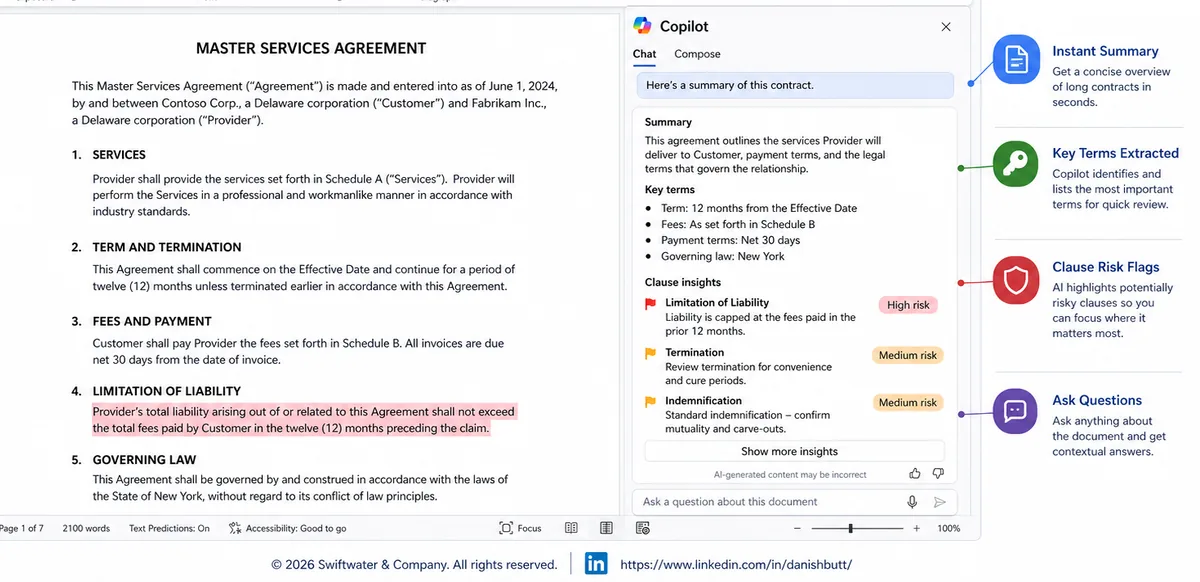
On the legal-specific side, the landscape splits by workflow:
Thinking about AI but not sure what is actually ready to deploy?
Swiftwater's AI Lab helps legal departments separate signal from noise, identifying where AI creates real leverage and building the governance to use it responsibly.
See Legal AI Solutions- Contract drafting and review: Leah by ContractPodAi (agentic contract review and obligation tracking), Spellbook (Word-native drafting for transactional lawyers), Harvey (enterprise legal platform), and Onit ReviewAI (playbook-driven AI review inside Word, integrated with Onit’s CLM).
- Legal research: CoCounsel from Thomson Reuters (grounded in Westlaw and Practical Law), Lexis+ with Protégé from LexisNexis (grounded in LexisNexis content), and Vincent AI inside Clio for practice-management users.
- Due diligence and multi-document analysis: Harvey Vault and Luminance.
- In-house specific platforms: GC AI, purpose-built around in-house workflows including playbooks, company-specific context, and matter memory.
A general counsel evaluating this stack should expect to layer the two: the enterprise copilot as the baseline for day-to-day productivity, and one or two legal-specific platforms for the workflows that most justify the spend, usually contract review, research, or due diligence. Vendor selection sits in the evaluation framework for in-house legal teams.
Where do AI legal assistants deliver the most value?
AI legal assistants are most effective in high-volume, repeatable workflows. A high-volume legal workflow is a legal task performed frequently with similar structure, such as NDA review or contract summarization. These workflows create the conditions where AI can consistently deliver value.
The most common areas:
- Contract review support: flagging missing clauses, deviations, and risks. See AI for contract review for the full pattern.
- Document summarization: converting long agreements into actionable summaries.
- Legal research assistance: reducing time spent on initial research.
- Template drafting: generating first drafts of standard documents.
- Matter intake: structuring and categorizing incoming requests, covered further in AI for legal matter management.
A useful reference point: Microsoft’s Corporate, External, and Legal Affairs team ran a controlled experiment with its Office of the Chief Economist on realistic legal tasks. Participants with Copilot completed work 32 percent faster and with roughly 20 percent greater accuracy, with 87 percent reporting higher productivity. That is the shape of outcome in-house teams should expect when AI assistants are deployed into the right tasks with the right guardrails. Thomson Reuters Institute’s 2025 Generative AI in Professional Services report adds supporting evidence: 26 percent of legal organizations are now actively using generative AI, with document review, legal research, and summarization cited as the leading use cases.
The key is not replacing legal work, but accelerating the first layer of it.
What can AI legal assistants not do reliably?
AI legal assistants have clear limitations that legal teams must understand. An AI limitation in the legal context is the inability of AI systems to apply nuanced legal judgment, context-specific reasoning, or risk interpretation at the level required for final legal decisions.
Common limitations:
- Context interpretation: difficulty understanding business-specific nuances.
- Legal judgment: inability to assess risk beyond patterns in data.
- Accuracy consistency: outputs may vary across similar inputs.
- Regulatory interpretation: limited ability to apply jurisdiction-specific rules.
Bloomberg Law’s legal operations research continues to place accuracy and reliability near the top of the concerns legal teams flag about AI. The professional-responsibility rules point in the same direction. ABA Formal Opinion 512 applies the ABA Model Rules directly to generative AI, placing the duty of technological competence under Rule 1.1 on the lawyer, reinforcing confidentiality under Rule 1.6, requiring supervision of non-lawyer assistance (which now includes AI tools) under Rules 5.1 and 5.3, and preserving candor to the tribunal under Rule 3.3. The international picture is consistent rather than uniform: the UK Solicitors Regulation Authority’s guidance, the CCBE’s guidance for European lawyers, and equivalent conduct frameworks in Canada, Australia, and other common-law jurisdictions all place ultimate responsibility for legal judgment on the attorney, not on the tool. AI can assist. It cannot replace responsibility.
How should in-house teams deploy AI legal assistants?
Deployment strategy determines whether AI assistants succeed or fail. AI deployment in legal is the structured implementation of AI tools within defined workflows, with clear boundaries and oversight.
Best-practice deployment includes:
- Defined use cases: start with specific tasks like NDA review or summarization.
- Human-in-the-loop: require legal review before final output.
- Workflow integration: embed AI into existing tools and processes.
- Performance monitoring: track accuracy, usage, and impact.
Teams that deploy AI assistants broadly without structure often see low adoption and inconsistent results. This is why many legal departments anchor deployment to a legal AI governance framework that covers use-case approval, data handling, and human-review protocols.
How do AI legal assistants impact legal team capacity?
The primary impact is not cost reduction. It is capacity expansion. Legal capacity expansion is the ability of a legal team to handle more work without increasing headcount.
AI legal assistants contribute to this by:
Evaluating legal technology but not sure where to start?
We help legal departments cut through the vendor noise, mapping technology to process maturity and building a roadmap that actually gets adopted.
See Legal Technology- Reducing time per task: faster drafting and review cycles.
- Eliminating repetitive work: freeing lawyers for higher-value tasks.
- Improving turnaround times: faster response to business needs.
The 2026 ACC Chief Legal Officers Survey consistently shows that legal teams are under pressure to do more with fewer resources. AI assistants directly address that challenge by increasing output without increasing cost, which is exactly the outcome a business case for legal AI is built on.
What risks should legal teams watch when using AI assistants?
The biggest risk is over-reliance. Over-reliance on AI occurs when legal professionals trust AI outputs without sufficient validation or oversight.
Key risks:
- Unverified outputs: accepting AI-generated content without review.
- Data exposure: inputting sensitive data into unsecured systems.
- Workflow bypass: using AI outside approved processes.
- Inconsistent usage: different lawyers using AI differently.
AI assistants must operate within defined governance structures, not as standalone tools. The broader risk pattern is covered in AI legal risk management in-house.
Two developments in the last eighteen months have sharpened the risk picture considerably.
First, courts have grown markedly less tolerant of unverified AI output in legal work. Sanctioned filings with hallucinated citations have appeared across federal and state courts, and judges in both the US and the UK have begun issuing standing orders and formal warnings on AI use in submissions. The trend is consistent: the court does not care that an AI wrote the brief. It cares that counsel signed it.
Second, and more consequential for in-house teams, the attorney-client privilege and work product protection can be lost when AI tools are used without proper protections. In United States v. Heppner (S.D.N.Y. Feb. 17, 2026), Judge Rakoff ruled that documents a defendant created using a consumer-grade generative AI platform were not protected by attorney-client privilege or the work product doctrine, because the tool is not an attorney, the terms of service did not support a reasonable expectation of confidentiality, and the client acted without counsel’s direction. The law-firm coverage from Duane Morris lays out the practical implications for in-house teams, the most important of which is that inputting privileged material into a free or individual-tier AI product may waive privilege over the underlying communications themselves. Enterprise-tier contracts with meaningful confidentiality commitments sit in a different posture, but the default assumption for any consumer AI tool should now be that privilege does not attach. This area will continue to evolve as other courts weigh in, and we will keep tracking it.
Bottom line
AI legal assistants are not replacements for lawyers. They are productivity tools that reshape how legal work is performed. The teams that benefit most are not those that use AI everywhere, but those that use it precisely where it delivers measurable value. AI legal assistants increase legal capacity when deployed with discipline, oversight, and clearly defined use cases.
If you are ready to deploy AI assistants effectively, explore how Swiftwater’s Legal AI Solutions help in-house teams implement AI with structured workflows, governance, and measurable impact.
Frequently Asked Questions
What is an AI legal assistant for in-house teams?
An AI legal assistant is an AI-powered system that helps in-house legal teams automate repetitive tasks, support legal analysis, and improve efficiency across contracts, research, and matter management.
What tasks can AI legal assistants perform for in-house legal teams?
AI legal assistants can automate drafting, summarization, and document review, accelerate legal research, support contract analysis, improve matter intake, and enhance access to internal legal knowledge.
Where do AI legal assistants deliver the most value?
They deliver the most value in high-volume, repeatable workflows such as contract review, document summarization, legal research, template drafting, and matter intake processes.
What are the limitations of AI legal assistants?
AI legal assistants cannot reliably apply nuanced legal judgment, interpret complex context, ensure consistent accuracy, or fully handle jurisdiction-specific regulatory analysis.
How should in-house legal teams deploy AI legal assistants?
Teams should deploy AI assistants with defined use cases, human-in-the-loop review, integration into existing workflows, and continuous performance monitoring.
How do AI legal assistants impact legal team capacity?
AI legal assistants increase capacity by reducing time spent on repetitive tasks, improving turnaround times, and enabling legal teams to handle more work without increasing headcount.
What risks should legal teams consider when using AI legal assistants?
Key risks include over-reliance on AI outputs, data confidentiality issues, inconsistent usage across teams, and potential loss of privilege when using unsecured tools.
Can AI legal assistants replace lawyers?
No, AI legal assistants cannot replace lawyers; they support legal work by improving efficiency, but final judgment, accountability, and decision-making remain with legal professionals.
This article is provided for educational and informational purposes only. Neither Swiftwater and Company nor the author provides legal advice. This content does not constitute professional legal, financial, or operational advice and should not be relied upon as such. Readers are encouraged to consult a qualified professional before making decisions based on the information provided. External links are included for reference only and reflect the views of their respective authors. Swiftwater and Company takes no responsibility for third-party content.