
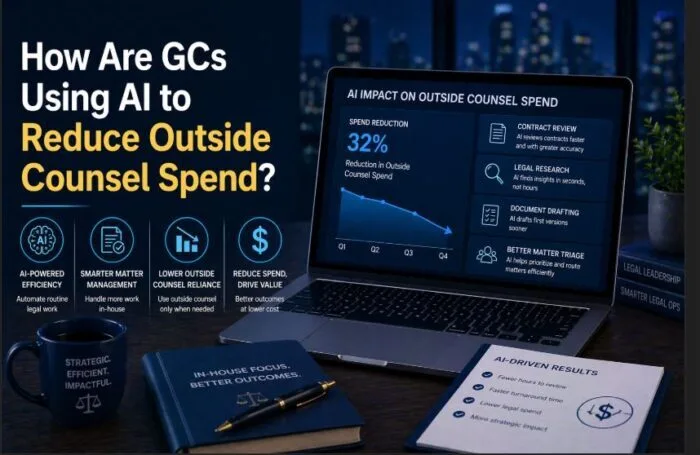

AI outside counsel spend reduction is the use of artificial intelligence to decrease reliance on external law firms by improving internal efficiency, automating legal workflows, and optimizing spend decisions. For most legal departments, outside counsel is the single largest cost driver, and the challenge is not just cutting spend but doing so without increasing risk or overloading internal teams.
This article is part of the Legal AI hub and extends the business case for legal AI into the single largest line item on most legal P&Ls.
How general counsel are using AI to reduce outside counsel spend:
- Bringing work in-house: automating tasks previously sent to law firms.
- Improving matter triage: assigning work to the right place the first time.
- Enhancing billing review: detecting inefficiencies and overbilling.
- Accelerating contract workflows: reducing reliance on external support.
- Strengthening decision-making: using data to control where spend goes.
AI does not replace law firms. It makes legal departments more selective about when to use them.
Why is outside counsel spend so difficult to control?
Outside counsel spend is unpredictable, decentralized, and often reactive. The Thomson Reuters State of the Corporate Law Department report continues to show outside counsel costs representing a significant share of total legal spend. The practical levers for reducing it without sacrificing quality sit in the broader legal spend playbook. The difficulty comes from four structural conditions:
- Unpredictable demand: legal issues arise without warning.
- Limited internal capacity: teams rely on external support to absorb peaks.
- Poor visibility: spend is fragmented across matters, firms, and systems.
- Reactive allocation: work goes out by default, not by strategy.
AI changes this dynamic by letting more work be handled internally and more decisions be driven by data.
How does AI reduce reliance on outside counsel?
AI lets legal teams retain work that would otherwise be outsourced. It also drives cost avoidance by forcing three decisions earlier: whether the work needs to be done at all, who should do it, and at what level. The shift happens on four fronts:
Thinking about AI but not sure what is actually ready to deploy?
Swiftwater's AI Lab helps legal departments separate signal from noise, identifying where AI creates real leverage and building the governance to use it responsibly.
See Legal AI Solutions- Automating routine tasks: contract review, document drafting, first-pass research.
- Standardizing workflows: repeatable processes for common matter types.
- Providing decision support: faster issue assessment inside the department using matter history and ELM data.
- Reducing turnaround time: internal teams become competitive on speed.
 The 2026 ACC Chief Legal Officers Survey continues to show controlling outside counsel costs as a top priority for general counsel.
Danish Butt worked with an Office of General Counsel overseeing a large asbestos portfolio to rationalize the full process from intake to resolution. The engagement examined how work flowed through national counsel down to local firms, and built a risk-based model covering everything from joint deposition strategy to SOPs for high-risk activities. Before any technology was introduced, the model alone produced year-one savings of approximately 25 percent.
How are general counsel using AI in billing and spend review?
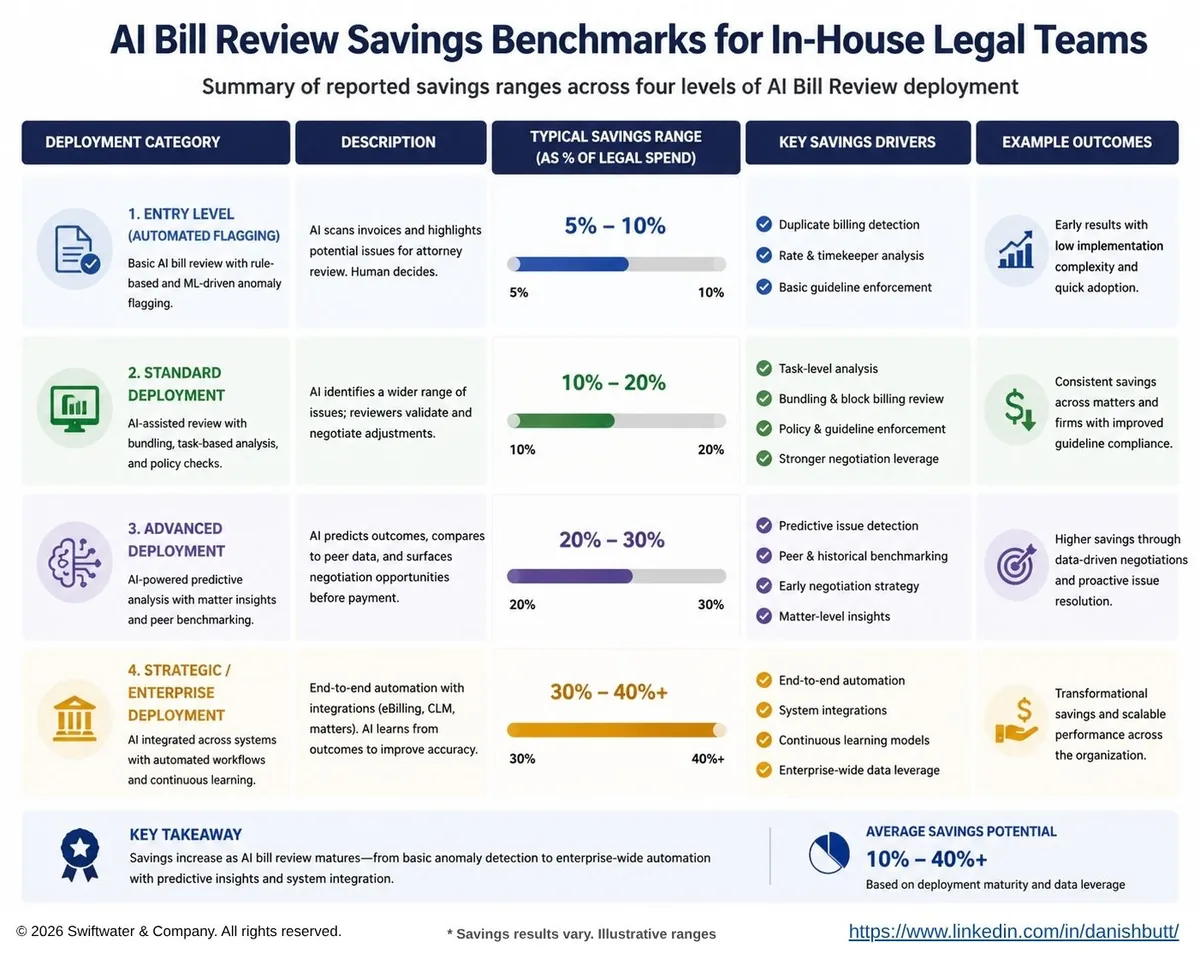
Billing review is one of the most direct applications of AI in cost control, and the benchmarks are now mature enough to cite.
Benchmarks from across the market land in a consistent range:
- Wolters Kluwer ELM Solutions: up to 10 percent annual reduction in legal spend from AI-powered bill review.
- Brightflag: around 10 percent reduction in spend and 80 percent reduction in administrative work.
- Legal Decoder: 10 to 25 percent savings on external legal spending.
- PERSUIT and Apperio: 10 to 20 percent reduction in outside counsel costs and 40 to 60 percent less time spent managing billing and approvals.
- Onit research study: large language models hit 92 percent approval accuracy on invoice review against a 72 percent ceiling set by experienced lawyers.
(Note: These studies have been published by the respective vendors noted above)
The mechanics are consistent across tools: flag anomalies, enforce billing guidelines, detect duplicate or excessive charges, produce structured spend data the legal department can actually act on.
What do current AI bill review tools still miss?
Most tools review invoices at the line-item level. They catch rule violations, block billing, duplicate entries, and off-guideline timekeepers. What they do not do is treat the invoice as an artifact of a legal project, litigation, or transaction.
A $40,000 invoice for three depositions in a complex product liability matter is either reasonable or not depending on the case posture, the witness list, the scheduling order, and the strategy your firm agreed to two months ago. A line-item review cannot see any of that.
Swiftwater has identified this as the current gap. Today’s AI bill review tools go one step beyond rules-based enforcement: they recognize patterns and surface items rigid rules would miss. They do not yet connect the invoice to the broader matter narrative. The result is a better first pass, not the full picture.
Line-item review tells you what was billed. It does not tell you whether it should have been billed at all for this matter, at this stage, by this team.
How did Swiftwater achieve $60 million in combined savings on legal spend?
Swiftwater’s own program pairs first-level human bill reviewers with AI analytics. The AI can handle pattern recognition, rule enforcement, and statistical anomaly detection across the full invoice population. The human handlers do what AI still cannot: they look at matter setup, payment terms, timekeeper setup, whether the staffing was appropriate, and whether the billed effort tracked the scheduling order and engagement terms.
Across the program, the combination produced approximately $60 million in combined cost avoidance and hard savings for clients.
The model is deliberately hybrid. AI delivers the coverage and consistency manual review cannot match at scale. The human reviewers close the gap between line-item compliance and matter-level decision-making and hygeine, supported by the Swiftwater managed services practice and the legal spend practice. Swiftwater’s partnerships with Legal Decoder for granular spend analytics and Prokurio for IP spend forecasting extend the analytical depth without adding client-side headcount.
How does AI improve matter allocation decisions?
Not every matter should go to outside counsel, and AI helps draw the line.
Evaluating legal technology but not sure where to start?
We help legal departments cut through the vendor noise, mapping technology to process maturity and building a roadmap that actually gets adopted.
See Legal Technology- Analyze matter complexity: flag which tasks actually require external expertise.
- Evaluate internal capacity: match work to available resources.
- Recommend routing: suggest in-house versus external handling with reasoning.
- Track outcomes: learn from past allocation decisions, not just anecdotes.
This shifts legal departments from reactive outsourcing to deliberate allocation. The AI for legal matter management article covers the triage mechanics in more depth.
What role does contract automation play in reducing spend?
Contracts are also a major driver of external legal work, and most of that work is not strategic. Transaction-heavy organizations need steady contracting support at a volume in-house teams cannot absorb. The overflow is what outside counsel ends up doing.
AI reshapes this by speeding contract review, standardizing agreements, automating approvals, and clearing the bottlenecks that would otherwise generate reactive outside counsel requests. The AI for contract review article covers the tooling and playbook dependencies. The CLM best practices guide covers the broader contract lifecycle environment this sits inside.
What are the risks of using AI for cost reduction?
AI cost reduction risk is the potential for efficiency-driven decisions to compromise legal quality or increase exposure. Key risks:
- Over-insourcing: bringing complex work in-house without the expertise.
- Under-supervision: relying on AI outputs without competent review.
- Inconsistent application: different teams using AI differently across the department.
- Data limitations: poor spend data producing incorrect or misleading conclusions.
- False savings: line-item flags that do not survive law firm pushback because they lack contextual reasoning.
- Bias: AI models trained on historical billing patterns can reinforce the patterns they should be questioning.
Cost reduction must sit inside a legal AI governance framework, not a standalone cost-cutting initiative.
Bottom line
AI is not eliminating outside counsel. It is changing how and when law firms are used, building internal capacity by shifting routine work to AI, and giving legal departments the first real economic lens they have had on the single largest line item they control. AI reduces outside counsel spend not by replacing firms, but by making legal departments more capable, efficient, and selective about when to use them.
If you are looking to control legal costs while maintaining quality, explore how Swiftwater’s Legal AI Solutions help legal teams optimize workflows, reduce external reliance, and improve spend visibility.
Frequently Asked Questions
How are GCs using AI to reduce outside counsel spend?
General counsel are using AI to bring more work in-house, improve matter triage, enhance billing review, automate contract workflows, and make data-driven decisions about legal spend.
Why is outside counsel spend difficult to control?
Outside counsel spend is challenging to manage due to unpredictable demand, limited internal capacity, poor visibility across matters and firms, and reactive outsourcing practices.
How does AI reduce reliance on outside counsel?
AI reduces reliance on outside counsel by automating routine legal tasks, standardizing workflows, accelerating internal processes, and enabling smarter decision-making within the legal department.
How is AI used in legal billing and spend review?
AI reviews invoices to detect anomalies, enforce billing guidelines, flag overbilling, and produce structured spend data that supports better cost control and decision-making.
What are the limitations of AI bill review tools?
AI bill review tools primarily focus on line-item analysis and may not capture broader context such as matter strategy, case complexity, or whether the work should have been performed at all.
How does AI improve matter allocation decisions?
AI helps legal teams evaluate matter complexity, assess internal capacity, recommend whether work should be handled in-house or by outside counsel, and learn from past allocation outcomes.
What role does contract automation play in reducing legal spend?
Contract automation reduces the need for external legal work by accelerating contract review, standardizing agreements, and eliminating bottlenecks that would otherwise require outside counsel involvement.
What risks should legal teams consider when using AI to reduce spend?
Key risks include over-insourcing complex work, relying on AI outputs without proper review, inconsistent usage across the team, poor-quality or incomplete data, and false savings that may not withstand scrutiny.
This article is provided for educational and informational purposes only. Neither Swiftwater and Company nor the author provides legal advice. This content does not constitute professional legal, financial, or operational advice and should not be relied upon as such. Readers are encouraged to consult a qualified professional before making decisions based on the information provided. External links are included for reference only and reflect the views of their respective authors. Swiftwater and Company takes no responsibility for third-party content.