
The short version
Six agentic AI examples that corporate legal teams can actually deploy. Not theory, not future state. Each comes with a strategic breakdown and implementation steps.
- Regulatory & compliance monitoring agent: autonomous horizon scanning across global regulators with first-pass impact analysis.
- Contract lifecycle management agent: autonomous intake, obligation tracking, and renewal alerts across the contract portfolio.
- Legal knowledge & training agent: drafts policy summaries, FAQs, and training content from your curated knowledge base.
- Litigation & eDiscovery management agent: automates legal holds, custodian tracking, and first-pass document review.
- Cybersecurity defense agent: detects, investigates, and contains threats at machine speed, with auditable response trails.
- Corporate governance & records agent: tracks filing deadlines, drafts routine resolutions, and audits the corporate record repository.
While headlines buzz with AI’s potential, the practical application within corporate legal departments remains a key question. General Counsel and legal operations leaders are looking past theoretical benefits to find tangible solutions that improve the day-to-day lives of their attorneys and staff. The real value lies not in replacing lawyers, but in augmenting their capabilities, automating tedious work, and creating a more efficient, strategic legal function. This shift toward autonomous systems is reshaping every corporate function. Organizations evaluating agentic workflows should first understand whether their existing processes, governance structures, and data environments are prepared for greater autonomy. A structured legal AI readiness assessment helps legal departments identify the operational foundations required before introducing agentic systems. For a broader view of how AI is reshaping legal operations specifically, see our Legal AI Hub.
This article explores six powerful agentic AI use cases, extrapolated from proven business applications, that can be adapted to revolutionize how corporate legal, risk, and compliance teams operate. We will move beyond high-level descriptions to provide a strategic breakdown of each use case. You will find specific tactics and actionable takeaways to help you implement these autonomous tools. These aren’t just futuristic concepts; they are replicable strategies designed to reduce complexity, enhance risk oversight, and free up your team for higher-value work.
I will demonstrate how these systems can handle everything from complex compliance monitoring to proactive litigation risk analysis, offering a clear path to building a more resilient and effective legal function.
1. The Autonomous Regulatory & Compliance Monitoring Agent
Imagine a dedicated compliance sentinel operating 24/7, tirelessly scanning a complex web of global regulatory databases, proposed legislation, and court rulings specific to your industry. This is the core function of an autonomous regulatory and compliance monitoring agent. It represents a fundamental shift from reactive, manual monitoring to proactive, automated intelligence gathering, making it one of the most powerful agentic AI use cases for corporate legal teams.
This AI agent is configured with your company’s specific operational footprint, including jurisdictions, products, and services. It then autonomously executes a multi-step workflow:
- Monitor: Continuously scans designated sources like government gazettes, regulatory body websites, and legal news feeds for keywords and relevant changes.
- Analyze: Upon detecting a relevant update, the agent analyzes the text to determine its potential impact on existing company policies, contracts, or operational procedures.
- Synthesize & Alert: It generates a concise, preliminary summary of the change, highlights the most critical clauses, and flags potential risks. This summary is then routed to the appropriate legal expert for review, complete with direct links to the source documents.
Strategic Breakdown
This agentic system moves beyond simple keyword alerts. It contextualizes information, performing a first-pass analysis that significantly reduces the manual burden on legal professionals. The goal isn’t to replace human lawyers but to augment their capacity, freeing them from the drudgery of horizon scanning to focus on high-value strategic counsel.
Key Insight: The agent’s primary value is transforming unstructured, high-volume regulatory data into structured, actionable intelligence. It acts as a powerful filter, ensuring that legal teams only spend time on changes that truly matter.
Actionable Takeaways & Implementation
For a legal department looking to implement this, the strategy is to start small and scale.
Thinking about AI but not sure what is actually ready to deploy?
Swiftwater's AI Lab helps legal departments separate signal from noise, identifying where AI creates real leverage and building the governance to use it responsibly.
See Legal AI Solutions- Define a Narrow Scope: Begin with a single, high-risk regulatory area, such as data privacy (GDPR, CCPA) or financial reporting standards for a specific jurisdiction.
- Identify Core Sources: Curate a precise list of official sources for the agent to monitor. Avoid overly broad searches to maintain the quality of the alerts.
- Establish a Human-in-the-Loop Workflow: Design a clear process for how the agent’s output is reviewed, validated, and acted upon by the legal team. The agent drafts the report; the human provides the final judgment and strategic advice.
This approach ensures that in-house counsel is always ahead of the curve, managing regulatory risk proactively rather than reacting to it after the fact. It is a prime example of how agentic AI use cases can directly improve the day-to-day efficiency and strategic impact of a corporate law function.
2. The Autonomous Contract Lifecycle Management (CLM) Agent
Corporate legal departments are often buried under the administrative weight of contract management. An autonomous CLM agent tackles this challenge head-on, managing the entire lifecycle of routine agreements from intake to renewal, freeing up attorneys for more strategic work. This agent acts as a hyper-efficient, always-on paralegal dedicated to contract administration.
This AI agent is integrated with the company’s contract repository, email, and ERP systems. It autonomously executes a sophisticated workflow:
- Intake & Triage: When a business user submits a standard contract request (e.g., an NDA or a simple service agreement), the agent gathers necessary details, selects the correct template, and routes it for the appropriate business approval.
- Obligation Tracking: Post-execution, the agent scans the final contract, extracts key dates, obligations, and clauses (e.g., renewal deadlines, payment terms, data privacy requirements), and enters them into a central tracking system.
- Proactive Alerts & Reporting: The agent proactively monitors upcoming deadlines, sending automated reminders to business owners for renewals or expirations. It can also generate reports on contract status, risk exposure, or compliance with specific clauses across the entire portfolio.
Strategic Breakdown
This agentic system transforms contract management from a series of manual, disjointed tasks into a streamlined, automated process. Its value is not just in efficiency, but in proactive risk mitigation. By ensuring no deadline is missed and all obligations are tracked, it prevents value leakage and reduces the risk of inadvertent breaches. It provides a single source of truth for the company’s contractual landscape.
Key Insight: The agent’s core function is to automate the “work about the work” in contract management. It handles the administrative burden, allowing legal counsel to focus on high-stakes negotiation, complex drafting, and strategic risk analysis.
Actionable Takeaways & Implementation
For a legal operations team, implementing this agentic AI use case is about reclaiming attorney time and gaining control over contractual risk.
- Start with Low-Risk, High-Volume Agreements: Begin with a single contract type like Non-Disclosure Agreements (NDAs). Configure the agent to handle the entire workflow from request to execution and storage.
- Standardize Templates and Playbooks: The agent’s effectiveness depends on clear rules. Develop standardized templates and playbooks that define the acceptable negotiation positions for routine clauses.
- Follow Proven Implementation Principles: Before deploying an autonomous CLM agent, ensure your foundational CLM processes are solid. See our guide on 10 CLM best practices for 2026 for the framework that makes agentic automation work.
- Establish an Escalation Path: Create a clear workflow for when the agent should escalate a matter to a human attorney. This could be triggered by a request for non-standard terms or a counterparty redline that deviates from the playbook.
3. AI-Driven Legal Knowledge & Training Agent
Imagine an autonomous agent tasked with creating the foundational materials that support a corporate legal department’s internal and external communication efforts. This agent can draft internal policy updates, create training materials for business units on new regulations, or even generate preliminary drafts for intellectual property descriptions. This is the essence of AI-driven content creation, a powerful agentic AI use case that extends far beyond marketing to enhance operational efficiency within legal functions.

This AI agent is provided with a secure, curated knowledge base of the company’s existing policies, brand guidelines, and past legal communications. It then executes a clear workflow:
- Generate: Based on a prompt from a lawyer (e.g., “Draft a one-page summary of our new remote work policy for the sales team”), the agent creates a structured, well-written first draft.
- Adapt: The agent can then be instructed to reformat that same content into different formats, such as a slide deck presentation, a set of FAQs for the company intranet, or even a script for a short training video.
- Review & Distribute: The generated drafts are sent to the designated attorney for review, editing, and final approval, ensuring legal accuracy and tone before internal distribution.
Strategic Breakdown
For a corporate legal team, this agentic system is not about selling products but about scaling internal expertise and ensuring consistent, clear communication. It automates the time-consuming “blank page” problem, allowing lawyers to transition immediately into the role of editor and strategist. This is crucial for managing the constant demand for guidance on policies, compliance, and training without overwhelming the department.
Key Insight: The agent’s value lies in its ability to translate complex legal concepts into accessible, multi-format communications at scale. It acts as a force multiplier for the legal team, ensuring that critical information is disseminated effectively and efficiently throughout the organization.
Actionable Takeaways & Implementation
To deploy this within a legal department, the focus should be on internal communication and knowledge management.
- Start with Internal Policies: Begin by tasking the agent with creating derivatives of a single, well-established company policy. For instance, turn a 10-page data handling policy into a 1-page summary for new hires.
- Establish a Secure Knowledge Base: Feed the agent with approved documents only. This includes final versions of policies, past legal memos, and brand style guides to ensure the output is accurate and on-brand.
- Mandate Human Oversight: Implement a strict workflow where no AI-generated content is distributed without thorough review and sign-off from a qualified attorney. The agent is a drafting assistant, not the final authority.
This application of agentic AI frees up valuable attorney time from routine drafting to focus on novel legal challenges and strategic risk mitigation. For an in-depth exploration of how AI is reshaping legal workflows, you can learn more about AI’s role in legal operations.
4. The Automated Litigation & eDiscovery Management Agent
Litigation and internal investigations generate a mountain of administrative tasks that can overwhelm legal teams. An automated litigation management agent acts as a dedicated case manager, handling the procedural and logistical elements of eDiscovery and litigation holds, allowing attorneys to focus on legal strategy.
These AI agents are designed to orchestrate the complex workflows associated with legal disputes. They execute a continuous, dynamic workflow:
- Initiate Legal Hold: Upon receiving instructions, the agent identifies potential data custodians from HR and IT systems, distributes the legal hold notice, and tracks acknowledgments automatically.
- Manage Data Collection: The agent interfaces with IT systems to manage the collection of data from custodians, ensuring a defensible chain of custody and tracking the status of each collection effort.
- Process and Review Support: The agent can perform initial data processing tasks, such as de-duplication and keyword filtering. It can then assist in the first-pass document review by identifying and tagging potentially privileged or irrelevant documents, significantly reducing the volume for human review.
Strategic Breakdown
From a business perspective, this agentic system provides adds efficiency to your defensibile process (consult your litigation team to rule out that agentic ai actions are somehow interfering with your defensibility position). By automating the legal hold process, it minimizes the risk of human error and spoliation. In eDiscovery, it dramatically reduces the time and cost associated with manual document review. The agent’s ability to meticulously document every action provides a robust, auditable trail that is invaluable in court.
Evaluating legal technology but not sure where to start?
We help legal departments cut through the vendor noise, mapping technology to process maturity and building a roadmap that actually gets adopted.
See Legal TechnologyKey Insight: The agent’s core value is bringing automation and process rigor to the administrative side of litigation. It frees up expensive legal talent from project management tasks to focus on case strategy, witness preparation, and legal arguments.
Actionable Takeaways & Implementation
For a legal department, implementing this requires close partnership with the IT department.
- Start with Legal Holds: The legal hold process is a well-defined, repetitive task that is an ideal starting point for automation. An agent can ensure consistency and defensibility across all matters.
- Integrate with Core Systems: Connect the agent to key data sources like the HR information system (for identifying custodians) and email archives (for data collection) to enable a seamless workflow.
- Establish Review Protocols: Define clear rules for how the agent should handle document review. For example, any document containing the names of in-house or outside counsel could be automatically flagged for privilege review by a human attorney.
This approach embeds process automation directly into the litigation workflow, making it more efficient, less costly, and more defensible.
5. AI-Powered Cybersecurity Defense Agents
Envision an elite, always-on security team that never sleeps, capable of detecting and neutralizing threats faster than a human operator could ever react. This is the reality of AI-powered cybersecurity defense agents. These autonomous systems represent a critical evolution in corporate security, shifting the paradigm from manual incident response to automated, real-time threat containment, making it one of the most vital agentic AI use cases for protecting a company’s sensitive data and intellectual property.
On an average, cybersecurity breach events cost ~$4.45M to the enterprise.

This AI agent is deployed across a company’s entire digital estate, from endpoints to cloud infrastructure. It executes a swift, continuous workflow to defend against attacks:
- Monitor & Detect: The agent perpetually analyzes network traffic, system logs, and user behavior, using sophisticated models to identify anomalies that signal a potential breach.
- Investigate & Triage: Upon detecting a threat, it instantly investigates its origin, scope, and severity. It correlates data from multiple sources to build a complete picture of the attack in milliseconds.
- Contain & Respond: The agent takes immediate, decisive action to neutralize the threat. This could involve isolating a compromised laptop from the network, blocking malicious IP addresses, or terminating unauthorized processes, all without human intervention.
Strategic Breakdown
For a corporate legal team, the implications are profound. A breach isn’t just a technical problem; it’s a legal and compliance crisis that triggers reporting obligations, potential litigation, and reputational damage. An agentic defense system dramatically shrinks the window of exposure, reducing the scope and impact of an incident. Its ability to autonomously document every step of an attack provides an invaluable, immutable audit trail for post-incident reviews and regulatory inquiries. By automating the foundational layers of defense, it frees human security analysts and legal counsel to focus on strategic risk management and compliance. To learn more, explore how to better approach managing cyber risk through legal frameworks.
Key Insight: The agent’s core value is its speed and autonomy. It transforms cybersecurity from a reactive, human-gated process into a proactive, machine-speed defense, directly minimizing the legal and financial fallout of a security breach.
Actionable Takeaways & Implementation
For a company aiming to leverage this technology, a phased deployment is key to building trust and ensuring seamless integration.
- Start with Detection Mode: Initially deploy the agent in a monitor-only mode. This allows it to learn the network’s normal behavior and flag potential threats for human review without taking automated action.
- Gradually Enable Automated Response: Begin by automating responses for low-risk, high-confidence threats, such as blocking known malware signatures. As the team gains confidence in the agent’s accuracy, expand its permissions to handle more complex incidents.
- Integrate with Legal & Compliance Workflows: Establish clear protocols for when and how the agent’s automated actions trigger notifications to the legal department. This ensures that counsel is immediately aware of significant incidents that may have legal or regulatory implications.
This approach allows a company to harness the power of autonomous defense while maintaining crucial human oversight, ensuring that its most critical digital assets are protected by a system that is both intelligent and accountable.
6. The Autonomous Corporate Governance & Records Agent
Maintaining meticulous corporate records is a fundamental, yet often tedious, responsibility of the legal department. An autonomous governance and records agent can automate the management of corporate minute books, entity management, and subsidiary compliance, ensuring the company’s legal house is always in order.
These AI systems execute a precise, schedule-driven workflow to maintain corporate hygiene:
- Track Compliance Deadlines: The agent monitors a calendar of all required corporate filings for every legal entity, such as annual reports, franchise tax payments, and board meeting schedules, across all jurisdictions.
- Automate Routine Documentation: For recurring events like standard board committee meetings, the agent can generate shell minutes, draft resolutions based on templates, and distribute meeting materials to directors.
- Audit and Remediate: The agent can periodically scan the corporate record repository to identify missing documents (e.g., a missing signature on a board consent) or inconsistencies and flag them for the corporate secretary or paralegal to correct.
Strategic Breakdown
For a General Counsel or corporate secretary, this agent provides peace of mind and operational excellence. It transforms corporate governance from a manual, checklist-driven task into an automated, “always-on” compliance function. This significantly reduces the risk of administrative errors that could lead to a loss of good standing for a subsidiary or create issues during a due diligence process for M&A or financing.
Key Insight: The agent’s primary value is ensuring unwavering consistency and completeness in corporate record-keeping. It provides a reliable, automated system of record that strengthens the company’s legal foundation and streamlines due diligence.
Actionable Takeaways & Implementation
For a legal department, deploying this agent is about building a scalable governance framework.
- Start with Entity Management: Begin by populating the agent with all the corporate data for the company’s subsidiaries. Task it with tracking annual report filing deadlines for a specific set of jurisdictions.
- Develop Standardized Templates: Create a library of pre-approved templates for routine resolutions, meeting minutes, and other corporate actions. This is the knowledge base the agent will use to generate documents.
- Establish a Verification Workflow: Implement a mandatory review step where a paralegal or attorney must review and approve any document generated by the agent before it is finalized or filed. The agent drafts; the human validates.
This proactive approach to governance ensures the legal department can support the business’s growth without getting bogged down in administrative details, reinforcing its role as a strategic partner.
Agentic AI Use Cases Comparison
| AI Application | Implementation Complexity | Resource Requirements | Expected Outcomes | Ideal Use Cases | Key Advantages |
|---|---|---|---|---|---|
| Regulatory & Compliance Monitoring Agent | Medium to High | High (data feeds, integration) | Proactive risk alerts, reduced manual effort | Monitoring global regulations, legislative tracking | Speed, continuous vigilance, targeted intelligence |
| Autonomous Contract Lifecycle Agent | High | Very High (integration, data migration) | Faster cycle times, reduced risk, cost savings | Managing NDAs, SOWs, routine vendor agreements | Efficiency, obligation tracking, data insights |
| Legal Knowledge & Training Agent | Medium | Moderate to High (data, monitoring) | Faster content creation, scalable training | Policy summaries, internal FAQs, training modules | Consistency, time savings, force multiplier |
| Litigation & eDiscovery Agent | High | Very High (integration, security) | Lower discovery costs, improved defensibility | Legal hold automation, first-pass document review | Cost reduction, reduced human error, audit trail |
| AI-Powered Cybersecurity Defense Agents | Medium to High | High (training, updates) | Faster threat detection/response, threat mitigation | Real-time network security and incident response | 24/7 operation, adaptive defenses, scales to large networks |
| Corporate Governance & Records Agent | High | High (data migration, validation) | Improved compliance, audit readiness | Subsidiary management, board meeting prep | Consistency, accuracy, reduced administrative burden |
More Use Cases
Here are links to
Microsoft Co-pilot’s legal use case list.
Evaluating or implementing a CLM platform?
We have guided legal departments through selection, implementation, and adoption, without the vendor bias. Let us talk about where you are and what you actually need.
See CLM ServicesAnthrophic Claude’s legal use case list.
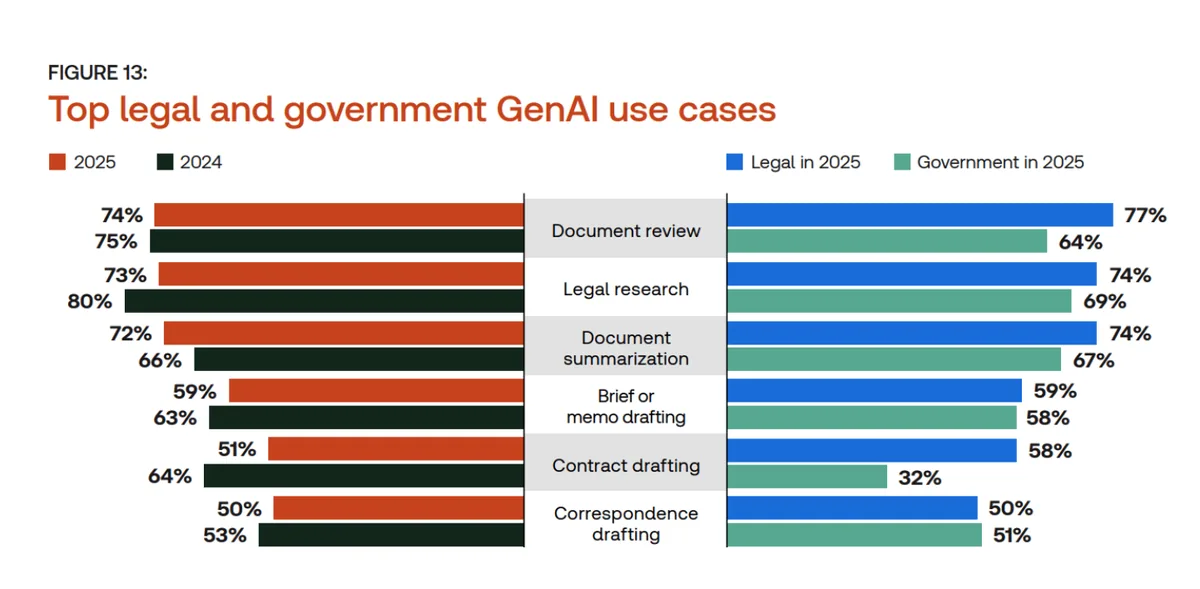
Here is a list of top legal and government genAI use cases (not neccessarily candidates for agentic AI), produced by Thomson Reuters.
The Path Forward: Integrating Agentic AI into Your Legal Function
The journey through these diverse agentic AI use cases, from autonomous cybersecurity defense to intelligent contract management, reveals a consistent and powerful theme. We are moving beyond AI as a passive analytical tool and into an era of AI as an active, autonomous partner. For corporate law, risk, and compliance departments, this evolution is not a distant sci-fi concept; it is an immediate strategic imperative for achieving operational excellence.
The examples detailed in this article, though drawn from various business functions, offer a clear blueprint for the legal world. The core principle is not about directly generating revenue but about creating strategic leverage. By delegating complex, yet routine, tasks to autonomous agents, legal departments can unlock immense value, mitigate unseen risks, and, crucially, improve the day-to-day professional lives of their attorneys.
Synthesizing the Strategic Vision
Reflecting on the agentic systems discussed, several key takeaways emerge for legal operations leaders. The true power lies in their ability to handle dynamic, multi-step processes that previously required constant human oversight.
- From Reactive to Proactive: Just as AI agents monitor supply chains for disruptions, legal agents can monitor regulatory databases for changes, automatically flag relevant updates, and even initiate preliminary impact assessments. This shifts the legal function from a reactive fire-fighting unit to a proactive risk-mitigation engine.
- Enhancing Human Expertise: Autonomous financial bots execute trades based on predefined strategies, freeing analysts for higher-level market analysis. Similarly, a legal agent can manage the entire contract lifecycle administration process, from intake and routing to tracking obligations and flagging renewal dates, allowing counsel to focus on complex negotiations and strategic advisory work.
- Scalable Diligence and Governance: The principles behind AI-powered cybersecurity, which autonomously detects and neutralizes threats, can be directly applied to information governance. Imagine an agent that constantly scans company data repositories, identifies non-compliant documents, and initiates remediation workflows based on established retention policies. This provides a level of scalable oversight that is impossible to achieve with manual audits alone.
Strategic Insight: The primary goal of implementing agentic AI in a legal context is to automate the “work about the work.” It’s about eliminating the administrative friction, the constant monitoring, and the repetitive follow-up that consumes valuable attorney time, enabling them to operate at the top of their skill level.
Your Actionable Roadmap to Agentic Integration
Embracing these powerful agentic AI use cases requires a thoughtful, phased approach rather than a department-wide overhaul. The key is to start small, prove value, and build momentum.
- Identify High-Friction, Low-Complexity Tasks: Begin by mapping your department’s workflows. Where do your attorneys and legal staff spend the most time on repetitive, administrative tasks? Good candidates include initial triage of legal service requests, NDAs with standard terms, or tracking compliance training completions.
- Define a Narrow Pilot Program: Select one specific pain point for your first agentic AI project. For example, create an agent to manage legal holds. The agent could be responsible for identifying custodians, distributing the hold notice, tracking acknowledgments, and sending automated reminders, escalating only the exceptions to a human.
- Prioritize Data Hygiene and Process Standardization: Agentic AI thrives on clean data and clear rules. Before implementation, ensure the underlying processes are standardized. If your contract intake process is chaotic, an AI agent will only automate that chaos.
- Measure Success and Iterate: Establish clear metrics for your pilot program. Focus on time saved, reduction in errors, or faster turnaround times. Use these results to build a business case for expanding the use of agentic AI to more complex challenges.
The integration of agentic AI represents a fundamental re-architecting of how legal services are delivered. As legal teams move from experimentation to production deployments, governance becomes increasingly important. Establishing a documented legal AI governance framework helps define accountability, oversight requirements, escalation protocols, and acceptable use standards for autonomous systems. It empowers legal departments to build a more resilient, efficient, and strategic function that can meet the escalating demands of the modern enterprise. The question is no longer if this technology will reshape the corporate legal landscape, but how quickly and effectively your team can harness its transformative power.
Looking to Evaluate Agentic AI for Your Legal Function?
Agentic AI creates opportunities to automate complex workflows, improve operational efficiency, and strengthen risk oversight. Successful deployments depend on governance, process maturity, data readiness, and practical implementation planning.
Learn how Swiftwater’s Legal AI Solutions help legal departments evaluate, implement, and scale AI responsibly.
Frequently Asked Questions
What is the difference between agentic AI and traditional legal AI?
Traditional legal AI typically performs a single task in response to a user request, such as summarizing a document or reviewing a contract. Agentic AI can execute multiple connected tasks autonomously, make decisions within predefined rules, interact with business systems, and complete workflows with limited human intervention.
Which legal processes are best suited for agentic AI?
The strongest candidates are processes that involve multiple steps, repetitive decisions, structured data, and clear escalation rules. Examples include contract administration, regulatory monitoring, legal hold management, compliance tracking, matter intake, and corporate governance workflows.
How should legal departments begin evaluating agentic AI opportunities?
Legal departments should start by identifying high-volume workflows that consume significant administrative time. Mapping existing processes, documenting decision points, and understanding where manual effort creates bottlenecks helps determine which use cases are best suited for agentic automation.
Does agentic AI require human oversight?
Yes. Successful agentic AI deployments combine automation with appropriate human oversight. Legal professionals remain responsible for legal judgment, strategic decisions, risk assessment, and approval of significant actions, while agents handle routine execution and workflow management.
What role does data quality play in agentic AI success?
Data quality is a critical factor. Agentic systems rely on accurate contracts, policies, matter data, compliance records, and business information to make informed decisions. Well-structured data and standardized processes generally produce stronger outcomes and more reliable automation.
How can legal teams measure the success of agentic AI initiatives?
Common success measures include reduced cycle times, fewer manual administrative tasks, improved compliance tracking, faster response times, increased attorney capacity, stronger operational visibility, and measurable efficiency gains across legal workflows.
What organizational capabilities are needed before deploying agentic AI?
Organizations benefit from having clear governance policies, documented workflows, standardized processes, reliable data sources, defined escalation procedures, and executive sponsorship. These foundations help ensure agentic systems operate consistently and align with business objectives.
What does a mature agentic AI legal function look like?
A mature legal function uses agentic AI to automate routine workflows, monitor risks proactively, coordinate information across systems, support decision-making, and provide operational visibility while maintaining appropriate attorney oversight and governance controls.
Disclamier: This article is provided for educational and informational purposes only. Neither Swiftwater and Company nor the author provides legal advice. This content does not constitute professional legal, financial, or operational advice and should not be relied upon as such. Readers are encouraged to consult a qualified professional before making decisions based on the information provided. External links are included for reference only and reflect the views of their respective authors. Swiftwater and Company takes no responsibility for third-party content..