
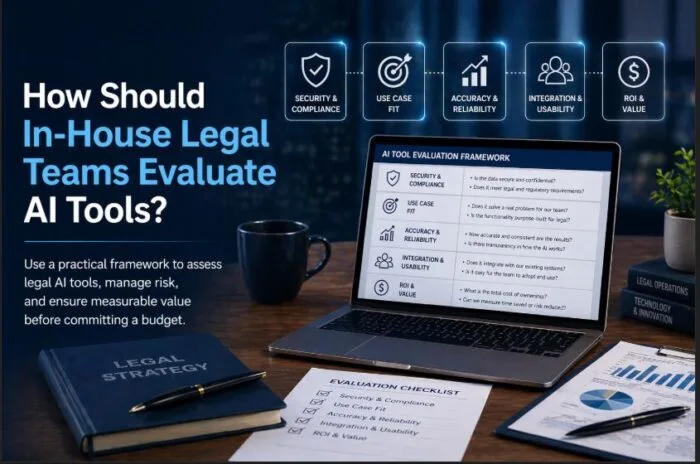

In-house legal teams should evaluate AI tools against five criteria: a specific, high-volume use case the tool actually solves; a grounding architecture that cites verifiable sources; a risk and regulatory posture that covers confidentiality, training-data practices, and the applicable US, UK, and EU regimes; integration with existing CLM, eBilling, matter management, document management, and knowledge management systems; and measurable ROI tied to time, cost, or risk outcomes. The teams that get consistent value from legal AI are the ones that defined this framework before the first vendor demo.
Most legal AI investments succeed or fail on the strength of the evaluation process itself. Vendor promises sound identical across a demo. A disciplined evaluation moves the conversation from features to fit: what the tool has to do, under what conditions, with what data, and with what measurable outcome.
This article is part of the Legal AI hub, a series on legal AI for in-house teams. Related cluster articles on readiness, governance, the business case, and a full transformation roadmap cover what to do next.
Why do most legal AI evaluations fail?
Legal AI evaluations succeed when they start with the legal workflow and fail when they start with the tool. A disciplined evaluation defines the use case, baseline metrics, and data and risk posture before the first vendor demo, then tests tools against that spec. The reverse pattern, where the team is impressed by a demo and works backward to find a use case, is the most common reason legal AI investments fail to deliver measurable value.
A well-run demo shows the tool at its best, using curated data and a question it was designed to answer. The issue arises when the team anchors its evaluation around what the demo showed rather than what the workflow requires. Experienced evaluators call this demo bias. A second pattern is feature fatigue: when a team cannot articulate the two or three things that actually matter, they default to counting features, and the longest capability list wins.
Microsoft’s legal function, Corporate, External and Legal Affairs (CELA), offers a useful counterexample. Before deploying Microsoft 365 Copilot, CELA ran a randomized controlled trial through Microsoft’s Office of the Chief Economist in May 2024 across more than 50 legal professionals. Published results showed 32% faster task completion, 20% greater accuracy, and 87% of participants agreeing that Copilot made them more productive. The numbers are reasonable because the tasks and evaluation criteria were defined before deployment, not after.
What should legal teams evaluate first?
The starting point is the workflow, not the technology. Strong evaluations begin by identifying a specific, high-volume legal task where AI can reduce time, cost, or risk without compromising quality. Contract review, invoice analysis, legal research, NDA triage, and matter intake are typical starting points because they combine repetition, defined inputs, and clear quality checks. Ambiguous or judgment-heavy work is a worse first use case.
Thinking about AI but not sure what is actually ready to deploy?
Swiftwater's AI Lab helps legal departments separate signal from noise, identifying where AI creates real leverage and building the governance to use it responsibly.
See Legal AI SolutionsGood first use cases share four traits: they occur often enough that automation is worth the effort, their inputs and outputs can be precisely described, they tolerate a controlled error rate caught by human review, and their outputs can be verified against an authoritative source.
A useful portfolio frame comes from AI advisor Allie K. Miller: Dot use cases are narrow line-of-business automations expected to pay back in three to six months, Dash use cases deploy broad productivity tooling like Microsoft Copilot or ChatGPT Enterprise across the workforce, and Star use cases are larger revenue or efficiency plays on a one-to-two-year horizon. In-house legal teams should begin with the Dot work and prove it before expanding.
Contract review is the most common first use case. Wolters Kluwer research indicates AI-powered contract lifecycle management can reduce review time by as much as 75%. The Big Four show the same pattern in adjacent workflows: PwC’s GL.ai flags journal-entry anomalies at scale, KPMG Clara automates substantive audit tasks, and EY uses machine learning to review lease contracts at a reported 97% accuracy. Outside counsel spend analysis is another strong starter, where AI-assisted invoice review surfaces billing issues that human reviewers miss at scale. Beyond contracts, the non-contract workflow set is already wide: for a practitioner’s view, see Danish Butt’s running list of 40 non-contract legal workflows AI now handles for in-house teams.
DLA Piper’s Copilot rollout shows how to sequence a large deployment. Chief Innovation Officer Andrew Gastwirth called it a “coalition of the willing” approach: several hundred licenses to motivated early adopters, a task force with a shared prompt repository, and data governance solidified before broader access. The principle applies in-house, too: start with workflows the early adopters care about and let proof points drive expansion.
How should teams evaluate AI output quality and grounding?
Any AI tool under evaluation should be tested on its ability to ground outputs in verifiable sources. Ask whether the system uses retrieval-augmented generation, what databases it searches, and whether citations point to real, current authority. A tool that produces confident-sounding answers without traceable sources is unusable for legal work. Run test queries whose answers are already known.
Grounding is how an AI system connects its output to source material. A general-purpose language model generates text from patterns in its training data; it has no live access to an authoritative database when it answers. Retrieval-augmented generation, or RAG, searches a curated database before generating the response and provides that material as context. RAG reduces hallucination but does not eliminate it.
The 2025 peer-reviewed study by Magesh, Surani, Dahl, Suzgun, Manning, and Ho, published in the Journal of Empirical Legal Studies, tested three leading legal AI tools and found Lexis+ AI hallucinated on approximately 17% of queries, Westlaw AI-Assisted Research on approximately 33%, and GPT-4 on approximately 43%. A hallucination included both factually wrong responses and “misgrounded” citations that point to real sources the source does not actually support. Misgrounding is the more dangerous failure mode because the citation looks legitimate. (Note: Since the study came out, each vendor has responded to the study and remain among the top tools being used for the purpose.)
The UK High Court has made the consequences concrete. In Ayinde v London Borough of Haringey and Al-Haroun v Qatar National Bank [2025] EWHC 1383 (Admin), Dame Victoria Sharp P held that publicly available generative AI tools are not capable of conducting reliable legal research and may cite sources that do not exist. The court imposed wasted costs orders, referred the practitioners to their regulators, and warned that future misuse could trigger severe sanctions, including contempt. The operating principle, as Colin S. Levy has argued, is that an AI output is a draft, not a deliverable; it carries no legal consequence until a human verifies it. Test every candidate tool on known-answer queries before trusting it with real work.
How should in-house teams assess AI risk?
AI risk assessment should apply a recognized framework rather than rely on vendor claims. The NIST AI Risk Management Framework (AI RMF 1.0) organizes AI risk across four functions: Govern, Map, Measure, and Manage. NIST’s July 2024 Generative AI Profile (AI 600-1) extends the framework to generative AI. ISO/IEC 42001:2023 provides a standard for a certifiable AI Management System. Together, these frameworks structure how in-house teams evaluate confidentiality, training-data practices, model behavior, and governance.
The concrete risks that matter for evaluation are well documented: training data practices, data residency and retention, sub-processor chains from the foundation model to the cloud host, auditability of outputs, and compliance with GDPR, UK GDPR, CCPA, and sectoral laws.
Adjacent industries have already written the playbook for why this matters. In early 2023, JPMorgan Chase, Bank of America, Citigroup, Deutsche Bank, Goldman Sachs, and Wells Fargo each restricted or banned consumer use of ChatGPT on corporate systems. In the same period, a major global semiconductor producer lost proprietary source code and meeting transcripts through three separate incidents reported in the trade press. Each of these organizations responded by building or contracting enterprise-grade alternatives: JPMorgan’s LLM Suite with OpenAI reached more than 60,000 employees; Goldman Sachs launched its GS AI Platform; and the semiconductor producer reintroduced AI under strict enterprise controls. As legal technology writer Colin S. Levy has put it, the contract and the configuration are the controls, not user intent. Consumer-tier tools do not substitute for enterprise agreements. Kevin Fumai, Assistant General Counsel at Oracle and a member of the IAPP AI Governance Center Advisory Board, has described the operating pattern in practitioner terms: a pro-innovation stance paired with very clear guidelines on when AI can and cannot be used. That combination, permissive inside a defined perimeter, is the in-house posture an evaluation should confirm a tool will support.
Bias is a separate and litigated risk class. In a closely watched collective action in the Northern District of California, the court certified a nationwide ADEA collective in May 2025 covering applicants aged 40 and over whose applications were screened by an AI hiring vendor’s tool, with filings referencing approximately 1.1 billion applications during the relevant period. The court held that AI vendors can be directly liable on an agency theory where their tools participate in the decision rather than merely implement employer criteria. The vendor’s model design and bias testing are now squarely within the risk assessment.
ABA Formal Opinion 512 (July 29, 2024) is the controlling US ethics source. It applies six Model Rules to generative AI use and requires informed client consent before submitting confidential information to a self-learning AI tool; boilerplate engagement-letter language does not suffice. State bars, including Florida, California, New York, New Jersey, Texas, and Pennsylvania, have issued parallel guidance. The fuller treatment sits in the AI legal risk management article.
Evaluating legal technology but not sure where to start?
We help legal departments cut through the vendor noise, mapping technology to process maturity and building a roadmap that actually gets adopted.
See Legal TechnologyWhat UK and EU formalities apply?
UK and EU in-house teams face a layered set of obligations that sit along US ethics guidance. In the UK, the SRA Standards and Regulations, UK GDPR, the Data Protection Act 2018, and ICO guidance on AI and data protection all apply. In the EU, the AI Act creates direct obligations phasing in from February 2025 through August 2027. Each layer of the AI stack must be mapped to its applicable regime during evaluation.
In the UK, the Solicitors Regulation Authority has published a Risk Outlook on AI in the legal market and expects Compliance Officers for Legal Practice to own regulatory compliance for new technology. The SRA Code of Conduct for Firms requires effective governance, material-risk monitoring, and staff competence. The Law Society’s generative AI guidance confirms that duties to the court and client apply to any work produced with AI assistance. The June 2025 Ayinde and Al-Haroun judgments have turned those duties into enforceable precedent.
In the EU, the AI Act (Regulation 2024/1689) entered into force on 1 August 2024 with a phased schedule. Prohibited practices and AI literacy obligations came into effect on 2 February 2025. Obligations for general-purpose AI (GPAI) models, effective from 2 August 2025, include technical documentation, copyright compliance, and transparency of training data. High-risk obligations under Annex III apply from 2 August 2026, and AI systems used to assist in the administration of justice and alternative dispute resolution fall within the high-risk category. That triggers conformity assessment, risk management, human oversight, logging, accuracy, and post-market monitoring obligations. Penalties reach up to €35 million or 7% of global annual turnover.
The deployer-versus-provider distinction matters most. Most in-house teams using off-the-shelf legal AI are deployers, with obligations including following the provider’s instructions, maintaining logs, ensuring human oversight, and supporting post-market monitoring. Teams that fine-tune a model or build a bespoke tool may cross into provider status, which carries substantially heavier obligations. Resolve this during evaluation, not after deployment. UK GDPR and EU GDPR continue to apply alongside the AI Act; the regimes are additive, and SCCs, DPAs, and DPIAs remain mandatory for any AI system processing personal data.
How important is integration and scalability?
Integration and scalability are among the most important evaluation criteria because they decide whether a pilot becomes a deployment. A tool that connects cleanly to existing CLM, eBilling, matter management, document management, and knowledge management systems fits how lawyers already work. A tool that requires context-switching or separate dashboards tends to lose users within the first quarter.
Gartner research on legal technology finds that teams with higher digital readiness are nearly twice as likely to see significant benefits from their technology investments, yet fewer than a quarter of legal departments are digitally ready. Microsoft’s CELA deployment reinforces the point: adoption stuck where Copilot connected to tools the team already used daily and where more than 40 AI champions across practice groups drove prompt sharing and training.
Integration evaluation should go past whether the tool has an API. Can it read documents from the existing document management system, or does it require upload? Does it connect to the knowledge management system so outputs can be captured, tagged, and reused? Can outputs be exported to the CLM or matter management system without rekeying? Can a lawyer trigger an AI review from within existing tools, or do they have to leave the tools to use it?
Scalability matters for the same reason. A pilot works with 10 users on a single workflow; scaling to 300 users across 6 workflows exposes integration gaps that never appeared in the pilot. Vendors that can show multiple enterprise references at the target scale seem like a better bet, but so can vendors that can point to impressive small deployments.
What should vendor due diligence cover?
Vendor due diligence should produce written answers on training data practices, data retention, sub-processor disclosure, security certifications, indemnification scope, and jurisdictional data flows. Industry-standard templates, including the Bonterms AI Standard Clauses, cover the core ground. A vendor that cannot answer these questions clearly or treats them as unusual is telling the evaluation team something about product maturity.
Five questions are non-negotiable. Will the vendor use customer prompts, outputs, or embeddings to train, fine-tune, or improve any model, and can that be disabled contractually and confirmed in the tenant configuration? How long prompts and outputs are retained by default, and what the shortest retention period is in writing. Who the sub-processors are, including the foundation model and cloud host, and what notice is given before any change. What the indemnification scope and liability cap look like, and whether they survive for IP infringement and data breach. And which jurisdictions store and process the data, with what cross-border transfer mechanisms?
The vendor’s data processing agreement, SOC 2 Type II report, and sub-processor list are available upon request. For EU personal data, Standard Contractual Clauses and an AI-aware DPA are required; for PHI, a separate HIPAA Business Associate Agreement; for high-risk AI under the EU AI Act, conformity assessment documentation; for Colorado consequential decisions under SB 24-205 (effective 30 June 2026), parallel deployer documentation. New York layered safety-reporting obligations for frontier models under its RAISE Act, signed on 19 December 2025 and taking effect on 1 January 2027, with California’s Transparency in Frontier Artificial Intelligence Act effective on 1 January 2026 in parallel.
As AI policy writer Luiza Jarovsky has documented in her work on global AI regulation, state-level activity is now the fastest-moving layer of the US stack, making jurisdiction mapping a continuous evaluation obligation rather than a one-off. Microsoft, Adobe, and Google each seem to offer output-level IP indemnification for their enterprise AI products (do your own diligence, always), providing procurement with a credible benchmark when negotiating with other vendors.
What defines a strong business case for legal AI?
A strong legal AI business case quantifies value across four dimensions: time saved on repeatable work, cost reduced across internal and external spend, risk mitigated through better accuracy or oversight, and capacity created without adding headcount. Without numbers, AI remains an experiment. Tools like legaltechcalculator.com help in-house teams model cost, savings, ROI, and the cost of inaction on a specific investment.
Qualitative benefits like “faster reviews” and “better consistency” do not get through a CFO. A defensible case translates them into hours saved, external spend reduced, incidents avoided, or work completed without new hires. Microsoft’s CELA measured 32% faster task completion and 20% greater accuracy. Thomson Reuters’ 2025 research estimates that legal professionals expect to save roughly 240 hours per person per year from AI-assisted work, worth about $19,000 per professional. Gartner projects large language models will boost legal department productivity 10% to 20% over the next two to five years. These are starting points for a modeled case, not substitutes for one.
Time and external spend are the easiest to quantify. Baseline hours on a workflow today, compared with post-deployment hours on the same workflow, produce a defensible number. Outside counsel spend reductions are measurable against a historical baseline. The 2026 ACC/Everlaw GenAI Survey reported corporate legal AI adoption more than doubled in a year, from 23% to 52%, and 64% of in-house teams expect to depend less on outside counsel because of AI capabilities they are building internally.
Evaluating or implementing a CLM platform?
We have guided legal departments through selection, implementation, and adoption, without the vendor bias. Let us talk about where you are and what you actually need.
See CLM ServicesHeadcount assumptions have to be explicit. The 2026 ACC CLO Survey found that while 36% of legal departments are implementing generative AI, 63% of CLOs expect to sustain current team headcount, meaning AI is being used to expand capacity rather than replace staff. Evaluate against that expectation, not hype. The deeper treatment sits in the dedicated business case article.
What mistakes should GCs and legal ops leaders avoid?
Successful legal AI programs come down to structured execution: define the problem before choosing the tool, plan the path to scale before launching the pilot, design for adoption, and put governance in place from day one. The four mistakes that most often derail programs mirror these disciplines.
The first is tool-first thinking. It is an easy pattern to fall into, and a very human one: a compelling demo can make anyone want to find a home for the capability. The sequence that holds up over time is the reverse, letting the defined use case, baseline, and success criteria drive the tool selection rather than the other way around.
The second is running pilots with no scale plan, what AI advisor Allie K. Miller has termed pilot purgatory: an ongoing sequence of proofs of concept that never produce systematic transformation or measurable ROI. A pilot is a test to determine whether a tool can deliver measurable value within a specific workflow with a small group. It is not the deployment. Integration work, training, governance, and change management need to be scoped before the pilot starts.
The third is treating adoption as a user problem rather than a design problem. If lawyers are not using the tool, the default assumption should be that the tool does not fit their workflow.
The fourth is skipping governance. Gartner projects that by 2026, 80% of organizations will formalize AI policies covering ethics, brand, and privacy. ABA Opinion 512 already treats generative AI as a nonlawyer assistant for supervision purposes, meaning every deployment requires a written policy covering approved tools, permitted data, verification standards, disclosure, and incident response. The legal AI governance article covers what the policy and program should comprise of.
Bottom line
Evaluating AI tools is now a core responsibility for in-house legal teams, not a strategic option to consider later. The question is no longer whether legal departments should use AI. It is how they rigorously evaluate the tools to avoid sanctions, data leaks, and failed pilots that have already played out across the profession and its adjacent industries.
The teams that succeed are the ones with a disciplined evaluation framework: a defined use case, tested grounding and output quality, verified risk and regulatory controls, confirmed integration, answered vendor questions, a quantified business case, and governance from day one. A properly conducted structured evaluation can indicate how successful your chosen AI tool will be in the legal department.
If you are ready to evaluate and deploy AI responsibly, explore how Swiftwater’s Legal AI Solutions help in-house teams implement AI with governance, integration, and measurable outcomes.
Frequently Asked Questions
Why should in-house legal teams evaluate AI tools before adoption?
In-house legal teams should evaluate AI tools to ensure they align with specific legal workflows, meet regulatory requirements, and deliver measurable value in terms of time, cost, or risk reduction.
What is the first step in evaluating AI tools for in-house legal teams?
The first step is identifying a high-volume legal workflow, such as contract review or invoice analysis, where AI can improve efficiency without compromising quality.
How can legal teams assess the quality of AI outputs?
Legal teams should test AI tools using known-answer queries and verify whether outputs are grounded in real, authoritative sources with accurate citations.
What risks should in-house legal teams consider when evaluating AI tools?
Key risks include data confidentiality, training data usage, regulatory compliance, model bias, and lack of auditability, all of which should be assessed using frameworks like NIST AI RMF or ISO 42001.
Why is integration important when selecting legal AI tools?
Integration is critical because AI tools must connect seamlessly with systems like CLM, eBilling, and document management to ensure adoption and scalability across legal workflows.
What should vendor due diligence include for legal AI tools?
Vendor due diligence should cover data retention policies, sub-processors, security certifications, indemnification terms, and jurisdictional data handling practices.
How do in-house legal teams build a business case for AI tools?
A strong business case quantifies time savings, cost reductions, risk mitigation, and increased capacity, supported by measurable baseline and post-implementation metrics.
What common mistakes should legal teams avoid when evaluating AI tools?
Common mistakes include starting with the tool instead of the use case, running pilots without a scale plan, ignoring user adoption challenges, and failing to establish governance frameworks.
This article is provided for educational and informational purposes only. Neither Swiftwater and Company nor the author provides legal advice. This content does not constitute professional legal, financial, or operational advice and should not be relied upon as such. Readers are encouraged to consult a qualified professional before making decisions based on the information provided. External links are included for reference only and reflect the views of their respective authors. Swiftwater and Company takes no responsibility for third-party content.