


Legal AI strategy board presentation is the structured communication of how a legal department plans to adopt AI to improve efficiency, manage risk, and support business objectives. Boards are no longer asking if legal will use AI. They are asking how. For most general counsel, the strategy work is the easier half. The harder part is translating it into the structure a board reviews well.
This article is part of the Legal AI hub and ties together the business case for AI in the legal department, the governance framework, and the transformation roadmap into a single executive narrative.
How experienced general counsel present legal AI strategy effectively:
- Frame AI as a business enabler, not a legal technology initiative.
- Quantify value and ROI with measurable impact.
- Address risk upfront with governance, compliance, and data controls.
- Define a clear, phased implementation roadmap.
- Align with enterprise priorities like cost, speed, and scalability.
The boards leaning in are the ones whose general counsel showed up with numbers, governance, and a sequence.
Why are boards focused on legal AI now?
Enterprise AI adoption is accelerating across every major function, and the board expects legal to keep pace without becoming the breach disclosed in next year’s 10-K. The Conference Board’s 2026 C-Suite Outlook Survey found that 43 percent of executives now rank AI and technology as their top investment priority for 2026, ahead of every other category. The Thomson Reuters 2025 Generative AI in Professional Services report shows the same pattern across professional services.
For most boards, legal AI surfaces two questions. How will it improve business performance, and how will the risk be controlled. Strategies that lead with one without the other tend to stall.
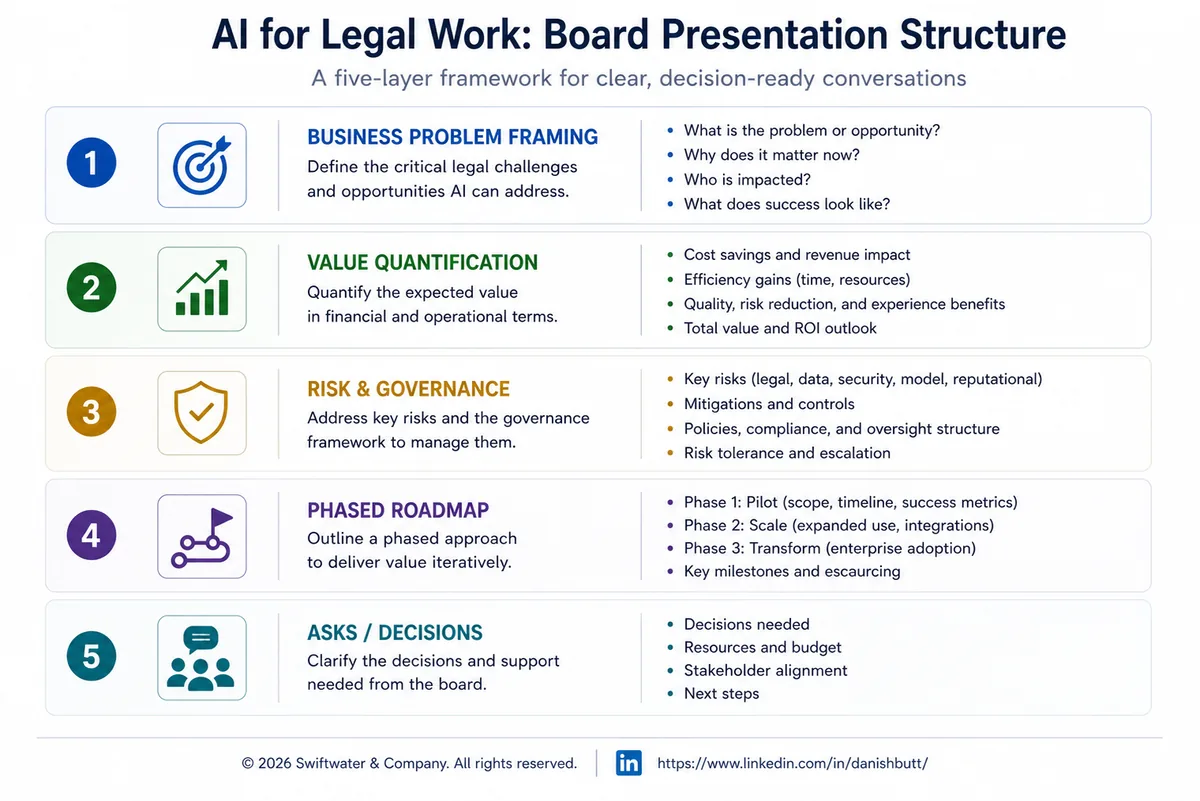
What does a board expect to see in a legal AI strategy?
Thinking about AI but not sure what is actually ready to deploy?
Swiftwater's AI Lab helps legal departments separate signal from noise, identifying where AI creates real leverage and building the governance to use it responsibly.
See Legal AI SolutionsBoards review legal AI the way they review any major program. The structure that lands well includes:
- Clear objectives: what problems AI will solve.
- Defined use cases: where AI will be applied first.
- Measured outcomes: expected impact on cost, speed, and risk.
- Governance structure: how AI will be controlled.
- Implementation timeline: a phased, defensible rollout plan.
The 2026 ACC Chief Legal Officers Survey consistently shows legal leaders working under pressure to improve efficiency while holding the line on risk. The strategy has to address both at once.
How should general counsel frame the value of legal AI?
Value belongs in business terms, with numbers the board can act on. The framing covers four dimensions: cost efficiency through reduced outside counsel reliance, speed through faster contract and matter cycles, scalability through handling more work without proportional headcount, and risk mitigation through more consistent application of controls.
The AI to reduce outside counsel spend article covers the cost lever in detail, including benchmarks of 10 to 25 percent savings on external legal spending from AI-assisted bill review and Swiftwater’s own program that produced approximately $60 million in combined cost avoidance and hard savings for clients. Danish Butt’s asbestos portfolio engagement produced 25 percent year-one savings from process redesign alone, before any technology was introduced. These are the kinds of figures that survive board scrutiny.
For ROI modeling that holds up in the boardroom, legaltechcalculator.com walks through cost, savings, ROI, and the cost of doing nothing for legal technology investments. It turns a strategy slide into a defensible financial case.
A useful proof point from outside the in-house function: a Harvard Law School Center on the Legal Profession study of AmLaw100 firms documented an AI complaint-response system that reduced associate time on a high-volume litigation workflow from 16 hours per matter to 3 to 4 minutes. Productivity gains exceeded 100 times. The 2025 Ediscovery Innovation Report from Everlaw, ACEDS, and ILTA found legal professionals reclaiming an average of 32.5 working days per year through generative AI use, scaling to roughly 200,000 hours annually for a large firm. Figures like these give the board reason to believe the productivity claim travels well beyond the demo.
How should legal AI risk be presented to the board?
Risk presented as a structured set of answers reads as competence. Risk presented as a list of fears reads as a problem looking for an owner. The four areas boards consistently probe:
- Data protection: how confidential information stays confidential, including model training posture and vendor data handling.
- Human oversight: where legal judgment is required, who provides it, and how the supervision is documented.
- Regulatory compliance: alignment with the EU AI Act, Colorado AI Act, NYC Local Law 144, and the patchwork of US executive guidance now in effect.
- Accountability: who owns AI outcomes when something goes wrong, and what the escalation path looks like.
Bloomberg Law surveys continue to place data security and governance at the top of board concerns about AI. The legal AI governance framework gives general counsel the structural answer across all four areas, anchored to NIST AI RMF and ISO/IEC 42001. The deeper risk treatment, including the bias, hallucination, and privilege exposure issues that boards now ask about by name, sits in AI legal risk management in-house.
PwC’s 2025 Annual Corporate Directors Survey, surfaced through the Harvard Law School Forum on Corporate Governance, found that the boards moving fastest on AI are doing so through proactive governance frameworks built collaboratively with the CEO, the general counsel, and the corporate secretary. The frameworks define when AI is used, how outputs are interpreted, and how decisions are documented. General counsel who arrive at the board with that work already in progress are speaking the board’s preferred language.
What implementation approach resonates with boards?
Phased execution lands consistently. The shape that holds up under board questioning:
- Pilot phase: prove value in low-risk, high-volume workflows like NDA review and matter intake.
- Controlled expansion: scale based on measured outcomes.
- Governance integration: apply policies from day one.
- Performance tracking: continuous measurement against the original business case.
The legal AI transformation roadmap covers the full sequencing across the AI portfolio. PwC’s 2026 AI predictions surface a useful pattern in this area: the organizations getting AI right are running top-down programs led by senior leadership rather than crowdsourcing pilots from the bottom up. Crowdsourced pilots produce impressive adoption numbers and limited business outcomes. A general counsel sponsoring an enterprise-aligned program has a stronger board narrative than one summarizing the activity of ten teams.
What mistakes should general counsel avoid in board presentations?
Most board-level mistakes are framing failures rather than strategy failures. The patterns that show up repeatedly:
- Overemphasizing technology: leading with tools and capabilities instead of business outcomes.
- Underestimating risk: glossing past difficult questions when the board is waiting for a direct answer.
- Lack of clarity: vague or abstract strategy slides that the board cannot evaluate.
- No measurable outcomes: missing financial or operational impact targets.
- Pitching rather than presenting: bringing enthusiasm to a room that needs a controlled program.
A board presentation is where general counsel demonstrate that the value, the risk, and the path are all understood and managed. Anything beyond that is filler.
Evaluating legal technology but not sure where to start?
We help legal departments cut through the vendor noise, mapping technology to process maturity and building a roadmap that actually gets adopted.
See Legal TechnologyBottom line
Presenting a legal AI strategy is a translation exercise. The technical work has been done. The risk has been mapped. The implementation has been sequenced. What remains is converting that into the language and rhythm the board uses for any major investment: numbers up front, governance close behind, and a sequence the directors can hold management accountable to. The general counsel who succeed at the board level have done the underlying work and built the artifacts to prove it.
If you are preparing to present AI strategy at the executive level, explore how Swiftwater’s Legal AI Solutions help legal teams design, implement, and scale AI with governance and measurable outcomes.
Frequently Asked Questions
What is a legal AI strategy board presentation?
A legal AI strategy board presentation is a structured communication that explains how a legal department will adopt AI to improve efficiency, manage risk, and support overall business objectives.
Why are boards focused on legal AI strategy?
Boards are focused on legal AI because enterprise-wide AI adoption is accelerating, and they expect legal teams to improve performance while managing risks such as data security and regulatory compliance.
What do boards expect to see in a legal AI strategy?
Boards expect clear objectives, defined use cases, measurable outcomes, governance structures, and a phased implementation roadmap.
How should general counsel present the value of legal AI?
General counsel should present AI value in business terms, including cost savings, improved speed, scalability, and risk reduction, supported by measurable financial outcomes.
How should legal AI risk be presented to the board?
Risk should be presented as structured answers covering data protection, human oversight, regulatory compliance, and accountability for AI outcomes.
What implementation approach works best for board-level AI strategy?
A phased approach works best, starting with pilot use cases, followed by controlled expansion, governance integration, and continuous performance tracking.
What mistakes should general counsel avoid in AI board presentations?
Common mistakes include focusing too much on technology, failing to address risk clearly, lacking measurable outcomes, and presenting an unclear or overly abstract strategy.
How should AI strategy be framed for board approval?
AI strategy should be framed as a business initiative with clear ROI, strong governance, and a structured implementation plan aligned with enterprise priorities.
This article is provided for educational and informational purposes only. Neither Swiftwater and Company nor the author provides legal advice. This content does not constitute professional legal, financial, or operational advice and should not be relied upon as such. Readers are encouraged to consult a qualified professional before making decisions based on the information provided. External links are included for reference only and reflect the views of their respective authors. Swiftwater and Company takes no responsibility for third-party content.