
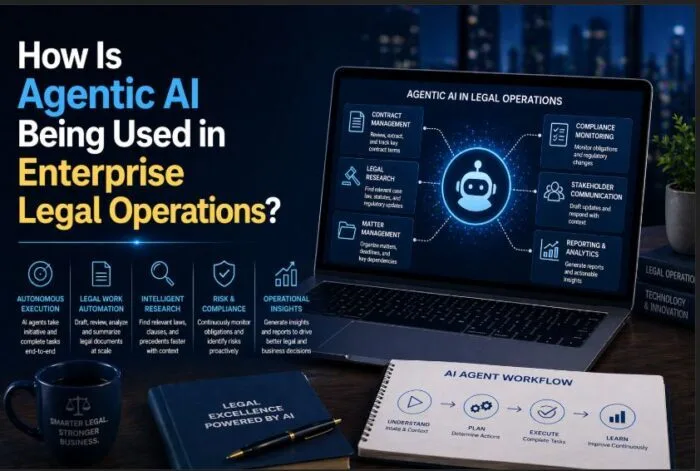

Agentic AI in legal operations refers to AI systems that can autonomously execute multi-step legal workflows by taking actions, making decisions within defined boundaries, and interacting with systems without constant human input. Enterprise legal teams are beginning to explore not just tools that generate outputs, but systems that complete tasks across workflows.
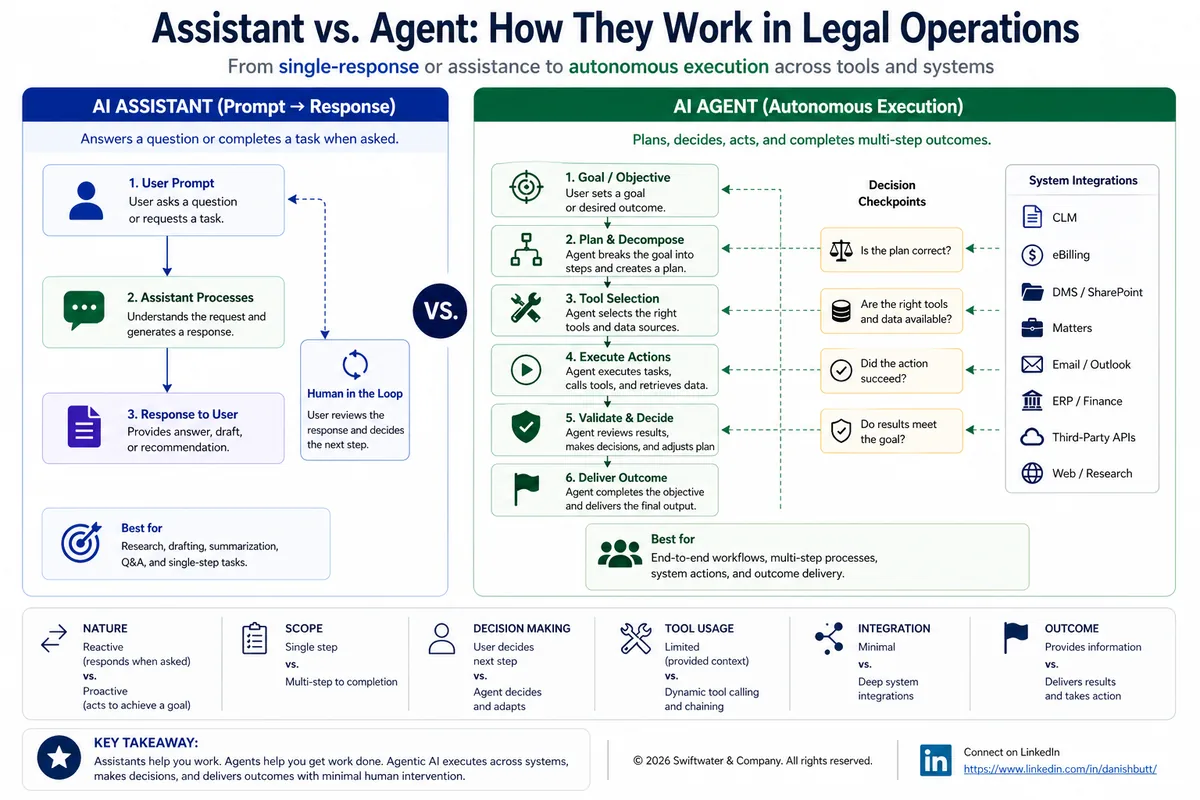
Most legal AI today assists. Agentic AI acts.
This article is part of the Legal AI hub and picks up where the AI legal assistant article leaves off.
What makes agentic AI different from traditional legal AI?
Traditional legal AI generates outputs when prompted. Agentic AI initiates and completes workflows based on predefined logic, triggers, and tool use.
Key differences:
- Action-oriented: executes tasks, not just generates responses.
- Multi-step workflows: handles sequences of legal actions.
- System integration: interacts with CLM, eBilling, and matter systems.
- Autonomous triggers: initiates actions based on events or conditions.
Every major frontier model now ships with agentic capabilities. OpenAI runs Operator and its Agents SDK. Anthropic’s Claude uses the Model Context Protocol (MCP), which crossed 97 million installs by March 2026 and has become the de facto standard for tool-using agents. Google launched its Gemini Enterprise Agent Platform and the Agent2Agent (A2A) protocol at Cloud Next 2026. Microsoft’s Copilot Studio and Agent 365 provide the enterprise control plane for agents inside Microsoft 365.
Thinking about AI but not sure what is actually ready to deploy?
Swiftwater's AI Lab helps legal departments separate signal from noise, identifying where AI creates real leverage and building the governance to use it responsibly.
See Legal AI SolutionsOn the legal-specific side, Leah AgenticOS orchestrates contract review and compliance agents on top of its CLM. Harvey Workflow Agents automate legal multi-step tasks. GC AI Playbooks runs agentic contract review inside Word for in-house teams.
What can legal learn from other industries already deploying agentic AI at scale?
Legal departments are not the first to navigate this shift. Insurance, lending, and credit have been running agentic workflows in production for over a year.
In insurance, Sedgwick’s Sidekick Agent with Microsoft reports more than 30 percent improvement in claims processing efficiency. One major insurer cited by McKinsey rolled out 80 AI models across claims, cutting complex-case liability assessment by 23 days, improving routing accuracy by 30 percent, and reducing customer complaints by 65 percent. Aviva reports over $80 million in annual value from AI-driven claims optimization.
In lending, consumer loan origination has compressed from three to five days to under 60 minutes for standard cases. McKinsey data shows banks using agentic AI have 3 to 15 percent higher revenues per customer and 20 to 40 percent lower cost to serve.
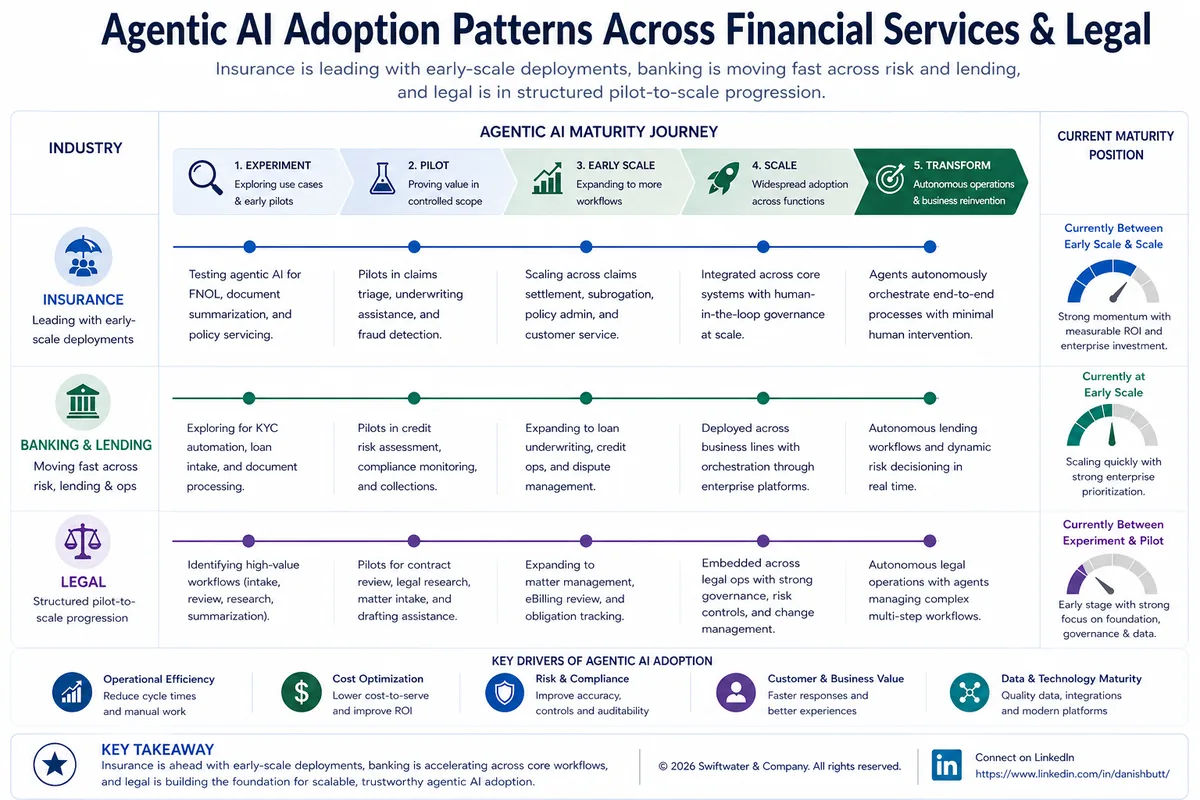
The mechanics (document intake, classification, rules application, decision routing, exception escalation) are now proven at scale in regulated environments. The question for legal is not whether agentic AI can work. It is where the contained, auditable wins are.
Where are enterprise legal teams applying agentic AI today?
Adoption inside legal is earlier than in insurance or lending, but specific use cases are emerging.
Five applications are most relevant:
- Contract lifecycle execution: routing contracts for approval, flagging risks, and updating systems.
- Matter intake and routing: categorizing requests and assigning them to the right team.
- Billing and invoice review: identifying anomalies, applying billing rules, flagging issues.
- Regulatory tracking: monitoring regulatory changes and triggering internal alerts.
- Knowledge management: retrieving and applying internal precedents across workflows.
For deeper treatment of the first two, see matter management and reducing outside counsel spend.
Swiftwater’s own practice reflects the pattern.
Danish Butt is leading an AI triage build for a client standing up a new legal service request capability. The system learns from explicit rules and human input in its first weeks, then returns routing recommendations a human can override. The target is to eliminate the mundane marshalling of matter flow across a globally distributed legal team so recovered time converts directly into legal department capacity.
Imran Jaswal, reporting from the Swiftwater AI Lab, is mapping agentic AI uses across the billing and legal spend value chain: intake, invoice review, spend analytics, and accrual. The goal is to eliminate rote human steps while preserving smart decision-making.
Swiftwater’s managed services practice is embedding agentic patterns directly into its own offerings, from work triage to bill preview.
Evaluating legal technology but not sure where to start?
We help legal departments cut through the vendor noise, mapping technology to process maturity and building a roadmap that actually gets adopted.
See Legal TechnologyWhat infrastructure is required for agentic AI in legal?
Agentic AI cannot operate in fragmented environments. Unlike marketing or general business AI, legal AI depends on enterprise knowledge (contracts, playbooks, matter history, timekeeper and vendor records) as much as on publicly available knowledge. The required infrastructure:
- Integrated systems: CLM, eBilling, and matter management platforms connected.
- Structured data: clean, standardized legal data across systems.
- Workflow mapping: clearly defined legal processes.
- API connectivity: AI systems able to interact with tools.
- Governance controls: policies governing AI actions and decisions.
 Without this foundation, agentic AI will not work reliably. Many teams anchor deployment to a legal AI governance framework before scaling.
The harder question is whether current data can be fixed in place at all. For many legal functions, the answer is no. Years of siloed systems, inconsistent tagging, missing timekeeper records, fragmented vendor masters, and partial matter histories leave data that is not just incomplete, but unreliable as a foundation for anything agentic.
At that point the decision shifts. Rather than cleaning the existing environment, the right move is often to migrate to a new platform and rebuild the data layer.
Swiftwater recently ran that program for a large technology company whose spend, vendor, timekeeper, and matter data had degraded to the point that straightforward reporting was unreliable. The engagement moved them to a cleaner platform with remediated data. The by-product was twofold: immediate spend control, and a legal data estate ready to support AI and agentic workflows.
Swiftwater’s legal spend practice and managed services run these programs.
Can an AI agent actually enter into transactions on behalf of a company?
The short answer: no, not on its own. An AI agent is not a legal person in any jurisdiction. Its actions are legally attributed to the human or corporate principal that deployed it.
US contract law, through the Uniform Electronic Transactions Act (UETA) and the federal E-SIGN Act, has long recognized “electronic agents” as capable of forming contracts, but only when the electronic agent’s action is legally attributable to the person to be bound. The principal consents. The agent executes. The principal bears the risk.
The legal system has adapted before. The same legislation that handled wet-ink versus electronic signatures is the frame being stretched now. It was built for rules-based systems. Applying it to probabilistic, self-planning agents is the live question.
An agent can act. The principal still consents, directs, and bears the risk.
Three developments worth tracking.
First, vendor terms of service for agentic AI products are allocating liability back to the user, a posture that will face unconscionability challenges as real money moves through these systems.
Second, common-law agency doctrine does not map cleanly: it presumes a self-interested human whose loyalty can be compelled by fiduciary duty, which an AI cannot feel.
Third, United States v. Heppner (S.D.N.Y. Feb. 17, 2026), covered in the AI legal assistant article, signals how courts will treat AI in the attorney-client relationship: not an attorney, not privileged, not a substitute for counsel’s direction.
For a general counsel, the practical implication: anywhere an agentic workflow touches a transaction with legal effect (a contract signature, a claim payout, a vendor payment, a regulatory filing), the human principal must be identifiable, documented, and authorized. The agent is the tool. The accountability stays with the principal.
Evaluating or implementing a CLM platform?
We have guided legal departments through selection, implementation, and adoption, without the vendor bias. Let us talk about where you are and what you actually need.
See CLM ServicesWhat risks are unique to agentic AI?
Agentic AI introduces a different category of risk because it takes action, not just provides output. Agentic AI risk is the potential for unintended actions, incorrect decisions, or system-level errors resulting from autonomous AI execution.
Key risks:
- Uncontrolled actions: AI executing workflows without sufficient oversight.
- Error propagation: mistakes amplified across multiple steps.
- System dependencies: failures in one system affecting entire workflows.
- Accountability gaps: unclear responsibility for AI-driven actions.
- Bias: AI systems can produce discriminatory outputs at scale, as illustrated by a 2025 federal collective certification against a major AI hiring vendor for ADEA disparate impact.
Error propagation matters most when the agent acts on systems of record rather than drafting something a human reviews. Vendor diligence, incident response, and monitoring cadence all need to be layered into the control plane.
Agentic AI increases efficiency. It also increases the importance of control.
How should legal teams start with agentic AI?
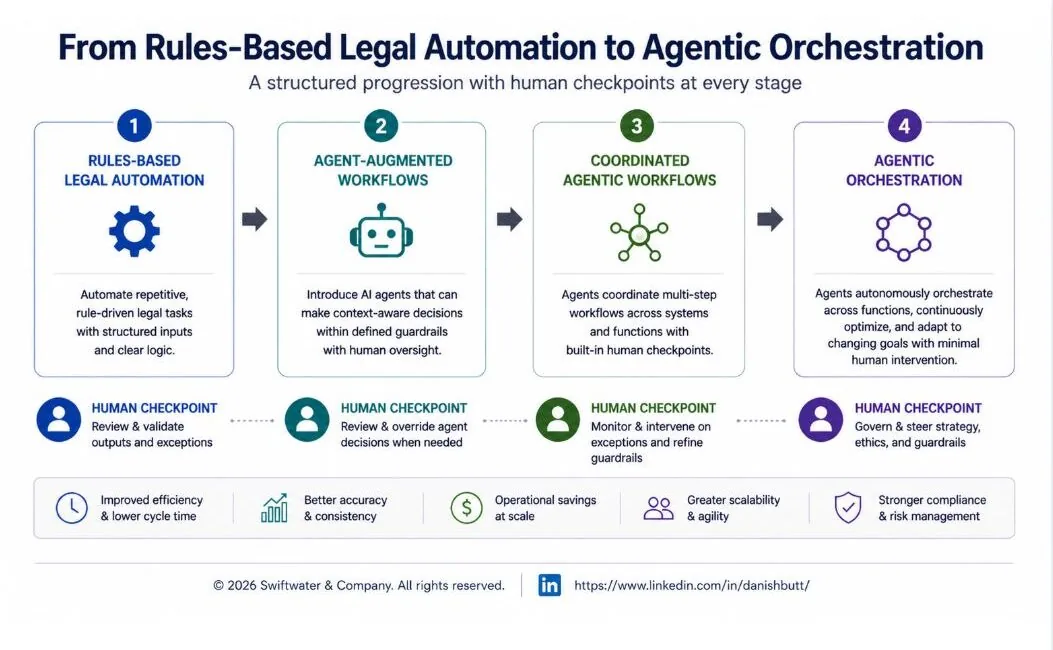
Agentic AI should not be deployed broadly at the start. A controlled rollout is recommended.
Best practice:
- Start with contained workflows: limited scope, low-risk processes.
- Define action boundaries: clear rules on what AI can and cannot do.
- Maintain human checkpoints: review critical steps before completion.
- Monitor performance closely: track outcomes and adjust workflows.
The road to full autonomy goes through controlled automation, with a documented owner, a defined scope, and an auditable trail.
What is the long-term impact of agentic AI on legal operations?
Agentic AI changes how legal work is structured. Instead of lawyers executing every step, AI systems handle workflow execution while lawyers focus on judgment, strategy, and risk.
The result: more scalable legal operations, faster business response times, and a shift in legal roles from task execution to oversight and decision-making. Agentic AI does not eliminate legal work. It reorganizes it.
The legal AI transformation roadmap covers how agentic initiatives sit alongside the rest of the AI portfolio.
Bottom line
Agentic AI represents the next stage of legal AI adoption: from assistance to execution. The legal departments that benefit will be those that adopt it deliberately, with strong infrastructure, clear accountability for agent-taken actions, and governance that anticipates the agency question. Agentic AI will not replace legal teams. It will redefine how legal work gets done at scale.
If you are exploring agentic AI capabilities, discover how Swiftwater’s Legal AI Solutions help legal teams implement structured, scalable, and governed AI workflows.
Frequently Asked Questions
What is agentic AI in enterprise legal operations?
Agentic AI refers to AI systems that can autonomously execute multi-step legal workflows, make decisions within defined boundaries, and interact with enterprise systems without constant human input. Unlike traditional AI that only generates outputs when prompted, agentic AI can take actions and progress workflows independently within a structured framework.
How is agentic AI different from traditional legal AI?
Traditional legal AI produces outputs based on user prompts or queries, whereas agentic AI goes further by initiating and completing workflows autonomously. It executes multi-step sequences, integrates with legal systems such as CLM and eBilling, and can respond automatically to defined triggers or conditions.
Where is agentic AI being used in enterprise legal teams?
Enterprise legal teams are applying agentic AI across several key workflows: contract lifecycle execution (routing contracts for approval, flagging risks, updating systems), matter intake and routing (categorizing requests and assigning to the appropriate team), billing and invoice review (identifying anomalies and applying rules), regulatory tracking (monitoring changes and triggering alerts), and knowledge management (retrieving and applying internal precedents).
What infrastructure is required for agentic AI in legal operations?
Agentic AI relies on a robust operational foundation. Legal departments need integrated systems such as CLM, eBilling, and matter management platforms, structured and clean legal data, clearly defined workflows, API connectivity for system interactions, and governance policies to control AI actions and decisions. Without these, agentic AI will not operate reliably.
Can agentic AI make legally binding decisions or transactions?
No, agentic AI cannot independently enter into legally binding transactions. Any action performed by an AI agent is legally attributed to the human or corporate principal that deployed it. The AI acts as a tool, but accountability and responsibility remain with the deploying entity.
What risks are associated with agentic AI in legal operations?
Agentic AI introduces risks due to its autonomous nature. Key risks include uncontrolled actions without adequate oversight, error propagation across workflows, dependency on multiple systems where failures in one can impact others, accountability gaps for decisions made by the agent, and bias or discriminatory outcomes in automated processes. Structured monitoring and incident response are critical to mitigate these risks.
How should legal teams start using agentic AI?
Legal teams should begin with low-risk, contained workflows and define clear boundaries for AI actions. Human checkpoints should be maintained to review critical steps, and performance should be closely monitored. Starting small and structured ensures controlled adoption and reduces the likelihood of operational errors.
What is the long-term impact of agentic AI on legal operations?
Agentic AI shifts the execution of routine legal tasks from lawyers to autonomous systems, allowing legal teams to focus on judgment, strategy, and risk oversight. The result is more scalable operations, faster business response times, and a reorganization of legal roles where AI handles task execution and humans oversee decision-making and compliance.
This article is provided for educational and informational purposes only. Neither Swiftwater and Company nor the author provides legal advice. This content does not constitute professional legal, financial, or operational advice and should not be relied upon as such. Readers are encouraged to consult a qualified professional before making decisions based on the information provided. External links are included for reference only and reflect the views of their respective authors. Swiftwater and Company takes no responsibility for third-party content.