
ELM Systems Integration: What Needs to Connect
ELM Implementation: What It Actually Requires for Success
Legal Technology Change Management: Why It Matters

What Is Legal Tracker? A Practitioner’s View

Legal Bill Review: What It Is and What It Catches

Outside Counsel Billing Guidelines: What to Include
Onit eBilling Implementation: What It Takes

How Does Legal eBilling Work? A Complete Guide
ELM Data Migration: How Legal Departments Should Approach It

What Is Legal Operations Consulting?

In-House Legal Software: What Do You Actually Need?

What Is a Legal Operations Platform?

Legal Matter Management Software: How to Choose
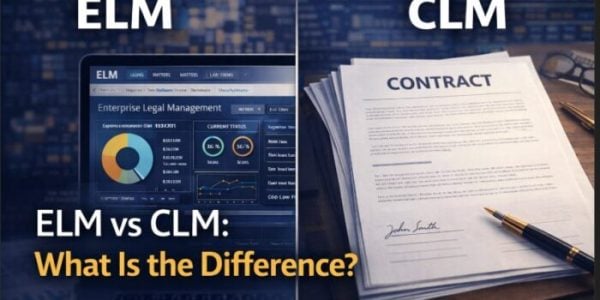
ELM vs CLM: What Is the Difference?

ELM Software: Buyer’s Guide for Legal Departments

What Is Matter Management in Legal?

What Is Enterprise Legal Management (ELM)?

Onit ELM: When It’s the Right Choice (and When It Isn’t)

Onit Implementation Partner: How to Evaluate One

What Is Onit Unity? The Next-Generation ELM Platform

What Is Onit Apptitude? Low-Code Legal Workflow Platform

What Is CounselGO? Onit’s eBilling Platform Explained

What Is SimpleLegal? Onit’s Mid-Market ELM Platform

What Is Onit ELM and How Does It Work?

Enterprise Legal Management (ELM) Software: What It Is, How It Works, and How to Choose the Right System
Why eBilling Tools Alone Aren’t Enough

How LEDES Format Enhances Legal Billing Metrics & Analytics
How Does the LEDES Billing Format Transform Legal Invoicing

Automate Legal Service Requests to Modernize Your Department
Transform Legal Operations: Matter Management within ELM Systems
 In today’s complex business environment, corporate legal departments are no longer just cost centers. They are evolving into strategic business partners, and the key to this transformation is adopting a disciplined, technology-driven approach to operations. This is where Enterprise Legal Management (ELM) becomes essential. ELM is not merely a piece of software; it’s a comprehensive strategy that unifies people, processes, and technology to manage a legal department’s entire operational footprint with business-like precision.
A robust ELM system provides a single source of truth for critical legal functions. It offers a centralized platform for everything from matter management and e-billing to contract lifecycle management and compliance oversight. For General Counsel, Legal Operations leaders, and Chief Compliance Officers, implementing an effective enterprise legal management solution is fundamental to gaining visibility, boosting efficiency, and clearly demonstrating the department’s value to the wider organization. To fully grasp the magnitude of ELM’s impact, it’s helpful to consider the broader context of how a true game-changer like ELM contributes to the overall digital transformation in the legal industry.
Navigating the crowded market of ELM providers can be challenging. This guide is designed to simplify that process. We will explore the top enterprise legal management solutions and advisory services, including Onit, Mitratech, Brightflag, and others, to help you find the best fit for your team. Each breakdown provides a detailed overview, screenshots, and direct links to help you make an informed decision and elevate your legal function. We’ll delve into the core modules, benefits, and implementation roadmaps that will empower your department to operate at its highest potential.
1. Swiftwater and Company
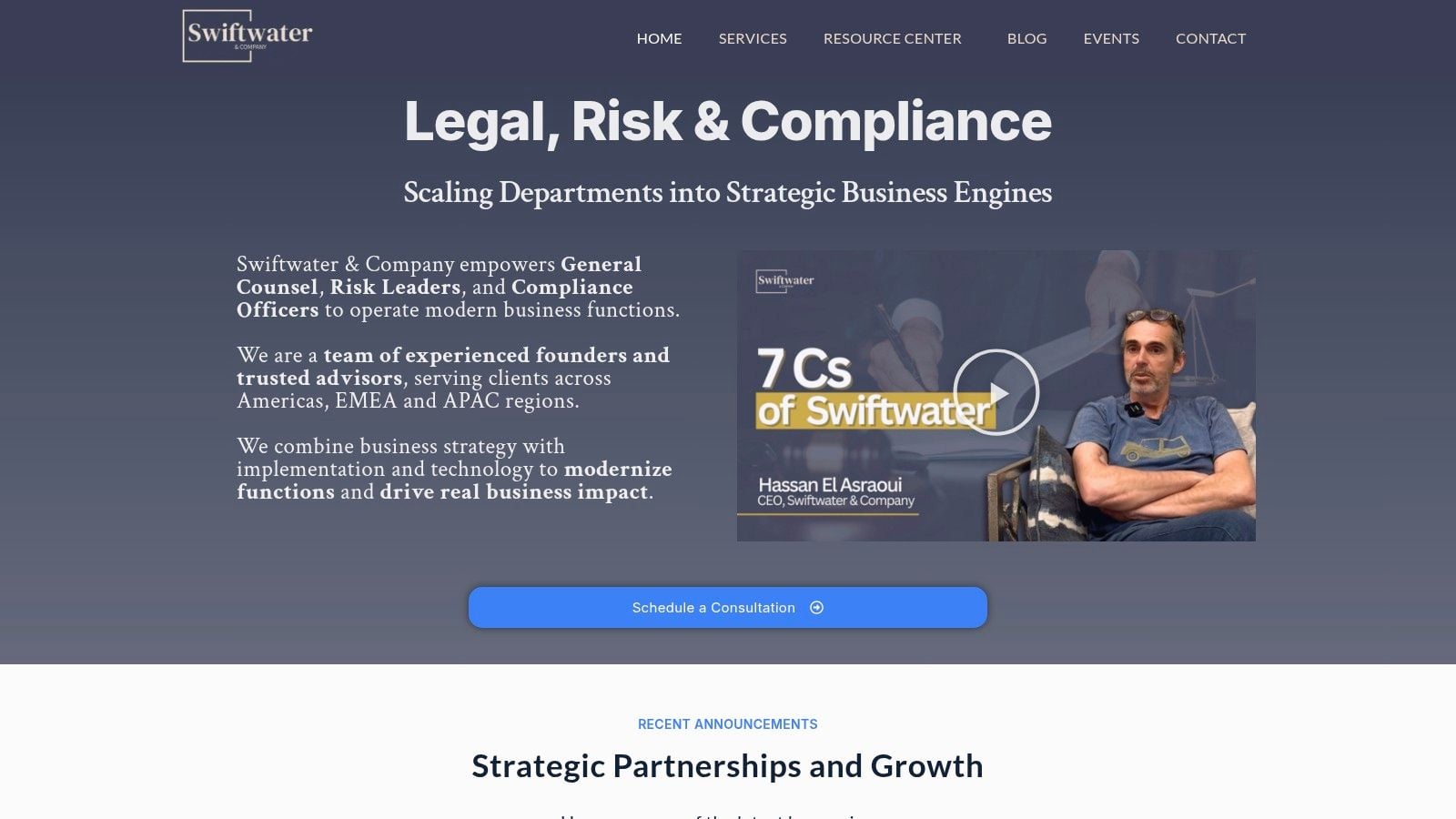
For enterprises seeking a holistic transformation of their legal operations, Swiftwater and Company offers a premier strategic advisory and implementation service. Unlike traditional consultancies or standalone software providers, Swiftwater distinguishes itself by delivering an integrated, end-to-end solution that bridges the critical gap between strategy and execution. This makes it an exceptional choice for organizations aiming to evolve their legal department from a cost center into a strategic business asset, providing a robust framework for advanced enterprise legal management.
With over 25 years of proven expertise, the firm partners directly with General Counsel and legal operations leaders to streamline workflows, optimize spend, and enhance risk oversight. Their approach is not merely about recommending technology; it’s about fundamentally re-engineering processes to drive measurable business value.
Core Strengths and Strategic Offerings
Swiftwater’s key differentiator is its unified service model. The same team of experts that develops a client’s strategic roadmap also leads its implementation, ensuring continuity and eliminating the common points of failure that occur during handoffs between different firms. This seamless integration of strategy, operations, and technology deployment is a significant advantage for complex global enterprises.
Their service portfolio is designed to address the most pressing challenges facing modern legal departments:
- Legal Operations and Technology Transformation: Swiftwater guides organizations through the entire technology lifecycle, from system selection and process design to implementation and change management. They ensure new platforms are not just installed but are deeply embedded into daily workflows to maximize adoption and ROI.
- Spend Management and Cost Control: Leveraging strategic partnerships with platforms like Legal Decoder, the firm implements AI-driven analytics to provide deep visibility into legal spend. This empowers clients to optimize outside counsel costs, enforce billing guidelines, and make data-informed sourcing decisions.
- Risk and Compliance Modernization: The team helps clients navigate complex regulatory landscapes by designing and implementing effective compliance programs, enhancing information governance protocols, and strengthening cybersecurity risk management frameworks.
Key Insight: Swiftwater’s integrated approach ensures that strategic recommendations are pragmatic and implementable. By managing both the “what” and the “how,” they deliver practical solutions that produce tangible results, such as significant cost reductions in legal spend and improved operational efficiency.
Unique Value Proposition and Use Cases
The firm’s value is particularly evident in large-scale transformation projects where deep domain knowledge and execution power are paramount. A highly experienced leadership team, composed of former legal, technology, and business executives, brings a C-suite perspective to every engagement.
Practical Use Case: Streamlining Corporate Investigations
Through its partnership with Onit, Swiftwater helps companies streamline and automate corporate investigation workflows. Instead of relying on manual tracking and disparate systems, clients can implement a centralized platform that manages everything from case intake and triage to evidence collection and reporting. This not only accelerates resolution times but also creates a defensible, auditable record, significantly reducing risk.
Practical Considerations
| Feature | Description |
|---|---|
| Service Model | Integrated strategic advisory and implementation services. |
| Expertise | Legal operations, spend management, risk, compliance, and technology. |
| Key Differentiator | End-to-end project ownership eliminates consulting handoff gaps. |
| Target Audience | Primarily mid-to-large corporate legal and compliance departments. |
| Pricing | Custom quotes provided after direct consultation. Not publicly listed. |
Pros:
- Comprehensive, end-to-end service from strategy to implementation.
- Deep expertise with a 25+ year track record in legal transformation.
- Advanced solutions through strategic partnerships with AI and analytics leaders.
- Highly experienced leadership team ensures strategic, business-focused outcomes.
- Proven ability to drive measurable cost savings and operational improvements.
Cons:
- Pricing is not publicly available, requiring direct engagement for a quote.
- Services are tailored for larger enterprises, which may not be accessible for smaller organizations.
For legal departments ready to undertake a meaningful transformation, Swiftwater and Company provides the strategic guidance, technological expertise, and hands-on implementation support needed to achieve superior performance in enterprise legal management.
Website: https://swiftwaterco.com
2. Onit
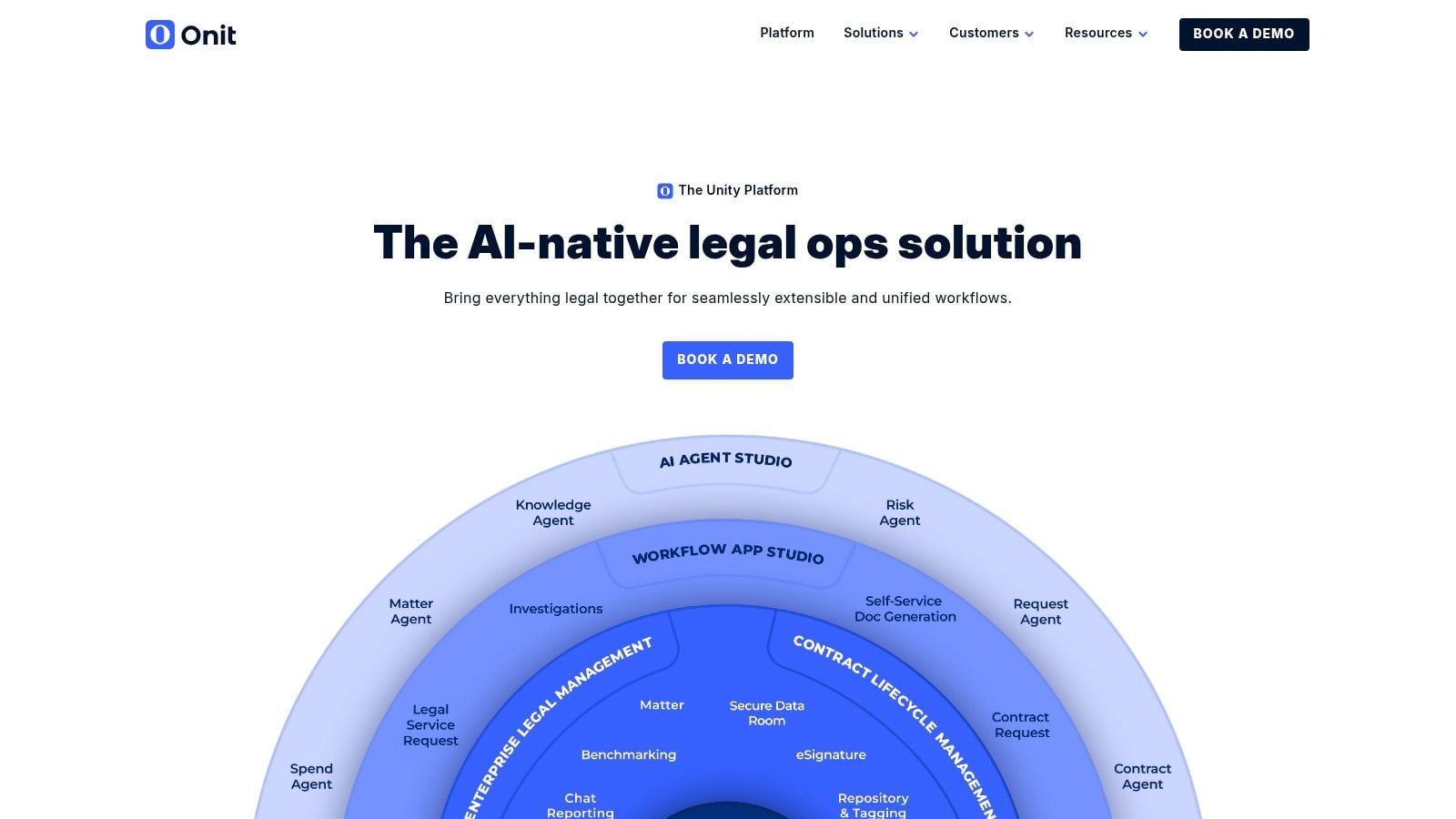
Onit positions itself as a highly flexible and workflow-centric platform for enterprise legal management (ELM). Instead of offering a rigid, one-size-fits-all solution, Onit’s strength lies in its Apptitude platform, which allows legal departments to build and configure custom applications and workflows. This approach empowers teams to digitize and automate unique processes far beyond standard matter and spend management, addressing specific operational bottlenecks.
The platform’s core philosophy is that legal operations are not static. Onit provides the tools for departments to evolve their technology as their business needs change. This adaptability makes it particularly valuable for large, complex organizations with non-standard legal or compliance procedures that other ELM systems struggle to accommodate.
Key Differentiators and User Experience
What truly sets Onit apart is its no-code/low-code configuration capability. Users with minimal technical expertise can design, build, and deploy custom workflows for tasks like contract review cycles, legal service requests, or compliance approvals. This level of customization ensures the platform aligns perfectly with an organization’s established procedures rather than forcing the team to adapt to the software’s limitations.
The user interface is generally clean and modern, focusing on dashboards that provide real-time visibility into key metrics. The experience is geared toward simplifying complex processes into intuitive, step-by-step actions for end-users.
Key Insight: Onit’s approach is ideal for legal departments that see technology as a strategic enabler for continuous improvement. Its configurable nature supports an agile methodology for legal operations, allowing for rapid iteration and deployment of new processes.
Implementation and Pricing
Onit’s powerful flexibility comes with a trade-off. Implementation is a significant project that requires careful planning, dedicated internal resources, and often, professional services from Onit or a certified partner. The timeline and cost are highly dependent on the complexity of the workflows being built.
Pricing is not publicly listed and requires a direct consultation. The model is typically subscription-based, factoring in the number of users, selected modules, and the level of customization required.
| Feature Area | Onit’s Approach | Practical Benefit |
|---|---|---|
| Workflow Automation | No-code/low-code platform for custom app building | Automate unique processes beyond standard ELM functions. |
| Matter Management | Centralized repository with configurable fields and stages | Tailor matter tracking to specific practice areas or case types. |
| Spend Management | Automated invoice review against billing guidelines | Significantly reduces manual review time and enforces billing discipline. To explore this topic in greater depth, you can learn more about advanced legal spend management strategies. |
| Reporting & Analytics | Real-time, customizable dashboards and reports | Gain actionable insights into workloads, cycle times, and spending trends. |
Website: https://www.onit.com/enterprise-legal-management/
3. Mitratech TeamConnect
Mitratech TeamConnect is positioned as a proven and comprehensive platform for enterprise legal management (ELM), trusted by many of the world’s largest corporate legal departments. It provides an end-to-end solution designed to centralize operations, control costs, and mitigate risk. The platform integrates core legal functions like matter management, e-billing, document management, and compliance into a single source of truth.
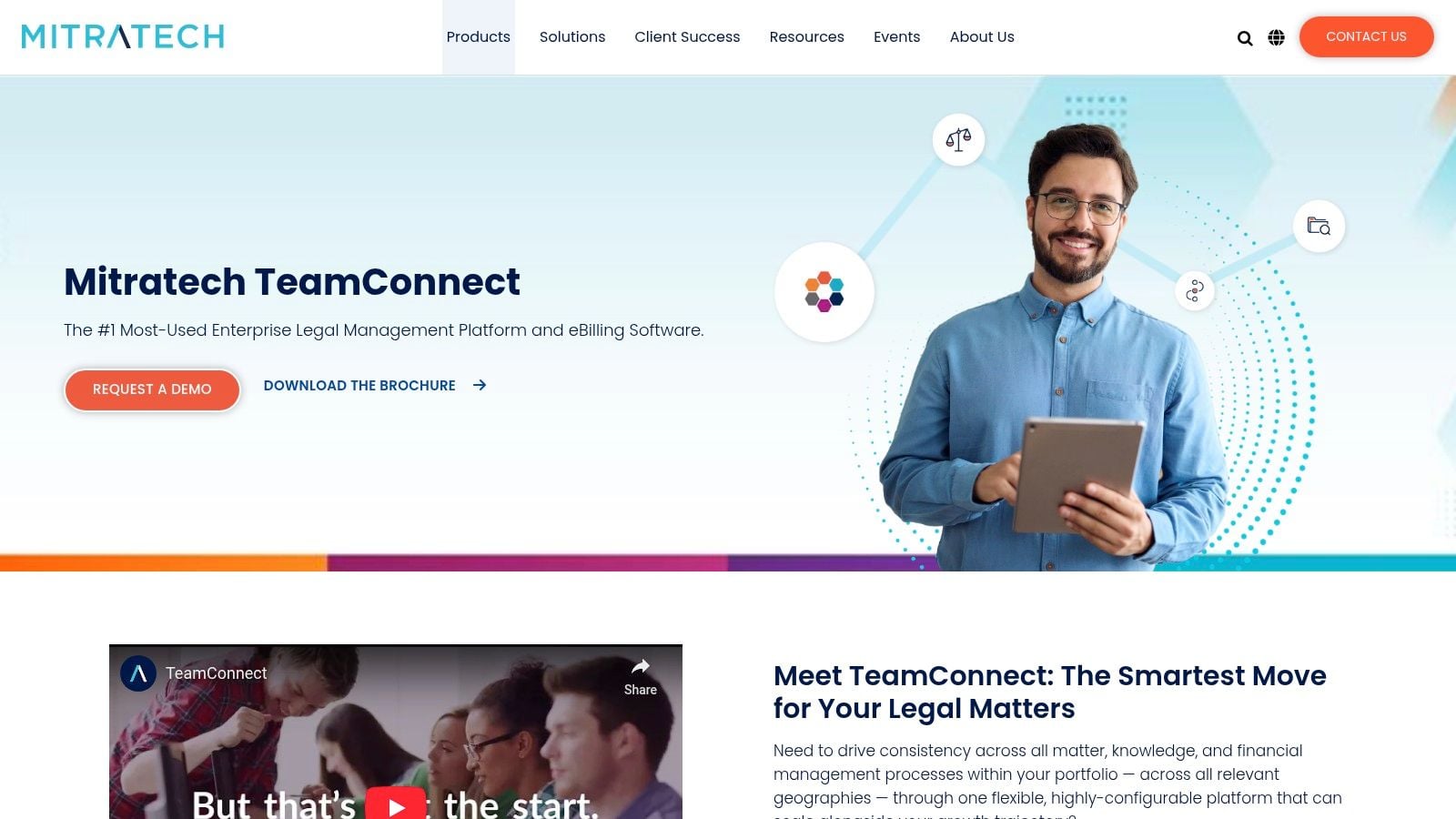
The core strength of TeamConnect lies in its robust, scalable architecture built to handle the complexities of global enterprises. Its approach focuses on delivering control and visibility across all legal activities, from tracking intricate litigation to managing a high volume of contracts and invoices. This makes it a go-to choice for departments seeking a mature, all-in-one system.
Key Differentiators and User Experience
A key differentiator for Mitratech is its deep industry expertise embedded within the platform’s features, particularly its use of AI. TeamConnect leverages AI-driven invoice review to automatically flag non-compliant billing entries, significantly reducing the manual effort required by legal staff and ensuring adherence to billing guidelines. This focus on practical automation extends to other areas, such as contract approvals and compliance reporting.
The user experience is geared toward efficiency for power users who manage complex legal portfolios. While it offers powerful capabilities, new users may find it has a steeper learning curve compared to more modern, streamlined interfaces. However, for organizations that need deep functionality, the platform’s comprehensive nature is a major asset.
Key Insight: TeamConnect excels in environments where standardization, control, and scalability are paramount. It’s an ideal fit for established legal departments aiming to consolidate disparate systems into a single, powerful platform to manage global operations and enforce consistent processes.
Implementation and Pricing
Implementing TeamConnect is a significant undertaking that requires dedicated project management and a clear understanding of the legal department’s operational goals. Mitratech and its partners provide extensive professional services to guide organizations through configuration, data migration, and user training to ensure a successful deployment.
Pricing is not publicly available and is determined through a direct sales consultation. The cost is typically based on a subscription model that considers the modules selected, the number of users, and the scale of the deployment.
| Feature Area | Mitratech’s Approach | Practical Benefit |
|---|---|---|
| Matter Management | Centralized hub for all case details, documents, and collaboration | Provides a single source of truth for all matters, improving visibility. |
| Spend Management | AI-powered invoice review and automated e-billing workflows | Reduces legal spend by automatically enforcing billing rules and saving review time. |
| Contract Management | Automated workflows for contract creation, approval, and reminders | Accelerates the contract lifecycle and minimizes risk from missed obligations. To better understand this area, you can explore more about optimizing contract workflow management. |
| Reporting & Analytics | Pre-built and customizable reports on performance and spend | Enables data-driven decision-making for resource allocation and strategy. |
Website: https://www.mitratech.com/products/teamconnect/
4. Brightflag
Brightflag differentiates itself in the enterprise legal management (ELM) space by positioning its platform around AI-powered spend and matter management. It is designed to give corporate legal teams granular visibility and control over their legal work and costs. The core of its technology is an AI engine that analyzes legal invoices and matter narratives, automatically flagging non-compliance with billing guidelines and uncovering deeper trends in vendor performance and resource allocation.
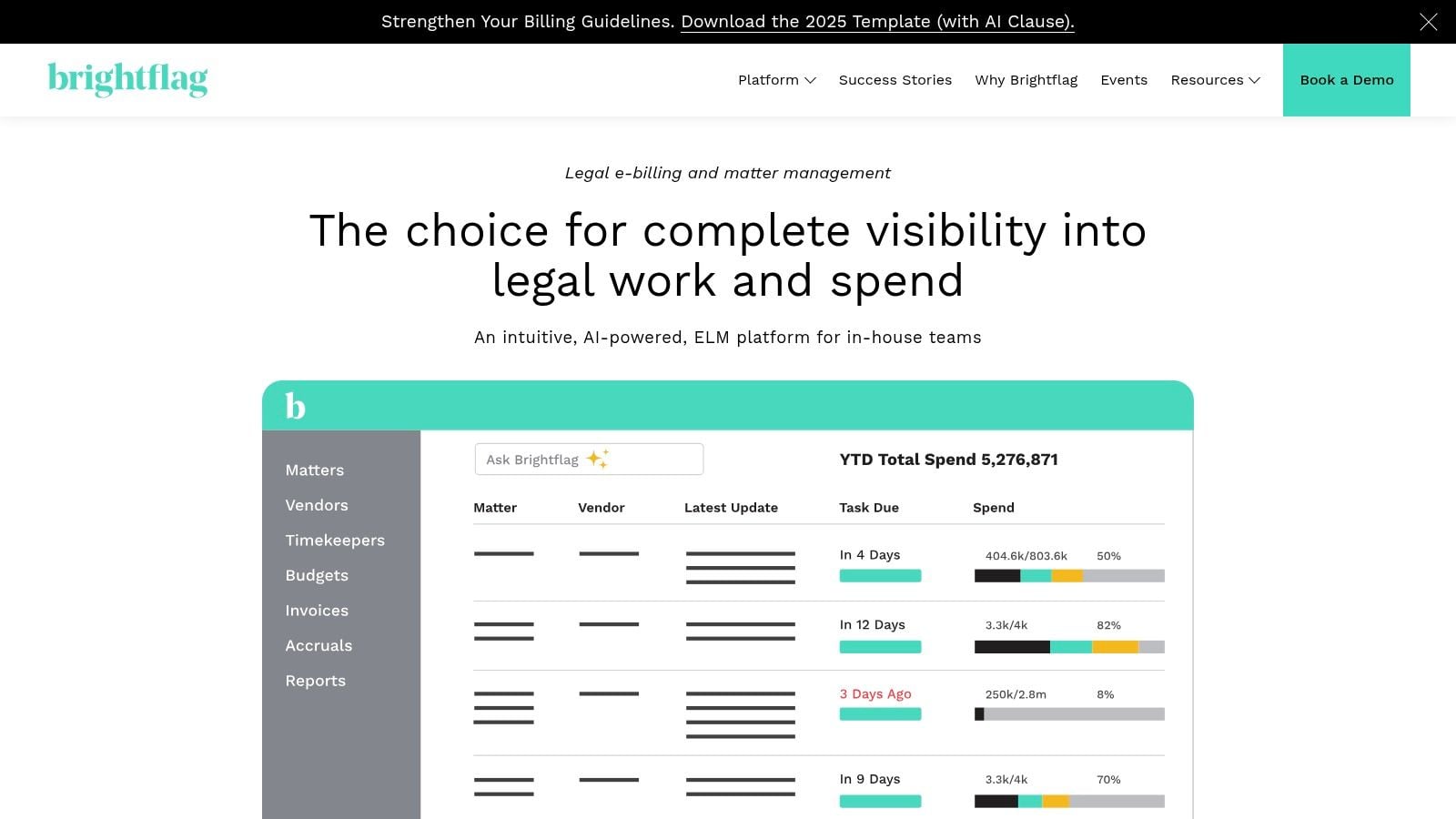
This AI-first approach moves beyond simple e-billing to provide strategic financial oversight. Brightflag helps legal departments transition from a reactive to a proactive stance on cost control, using data to inform decisions about law firm selection, matter budgeting, and overall operational efficiency. It’s particularly suited for teams aiming to demonstrate value through quantifiable savings and data-driven management.
Key Differentiators and User Experience
The primary differentiator for Brightflag is its proprietary AI, which reads and interprets unstructured data within invoices and time entries. This “narrative analysis” allows it to catch complex billing issues that keyword-based systems might miss, such as block billing or vague descriptions. This saves significant time for in-house counsel who would otherwise manually scrutinize line items.
The platform’s user interface is built for clarity and quick access to insights. Dashboards prominently display key performance indicators related to spend, savings, and matter status. The experience is designed to be intuitive for both legal professionals and finance partners, simplifying the process of invoice approval and budget tracking.
Key Insight: Brightflag’s AI-driven invoice review is its standout feature, transforming spend management from a manual, administrative task into a strategic, data-rich function. It empowers legal ops to not just track costs, but to understand the value being delivered by outside counsel.
Implementation and Pricing
Implementing Brightflag involves a structured onboarding process focused on configuring the AI to the organization’s specific billing guidelines and matter types. While the platform is user-friendly, the initial setup requires dedicated time from the legal operations team to ensure the AI is properly trained and integrations with systems like Accounts Payable are established.
Pricing information is not publicly available and is provided through direct consultation. The model is subscription-based, likely influenced by the volume of legal spend processed, the number of users, and the specific modules required.
| Feature Area | Brightflag’s Approach | Practical Benefit |
|---|---|---|
| Spend Management | AI-powered invoice review and narrative analysis | Automates identification of non-compliant billing, generating direct cost savings. |
| Matter Management | Integrated matter tracking with real-time budget data | Provides a unified view of matter progress and its financial impact. |
| Reporting & Analytics | Pre-built and customizable reports on spend and vendor trends | Enables data-driven negotiations with law firms and strategic resource allocation. |
| Vendor Management | Performance dashboards comparing law firm rates and efficiency | Offers objective data to evaluate and manage outside counsel relationships effectively. |
Website: https://brightflag.com/
5. LexisNexis CounselLink
LexisNexis CounselLink is a robust, cloud-based platform that offers a comprehensive suite for enterprise legal management (ELM). It integrates work management, financial management, and vendor management into a single, unified solution designed to give corporate legal departments a 360-degree view of their operations. The platform is known for its powerful data analytics and its use of AI-driven tools to enhance efficiency and strategic decision-making.
CounselLink’s core value proposition lies in its ability to centralize disparate legal functions and data sources. By providing a single source of truth for matters, contracts, and spend, it empowers legal operations teams to move from a reactive to a proactive stance, identifying trends, managing risk, and optimizing resource allocation across the entire department.
Key Differentiators and User Experience
A significant differentiator for CounselLink is its foundation in the vast LexisNexis data ecosystem. This allows the platform to offer sophisticated benchmarking and analytics, enabling departments to compare their performance against industry peers on metrics like law firm rates and matter cycle times. The platform also features AI-powered tools within its contract lifecycle management and financial modules to accelerate review and analysis.
The user experience is designed for functionality and control, providing deep visibility into every aspect of legal operations. While feature-rich, this depth can present a steeper learning curve for new users who are unfamiliar with comprehensive ELM systems. However, once mastered, the interface offers powerful control over workflows and reporting.
Key Insight: CounselLink is particularly powerful for data-driven legal departments focused on benchmarking and financial optimization. Its ability to leverage aggregated, anonymized data provides unique strategic insights that are difficult to replicate with other systems.
Implementation and Pricing
Implementing CounselLink is a structured process that requires close collaboration with the LexisNexis team to configure the platform according to an organization’s specific needs, compliance rules, and operational workflows. Given its comprehensive nature, implementation is a significant project best suited for organizations ready to invest in process transformation.
Pricing information is not publicly available and is provided through direct consultation. The cost is determined by factors such as the number of users, the specific modules selected (e.g., financial management, CLM), and the level of customization and support required for a successful deployment.
| Feature Area | CounselLink’s Approach | Practical Benefit |
|---|---|---|
| Financial Management | Advanced e-billing, spend analysis, and budget tracking | Enforces billing guidelines, controls outside counsel spend, and improves budget predictability. To better understand this process, explore how the LEDES e-billing format transforms legal invoicing. |
| Matter Management | Centralized hub for all case details, documents, and collaboration | Provides real-time visibility into matter status and workload distribution. |
| Vendor Management | Tools for tracking law firm performance and compliance | Enables data-backed decisions for selecting and managing outside counsel. |
| Analytics & Reporting | AI-powered analytics and industry benchmarking data | Offers strategic insights to optimize departmental performance and cost-efficiency. |
Website: https://www.lexisnexis.com/en-us/products/counsellink.page
6. SimpleLegal
SimpleLegal targets the core pain points of legal operations with a modern, intuitive approach to enterprise legal management (ELM). The platform is designed for ease of use and rapid implementation, making it an attractive option for corporate legal departments seeking to streamline key functions like matter management, e-billing, and vendor management without the extensive configuration demands of more complex systems. Its primary goal is to provide clear visibility and control over legal operations from a single, centralized hub.
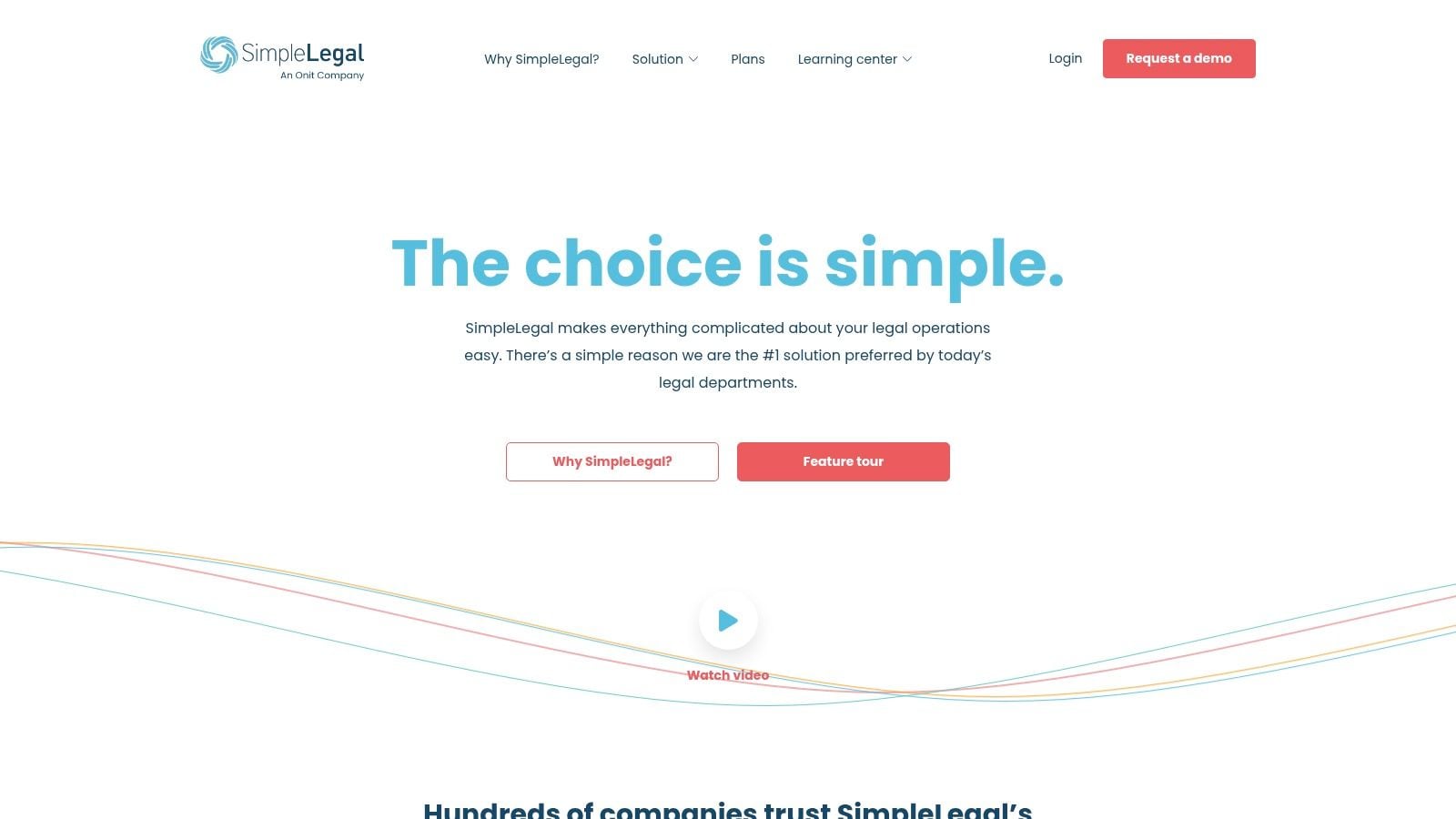
The platform emphasizes practicality and efficiency. By focusing on the essential modules that drive the most value, SimpleLegal helps teams automate routine tasks, enforce billing guidelines, and capture critical data for strategic decision-making. This focus makes it particularly well-suited for legal departments that are beginning their legal operations journey or those who prioritize a straightforward user experience over deep, granular customization.
Key Differentiators and User Experience
The standout feature of SimpleLegal is its user-friendly interface. The platform is built to be accessible to all members of the legal team, regardless of their technical proficiency. This minimizes the learning curve and encourages widespread adoption, which is critical for the success of any ELM implementation. The experience is centered on clean dashboards and logical workflows that simplify tasks like invoice approval and matter updates.
Unlike systems that require extensive setup, SimpleLegal is engineered for quick deployment. This allows legal departments to realize value faster and with less reliance on IT or external consultants, providing a more immediate return on investment for core legal operations functions.
Key Insight: SimpleLegal’s strength is its simplicity and focus on core ELM functionality. It is an ideal solution for legal teams that need a powerful, out-of-the-box solution to organize matters, control spend, and gain operational insights without the complexity and long implementation cycles of more customizable platforms.
Implementation and Pricing
SimpleLegal is known for a more streamlined implementation process compared to many competitors. The company emphasizes a collaborative onboarding experience designed to get departments up and running efficiently. While integrations with systems like NetSuite or Workday are available, the focus remains on a manageable and predictable deployment.
Pricing is not disclosed publicly and is determined through a direct sales consultation. The model is subscription-based, likely influenced by the number of users, matter volume, and specific modules required. Potential customers should contact SimpleLegal for a customized quote based on their department’s size and needs.
| Feature Area | SimpleLegal’s Approach | Practical Benefit |
|---|---|---|
| Matter Management | Centralized repository with all related documents, tasks, and financials. | Provides a single source of truth for every case or project, improving team collaboration. |
| E-billing & Spend | Automated invoice review against pre-set billing rules and budgets. | Reduces manual review efforts and ensures compliance with billing guidelines. |
| Reporting & Analytics | Pre-built dashboards and customizable reports on key legal metrics. | Enables data-driven decisions on vendor performance, resource allocation, and spending. |
| Vendor Management | Tools to track law firm performance, rates, and compliance. | Optimizes relationships with outside counsel and improves cost-effectiveness. |
Website: https://www.simplelegal.com/
7. Litify
Litify brings the power of the world’s leading CRM to the legal sector, positioning itself as a comprehensive platform for enterprise legal management (ELM) built directly on Salesforce. This unique foundation allows legal departments to operate with the same data-driven discipline and connectivity as sales, marketing, and service teams. By leveraging the Salesforce ecosystem, Litify offers a highly extensible and familiar environment for managing matters, documents, and client interactions.
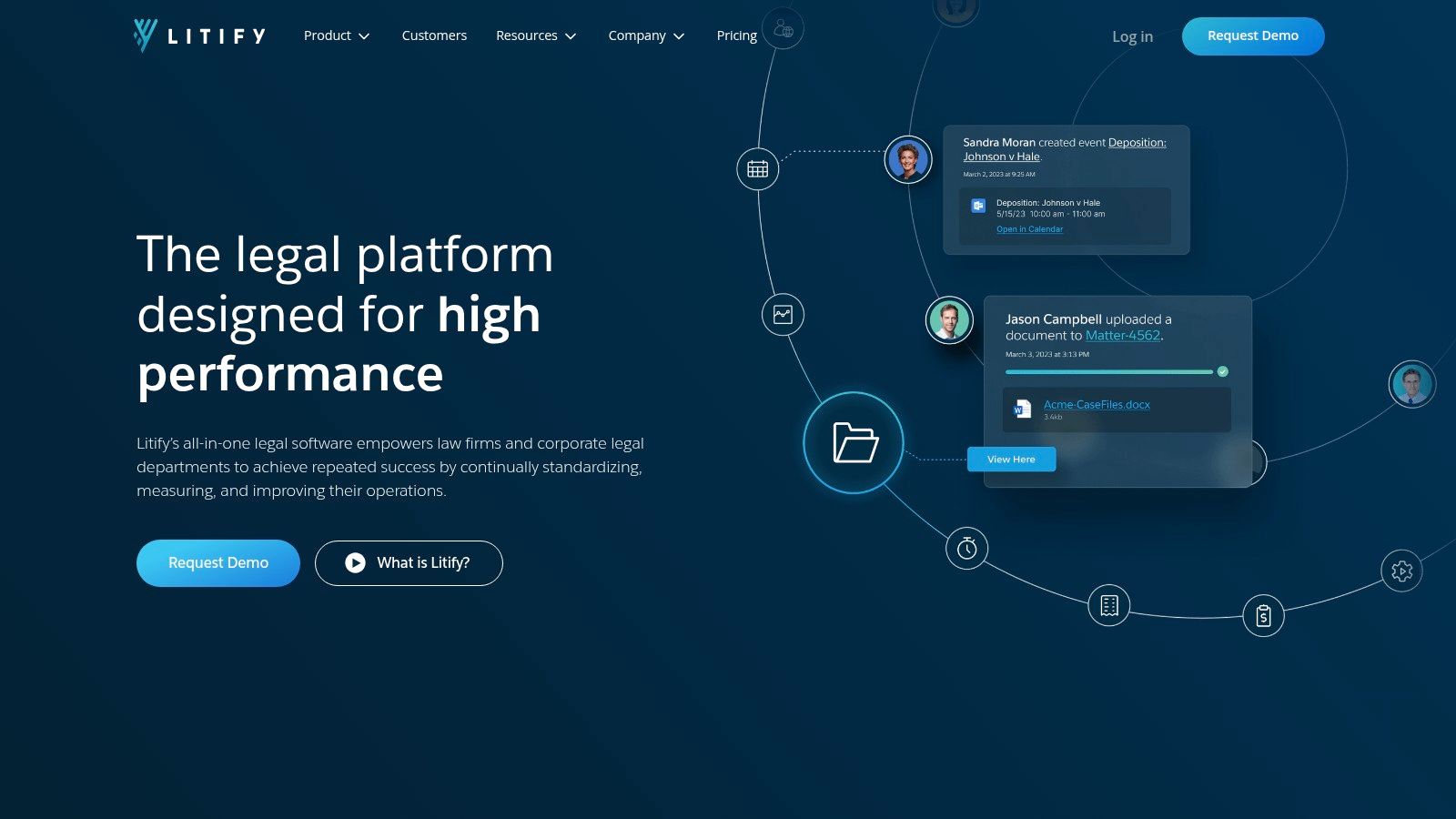
The platform is designed to break down information silos that often plague corporate legal departments. It creates a single source of truth for all legal operations, from initial intake to final resolution. This approach is particularly beneficial for enterprises that have already invested heavily in Salesforce, as it allows for seamless integration with existing business processes and data, providing a holistic view of how legal activities impact the broader organization.
Key Differentiators and User Experience
Litify’s primary differentiator is its native Salesforce architecture. This isn’t just an integration; the platform is fundamentally part of the Salesforce environment. This allows for unparalleled customization using Salesforce’s standard tools (like Process Builder and Flows) and access to thousands of third-party apps on the AppExchange. Legal teams can connect their operations directly with CRM data, financial systems, and other enterprise tools without complex, custom-built connectors.
The user experience will feel familiar to anyone who has used Salesforce, which can significantly reduce the learning curve in organizations where the CRM is already entrenched. The interface is focused on dashboards, reports, and configurable layouts that allow users to see the information most relevant to their roles, from individual attorneys to the general counsel.
Key Insight: Litify is an excellent choice for enterprises that are “all-in” on the Salesforce platform. It allows legal to become a fully integrated business unit, leveraging the same robust security, reporting, and automation capabilities used by the rest of the company.
Implementation and Pricing
Implementation of Litify often involves a Salesforce implementation partner or Litify’s professional services team. The process requires a clear understanding of both the legal department’s specific workflows and the company’s existing Salesforce configuration. The timeline can vary depending on the level of customization needed to tailor the platform to the organization’s unique legal processes.
Litify’s pricing is not publicly available and requires a direct inquiry. The cost is typically determined by the number of users, the specific features or modules required, and the complexity of the implementation. Because it’s built on Salesforce, licensing for the underlying Salesforce platform may also be a factor in the overall cost.
| Feature Area | Litify’s Approach | Practical Benefit |
|---|---|---|
| Matter Management | Centralized case files on the Salesforce platform | Provides a 360-degree view of matters, linking them to related company accounts and contacts. |
| Document Management | Integrated tools for document generation, storage, and e-signature | Automates routine document creation and streamlines approval workflows within a single system. |
| System Integration | Native to the Salesforce platform | Enables seamless connection to sales, service, and marketing data, plus thousands of AppExchange apps. |
| Reporting & Analytics | Leverages powerful, native Salesforce reporting and dashboards | Creates detailed reports on team productivity, matter cycle times, and outcomes with enterprise-grade tools. |
Website: https://www.litify.com/
Top 7 Enterprise Legal Management Solutions Comparison
| Solution | Implementation Complexity 🔄 | Resource Requirements ⚡ | Expected Outcomes 📊 | Ideal Use Cases 💡 | Key Advantages ⭐ |
|---|---|---|---|---|---|
| Swiftwater and Company | Moderate to High (end-to-end advisory) | High (customized strategic support) | Significant cost savings, operational efficiency | Large corporate legal & compliance teams | End-to-end services, deep domain expertise, AI-driven insights |
| Onit | Moderate to High (configurable workflows) | Moderate to High | Improved efficiency, visibility into operations | Corporate legal departments needing customization | Highly configurable, workflow automation, robust analytics |
| Mitratech TeamConnect | Moderate (automation & AI tools) | Moderate | Streamlined legal ops, reduced invoice costs | Legal teams seeking integrated ELM with AI | End-to-end automation, AI invoice review, contract management |
| Brightflag | Moderate (AI implementation) | Moderate | Enhanced cost control, operational visibility | Legal teams focused on spend control and analytics | AI-driven invoice insights, automated processes |
| LexisNexis CounselLink | Moderate to High (comprehensive ELM) | Moderate to High | Efficient operations, compliance optimization | Organizations needing unified legal & financial management | Customizable, AI tools, advanced analytics |
| SimpleLegal | Low to Moderate (user-friendly interface) | Moderate | Workflow optimization, financial oversight | Legal departments seeking ease of use | User-friendly, automated processes, integrated reporting |
| Litify | Moderate (Salesforce-based platform) | Moderate to High | Streamlined workflows, improved collaboration | Enterprise legal teams on Salesforce platform | Salesforce integration, document & client management |
Making Your Choice: Beyond Features to Strategic Partnership
Navigating the landscape of enterprise legal management solutions can feel overwhelming. We’ve explored a range of powerful platforms, from the comprehensive, customizable ecosystems of Mitratech TeamConnect and Onit to the focused, AI-driven spend management of Brightflag and the accessible, modern interface of SimpleLegal. Each tool, whether it’s the established LexisNexis CounselLink or the platform-based Litify, offers a distinct set of features designed to address the core challenges of modern legal departments: controlling costs, managing matters, mitigating risk, and proving value.
The journey you’ve taken through this guide highlights a critical truth: the “best” ELM system is not a one-size-fits-all solution. Your ideal platform depends entirely on your department’s maturity, complexity, primary pain points, and strategic ambitions. A successful selection process moves beyond a simple feature-for-feature comparison and delves into a deeper strategic alignment.
From Feature Checklist to Strategic Fit
The initial temptation is to create a massive spreadsheet comparing every feature. While useful, this approach can lead to “analysis paralysis” or, worse, choosing a tool that’s powerful on paper but a poor fit in practice. Instead, reframe your evaluation around strategic outcomes.
- For Cost-Conscious Departments: If your primary directive is to get a handle on legal spend, a platform like Brightflag with its AI-powered invoice review or SimpleLegal’s straightforward spend and matter management might be the most direct path to ROI.
- For Complex, Global Operations: Large, multinational corporations with intricate workflows, diverse practice areas, and a need for deep customization will likely find a better fit with robust platforms like Mitratech TeamConnect or Onit, which are built to handle enterprise-level complexity.
- For Integration-Heavy Environments: If your legal team operates within a larger ecosystem like Salesforce, a native platform like Litify could offer seamless integration and a unified user experience, reducing friction and boosting adoption.
A core component of any ELM platform is its ability to handle vast amounts of documentation. While these systems have robust built-in capabilities, understanding the principles of document organization is key. For additional context, exploring the features of the top document management software can provide a broader perspective on best practices for version control, security, and collaborative access that you should expect from your chosen ELM’s document module.
The Human Element: Implementation and Adoption
Choosing the right software is only half the battle. The most significant challenge in any enterprise legal management initiative is not the technology itself, but the organizational change it requires. A successful implementation is less about a “go-live” date and more about a fundamental shift in how your legal team works. This is where the true value of a strategic partner becomes undeniable.
Key Insight: The ROI of an ELM platform is not realized upon purchase; it is realized through user adoption, process optimization, and the strategic use of the data it generates. Without a plan for these human factors, even the most powerful software will fail to deliver on its promise.
Consider these critical post-selection factors:
- Workflow Redesign: Simply digitizing inefficient or outdated processes will only make you inefficient faster. A partner can help you re-imagine workflows to take full advantage of the new system’s automation and data-capturing capabilities.
- Change Management: Attorneys and legal staff are often resistant to new technology that disrupts their established routines. A structured change management plan, including clear communication, targeted training, and stakeholder buy-in, is essential for driving adoption.
- Data Strategy: An ELM system is a goldmine of data. But without a strategy for what to measure, how to build reports, and how to translate data into actionable business intelligence, it’s just noise. You need a plan to turn metrics into insights that guide strategic decisions.
Ultimately, your choice in an enterprise legal management platform is a foundational decision that will echo for years. It’s an investment in efficiency, intelligence, and the strategic evolution of your legal function. By moving beyond a simple comparison of features and focusing on the strategic partnership required for a successful transformation, you position your department not just to manage legal work, but to become a true driver of business value.
Ready to ensure your ELM investment delivers maximum ROI? Partnering with an expert advisory firm like Swiftwater and Company can bridge the gap between powerful technology and transformative results. Their team specializes in helping legal departments navigate the complexities of ELM selection, implementation, and optimization to achieve true operational excellence.