
🗓️ Updated March 2026 — includes ELM vs CLM comparison and 2026 selection guidance for in-house legal teams.
Enterprise legal management (ELM) is a category of software designed to help corporate legal departments manage their operations from a single, integrated platform. It typically combines matter management, e-billing and spend management, and analytics into one connected system.
Lawyers are juggling critical case details in one system, finance is tracking multi-million dollar invoices in complex spreadsheets, and vital contracts are buried in endless email chains. It’s chaotic, inefficient, and, frankly, a recipe for costly mistakes. This is the exact problem that enterprise legal management (ELM) software was built to solve.
At its core, an ELM platform acts as the single source of truth for the entire legal function. It’s far more than a digital filing cabinet; it’s a strategic engine designed to bring order to the chaos and drive real efficiency. This guide is part of Swiftwater’s Enterprise Legal Management Resource Hub, a collection of practitioner-focused resources covering ELM strategy, implementation, legal operations, matter management, and legal spend management. The goal is to help legal departments shift from just reacting to problems to proactively managing risk and delivering clear business value.
This isn’t just a minor upgrade. It’s a fundamental change in how legal work gets done. An ELM system connects all the dots, creating a central hub for data, automating repetitive tasks, and providing powerful analytics for smarter decision-making.
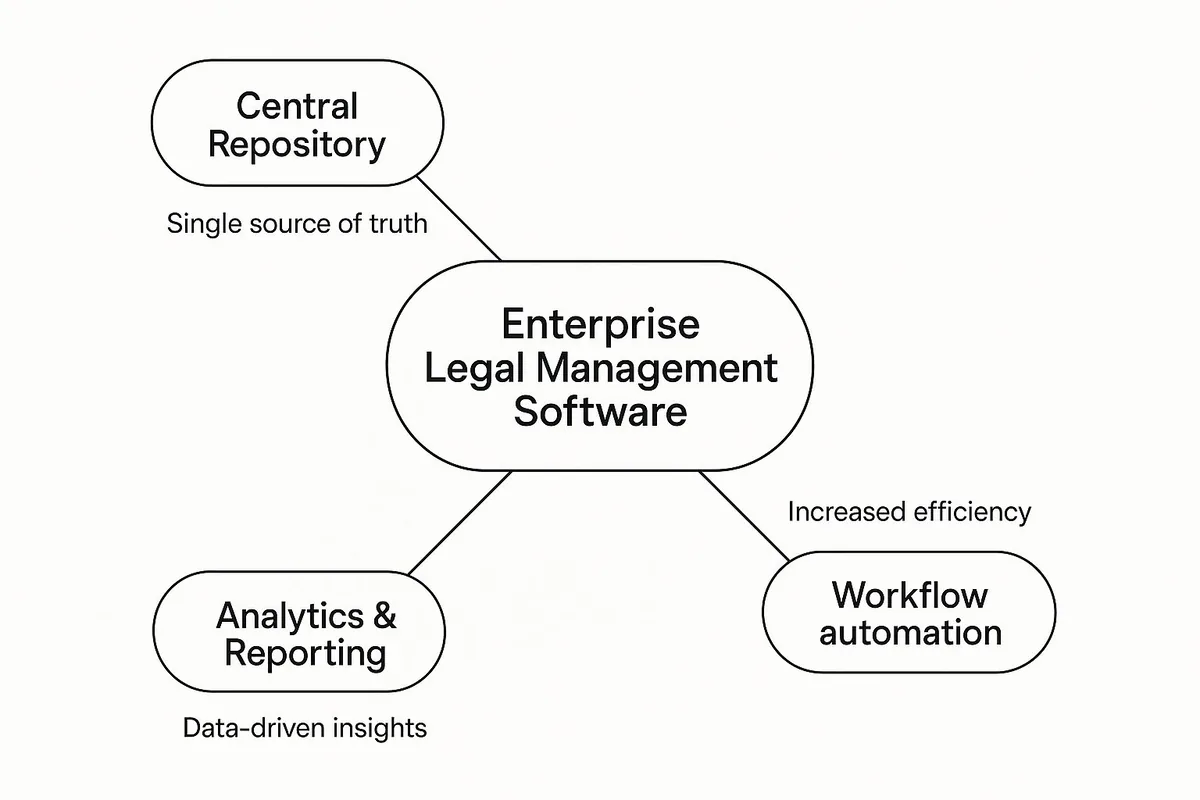
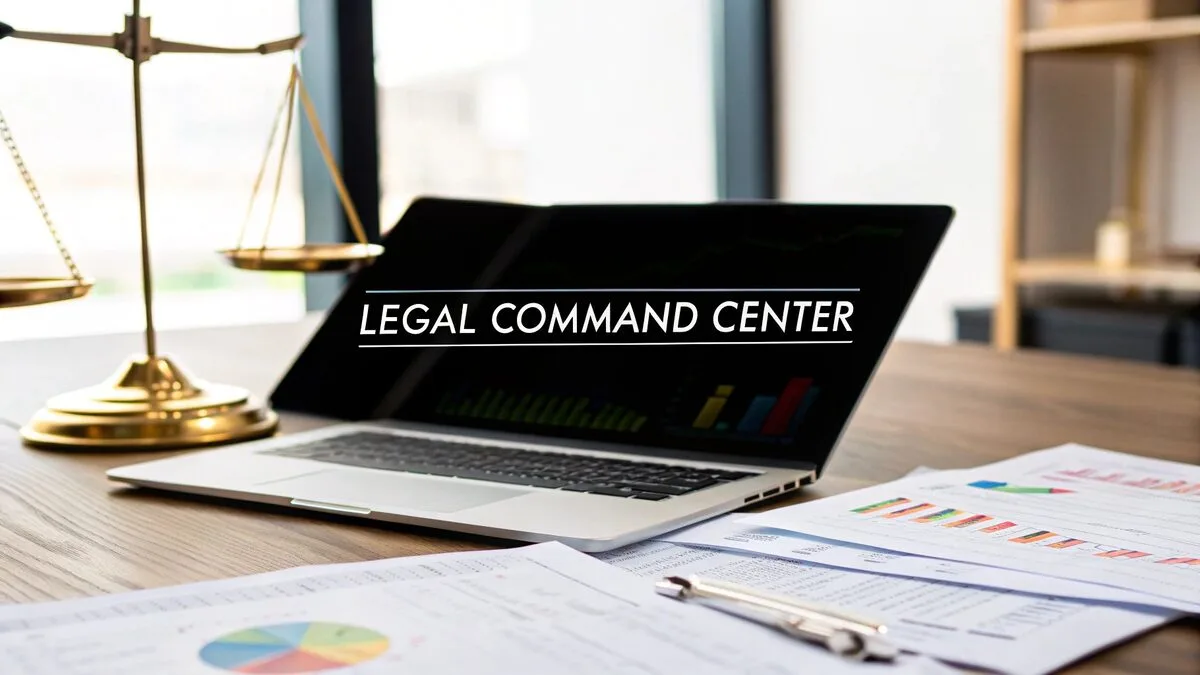
The image above really brings this concept to life, showing how a central data repository, automated workflows, and analytics work together. It’s about turning scattered information into organized, actionable intelligence.
What is an Enterprise Legal Management (ELM)?
Enterprise legal management (ELM) helps corporate legal departments helps establish a single source of truth. It is a platform technology solution that combines matter management, e-billing and spend management, and analytics into one connected system.
Running an ELM or eBilling implementation?
Swiftwater has three Level 4 Onit-certified practitioners. If you are evaluating, implementing, or rescuing an ELM program, let us talk about what that actually takes.
See ELM ServicesUnlike point solutions that address one problem in isolation, an ELM system is designed to give General Counsel and legal operations leaders a unified view of everything the department is responsible for – cases, costs, tasks, and compliance. The goal is to shift the legal function from reactive administration to proactive, data-driven business partnership.
Moving the Legal Function into the Digital World
The move toward ELM isn’t just a passing trend; it’s a seismic shift in how corporate legal departments operate. The market numbers tell the story. The global Enterprise Legal Management software market was valued at USD 3.4 billion in 2023 and is on track to hit USD 10.5 billion by 2033. This explosive growth is fueled by one thing: the urgent need for automation in the face of rising legal complexity.
ELM is a highly specialized form of workflow automation tailored specifically for legal work. By taking over routine administrative tasks—like reviewing invoices, tracking deadlines, and pulling reports—the software frees up highly skilled attorneys to focus on what they do best: strategic, high-value work. They’re no longer bogged down in administrative quicksand.
The real power of an ELM system lies in its ability to connect disparate legal functions. It breaks down data silos, ensuring that information from matter management informs financial decisions, and contract data is available for risk analysis.
This deep integration is what truly sets an ELM platform apart from standalone point solutions. Instead of using one piece of software for e-billing and another for contract management, everything is interconnected, feeding into a single, unified view of the department’s operations.
For example, I recently worked with a $10B+ revenue global retail enterprise that had been growing through significant mergers & acquisition activity. As we engaged, I realized they have pockets of data residing in multiple case management, contract management, and workflow systems. This was in addition to local and shared drives, and also email servers. The first task was to create a strategic plan that laid out how these silos will be amalgamated into a connected architecture so the leadership and line lawyers can have decision-supporting information at their finger tips.
The table below starkly contrasts the old way of doing things with the new, automated reality an ELM provides.
The ELM Transformation
This table contrasts the operational reality of a legal department before and after implementing Enterprise Legal Management software, showcasing the direct impact on key functions.
| Operational Area | Before ELM (The Old Way) | After ELM (The New Way) |
|---|---|---|
| Matter Management | Information is scattered across emails, documents, and spreadsheets, leading to confusion and missed details. | A single, centralized hub for every case, document, and deadline provides a complete and instant overview. |
| Legal Spend | Invoices are reviewed manually, billing guidelines are difficult to enforce, and budgets are based on guesswork. | Automated invoice review flags non-compliant charges, enforces billing rules, and provides real-time budget tracking. |
| Reporting | Creating reports is a time-consuming manual process of pulling data from multiple sources, often resulting in outdated insights. | Dashboards and analytics provide instant, data-driven insights on demand, enabling proactive strategic decisions. |
| Risk & Compliance | Tracking obligations and compliance is inconsistent, exposing the organization to potential risks and penalties. | A unified view of all legal matters and contracts makes it easier to monitor obligations and ensure consistent compliance. |
Seeing the “before” and “after” side-by-side makes the value crystal clear. It’s not just about doing the same things faster; it’s about fundamentally changing how the legal department functions and the value it contributes to the entire organization.
Understanding the Core Features of an ELM Platform
It’s best to think of enterprise legal management software as a sophisticated, integrated toolkit. Each module is like a specialized instrument, built to solve a specific, high-stakes problem that in-house legal teams deal with every day. Instead of juggling a messy collection of spreadsheets and overflowing inboxes, these core features bring everything together into a unified command center.
This modular design is great because it lets a legal department tackle its most painful problems first, then build out a more complete system over time. Let’s dig into the four essential pillars that form the foundation of most ELM platforms, and see how they turn administrative headaches into strategic advantages.

Matter Management: The Project Command Center
At the very heart of any ELM system is matter management. I like to call this the central nervous system for all the department’s legal work. It creates a single source of truth for every case, project, or legal issue that comes across your desk.
Think about the old way: critical information for just one lawsuit could be scattered across dozens of emails, saved on different people’s hard drives, and stuffed into physical folders. With a matter management module, every single document, deadline, email chain, and team assignment is neatly organized inside a dedicated digital file for that specific matter. This gives you complete visibility and makes sure nothing ever falls through the cracks. Many platforms also offer powerful tools for handling both internal and external legal requests, like those coming in from legal front doors and service request forms. For legal teams evaluating how matter management works in practice, see What Is Matter Management in Legal?. For departments selecting a dedicated solution, Legal Matter Management Software: How to Choose provides a framework for comparing platforms and capabilities.
E-Billing: The Financial Watchdog
Next up is e-billing and spend management. This module is your department’s ever-watchful financial watchdog. It automates the entire process of reviewing legal invoices and brings some much-needed discipline to what you spend on outside counsel.
Want the review function run for you?
Every outside counsel invoice checked against your guidelines, rates, and matter context, inside the eBilling platform you already own, with the exception handling, vendor coaching, and savings reporting that separate a review program from invoice processing.
See Bill Review ServicesWithout this, legal teams are stuck manually combing through thousands of line items on invoices—a process that’s not only incredibly time-consuming but also full of opportunities for human error. An e-billing system puts this on autopilot by:
- Enforcing Billing Guidelines: It automatically flags any charges that go against your pre-set rules, like block billing, questionable time entries, or work performed by unapproved staff.
- Tracking Budgets in Real-Time: You get an up-to-the-minute picture of how much you’re spending against matter-specific budgets, which helps you avoid those nasty, costly overruns.
- Streamlining Approvals: Invoices are automatically routed to the right people for approval, which dramatically speeds up payment cycles and keeps your law firms happy.
This completely shifts the team’s focus from tedious manual reviews to genuine strategic financial oversight. Organizations evaluating e-billing capabilities should also understand how legal invoice review and billing guideline enforcement work together. Our guides on How Does Legal eBilling Work? A Complete Guide and Outside Counsel Billing Guidelines: What to Include explore the operational controls that sit behind effective spend management. For anyone serious about improving their legal operations management, this is absolutely foundational.
Contract Lifecycle Management: The Digital Dealmaker
Another incredibly powerful feature is Contract Lifecycle Management (CLM). This module takes the entire journey of a contract – from the moment it’s created to its final renewal or termination – and makes it digital and automated. A good CLM tool can turn what is often a chaotic, manual process into a smooth, predictable workflow.
📋 For a detailed breakdown of how to implement CLM effectively, see our guide on 10 CLM best practices for 2026 →
Although contract lifecycle management systems exist as an independent and complex category of tools, for many smaller to medium sized enterprises a good starting point can be using an embedded tool within ELM. It may not be able to handle all requirements, but if scoped properly, it may handle many types of contracts. Another advantage of connecting the CLM to your ELM is that you can engage your law firms easily (given the two modules/systems talk to each other) on contract reviews.
The core functions you’ll find in a CLM module usually include:
- Centralized Repository: Every contract lives in one searchable database. This alone eliminates the huge risk of lost agreements or missed renewal dates.
- Template Automation: Your lawyers can spin up new contracts from pre-approved templates in minutes, ensuring every agreement is consistent and compliant.
- Automated Alerts: The system will ping you automatically for key dates, like an upcoming expiration or a renewal deadline, so you don’t miss opportunities or get stuck with unwanted auto-renewals.
By integrating a CLM, legal teams can close deals faster, cut down on risk, and squeeze more value out of every single one of their contractual relationships.
Analytics and Reporting: The Strategic Advisor
Finally, the analytics and reporting module acts as the legal department’s trusted strategic advisor. This is where all the data flowing through the matter management, e-billing, and CLM modules gets pulled together and turned into business intelligence you can actually use.
Instead of relying on gut feelings or outdated spreadsheets, legal leaders can use data to make informed decisions. Dashboards can visualize key metrics like total legal spend, law firm performance, and matter cycle times.
This kind of data-driven approach is quickly becoming the standard across every other business function. Corporate legal teams, law firms, and even government agencies are adopting ELM solutions to get a better handle on these very functions. And as cloud-based options become more common, even small and mid-sized companies can now get their hands on these powerful tools—a trend that has been detailed in recent market analysis.
ELM vs CLM vs Matter Management: What is the Difference?
For most mid-to-large enterprise legal departments, ELM is the right starting point because it encompasses matter management and often includes a CLM module. Standalone CLM makes more sense when contract volume is the primary pain point and the rest of the department is already well-managed.
| ELM | CLM | Matter Management | |
|---|---|---|---|
| Scope | Full legal department operations | Contract lifecycle only | Legal cases and projects only |
| Primary user | GC, Legal Ops, Finance | Legal, Procurement, Sales | Attorneys, paralegals |
| Core function | Unified legal command center | Contract creation to renewal | Case and matter tracking |
| Best for | Mid to large enterprise legal departments | Organizations with high contract volume | Law firms and litigation-heavy departments |
| Includes CLM | Often yes, as a module | Standalone | Rarely |
If contract management is your primary challenge, our detailed comparison ELM vs CLM: What Is the Difference? examines where standalone CLM platforms fit and where a broader ELM strategy becomes the better long-term choice.
The Real Business Benefits of Using ELM Software
Beyond all the bells and whistles, what does enterprise legal management software actually do for the business? It’s the question C-suite wants to know. When you cut through the technical jargon, the value of an ELM platform comes down to three things that leadership understands: tighter financial control, better operational performance, and much smarter risk management.
Think of an ELM investment less as a tool for the legal department and more as a strategic upgrade for the entire company. It’s about transforming a department often seen as a cost center into a genuine business partner. By bringing all your legal data into one place and automating the tedious workflows, an ELM system delivers the intelligence you need to make better decisions, get a handle on spending, and proactively protect the company. The impact ripples out far beyond the legal team, touching the organization’s bottom line and its ability to move strategically.

Driving Financial Control and Predictability
One of the first and most powerful benefits you’ll see from an ELM platform is its ability to finally get a grip on legal spend. For most companies, outside counsel costs are a huge, often unpredictable line item. An ELM system brings a level of financial discipline that’s simply out of reach with manual tracking and scattered spreadsheets.
The e-billing module alone works like an automated auditor, checking every single invoice against your billing guidelines. This process catches all the non-compliant charges that used to slip through the cracks, often saving companies 5-10% on external legal spend almost immediately. For a closer look, our guide on Legal Spend Management offers some great strategies. This improved oversight also helps with streamlining invoice management for law firms, making sure everything is accurate and paid on time.
Is your legal spend data telling you the full story?
We help legal departments build the analytics, rate governance, and reporting infrastructure to move from invoice processing to strategic spend management.
See Legal Spend ServicesThe biggest financial win is predictability. When you can track budgets in real time and analyze past spending data, the legal team can forecast future costs with incredible accuracy. No more budgetary surprises for the CFO.
I worked with a global pharmaceutical client whose stated mission to implement e-billing was “no-surprises” in legal spend. Similarly, I helped define the long term goals for the ELM/e-billing system for a medical device manufacturer, and we came up with “higher accuracy in predictability” as the ultimate state goal for the system.
Achieving Operational Excellence
An ELM platform also kicks off a wave of operational improvements by fundamentally changing how legal work is done. It automates the low-value, repetitive administrative grind, freeing up your highly skilled—and highly paid—attorneys to focus on high-stakes work that actually requires their expertise. That shift has a direct impact on the department’s overall productivity and efficiency.
Instead of wasting hours digging for documents or manually pulling together reports, lawyers can pour their energy into complex negotiations, critical legal analysis, and advising business leaders. This leads to some major operational wins:
- Faster Case Resolution: With all matter-related information in one spot, teams collaborate more effectively and push cases to resolution much faster.
- Reduced Administrative Burden: Automating tasks like invoice reviews and deadline tracking slashes the administrative workload that bogs down legal pros.
- Improved Resource Allocation: Leaders get a clear view of who is working on what, allowing them to balance workloads and prevent burnout.
Becoming a Proactive Risk Management Partner
This might be the most strategic benefit of all. ELM software gives the legal department the power to shift from a reactive to a proactive risk management partner. With all legal data—from contracts and litigation to compliance checks—in a single system, the team can finally spot patterns and emerging risks before they spiral into full-blown crises.
The analytics tools in an ELM can uncover hidden liabilities buried in thousands of contracts or pinpoint which types of disputes are secretly costing the company a fortune. This data-first approach lets the legal team get out of “firefighting” mode and into an advisory role, steering the business away from legal and financial trouble. This powerful shift in capability is a big reason the market for these tools is growing so fast.
How to Choose the Right ELM Software
Choosing an enterprise legal management platform is a huge decision, one that will stick with your department for years. It’s all too easy to get wowed by a polished sales demo, but the right choice goes way beyond flashy features. The best system should feel like a natural extension of your team, not just another piece of technology you have to wrestle with every day.
Making the right call starts with a brutally honest internal assessment. Think of it like drawing up the blueprint before you even think about pouring the foundation for a new house. You have to clearly separate your absolute “must-haves” from the “nice-to-haves”. If you don’t, you risk paying a premium for bells and whistles your team will never actually touch.
This isn’t just about solving today’s headaches. It’s about anticipating tomorrow’s challenges. The ideal enterprise legal management software should not only fix your current operational logjams but also be able to grow with your department as it evolves.
Assess Your Department’s True Needs
Before you even glance at a single vendor website, you need to conduct a frank audit of your department’s workflows. Where are the real bottlenecks? Are you bleeding money on out-of-control legal spend, drowning in disorganized matter files, or wrestling with chaotic contract management?
Get specific. It’s not enough to say “we need better reporting.” What does that actually mean for your team? Do you need to track law firm performance by matter type, or is the goal to forecast budgets with more confidence? The clearer you are about your needs, the faster you can weed out vendors that are simply not a good fit.
A common mistake is buying software that solves someone else’s problem. A platform perfect for a patent-heavy tech company might be a poor fit for a legal team focused on regulatory compliance. Your unique operational DNA must drive the decision. For a deeper evaluation framework, see ELM Software: Buyer’s Guide for Legal Departments, which breaks down vendor selection criteria, implementation considerations, and common procurement mistakes.
To build a solid foundation for your search, get your key stakeholders in a room from day one.
TIP: An ELM system might be one of your key and biggest investments in the legal function. If you do not anticipate spending 20-30 hours minimum a week on implementation, then I suggest hiring an advisor or consultant who has been there and done that. There are many value added items that consultant (like Swiftwater) provide. They help you get away from an empty slate challenge and prevent you from reinventing the wheel. Since this might be your first or second selection and implementation while the consultant may have been through a dozen or more, they will have a much honed in sense of how to lead to success. You can do it by yourself, but you are going to get less heartburn if you choose a partner. And, the chances of the system getting adoption becomes much higher due to the collective expertise the partner brings.
Talk to your attorneys, paralegals, and financial managers. What are their biggest daily frustrations? Their on-the-ground insights are pure gold for identifying the features that will genuinely boost productivity and, most importantly, get people to actually use the software.
Prioritize Scalability and Integration
A critical factor that often gets missed in the initial excitement is scalability. Your legal department’s needs are going to change. You might grow the team, take on more complex matters, or expand into new lines of business. Your ELM software has to be able to scale right alongside you, without friction.
Just as important is the platform’s ability to play nice with your existing tech stack. Your enterprise legal management software shouldn’t be an isolated island of data. It needs to talk effortlessly with other core business systems to create a single source of truth.
Key integrations to look for include:
- ERP / Accounts Payable Systems: To connect legal spend data directly into the company’s main financial records.
- CRM Platforms: To link legal matters (especially, contracts) with specific customer accounts or sales activities.
- Document Management Systems: For seamless access to documents without creating confusing duplicates.
Without solid integration capabilities, you’re just creating another data silo—and that defeats one of the main reasons for getting an ELM system in the first place.
Evaluate the Total Cost and User Experience
Finally, you have to look beyond the sticker price and evaluate the total cost of ownership (TCO). This isn’t just the license fee; it includes implementation, training, ongoing support, and any potential upgrade costs. A system that looks cheaper upfront can quickly become a money pit if you’re getting nickel-and-dimed for every little thing.
While initial implementation costs and training remain barriers for some, the long-term returns from automation and improved legal spend management justify the investment. Top providers are constantly innovating to meet this demand, particularly in regulated industries.
But here’s what might be the most important factor of all: never, ever underestimate the power of a great user experience. If the software is clunky, confusing, or just plain difficult to navigate, your team won’t use it. It’s that simple.
Insist on a hands-on trial or pilot program for your key users. Make sure the platform is one they will embrace, not just endure. At the end of the day, a high adoption rate is the ultimate measure of a successful implementation.
To help you navigate conversations with potential vendors, here’s a checklist of questions to ask. This will help you dig deeper than the sales pitch and find a partner that truly understands your needs.
ELM Vendor Evaluation Checklist
Key questions to ask potential ELM software providers to ensure you select the best fit for your organization’s unique needs.
| Evaluation Category | Key Questions to Ask | Why It Matters |
|---|---|---|
| Needs Alignment | How does your platform specifically address our top 3 challenges (e.g., spend management, matter organization, contract obligations)? Can you show us? | You need a solution for your problems, not a generic one. A good vendor can connect their features directly to your pain points. |
| Scalability | What does your pricing and infrastructure look like as we add more users, matters, or data over the next 5 years? | Avoid future shocks. A platform that’s affordable today might become prohibitively expensive as your department grows. |
| Integration | Which of our current systems (ERP, Accounts Payable, CRM, DMS) have you integrated with before? Can we talk to a reference who uses a similar integration? | “Yes, we can integrate” is easy to say. Proof is better. This confirms their technical capability and reduces implementation risk. |
| User Experience | Can our core team (attorneys, paralegals) get a trial account to test drive the platform for a week with our own sample data? | Demos are curated. A real trial reveals how intuitive (or frustrating) the software is for the people who will live in it daily. |
| Total Cost (TCO) | Can you provide a detailed breakdown of all costs for the first three years, including implementation, training, support, and any potential add-ons? | This uncovers hidden fees and gives you a realistic budget. The initial license fee is often just the beginning of the story. |
| Support & Partnership | What does your standard support package include? What is the typical response time? What does the implementation process look like from your end? What kind of support do you provide our e-billing law firms & vendors? | You’re not just buying software; you’re entering a long-term relationship. Ensure their support model and implementation team are solid. |
Using a structured approach like this helps you cut through the marketing noise. It forces a focus on what truly matters: finding a platform that not only solves your problems today but also serves as a strategic partner for your legal department’s future.
A Roadmap for Successful ELM Implementation
Let’s be honest. Even the most powerful enterprise legal management software is just an expensive piece of code if your team won’t actually use it. Successfully rolling out an ELM platform is fundamentally a change management project, not just an IT task. It’s about people and process first, technology second. A thoughtful implementation roadmap is what separates a game-changing investment from a frustrating failure.

This journey starts long before anyone logs into the new system. It begins by acknowledging that you’re asking busy professionals to change the way they’ve worked for years.
Overcoming this natural resistance requires a clear strategy focused on communication, support, and building momentum from day one. At Swiftwater we take change management holistically. Our team of senior consultants have been through every possible situation to understand that the answer is not to just slap one of the two-dozen change management philosophies – learn more about our guide to user adoption and change management.
Build a Foundation for Adoption
Before you flip a single switch, you have to lay the groundwork. These initial steps are all about getting the right people on board and aligned, setting the stage for a smooth transition. Rushing this phase is a classic mistake that can sink the entire project before it even starts.
A successful foundation really comes down to three things:
- Secure Executive Sponsorship: Your General Counsel or Chief Legal Officer needs to be the project’s number one champion. Their visible support sends a clear message: this is a critical business priority, not just another IT experiment.
- Assemble a Cross-Functional Team: This can’t just be a legal-led initiative. Bring in people from IT, finance, and operations. This ensures everyone’s needs are considered and builds buy-in across the departments that will be touched by the new system.
- Plan a Phased Rollout: Don’t try to boil the ocean. A “big bang” implementation is a recipe for overwhelming your users. Instead, launch core modules like matter management and e-billing first. This delivers quick wins and builds user confidence before you introduce more complex features.
A phased approach makes the change feel manageable. It allows the team to master one part of the system, see its immediate value, and become eager for the next stage, rather than feeling intimidated by a massive, all-at-once shift.
Drive Engagement and Prove Value
With a solid foundation in place, the focus shifts to getting people to use the software and making it an indispensable part of their daily routine. This is where you connect the platform’s features to real-world benefits, answering that all-important question every user has: “What’s in it for me?”
A powerful tactic is to empower internal champions. Find those enthusiastic team members who pick up the technology quickly and can become the go-to resource for their colleagues. These advocates provide on-the-ground support and generate a positive buzz that official communications simply can’t replicate.
Next, you have to clearly communicate the specific benefits for each group. For attorneys, it’s less admin work and more time for high-value legal analysis. For paralegals, it’s instant access to perfectly organized case files. For finance, it’s all about predictable budgets and getting a handle on costs.
Finally, celebrate your early wins to build momentum. When the system helps you close a case faster or saves the company $50,000 in flagged invoice errors, shout it from the rooftops. These tangible results prove the system’s value and can turn even the biggest skeptics into believers.
This ongoing process of demonstrating value is a key part of how the head of legal operations can implement continuous improvement within the department.
If you are evaluating ELM platforms or planning an implementation, explore Swiftwater’s Legal Technology Solutions to learn how we support enterprise legal departments with platform selection, implementation, migration, and user adoption.
Frequently Asked Questions
Even with a solid grasp of the benefits, practical questions always come up when you are thinking about investing in enterprise legal management software. This section gives you direct answers to the most common questions I hear, covering who this is for, what implementation really looks like, the pitfalls to avoid, and how ELM compares to other systems.
Is ELM software only for large enterprises?
That is a common misconception, but the short answer is no. While ELM systems were traditionally the domain of massive corporations with sprawling legal teams, that has changed dramatically. Modern, cloud-based solutions are built to scale and are far more affordable, putting them squarely within reach for mid-sized and even smaller, fast-growing legal departments. The key is to find a platform that is modular, so you can start with just the core functions you need today and add more capabilities as your team and its needs grow.
How long does it take to implement an ELM system?
Based on the complexity of your needs and how many modules you are rolling out, a typical phased implementation takes anywhere from three to nine months. If you are a global or highly regulated company, be prepared to double that estimate to account for organizational complexity and user adoption needs. Most teams I work with start with the essentials like Matter Management and E-billing. This approach delivers immediate value and scores quick wins, which is crucial for building momentum before tackling more complex features like contract lifecycle management.
Can ELM software integrate with our existing tools?
It absolutely should, and this is non-negotiable. A good enterprise legal management software platform is designed to connect with your other core business systems. The real value comes when your ELM can communicate with your company’s ERP for financial data, your CRM for sales context, and your document management system for a single source of truth. Avoid any platform that creates another data island.
What is the biggest mistake companies make when choosing an ELM?
Without a doubt, the most frequent misstep is getting focused on a large feature list while completely overlooking user adoption. A system packed with every feature imaginable is worthless if your team finds it too clunky or complicated for day-to-day work. Prioritize an intuitive user experience and choose a vendor who acts as a true implementation partner, not just a seller. That is the key to getting your team on board and seeing a real return on your investment. Most successful vendors bring in an implementation partner who brings experience in user adoption, process reengineering, subject matter expertise, and support.
What is the difference between ELM and CLM?
ELM is the broader platform. CLM is one module within it. A contract lifecycle management system handles the full journey of a contract from creation through renewal. An ELM system does that plus matter management, invoice processing, spend analytics, outside counsel management, and compliance tracking. For organizations with high contract volume as their primary pain point, a standalone CLM may be the right starting point. For mid to large enterprise legal departments managing multiple functions at once, ELM is typically the better fit.
What does enterprise legal management software cost?
ELM software pricing varies significantly based on the number of users, modules selected, and vendor. Smaller legal functions typically budget around $20,000 to $50,000 per year for ELM solutions. Legal departments looking for enterprise-grade platforms typically budget from $100,000 to $500,000 or more annually. Most vendors require a discovery call before providing pricing.
Disclaimer: This article is provided for educational and informational purposes only. Neither Swiftwater and Company nor the author provides legal advice. This content does not constitute professional legal, financial, or operational advice and should not be relied upon as such. Readers are encouraged to consult a qualified professional before making decisions based on the information provided. External links are included for reference only and reflect the views of their respective authors. Swiftwater and Company takes no responsibility for third-party content.