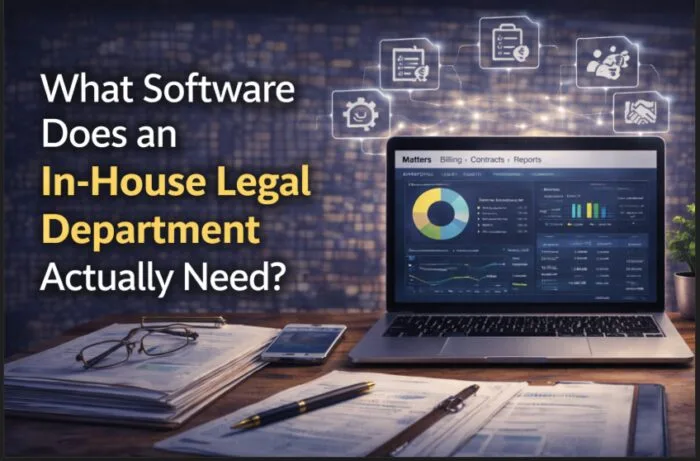

In-house legal software covers four core categories: an ELM platform for matter management and eBilling, a CLM system for contract lifecycle management, workflow automation for intake and process routing, and analytics for reporting to the business. Most departments start with ELM and eBilling and layer the rest as the function matures. Buying too little creates operational blind spots. Buying too much creates a fragmented stack that nobody fully adopts. The practical question is not what is the most advanced legal operations software available but what does this legal department actually need now, and what should come next.
For foundational context on the ELM category that anchors most in-house legal software decisions, see what is enterprise legal management.
In-house legal software vs law firm software: what is the difference?
Before evaluating any specific product, it is worth being clear about who is doing the buying. The legal technology market serves two fundamentally different buyers and the products designed for one are largely not suited to the other.
| Dimension | In-House Legal Software | Law Firm Software |
| Primary user | Corporate legal department | Law firm, outside counsel, legal service provider |
| Core purpose | Manage legal operations inside a corporation | Run a legal services business |
| Key functions | Matter management, eBilling, spend control, intake, reporting to the business | Time and billing, client matter management, docketing, trust accounting, court deadline tracking |
| Billing direction | Controls and validates invoices received from law firms | Generates and submits invoices to clients |
| Leading platforms | Onit, Mitratech, Thomson Reuters Legal Tracker, Wolters Kluwer TyMetrix | Clio, Aderant, Elite, PracticePanther |
| Reporting audience | General Counsel, CFO, C-suite | Managing partners, CFO, clients |
| Primary outcome | Operational visibility, spend control, process efficiency | Revenue, billing realization, client service delivery |
The distinction matters because vendor marketing language often uses the same terms, including matter management, billing, and workflow, to describe entirely different things depending on who is being addressed. A corporate legal department evaluating in-house legal software should be looking specifically at ELM platforms, legal operations tools, and CLM systems designed for in-house environments, not at practice management software designed to run a law firm.
What are the four core categories of legal department software?
Most in-house legal software falls into four functional categories, and understanding how they relate to each other is more useful than evaluating each in isolation.
The first and most foundational is enterprise legal management software. This is the operating system for legal operations, covering matter management, outside counsel oversight, legal spend, eBilling, reporting, and legal service requests. For most corporate legal teams, this is the most important system because it creates operational visibility across the function. Matter management sits within ELM as its foundational data layer. Some teams evaluate standalone matter management capability separately when visibility into legal work is their most immediate gap before they are ready for a full ELM deployment, but in most mature environments matter management lives inside the ELM platform. For a full view of what ELM covers and how the leading platforms compare, see the ELM software buyer’s guide.
The second is contract lifecycle management software, which handles drafting, negotiation, approvals, execution, obligation tracking, and renewals. It is essential for teams with high contract volume but does not replace ELM because its focus is contracts rather than the broader operating model of the legal department. For the distinction between ELM and CLM, see ELM vs CLM.
Running an ELM or eBilling implementation?
Swiftwater has three Level 4 Onit-certified practitioners. If you are evaluating, implementing, or rescuing an ELM program, let us talk about what that actually takes.
See ELM ServicesThe third is workflow and intake software, which supports legal service requests, approval routing, escalation logic, and structured intake. Legal departments often fail operationally at the entry point, where work arrives through email or informal requests rather than a controlled intake mechanism. For a practical view of how intake automation works, see how to automate legal service requests.
The fourth is analytics and reporting technology. Some of this sits inside the ELM platform and some may sit in business intelligence layers. Either way, legal leadership needs reporting on workload, spend, cycle times, and outside counsel performance that can be presented to the CFO and C-suite with the same credibility as any other business function.
Does every legal department need a full ELM platform?
No. Not every legal team needs a full ELM platform immediately, and buying one before the organization is ready to implement and adopt it is a more common mistake than waiting too long.
A smaller legal department with low outside counsel spend, limited reporting requirements, and manageable work volume may be able to operate for some time with lighter systems. Onit’s SimpleLegal, for example, is designed specifically for legal departments at an earlier stage of maturity that need structured matter management and eBilling without full enterprise configuration complexity. For a full view of when SimpleLegal is the right starting point versus a full enterprise ELM deployment, see what is SimpleLegal.
But once work volume, spend complexity, or leadership reporting needs increase, the absence of an ELM platform becomes a constraint that shows up in missed budgets, unreliable reporting, and growing frustration from the business about response times and visibility.
The trigger points are consistent: matters tracked in spreadsheets that nobody fully trusts; limited visibility into outside counsel costs until invoices arrive; inconsistent intake and prioritization; reporting to the business that relies on estimates rather than system data; and growing legal demand without added headcount. When two or more of these are present, the legal department is already operating below the level the business expects.
According to the ACC Chief Legal Officers Survey, legal departments continue to face pressure around efficiency, workload, and cost discipline. That pressure is what makes in-house legal software selection a strategic decision rather than a procurement exercise.
When does an in-house team need CLM alongside ELM?
A legal team needs CLM alongside ELM when contracts become a major operational workload in their own right. If contract intake, drafting, approvals, and renewals are high-volume and process-sensitive, a CLM system is necessary. But as explained in detail in the ELM vs CLM guide, the two systems are not interchangeable and each addresses a distinct operational need.
A legal department can have excellent CLM capability and still have poor visibility into overall legal workload, outside counsel spend, or service request intake. Equally, a department can have a strong ELM platform and still struggle with contract bottlenecks if it lacks proper CLM support. The practical test is where the dominant operational burden lies. If contracts are the primary pain point, CLM rises in priority. If legal demand, outside counsel, matter visibility, and spend control are the bigger issue, ELM comes first. Most mature legal functions ultimately need both.
Swiftwater implements both ELM and CLM programs. For a view of how Swiftwater approaches CLM alongside legal operations transformation, see CLM advisory and implementation services.
How does workflow automation fit into an in-house legal software stack?
Workflow automation is what stops in-house legal software from becoming a record keeping layer. Without it, the software stores matters, invoices, or requests but much of the actual work still moves through email, informal follow-up, and manual approvals.
More importantly, workflow automation gives legal leadership a live view of where work actually is at any given moment and the ability to orchestrate it through to resolution. A request enters the system, gets routed to the right attorney, triggers an approval chain, escalates if a deadline approaches, connects to the matter record, generates the appropriate reporting event, and closes out with an outcome captured. That entire sequence happens in the system rather than across a combination of email threads, calendar reminders, and memory. The system does not just record what happened. It actively drives the work from intake to resolution.
Without workflow capability, a legal department can have excellent data structures and still operate reactively. With it, legal operations becomes genuinely operational rather than administrative.
Want the review function run for you?
Every outside counsel invoice checked against your guidelines, rates, and matter context, inside the eBilling platform you already own, with the exception handling, vendor coaching, and savings reporting that separate a review program from invoice processing.
See Bill Review ServicesAccording to the 2025 CLOC State of the Industry Report, 66% of legal departments identify automation as a high priority, with 33% planning to adopt workflow tools within the next one to two years. That sustained prioritization reflects how consistently the absence of structured workflow is identified as the gap between having legal software and actually running a legal operations function.
For a full view of how workflow automation operates within an ELM environment, see what is Onit Apptitude and legal workflow automation.
What should legal departments implement first?
Most legal departments should implement in-house legal software in a phased sequence rather than attempting a full legal department technology environment in one move. Over-scoping is one of the most consistent causes of adoption failure across every platform Swiftwater has implemented.
Phase one is usually matter management and eBilling. This creates visibility into legal work and legal spend, the two most common pain points in corporate legal departments. In one program, Swiftwater achieved $60M in legal spend savings for a global technology company by establishing this foundational layer of ELM and eBilling governance, demonstrating the return available when the infrastructure is implemented correctly from the start.
Phase two is usually intake and workflow automation. Once the team can see matters and spend, the next challenge becomes controlling how work enters and flows through the function. Getting legal requests off email and into a structured system transforms both the legal team’s capacity and the business’s experience of working with legal.
Phase three is CLM or deeper process-specific tooling, depending on where operational bottlenecks remain after phases one and two are stable and adopted.
When evaluating the sequence, the most useful questions are where the biggest operational blind spot is today, which process creates the most friction for the legal team and the business, what data leadership needs to see first, and which implementation the organization has the capacity to absorb successfully.
For a full framework on assessing readiness before committing to a sequence, see the ELM buyer’s readiness checklist in the ELM software guide.
Bottom Line
In-house legal software should be built as a sequence, not an accumulation of tools. Most departments need ELM and eBilling first, CLM when contract volume justifies it, and workflow automation when legal intake and approvals start to break under manual processes.
The right legal department software stack is not the most comprehensive one. It is the one that fits the current operating model, solves the most pressing bottlenecks, and leaves room to mature without creating complexity the team cannot govern.
Is your legal spend data telling you the full story?
We help legal departments build the analytics, rate governance, and reporting infrastructure to move from invoice processing to strategic spend management.
See Legal Spend ServicesThe legal departments that get the most from their software investments are the ones that implemented in the right order, adopted fully before expanding, and treated each phase as operational infrastructure rather than a technology project.
If you are ready to plan the stack in the right order, explore Swiftwater’s legal technology implementation services.
Disclaimer: This article is provided for educational and informational purposes only. Neither Swiftwater and Company nor the author provides legal advice. This content does not constitute professional legal, financial, or operational advice and should not be relied upon as such. Readers are encouraged to consult a qualified professional before making decisions based on the information provided. External links are included for reference only and reflect the views of their respective authors. Swiftwater and Company takes no responsibility for third-party content.