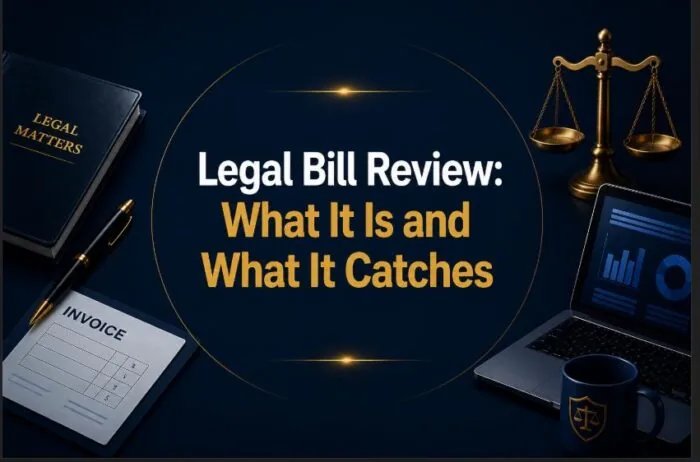

Legal bill review is the systematic audit of outside counsel invoices for compliance with billing guidelines, approved rate schedules, and matter budgets, delivered through three layers: automated bill review (where the platform catches rule-based violations), managed bill review (where a dedicated team applies billing-discipline expertise), and attorney bill review (where the responsible attorney applies matter-specific judgment). The strongest programs coordinate all three so that each layer focuses on the work it can do best.
Many legal departments think of bill review as a single function performed after invoices arrive. In practice, strong legal bill review structures how bills are submitted, validated, challenged, and approved across multiple checkpoints. For broader operational context, see the enterprise legal management hub and how legal eBilling works.
What is legal bill review?
Legal bill review is the process of examining outside counsel invoices to identify charges that do not comply with legal billing guidelines, approved rates, staffing expectations, or matter budgets. It functions as a legal operations control rather than an accounts payable exercise.
A legal bill review process typically checks for:
- Time entries that violate billing rules
- Rates that do not match approved schedules
- Administrative or overhead charges that should not be billed
- Excessive staffing or duplication of work
- Budget overruns or matter-level anomalies
In simple terms, legal bill review asks whether the invoice reflects the work that should have been billed, billed at the right rate, in the right way, for the right matter. According to the 2025 ACC Chief Legal Officers Survey, cost containment continues to rank among the top priorities for legal department leaders, which makes invoice discipline central to legal operations rather than a back-office function.
What are the three layers of legal bill review?
Modern legal bill review operates in three coordinated layers: automated bill review handled by the platform, managed bill review delivered by a dedicated billing team, and attorney bill review where the responsible attorney applies matter-specific judgment. Each layer focuses on a different kind of question, and the strongest programs make sure each kind of work happens in the layer best suited to handle it.
Automated bill review is the first pass. The eBilling platform validates each invoice against billing guidelines, rate cards, LEDES format requirements, and configured rules at the line-item level. Rule-based violations get flagged or rejected at submission, before any human reviewer sees the invoice. This layer scales efficiently because it requires no human time per invoice, which is essential when invoice volume runs into the thousands per quarter. See outside counsel billing guidelines for how rules get encoded for automated enforcement.
Want the review function run for you?
Every outside counsel invoice checked against your guidelines, rates, and matter context, inside the eBilling platform you already own, with the exception handling, vendor coaching, and savings reporting that separate a review program from invoice processing.
See Bill Review ServicesManaged bill review is the middle layer. A dedicated team of billing-discipline specialists applies expertise that scales beyond what attorney time can reasonably support. The team works flagged exceptions, coordinates with outside counsel on questioned items, identifies recurring patterns across firms, and produces structured analysis for legal operations and finance leadership.
This layer catches what rule-based systems cannot easily codify and what attorney review at scale cannot catch consistently:
- Recurring guideline exceptions across firms
- Small but systematic overbilling patterns
- Timekeeper rate mismatches in large invoices
- Task code application that varies across multiple matters
- Gradual budget drift over time
The defining feature of strong managed bill review is that it maintains cordial law firm relationships while enforcing discipline, because the work happens with consistent methodology and clear communication rather than ad-hoc challenges. Many enterprise legal departments deliver this layer through a managed bill review service rather than building the capability in-house. For deeper coverage, see legal invoice review managed service.
Attorney bill review is the context layer. The attorney responsible for each matter applies judgment about whether the work, staffing, strategy, and outcomes reflected in the invoice match what they know about how the matter was handled. Attorneys are time-pressed and carrying material legal work, and routing rule-based or pattern-based review to them at scale produces inconsistency rather than discipline. The first two layers exist precisely so attorney time can be reserved for judgment calls only attorneys can make.
The order matters. Without automated review, the managed and attorney layers get overloaded with structural exceptions. Without managed review, attorneys end up doing pattern detection that is poorly suited to their workflow. Without attorney review, the program loses the matter-specific judgment that distinguishes appropriate work from inappropriate work.
What does AI-powered bill review catch that rule-based systems do not?
AI-powered bill review catches patterns and anomalies that are difficult to codify into static rules: narrative descriptions suggesting inefficient work, repeated low-value tasks spread across many invoices, unusual time allocation patterns, potential duplication across multiple timekeepers, and deviations from expected billing behavior by matter type or firm.
Rule-based systems are excellent at enforcing explicit billing guidelines: rates above approved thresholds, missing required billing codes, prohibited expense categories, invoice format issues, and specific staffing violations. AI does not replace those rules. It adds a second analytical layer that operates on the same invoice data after the rule-based pass.
The financial case for AI-powered review has strengthened sharply with rate inflation. According to Persuit’s research on law firm rate negotiation trends, even legal departments that negotiate aggressively typically see net year-over-year rate increases in the high single to double digits. As rates rise, the gap between catching obvious overcharges and catching subtle inefficiency becomes the difference between a bill review program that produces measurable savings and one that simply checks compliance boxes.
For deeper coverage of AI-powered invoice review specifically, see AI legal invoice review.
What is the difference between bill review and billing guideline enforcement?
Bill review and billing guideline enforcement are related but distinct functions. Billing guideline enforcement is preventive, happening at or before invoice submission to confirm that invoices comply with established rules. Bill review is evaluative, focusing on what still needs to be questioned, challenged, or interpreted after automated checks have run.
A mature program uses both. Without billing guideline enforcement, bill review becomes overloaded with preventable issues, and reviewers end up spending time on obvious rule violations instead of higher-value judgment calls. Without bill review, a department may enforce rules mechanically but miss broader billing inefficiencies, narrative quality issues, or strategic patterns that no rule was designed to detect.
Firm portals like CounselGO and BillingPoint handle the enforcement layer at submission. The automated, managed, and attorney review layers operate downstream once invoices reach the corporate eBilling system.
How should bill review fit into an eBilling governance program?
Legal bill review should sit inside a broader eBilling governance framework rather than beside it. That framework should include:
Reviewing defense counsel invoices at claims volume?
Claims litigation and staff counsel programs run within the same five-activity review model, adapted to defense-counsel guidelines, high invoice volumes, and claims-system coordination, with reviewers who understand the sequence of litigation activity.
See Bill Review Services- Clearly documented outside counsel billing guidelines
- Structured invoice submission requirements
- LEDES format and billing code validation
- Approved rate schedules
- Matter budgets
- Review thresholds and escalation rules
- Reporting on recurring exceptions and law firm behavior
Bill review then becomes one coordinated control point in a broader process. A strong eBilling governance program uses bill review to answer not only whether an invoice is payable, but also:
- Which firms repeatedly trigger exceptions?
- Which matters show unusual billing patterns?
- Where are budgets drifting?
- Which billing rules need revision or stronger enforcement?
According to Apperio’s research on the pursuit of control in legal spending, 46% of legal departments identify lack of transparency around time, billing, and law firm invoices as a top barrier to controlling costs, which is exactly the gap a layered bill review program is designed to close.
For a deeper view of what happens when governance breaks down, see the cost of eBilling governance failure. For the broader strategic frame, see legal spend management or the legal spend hub.
Bottom Line
Legal bill review is the audit function that tests whether outside counsel invoices comply with billing rules, rate structures, and matter expectations. It works best when it is delivered in three coordinated layers: automated review for rule-based compliance, managed review for pattern-based and relationship-aware enforcement at scale, and attorney review for matter-specific judgment.
The departments that get the most value treat bill review as legal spend management infrastructure rather than as an accounts payable task. Done well, it strengthens billing discipline, improves cost control, maintains constructive law firm relationships, and turns invoice data into operational insight that compounds over time.
Our professionals have implemented and operated bill review programs across complex enterprise environments, including layered programs combining platform-side automation, managed bill review delivered as a service, and structured attorney workflows that respect attorney time while preserving final judgment.
Strong legal bill review programs put each kind of review where it can be done well: rules in the platform, patterns in the managed layer, and judgment in the attorney layer.
If you are building or modernizing a legal bill review program, explore how Swiftwater’s legal bill review services and legal technology implementation services support enterprise programs end to end.
Frequently Asked Questions
What is legal bill review?
Legal bill review is the process of examining outside counsel invoices to ensure compliance with billing guidelines, approved rates, staffing expectations, and matter budgets.
What are the three layers of legal bill review?
The three layers are: automated bill review (platform-based rule enforcement), managed bill review (expert review of flagged exceptions), and attorney bill review (matter-specific judgment by the responsible attorney).
How does AI-powered bill review differ from rule-based systems?
AI-powered bill review identifies inefficiencies and patterns such as repeated low-value tasks or unusual time allocation, which rule-based systems cannot detect.
What is the difference between bill review and billing guideline enforcement?
Billing guideline enforcement happens at or before invoice submission to ensure compliance, while bill review occurs after submission to evaluate whether there are issues that require further investigation or interpretation.
How should bill review fit into an eBilling governance program?
Bill review should be integrated into the broader eBilling governance program, which includes documented billing guidelines, approval workflows, LEDES validation, and reporting on recurring exceptions and law firm behavior.
What common issues arise during bill review?
Common issues include overbilling, inconsistencies across firms, missed visibility into emerging spending patterns, and increased manual workload due to weak guideline enforcement.
Why is it important to have a layered approach to legal bill review?
A layered approach ensures that each step of the review process is handled by the most suitable method: automation for compliance, managed review for patterns, and attorney review for judgment.
How often should legal billing guidelines be reviewed and updated?
Legal billing guidelines should be reviewed annually, or when significant changes occur in firm relationships, legal work, or cost trends that the current rules do not address.
Disclaimer: This article is provided for educational and informational purposes only. Neither Swiftwater and Company nor the author provides legal advice. This content does not constitute professional legal, financial, or operational advice and should not be relied upon as such. Readers are encouraged to consult a qualified professional before making decisions based on the information provided. External links are included for reference only and reflect the views of their respective authors. Swiftwater and Company takes no responsibility for third-party content.