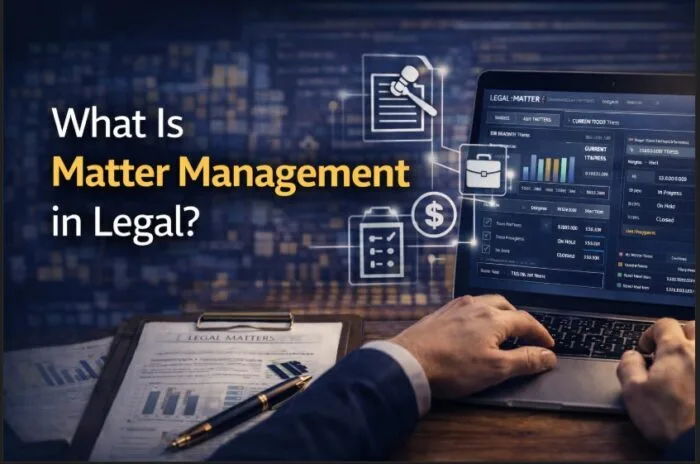

Matter management in legal is the process of tracking, budgeting, and reporting on every piece of legal work handled by an in-house legal department, whether managed internally or by outside counsel. A matter management system gives legal leadership real-time visibility into the active portfolio: what is open, who is working on it, what it is costing, and where it is going. It is the foundation of legal operations, and without it, legal teams cannot manage workload, control spend, or report on performance with any consistency.
For broader context on how matter management fits into the full legal operations stack, see what is enterprise legal management.
What does matter management actually cover?
A matter is any discrete piece of legal work. It could be a dispute, a contract negotiation, a regulatory inquiry, an employment issue, an IP filing, or an internal advisory request. In a matter management system, each of these is captured as a structured record with consistent fields, ownership, status, budget, and timeline.
Matter management covers the full lifecycle of that work from the moment a request comes in to the moment the matter is closed and the outcome is recorded. This includes intake, where legal requests from the business are captured and routed to the right team; matter creation and setup, where the matter record is opened with the relevant matter type, assigned counsel, and budget; work tracking, where progress, tasks, documents, and communications are recorded against the matter; spend tracking, where internal time and outside counsel costs are attributed to the matter; and closure, where outcomes and learnings are captured for future reference.
| Matter Type | Examples |
| Litigation and disputes | Commercial claims, regulatory enforcement, arbitration |
| Employment and HR | Terminations, discrimination claims, workplace investigations |
| Contracts and commercial | Major agreements, supplier disputes, customer negotiations |
| Regulatory and compliance | Licensing, investigations, government inquiries |
| Intellectual property | Patent filings, trademark registrations, IP disputes |
| Corporate and transactional | M&A, joint ventures, restructuring |
| Internal advisory | Business unit requests, policy questions, board matters |
Without a matter management system, this work lives across email threads, shared drives, and individual spreadsheets. Legal leadership has no consistent view of what is happening, no reliable data on what it is costing, and no way to report on performance or manage risk at a portfolio level.
What is legal matter-centricity?
Legal matter-centricity is the organizing principle that the matter is the foundational element of legal operations. Everything connects to it. Every bill, document, task, motion, filing, date, and communication belongs to a matter record. The matter is the center of the universe around which all other data orbits.
The physical analogy is a red-weld folder. Before digital systems, a legal matter lived in a physical file: the folder held the correspondence, the court filings, the bills from outside counsel, the internal notes, and the final outcome. Everything related to that matter went into one place. Nothing lived somewhere else. Matter-centricity is that same principle, applied digitally and at scale.
Running an ELM or eBilling implementation?
Swiftwater has three Level 4 Onit-certified practitioners. If you are evaluating, implementing, or rescuing an ELM program, let us talk about what that actually takes.
See ELM ServicesIn a matter-centric system, an invoice is not just a financial document. It is a charge against a specific matter, validated against that matter’s budget and billing guidelines, attributable to the outside counsel relationship on that matter, and reportable as part of that matter’s total cost. A task is not just a to-do item. It is a step in the lifecycle of a specific matter with a deadline, an owner, and a connection to the matter’s status. A document is not just a file. It is part of the record for that matter, searchable and retrievable in the context of the work it supports.
When matter-centricity breaks down, legal operations breaks down with it. Invoices arrive disconnected from matters. Documents live in folders that nobody can find. Tasks exist in email. The matter record is incomplete, and everything that depends on it, including spend analytics, reporting, and outside counsel performance data, is unreliable as a result.
Why is matter management the foundation of ELM?
Matter management is not one module among many in an ELM platform. It is the data layer that every other module depends on.
Legal spend management is only meaningful when spend is attributed to specific matters. eBilling enforcement works because invoices are validated against the budgets and billing rules attached to individual matters. Legal service request intake feeds matter creation. Workflow automation runs against matter status and matter data. Reporting draws on the matter record as its primary source. Remove matter management and the rest of the ELM platform becomes a collection of disconnected tools rather than a connected operational system.
This is why legal departments that implement ELM without investing in the matter management design consistently underperform on reporting and spend control. The system is only as good as the matter records inside it. Clean, structured, consistently populated matter data is what separates an ELM system that delivers insight from one that stores information.
According to the ACC Chief Legal Officers Survey, legal departments are expected to manage increasing workloads without proportional increases in resources. Matter management is how legal operations absorbs that pressure without simply adding headcount, because it gives leadership the visibility to allocate work intelligently rather than reactively.
According to the Thomson Reuters Institute 2024 State of the Corporate Law Department, 72% of legal departments are focused on building efficient in-house workflows and optimizing external counsel engagements. Matter management is the infrastructure that makes both possible in practice.
For a full view of how matter management connects to legal spend and eBilling governance, see what is Onit ELM.
What does a well-configured matter management system look like?
A well-configured matter management system reflects how the legal department actually operates, not how a default configuration suggests it should operate. The distinction matters because default matter types, fields, and workflows are rarely a precise fit for any specific legal function, and the gap between default configuration and real operating model is where adoption breaks down.
Good matter management configuration starts with the right matter types. A legal department covering litigation, employment, IP, and corporate transactions needs matter structures that reflect the distinct data requirements of each. A litigation matter needs fields for court, jurisdiction, opposing counsel, and exposure estimate. An IP matter needs fields for filing dates, jurisdictions covered, and renewal triggers. Applying a single generic matter template across all work types creates records that are structurally incomplete for most of the work they are supposed to track.
Beyond matter types, a well-configured system has consistent intake workflows that route requests to the right team based on request type and complexity, budget structures that align with how the legal department reports to finance, outside counsel assignments that connect matter records to the eBilling layer, and reporting templates that answer the questions legal leadership and the CFO actually ask.
The result is a system where matter records are populated consistently, data is reliable enough to act on, and reporting reflects reality rather than estimates. According to the Wolters Kluwer 2026 Future Ready Lawyer Survey, 62% of legal professionals report saving between 6 and 20% of their work week through process automation. A well-configured matter management system is the foundation that makes that kind of automation reliable, because automation built on poor data produces poor results at speed.
For a deeper look at how matter management software options compare across the market, see legal matter management software.
Want the review function run for you?
Every outside counsel invoice checked against your guidelines, rates, and matter context, inside the eBilling platform you already own, with the exception handling, vendor coaching, and savings reporting that separate a review program from invoice processing.
See Bill Review ServicesWhat is the difference between matter management and case management?
Matter management and case management are related concepts that are frequently used interchangeably, but they describe different systems serving different audiences.
Matter management is used by in-house legal departments to track all types of legal work across the full legal function, including disputes, contracts, regulatory matters, employment issues, and advisory requests. The scope is broad and the primary user is the in-house legal team managing the company’s full legal portfolio.
Case management typically refers to systems used by law firms or litigation-focused teams to manage active cases: court dates, filings, deadlines, witness lists, and discovery. The scope is narrower and focused on the mechanics of running a legal case rather than managing a legal department’s full body of work.
For a corporate legal department, matter management is the relevant system. Case management tools may be relevant for specific litigation-heavy functions, but they are not a substitute for the full operational visibility that matter management within an ELM platform provides.
Bottom Line
Matter management is the foundation of legal operations because it creates the business layer that everything else depends on. Spend control, workload visibility, outside counsel performance, and operational reporting all start with a well-structured matter record.
Legal departments that treat matter management as an administrative system rather than a strategic one consistently find that their ELM investment underdelivers. The platform performs to the quality of the data inside it.
Without matter management, legal work is visible only to the people doing it. With it, legal leadership can see the full picture, manage resources deliberately, and report on performance with the same credibility as any other business function.
If you are implementing a matter management system or redesigning an existing one, explore how Swiftwater’s legal technology implementation services approach matter management configuration from a practitioner-led perspective.
Frequently Asked Questions
What is matter management in legal?
Matter management in legal is the process of tracking, organizing, budgeting, and reporting on legal work handled by an in-house legal department. It gives legal leadership visibility into what matters are open, who owns them, what they cost, what stage they are in, and how they connect to the broader legal portfolio.
What does matter management actually cover?
Matter management covers the full lifecycle of legal work, from intake and matter creation through work tracking, spend tracking, document organization, task management, reporting, and closure. Each matter is captured as a structured record with consistent fields such as matter type, owner, status, budget, timeline, outside counsel involvement, and outcome.
What is legal matter-centricity?
Legal matter-centricity means the matter record is the central organizing point for legal operations. Documents, communications, invoices, tasks, deadlines, budgets, and outcomes are connected back to the relevant matter. This gives legal teams a clearer view of the full history, cost, status, and context of each piece of legal work.
Why is matter management the foundation of ELM?
Matter management is the foundation of Enterprise Legal Management because every other ELM function depends on structured matter data. Legal spend management, eBilling, workflow automation, legal service requests, and reporting all rely on accurate matter records. When matter data is clean and consistent, the broader ELM platform can produce more useful reporting, controls, and operational insight.
What is the difference between matter management and case management?
Matter management is used by in-house legal departments to track all types of legal work across the legal function, including disputes, contracts, employment issues, regulatory matters, IP work, and advisory requests. Case management is usually more litigation-focused and is often used to manage court dates, filings, deadlines, discovery, and active legal cases.
What does a well-configured matter management system look like?
A well-configured matter management system reflects how the legal department actually works. It includes the right matter types, intake workflows, ownership fields, budget structures, outside counsel assignments, task tracking, document connections, and reporting templates. The goal is to create matter records that are easy to use, consistently populated, and reliable for leadership reporting.
Why is matter management important for legal operations?
Matter management is important for legal operations because it gives the department a structured view of workload, ownership, risk, cost, and performance. It helps legal teams allocate work, monitor matter progress, manage outside counsel, support reporting, and make better decisions about resources and priorities.
What does matter management enable in terms of legal spend control?
Matter management supports legal spend control by connecting legal costs to specific matter records. Outside counsel invoices, budgets, rate information, and billing guideline activity can be tracked against the matter they relate to. This gives legal teams better visibility into matter-level costs, budget variance, outside counsel performance, and total portfolio spend.
Disclaimer: This article is provided for educational and informational purposes only. Neither Swiftwater and Company nor the author provides legal advice. This content does not constitute professional legal, financial, or operational advice and should not be relied upon as such. Readers are encouraged to consult a qualified professional before making decisions based on the information provided. External links are included for reference only and reflect the views of their respective authors. Swiftwater and Company takes no responsibility for third-party content.