
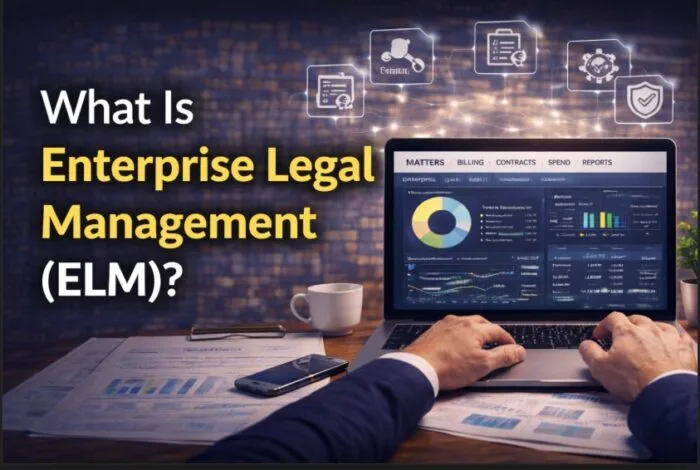

Enterprise legal management (ELM) is a category of legal operations technology used by in-house legal teams to manage matters, control legal spend, automate workflows, and improve operational visibility across the legal function. It is not just a tool. It is the operating system for a modern legal department, replacing the fragmented combination of email, spreadsheets, and disconnected software that most legal teams outgrow as they scale.
For broader context, explore the enterprise legal management hub.
What does enterprise legal management software actually cover?
Enterprise legal management software covers the full operational scope of an in-house legal function in a single connected system. At its core, that includes matter management for tracking all legal work; legal spend management and eBilling for controlling and validating outside counsel invoices; contract lifecycle management for governing contracts from creation through renewal; legal service requests for structured intake of work from the business; and workflow automation for routing approvals, escalations, and recurring processes.
What makes a platform ELM rather than a collection of legal tools is integration. A genuine ELM platform connects these functions so that matter data informs spend reporting, intake feeds matter creation, and billing data connects to analytics. Fragmented tools can perform individual functions. An ELM platform performs them together.
According to the 2026 CLOC State of the Industry Report, based on the 2025 CLOC Law Department Survey, legal operations has become the primary lever for efficiency at scale across legal departments, with technology strategy, financial management, and outside counsel management topping the priority list. ELM is the infrastructure that makes all three manageable in practice.
What is the difference between ELM and CLM?
Enterprise legal management and contract lifecycle management are frequently confused, and sometimes marketed as interchangeable. They are not.
ELM manages the full operational infrastructure of a legal department: matters, outside counsel relationships, billing, spend analytics, workflow automation, and legal service requests. CLM manages the contract lifecycle specifically: drafting, negotiation, approval, execution, obligation tracking, and renewal. ELM is the broader operational system. CLM is a specialized function that sits within or alongside it.
Running an ELM or eBilling implementation?
Swiftwater has three Level 4 Onit-certified practitioners. If you are evaluating, implementing, or rescuing an ELM program, let us talk about what that actually takes.
See ELM ServicesMost mature legal departments need both. The leading ELM platforms, including Onit, offer native CLM capability or structured integration with dedicated CLM systems. The decision is not ELM or CLM. It is which ELM platform best supports the CLM integration your legal function needs. For a full treatment of this distinction, see ELM vs CLM.
According to Gartner’s enterprise application guidance, enterprise systems are defined by their ability to integrate multiple business functions into a unified platform, which is exactly what distinguishes a genuine ELM deployment from a set of standalone legal tools.
What is the difference between enterprise ELM platforms and mid-market tools?
Although the category is called enterprise legal management, there is an important distinction between the tools available in the market. Enterprise-level platforms are designed for larger organizations with complex workflows, multi-jurisdiction operations, deep integration requirements, and significant outside counsel programs. Mid-market tools are designed for startups, smaller companies, and organizations at an earlier stage of legal operations maturity, where the needs and budget profile are different.
Enterprise ELM platforms include Onit (OnitX and Unity), Mitratech (TeamConnect), Wolters Kluwer ELM Solutions (TyMetrix), and LexisNexis CounselLink, which plays in both enterprise and mid-market environments.
For the mid-market and non-enterprise segment, the field includes Onit’s SimpleLegal, Wolters Kluwer’s Brightflag, Mitratech’s Acuity and Casecloud, LexisNexis CounselLink+, Thomson Reuters Legal Tracker, and others. These platforms are purpose-built to deliver core matter management and eBilling capability at a scale and price point suited to smaller or less complex legal functions.
Each platform provides matter management, legal spend management, and reporting and analytics as core capabilities, but they differ in workflow flexibility, development philosophy, implementation complexity, and the depth of specific modules such as eBilling and benchmarking analytics. For a comparison of the major enterprise platforms, see our ELM software buyer’s guide.
Who uses enterprise legal management systems?
Enterprise legal management systems are used by corporate legal departments across industries, from global enterprises managing hundreds of outside counsel relationships to mid-market companies standing up their first structured legal operations infrastructure. The deciding factor is not the size of the organization. It is the complexity of the legal function and the scale of outside counsel engagement.
A legal department managing significant outside counsel spend, a high volume of incoming legal requests, multi-jurisdiction operations, or meaningful reporting obligations to the CFO or board needs a full ELM platform. A smaller team whose legal work is primarily advisory and whose outside counsel relationships are limited in scope may only need eBilling and intake workflow capabilities, or a mid-market solution, rather than a full enterprise ELM deployment. Starting with the right-sized tool and scaling up as the function matures is a legitimate and often sensible path.
A December 2024 Gartner survey of in-house and law firm lawyers found that only 20% of legal matters sent to outside counsel stay within budget range, and that the average legal department spends $162,000 a year paying lawyers to duplicate, at least in part, the efforts of outside counsel. Without visibility into what outside counsel is doing and what it is costing, overspend is structural, not occasional.
What does that mean for your legal department specifically? The Legal Tech ROI Calculator helps legal departments calculate the cost of their current situation, the potential savings from ELM and eBilling implementation, and the ROI of acting now versus the cost of doing nothing. If you are making a case to your CFO, this is where to start.
When does a legal department need an ELM system?
The signals that a legal department is ready for ELM are consistent across industries. Legal spend is growing but difficult to track. Matter status lives in someone’s inbox. Outside counsel billing is reviewed manually and inconsistently. Leadership is asking questions about legal performance that the team cannot answer with data. Reporting to the CFO involves estimates rather than numbers.
At that point, the tools the department has been using have reached their ceiling. ELM does not just automate what the team is already doing. It provides the infrastructure that makes a different kind of legal function possible: one that tracks work systematically, controls spend through enforcement rather than manual review, and reports on performance with the same credibility as finance or procurement.
According to McKinsey and Company, structured systems and automation significantly improve operational efficiency in complex functions. Legal operations is precisely that kind of function, and ELM is the primary vehicle for that transformation.
Want the review function run for you?
Every outside counsel invoice checked against your guidelines, rates, and matter context, inside the eBilling platform you already own, with the exception handling, vendor coaching, and savings reporting that separate a review program from invoice processing.
See Bill Review ServicesWhat role does implementation play in ELM success?
Enterprise legal management success depends on more than selecting the right platform. The platform provides the capability. Implementation determines whether that capability is realized.
A well-implemented ELM system is configured to reflect how the legal department actually operates, populated with clean and structured data, integrated with the enterprise systems it depends on, and adopted by the people who need to use it. A poorly implemented one processes invoices but does not generate insight, tracks matters but does not surface risk, and goes live on schedule while delivering a fraction of its potential value.
Swiftwater’s Onit Level 4 certified practitioners have delivered ELM implementations at significant scale, including a deployment spanning 90,000 employees in eight languages covering ELM, CLM, eBilling, and LSR simultaneously. That is one set of examples. Swiftwater’s broader bench of experts has implemented all major ELM systems available in the market, across industries, geographies, and organizational structures, with consistent results. The variables that determine whether ELM delivers value are the same regardless of which platform is in play, and getting them right is a discipline that comes from accumulated delivery experience, not from reading the implementation guide.
For a full treatment of what successful ELM implementation requires, see ELM implementation guide. For a guide to the software options available, see ELM software guide.
Bottom Line
Enterprise legal management is the foundation of modern legal operations. It transforms a legal department from a reactive function into a structured, data-driven system with visibility into matters, spend, and performance that leadership can actually act on.
Whether you run a one-person legal team or a legal department of a thousand, an ELM system gives you a central control panel for how legal work flows internally, how outside counsel relationships are managed, and how the function reports to the business. It is the difference between a legal department that operates on instinct and one that operates on evidence.
Without enterprise legal management, legal work is fragmented and largely invisible to the rest of the business. With it, legal becomes a function that operates with the same data discipline, process rigor, and accountability as any other business unit at the table.
If you are evaluating ELM platforms or planning an implementation, explore how Swiftwater’s legal technology implementation services approach ELM deployment from a practitioner-led perspective.
Frequently Asked Questions
What is Enterprise Legal Management (ELM)?
Enterprise Legal Management (ELM) is a category of legal operations technology used by in-house legal teams to manage matters, legal spend, workflows, contracts, service requests, and operational reporting. An ELM platform gives the legal department a connected system for managing legal work, financial controls, outside counsel activity, and department performance as the function scales.
What does ELM software cover?
ELM software typically covers matter management, legal spend management, eBilling, outside counsel management, contract lifecycle management, legal service requests, workflow automation, and analytics. The value of ELM comes from connecting these areas so matter data, billing data, contract data, and workflow data can support better legal operations decisions.
What is the difference between ELM and CLM?
ELM, or Enterprise Legal Management, manages the broader operations of the legal department, including matters, legal spend, outside counsel, workflows, service requests, and analytics. CLM, or Contract Lifecycle Management, focuses specifically on contracts from drafting and negotiation through execution, renewal, and obligation tracking. CLM may sit within an ELM platform or integrate with it, but ELM is the broader operating system for the legal function.
What is the difference between enterprise ELM platforms and mid-market tools?
Enterprise ELM platforms are usually designed for larger or more complex legal departments with multi-jurisdiction operations, advanced workflows, significant outside counsel programs, and deeper integration requirements. Mid-market tools are often designed for teams that need matter management, eBilling, and spend visibility with faster deployment and lower configuration complexity. The right choice depends on workflow complexity, scale, budget, integration needs, and legal operations maturity.
Who uses enterprise legal management systems?
Enterprise legal management systems are used by corporate legal departments that need structured control over matters, spend, outside counsel, contracts, workflows, and reporting. They are common in larger organizations, but the need for ELM is driven by operational complexity as much as company size. A growing legal team may need ELM when legal work, spend, and reporting can no longer be managed effectively through disconnected tools.
When does a legal department need an ELM system?
A legal department may need an ELM system when matter volume, outside counsel spend, reporting demands, contract activity, or workflow complexity has grown beyond manual processes. ELM becomes especially useful when leadership needs reliable answers about legal spend, matter status, outside counsel performance, budgets, and legal department workload.
What role does implementation play in ELM success?
Implementation plays a major role in ELM success because the platform must reflect how the legal department actually works. A strong implementation includes process design, data migration, configuration, integrations, reporting setup, user training, and change management. The goal is to create a system that legal teams trust, use consistently, and rely on for operational decisions.
How can Onit ELM help improve legal department operations?
Onit ELM can help legal departments improve operations by centralizing matter management, legal spend control, eBilling, workflows, contracts, and analytics. It gives legal operations teams better visibility into work, cost, ownership, status, and performance. When implemented well, Onit can support more consistent processes, stronger financial oversight, and better legal department management.
Disclaimer: This article is provided for educational and informational purposes only. Neither Swiftwater and Company nor the author provides legal advice. This content does not constitute professional legal, financial, or operational advice and should not be relied upon as such. Readers are encouraged to consult a qualified professional before making decisions based on the information provided. External links are included for reference only and reflect the views of their respective authors. Swiftwater and Company takes no responsibility for third-party content.