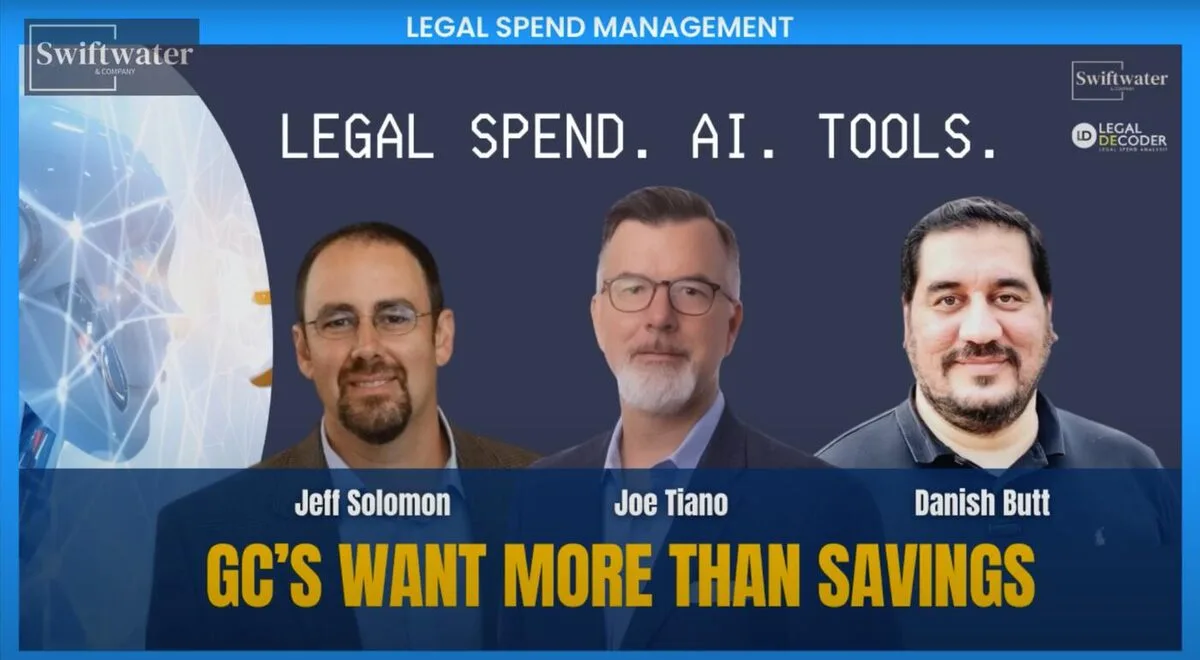

Recently, I spoke to Joe Tiano of Legal Decoder and Jeff Solomon of Swiftwater and Company on topics about the evolving landscape of legal spend management and AI’s impact on the legal industry.
Summary
Our conversation covered the current bullish state of the legal market, where law firm profitability continues to rise alongside client demands for greater predictability and control over legal costs.
We explored how AI promises to deliver not just cost savings, but critically important speed improvements that enable legal teams to keep pace with accelerated business demands across other corporate divisions. While AI is changing how legal services are delivered, legal departments still need strong legal spend management foundations to measure performance, evaluate outcomes, and quantify the impact of new technology investments.

The discussion delved into sustainable economic models for law firms adopting AI, As AI adoption expands, budgeting and forecasting disciplines will become even more important. Legal departments will need better visibility into how technology impacts matter costs, staffing models, and outside counsel budgets over time., with Joe arguing that strategic displacement of low-value work through AI can actually create win-win scenarios where clients pay less while law firm partners maintain profitability through higher rates on remaining high-value work. We examined the data trends emerging since generative AI’s advent, concluding it’s still too early for definitive analysis but emphasizing the critical need for organizations to establish baseline metrics before implementing AI strategies.
A significant portion of our conversation focused on the limitations of current legal technology tools, particularly eBilling systems that generate data without providing actionable insights, and the growing need for expert interpretation to transform raw spend data into strategic guidance.
We concluded with practical advice for legal leaders: embrace AI adoption early to maintain control over implementation, establish data baselines for measuring success, and leverage industry expertise to avoid common pitfalls while building organizational AI fluency.
Is your legal spend data telling you the full story?
We help legal departments build the analytics, rate governance, and reporting infrastructure to move from invoice processing to strategic spend management.
See Legal Spend ServicesKey Discussion Points:
- Legal Market Trends: Current bullish outlook with rising law firm profitability and client demands for spend predictability and control
- AI’s Dual Promise: Cost savings and speed improvements, with speed being equally or more important than cost reduction
- Industry Evolution: Shift from “practice of law” to “business of delivering legal services” with multiple service delivery models
- Sustainable AI Economics: How law firms can reduce hours and headcount on low-value work while increasing rates and profitability
- Junior Lawyer Impact: Need for reskilling rather than job displacement, with AI eliminating mundane tasks and enabling more intellectually stimulating work
- Implementation Timing: Still early for definitive data trends, but organizations must analyze current work patterns before AI adoption.Establishing a baseline before introducing AI is critical. Without understanding current staffing patterns, spend allocation, and outside counsel utilization, legal departments may struggle to measure whether AI initiatives are actually improving performance.
- Technology Tool Gaps: Current eBilling systems provide data but lack actionable insights, requiring expert analysis for strategic value. This distinction between data and insight is becoming increasingly important. Many legal departments have access to extensive spend reports but struggle to translate that information into meaningful decisions. The next stage of legal spend maturity is not collecting more data, but understanding which data drives action.
- Practical AI Strategy: Start with realistic expectations, identify quick wins, establish baselines, and leverage industry expertise
- Competitive Differentiation: Law departments now asking firms about AI usage as a selection criterion rather than a concern
- Change Management: Importance of building AI fluency and managing adoption under your own terms rather than having it imposed
Transcript
(auto generated transcript)
Danish Butt (Host, Swiftwater & Company): Hello and welcome! I have with me Jeff Solomon and Joe Tiano from Legal Decoder, and Jeff is part of the Quarter team. I’m excited to tackle all things spend management. We’re going to discuss from a perspective of law firms, we’re also going to be tackling in-house trends, and most of all, the impact of AI on legal spend management. So welcome Joe, welcome Jeff – excited to have you.
Joe Tiano (Legal Decoder): Thanks for today.
Jeffrey Solomon (Swiftwater & Company): Yes, great to be here.
Danish Butt: Okay, maybe we start with quick introductions. I’m Danish Bhatt. I am part of the Swiftwater and Company advisory team. We advise the office of general counsel in managing their spend, helping them with effectiveness and efficiency. Joe, do you want to go ahead next and introduce yourself?
Joe: Sure, Joe Tiano. I’m a lawyer by trade. I practiced law for about 17 years. Most recently I was a partner at a firm called Pillsbury Winthrop Shaw Pittman before starting Legal Decoder back in 2015. I am the CEO of Legal Decoder. We are analyzing legal spend data to help law firms and their clients get better visibility, value, and efficiency from that partnership and by using spend analysis data to understand exactly how value is getting delivered.
Danish Butt: By the way, we’re excited to be partners with Legal Decoder. We recently announced our partnership after working together on several different clients and achieving great results together. So woohoo!
Joe: Yeah, I’m equally excited about this. I’ve said for a while now that you could throw technology at a lot of different problems, but legal spend driving value is one where technology by itself may not solve a problem independently, and you really need experts like the team you have at Swiftwater to really put a layer of subject matter expertise on things that really drives better outcomes for clients across the legal industry. So I’m likewise excited to work with a team like Swiftwater and the talent pool that you have there.
Danish Butt: Thank you for the kind words, and we are equally excited to work with the technology that really helps us bring those insights together. Jeff, I’m glad that you’re on team Swiftwater now. We don’t have to meet at conferences every few months – that was our standing routine for a number of years. So it’s great to finally be on the same team.
Jeff: So I’m Jeff Solomon. I’ve been for the last 25 years within legal, legal technology, and law department consulting in many different capacities. So excited to be able to bring the team together, continue working with Joe as I’ve had some overlap with Joe in past lives. Really looking forward to the discussion today and the next several months.
Danish Butt: Wonderful. So let’s start with sort of the burning trend that I’m seeing. This year there’s a lot of focus in spend. I think more than what I’m seeing in cost cutting, I’m also seeing that there’s a lot more desire for control and predictability that is being demanded by finance. So maybe let’s just start generally with what trends are you seeing this year and going into next year with all the geopolitical environment? How do you see it?
Joe: Well, I’m pretty bullish on the legal market overall. You know, it tends to be sort of a countercyclical industry at times, and so who knows where the economy is going. It seems to be going pretty well so far. If law firm profitability and law firm profits are any indication on how the industry is doing, it seems to be doing pretty well. Profitability was up considerably last year. Part of that may be due just to increasing hourly rates. Demand, I think, was up a little bit according to a couple studies that I saw – not a huge increase in demand, but a decent increase in demand.
Want the review function run for you?
Every outside counsel invoice checked against your guidelines, rates, and matter context, inside the eBilling platform you already own, with the exception handling, vendor coaching, and savings reporting that separate a review program from invoice processing.
See Bill Review ServicesOn the corporate side of the world, I think the same mantras that have been pervasive across the industry for the past decade kind of continue to echo within the departments. Still in the economies that we’re moving into, one is just a need to understand better the value that legal departments are delivering to the overall corporate client. Second is figuring out a way to sort of leverage the partnership with outside counsel to make sure that the value proposition is solid and outside counsel’s continuing to deliver optimal value at a reasonable price. And I think third, the new sort of trend – and I know we’re going to get into this quite a bit – is sort of the artificial intelligence craze right now. You can’t really take two paces in any direction at any conference or reading any industry or business media without seeing AI splashed all over the headlines.
Jeff: Yeah, agreed. I mean, equally bullish on the current and future state. We’ve been through cycles like this before. Legal spend continues to rise, law firm profitability continues to rise, rates continue to grow. I think you nailed it, Danish, with predictability. As much as we hear about cost cutting and savings, while there is a desire to pay the right amount and work with the right firm, there’s an equal desire to be able to kind of call the ball on what your spend is for a certain case, a certain segment, a certain year, and then be able to have some level of confidence that you can deliver on what you were predicting early on.
Joe: Yeah, and I think a real interesting trend that’s really been happening over a long time – and this is where I think Swiftwater adds an incredible amount of value because you’re able to sort of pinpoint this type of thing – the industry’s changed, right? It’s changed from the practice of law to the business of delivering legal services. I think that’s kind of like the era that we’ve moved into and that we’re squarely in right now. And when it comes to delivering legal services, part of it may be the pure practice of law delivered by lawyers, part of it may be technology-enabled lawyering, part of it may be alternative legal services providers and consultants really driving the approach to delivering the legal services, and part of it may be technology alone sort of helping out.
I think it’s just interesting how the industry has evolved where you can’t just, from a lawyer’s perspective, spend as much time as you want to spend, deliver a perfect product, and then hand off the first service bill for a million bucks. I mean, life has changed dramatically because there are many more options out in the market right now, and I don’t think anything’s going to change in that regard except really increase and have more options.
Danish Butt: It’s very valid. Pointing all the – there’s sort of a confluence of all these factors coming in, right? The LSPs are maturing, which I kind of said this a few years ago. I mean, is “alternative legal service provider” a term now? I think there are other terms being introduced and legislation was changing, but I think definitely a lot of that is coming in. The maturity of the operations function in legal has also something to do with it as well.
Joe: Yeah, it was really interesting too because I was at a conference two, three weeks ago at the ASU law school, and I was speaking with somebody – I can’t remember the consulting group that came in. I was talking with the principal there and saying, “So what part of the market are you looking to displace?” There really wasn’t a solid answer saying we’re looking to displace low-value work or high-value work or all work. They’re hoping to be additive into the equation, and it was just really interesting to me because you now have some of the barriers torn down in terms of who could practice law and what kind of advice they could give and how they could give it. It’s going to be interesting to see how that model evolves out.
I mean, from sort of a 50,000-foot view, you kind of look at some of the Big Four consulting organizations and they’re advising on M&A, they’re advising on software implementation, they’re advising on tax, they’re advising on a whole myriad of different things. And you say, “Well, is law a natural extension?” And it’s like, I don’t know, maybe it is, maybe it’s not. I mean, in some sense, a part of me says it’s such a specialized area that you need sort of consultants with certain expertise, and the generic “we do everything” type of consulting may eventually prove to be very beneficial to the industry as a whole. But I think to start off with, I think we really ought to look at consultants that have expertise and deep expertise within sort of the field that we’re in, which is the legal field. We’ll see how it plays out.
Jeff: Yeah, agreed. And I think one thing that’s really going after is ultimately better quality and faster. And it extends beyond kind of the work that these firms are taking on that’s additive, but also extends into – we talk a lot about freeing up a lawyer’s time. Freeing up a lawyer’s time, and you could look at that through the lens of “let’s do it for cheaper,” but ultimately you’re doing it through the lens of “let’s let them have greater focus on the things where they’re really adding the most value,” and that includes the client experience. So the clients that they’re working with, being able to have the deeper connection and the deeper partnership there because they’re not necessarily tied up in the weeds of all these various tasks where they can bring in experts who are better positioned to do it more.
Danish Butt: Great point. I want to shift our discussion to AI. So I was thinking about it – do we start from the big question and go to the small ones? So I do want to individually address them. What I find very interesting in anything we label with AI, especially in legal, is like, what’s the promise? I’m going to ask you from both perspectives. So what are GCs, law firms – what’s the big promise AI is showing them? What are you getting? Yeah, Jeff, I’d like to hear your view on this first, and I’ll kind of riff off of what you said because I’m curious what you think.
Jeff: Yeah, so I think the initial gut check is cheaper. I mean, that’s what you hear – instead of spending time going through 500 documents, you can leverage AI to summarize those documents and produce a nice summary that you’re able to leverage, of course with the appropriate – informed, not replaced – quality controls at the end of it. But ultimately, going at better and faster. Time is an issue, and the amount of time that these types of tasks take, not from a cost perspective but just from a time-on-a-calendar perspective, is material. And where you can replace those with technology and then jump in later in the process and provide the same amount of value, same amount of expertise in the analysis of those, is just critical and a huge step forward that we’ve taken over the last couple years.
And similarly, beyond looking at kind of what we call the low-value tasks or the repetitive tasks, things like that, just the technology that’s available to allow lawyers to evaluate risk and test case strategies before they actually do it in practice – that’s kind of the exciting future that I’m looking at.
Joe: Yeah, Jeff, I’m glad you went first because I suspect you’d say something prescient, as you always seem to do. But you echoed some of the – or maybe led off what’s the same principle that I heard from somebody else, a good friend of mine, Whitney Stefco. She’s in legal ops. We were talking about sort of the same issue, and she said, “You know, cost savings is important, but speed is equally as important, if maybe not more important.” I said, “Really? I never really thought of it that way. Why?” And you alluded to it, Jeff.
She was talking about how, within the legal department, they used to – and I’m making these numbers up – they used to have to evaluate all of the legal aspects of releasing a dozen new car models per year, right? And now it’s like, because all of the other divisions – the engineering division and sort of the architectural division at these large organizations like Ford – because they can now leverage Gen AI products, they’re not producing 12 prototypes of new vehicles, they’re producing – again, making this up – 300 prototypes of new vehicles. And so that’s putting an interesting sort of pressure point on the inside legal team where they now have to be able to react and react faster because they’re getting business pressure from other people.
They’re having to adopt AI not just for sort of the cost savings purposes, but the time-saving purposes that you alluded to, Jeff. And now that’s sort of trickling down to the law firms where it’s like, “Well, we need turnaround on these regulatory applications or whatever the other things are that happen with the legal aspects of releasing new models of cars.” It’s like I really had never thought about that, and Whitney brought that up with me. You brought it up again, and it just really opened my eyes to sort of like the promise of AI is not just sort of cheaper, but it’s the “wow, we could actually get a lot more done in a lot less time,” and our business clients over here are asking for it.
I always break down AI sort of in two components in the legal industry. I always think about it sort of like AI that’s promoting, augmenting, amplifying, expediting the practice of law, and then sort of the other piece of it, which is AI that’s sort of amplifying and facilitating the business of running a legal organization, whether it’s a law firm or whether it’s an internal legal department. I kind of break down AI into those two components, and I see clear benefits for each. The ability to kind of get legal work done faster and better, more accurately, with of course all the safeguards that Jeff mentioned, is important. But also the business of running a legal department or a law firm – being able to identify tasks which are appropriate to sort of reshuffle and reallocate amongst people I think is really important. And what that means from an economic perspective is really fascinating.
Struggling to control outside counsel spend?
We help legal departments build the governance, billing guidelines, panel structure, and rate programs that take back control of what outside counsel costs.
See Legal Spend ServicesDanish Butt: Let me ask you a general question. So I mean, cheaper, faster, better sounds great in theory, but let’s talk about it from a business perspective. I can see the corporate law department being very happy if they can get cheaper, faster, better. What about law firms? I mean, is that truly a sustainable model for some of the law firms who invest a lot in providing services in a certain way?
Joe: I’ve got super strong feelings on this. Let me jump in. I just wrote an article on this, and I don’t think the current economic model is sustainable when it comes to AI. I am not calling for the death of the billable hour like people have been calling for it for decades now, and it’s just like it’s the thing that never seems to want to die. I’m not calling for it either, but what I am suggesting – and I suggest this in the article – is if you take a look at the work that’s being done at law firms and now can be done inside general counsel’s offices and legal departments, AI is going to displace a lot of that work. A lot. And it’s the low-value work that it’s going to displace, not the high-value work that’s going to get displaced.
So when you start to think through what’s the law firm economic model going to look like in the future, we actually built out an economic model where, believe it or not, you could actually reduce the number of hours, reduce some of the headcount that would be handling that low-value work because there’s lower amounts of – decreased low-value work, right? You now can increase your billing rates, and at the end of the day, when you work through this economic model, what we worked out is you could actually drive less revenue to a law firm, meaning clients are paying less, which should make clients happier. But the law firm itself and the law firm partners are operating within a more profitable organization, which benefits partners.
So it winds up being a win-win overall. Clients are paying less, but overall law firm partners are making more because they’ve adjusted their economic model to rationalize for what’s being taken over by AI. To me, it seems like a win-win for everybody except for sort of the more junior of our colleagues. But the answer for the more junior of our colleagues isn’t “you’re going to be out of a job, good luck.” The answer is “you’re going to have to get reskilled,” right? There’s going to be a role for you in the legal industry going forward, but that role may not be what the role traditionally has been for the first, second, third years of law. You may need to learn different skills. You’re going to be valuable in a different way to the law firm.
So I’m very bullish on AI and what it’s going to do for the industry. I think between creating better efficiencies, better results, better economics, and oh, by the way, access to justice is kind of a huge thing that I care about – all the people who are underserved right now who could get served by, who could get helped by artificial intelligence – it’s a benefit to everybody. I just see this as being a good trend going forward.
Jeff: Yeah, agreed, particularly on the early career lawyers through the lens of “inform, not replace.” There’s still some work for them there, just not the same way it was before. But once this becomes kind of more of the status quo and there’s less uncertainty about it, I think it’ll ultimately be a better model for the first-year associates in that they’re just being exposed to different things and more advanced things than they would have maybe seen before in their second and third years, for sure.
Joe: And like, it’s all of the crummy work that they’re not going to have to do. So you look at things like talent retention, right? Billing 2,400 hours, getting stuck in the metaphorical dark, dingy room reviewing document after document after document – like, nobody wants to do that sort of work, no matter what you get paid. But now, I think you hit it on the head, Jeff – they’re going to start getting work that’s intellectually stimulating and challenging. Talent retention issues and professional gratification I think should – feels like it should go up.
Danish Butt: Let me ask you from a data standpoint, right? Joe, you’ve seen billions of dollars of data. Jeff, you’ve created products around that, looked at data. What’s the data trend showing you in the last – let’s say since the advent of Gen AI in the last two or three years? Does the data support what we’re thinking business-wise, or is it sort of lagging right now? What’s happening in the trenches?
Joe: So I think it’s too early to make any judgments on what the trends are and what the data is showing, primarily because the legal departments and the law firms are still just getting their minds wrapped around “what do we be reallocating and diverting to artificial intelligence rather than to human beings?” I don’t think they fully have sort of baked that out in their mind. I think because they haven’t baked it in their mind, it hasn’t really gone into practice. Maybe Jeff’s got a different view on that.
But what I think has to happen – I think any organization that wants to run in an economically responsible way and be a good fiduciary of what’s getting spent from a legal department and be a good manager of a law firm – I truly believe that these organizations need to take a look at the data, figure out what type of work and how much of it is going to get displaced by AI or become Gen AI-enabled services or move to an ALSP, truly do a deep dive into that data, figure out what’s going to get displaced, and then re-engineer the financial model accordingly.
I mean, right now, if firms are putting their finger up in the air saying, “I’m kind of worried about this AI thing,” but they’re not taking the time to figure out, “Well, what’s going to be the economic effect of it?” – man, they are playing Russian roulette, and there’s a lot of bullets in the chamber that I’d be worried about.
Jeff: Yeah, no, I agree with that. Still a little early to tell on what the data shows from seeing it in practice on a large enough scale. But I do think that we’re kind of right where you say we are – that we have kind of a mix of law firms who are kind of further along on that journey and have started doing that analysis and are starting to introduce technology like that at small scale, and then the ones who aren’t quite there yet.
And then interestingly, as we look at some of the law departments who are working with multiple firms, reaching out for kind of proposals for certain types of work, I’m seeing more and more questions about their use of AI on those questionnaires, almost indicating that to some extent it’s becoming kind of a competitive differentiator. Because a couple years ago we would see those kinds of questions and it was really about the law departments were skittish about AI and they were concerned about security, and they were asking to make sure you weren’t using it. And now they’re asking to make sure you are. So I think everybody’s going to have to jump on that train pretty quickly.
Joe: So just out of curiosity, how are you guys at Swiftwater kind of thinking about the AI adoption amongst your clients, and what sort of advice are you giving your clients when it comes to “this is how you should be sort of roadmapping things and planning out things?” You want to jump on that one, Don?
Danish Butt: Sure, yeah. It’s an interesting conversation. I was talking to Stephen Lerner from Law360 the other day about who’s lagging versus who’s leading – is it the law firms or is it the GCs or internal organizations? First of all, you need to recognize sort of the current state, right? The current state: typically legal does not have a chief AI officer for legal, right? We’ve gotten to the extent of now having somebody who can head legal ops, and they’re dual-hatting, as we say it, to become the AI liaison. But we don’t have that. Law firms, on the other hand, have the advantage that they have chief knowledge officers or chief innovation officers, and they can invest in that resource.
So I think one thing we could say is that there is digital fluency. Now we need some Gen AI fluency where people can talk in terms and articulate the terms. The second question is also that there’s a demand for knowledge that goes hand-in-hand and saying the easiest way for legal departments to show an ROI is to identify a use case that says, “I can get in quickly and train people quickly, and I can show an ROI to build on.” So there’s a lot of demand, and I think that’s sort of one of the reasons that CLM is out there, because they’ve done a good job in educating the market about contracts and those ROIs.
I still think that there’s a lot to be done in the general world of legal to educate people of what can be done. Again, there are some industries that are ahead, like the finance industry, because they tackled this problem of claims and risk management and stuff. They were very much on the beat with machine learning. They had teams who were sitting in. Or tech companies who’ve got like engineers who can speak the language.
So what we’re saying is, from a roadmapping perspective, you do have to make some investment in learning about the information, have some kind of plan that says, “Let’s test something out. Don’t try to do it all yourself and leverage from industry experts, conferences in the market.” We can help you sort of tell you what’s working, what’s ripe for taking advantage today. I think that’s sort of the starting point before you say, “Well, let me get some AI tech and let’s work.” That’s going to result in a lot of – you know, it’s hard to try to do it yourself.
Jeff: Yeah, you definitely want to do the analysis. You don’t want to take a big swing and have it miss, and then from a change management perspective, you spend the next six months getting buy-in internally to dive back into the pool.
Joe: That’s a really good approach because I mean, you know, I think everyone has trepidations and skepticism around AI. And when you talk about an industry that’s historically been data-phobic and techno-phobic, it’s like it’s punctuated. And so that approach that you guys are articulating really makes a lot of sense where it’s like, “Look, let’s just figure out what we could do, pay attention to change management, get quick wins, don’t over-invest, and make a difference where you see an ROI.” I think it’s great advice.
Danish Butt: Let me ask you this. Machine learning was sort of the closest thing I was thinking where it transformed how legal was functioning – the law firms and in-house. One of the things with the advent of the technology-assisted review in the eDiscovery space sort of changed our expectations that we want AI to give us outsized returns, right? Suddenly, within five years, you went from like we’re paying for reviewers $200-$300 an hour, and it was supposed to bring it down to cents on the dollar for reviewing documents. Can that be also a factor that people just want too much from AI out of the start? Otherwise, it’s like, “Hey, it’s very incremental. I don’t want that.” Is that always a risk?
Jeff: I’m usually a proponent of setting realistic expectations on proving out that first use case. Of course, there will be people who will say, “This is going to reduce our spend by 50%. It’s going to reduce the cycle time on a litigation by 40%.” But setting targets like that makes them difficult to attain. But there’s a nice blend of cost savings, time savings, and quality improvements.
Joe: Yeah, I think it’s interesting. I mean, you draw the parallel with TAR, and there’s almost sort of like a limited use case, as Jeff alluded to, with TAR. Like, you could actually look at it and see sort of like the before and the after. Here’s what our life looked like before technology-assisted review, and here’s what it looks like afterwards. You quantify the metrics, you can look at the outputs with the outcomes.
Right now with Gen AI, it’s like there’s so many different flavors of it that you almost have to start to think about bucketing each of the types of AI tools into its own component to be able to kind of look at sort of at T0 and then T-whenever you want to measure it, right? Some of them – maybe if we’re talking about document generation or legal research or contract analysis – some of them may do great versus some of the historic TAR articles. Some of them may be laggards for whatever reason.
So I think that to ask a question like you asked and try to come up with an answer, I’d want to sort of bucketize them more to figure out, “Well, this is how this compares with TAR, this is how that compares with TAR,” and so forth. Because if you look at it sort of like holistically, then I’m not sure you’re really getting a clear picture.
Danish Butt: My thought was this more of a conditioning sort of thing, right? I mean, suddenly it was like, “Yeah, you’re spending millions of dollars,” which, funnily, the analysis Joe and Jeff were doing with one of our colleagues came around the other day – we still found that the firms are still overpaying for eDiscovery in certain cases, right, where they’re not able to see the data real-time and manage it. So it’s still happening. But I feel like sometimes the expectations are that, “Okay, if you’re going to invest some in something new, you have to have outsized returns.”
Joe: Well, you know, it’s still new enough for us to sort of say it’s okay to be cautious. I mean, you’re going to get the compounded returns in a little bit.
Danish Butt: Switching gears. On the side of both of you are very familiar with technology, right? You’ve lived and breathed technology and kind of come at it from a practitioner standpoint and saying you ought to have the right technology as a business person, as a good lawyer, to be able to manage your cases. eBilling was a tool that everybody wanted. Now I’m seeing in the last few years that sort of it’s waning down in percentage, but I think that’s because firms and organizations are getting mature.
I feel that law firms and legal departments are not supported adequately by the tools that are out there in the market to make the kind of decisions that would be required in this advanced stage. How do you see that? Do you agree with that? Do you feel like everybody has the tools and they’re not using them, or do you feel like they need to have like a good combination of tools and processes to get to the next level?
Joe: So I don’t want to make this an infomercial for Legal Decoder, but I do need to sort of point out something that I truly believe. I think a lot of the tools that have been out there for decades – which are the eBilling tools – they push a lot of data through pipelines, and their forte is really payment processing and process management. Because there’s data there, there’s of course the ability to do data analytics over that data.
The problem that I hear, that I see, that I think clients experience, whether it’s on the law firm side or on the client side with billing systems or eBilling systems, is look, you could run 75 million different reports out of any of the eBilling or billing platforms, but good luck choosing the right report that’s going to tell you what you need. And once you choose that right report, it’s kind of like, “Have fun interpreting it yourself,” right?
And that’s one of the reasons why I think we provide a little bit of a differentiator at Legal Decoder – it’s like we actually do the hard work of analyzing that data, categorizing that data, bucketizing that data, driving insights from the data. So when someone looks at something, it’s not like, “I got a report and I got to figure it out.” It’s kind of like, “Here’s the answer,” right? And what people are looking for is trying to find the answers rather than finding data that they have to sift through, cull through, and analyze themselves.
So look, these billing tools are good for their sort of original purpose. Good ones will evolve and develop the capabilities to do things that I just articulated – what they should be doing, which is not producing more data but producing insights. And the ones that don’t, they’re just going to be a tool that’s probably just part of a process management system, in my opinion.
Jeff: Yeah, I mean, we see kind of demand for eBilling wane to some extent, at least from a survey perspective, because at this point everybody has it. Although the majority aren’t doing it well. Like Joe said, to the majority of law departments out there, eBilling means electronic billing of invoices with a mechanism for paying the law firms for those invoices, and there’s not really a great amount of analysis that’s happening beyond that – beyond the typical just eBilling budget tracking, things like that.
And if you pull reports, whether it’s predefined for you or you have to think of the metrics you want to look at on your own, I mean, it is really hard to identify some of those trends that Joe was talking about. You would have to basically know the scenario you’re looking for and go in and identify that scenario. Like, if you’re trying to say, “How many drop-in timekeepers do I have across this?” – it’s hard to do that in bulk. You’d have to know that’s what you’re looking for.
So having technology and tools supplemental to just the basic eBilling is critical into the process. It’s almost impossible to find the information that’s helpful to you.
Joe: And sort of to pile on, and I’ll toot a Swiftwater horn for a moment – once those trends have been surfaced, right, you need sort of subject matter experts to look at those trends and say, “Okay, those trends are okay because…” or “Those trends are not okay because…” And that’s why I’m really excited about our partnership, because it’s one thing that data by itself can be dangerous, but data in the hands of people who know what the data means and how to use the data as a tool is invaluable from an organizational perspective. And that’s why it’s kind of like you guys bring the understanding of what the trends mean and how they need to be implemented from a strategic point of view like few other groups can.
Danish Butt: Thanks, Joe. I mean, I really appreciate you kind of bringing that point. And my question was from a perspective of you have to have some base technology and the data collection regimen and the hygiene and the data. But once you start hitting the maturity of that function, then you need to start looking at other ways. I get asked this question all the time: “Okay, well, I’ve got this system. I’ve saved the 10%. Excited! How do I save another 10% next year?” Right? And it’s not about like cutting down the budget. It’s more about, “How can I do work more efficiently?” or like you said, “My business needs more. I can’t get a headcount. Can technology be something for me to be that scaling factor?”
So there has to be a combination. You have to have good data, you have to have good operations to make sure you’re being a good corporate citizen and managing those bills. But then if you want that additional insight, you need support, you need some more translation. And what I’m excited is that there are folks like you who are focusing on exactly that and saying, “Where do we take it to the next level?” Right? If you’re a very mature organization, you’ll be happy with 2% savings next year. How do you get that, right? Or if you’ve got your preferred provider programs and you’re looking at something, you just can’t say, “Oh, give me a 10% rate cut.” You’ll have to look into the details, and you have to make sure that we can kind of go…
I know we are coming at times – we’ve come at it from different angles. We’ve talked about spend management. It’s great to hear, Joe, from your perspective, the academic perspective. What’s going to happen to people who are going to pursue their clerkships and JDs?
So as we close this down, if you’re advising a legal leader right now, what is the advice that you’re going to provide them looking at AI and its impact on the cost, delivery, effectiveness?
Joe: So the advice that I would give today is: if you have data available to you, you need to take a look at that data, understand historically where have I been spending, what have I been spending it on, and who has been doing it, and what’s going to get displaced in the future by generative AI. Because that’s going to shape the strategy of every law firm and every legal department in the future.
It’s kind of like when you go to your physician, right, and they want to take your baseline blood pressure. I think legal departments need to be able to take their own baseline blood pressure in the legal department – figure out those things that I just mentioned – because you’re going to want to make some strategic decisions, adaptations, improvements going forward. But you need that baseline in order to monitor whether the decisions that you’re making along the way, implementing and executing upon, are making the difference that you thought they were going to make. And if they do, great. And if they don’t, then you need to make adjustments. But you’ll never know without actually setting that baseline at the start. So that’s my view.
Jeff: Yeah, and mine would be: in general, start to embrace it. You know, AI in this use case is pretty far along but still ultimately in what will probably end up being the early phases. The way it’s being used now and the way it will likely be used five years from now or 10 years from now – we might look back at this time and it’s a fraction of what it is then. But, you know, so as confidence builds, we’re going to see the use expand even further.
You know, also embracing it allows you to create the use cases and the guardrails and the controls around it under your terms as the law firm, rather than having those pushed on you or dictated to you. And as you look at kind of the younger lawyers who are coming up through college and law school in the AI age, they’re using it. So if you don’t have the tools that are available for them, they’re going to use tools that are out there. They’re not going to be the tools that you want them to use. So manage that process and own it.
Danish Butt: Absolutely wonderful advice, and I really thank you both. As a parting comment, I would like to reiterate what you guys have said, maybe a little bit differently. There’s a lot of conventional noise out there, so you shouldn’t be believing everything that makes it to the newspaper headline – but you know, bad things usually make it there. And then there’s lots of conventional wisdom of folks trying to use Gen AI in lieu of traditional tools, which is probably not the best use. Using it for your web searches is probably not the best use. Having it do some tasks – probably agents and so on will be coming.
Rely on folks who are there, been there, done that, and are a little bit ahead of you to help you at least not make the mistakes they have made. Or you can call any of us and see the cuts from the trenches that we’ve had. But what that will do is help you – for your organization, whether you’re in a law firm or in a corporate function or an independent allied user of Gen AI in the legal industry – at least not make those mistakes and go to the next level and probably face different problems. And then you can be the beacon for more people to come.
Exciting time, folks. Thank you very much for your time. I will see you guys in the next episode of this.
Joe: Looking forward to it.
Jeff: Thank you.
“If you are exploring how AI can improve legal spend visibility, forecasting, and decision-making, Swiftwater’s Legal Spend Management Services help legal departments establish the data foundations, governance models, and operational discipline needed to turn technology into measurable business outcomes.”
Frequently Asked Questions
How is AI changing legal spend management?
AI is helping legal departments move beyond traditional invoice review and reporting by identifying patterns, surfacing risks, improving forecasting, and supporting more informed decision-making. The focus is increasingly shifting from cost reduction alone to better visibility and operational efficiency.
Should legal departments establish a baseline before adopting AI?
Yes. Establishing a baseline allows legal departments to measure the impact of AI initiatives over time. Understanding current spend patterns, staffing models, matter costs, and outside counsel utilization provides the context needed to evaluate future improvements.
Can AI improve legal spend forecasting?
AI can support forecasting by analyzing historical spend patterns, identifying trends, and highlighting factors that influence future costs. Combined with strong governance and quality data, these insights can help legal departments improve budget predictability.
What role does data quality play in AI adoption?
Data quality is critical. AI systems depend on accurate and consistent information to generate reliable outputs. Strong matter data, vendor information, billing records, and spend classifications improve the quality of insights produced by AI-enabled tools.
Will AI replace legal spend management professionals?
AI is expected to enhance legal spend management rather than replace it. Technology can process large volumes of information efficiently, while legal operations professionals provide the context, judgment, and strategic interpretation needed to turn data into action.
How can legal departments prepare for AI-driven spend management?
Preparation typically includes improving data quality, establishing governance processes, documenting workflows, identifying high-value use cases, and building organizational understanding of AI capabilities and limitations.
What legal spend activities are most likely to benefit from AI?
Common areas include invoice analysis, spend forecasting, outside counsel benchmarking, matter budgeting, reporting, and identifying billing patterns that may require additional review.
How should legal departments measure AI success?
Success should be measured against clearly defined objectives such as improved forecasting accuracy, faster reporting cycles, greater spend visibility, enhanced decision-making, or operational efficiency gains. Measuring against an established baseline helps demonstrate progress over time.
Disclaimer: This article is provided for educational and informational purposes only. Neither Swiftwater and Company nor the author provides legal advice. This content does not constitute professional legal, financial, or operational advice and should not be relied upon as such. Readers are encouraged to consult a qualified professional before making decisions based on the information provided. External links are included for reference only and reflect the views of their respective authors. Swiftwater and Company takes no responsibility for third-party content.