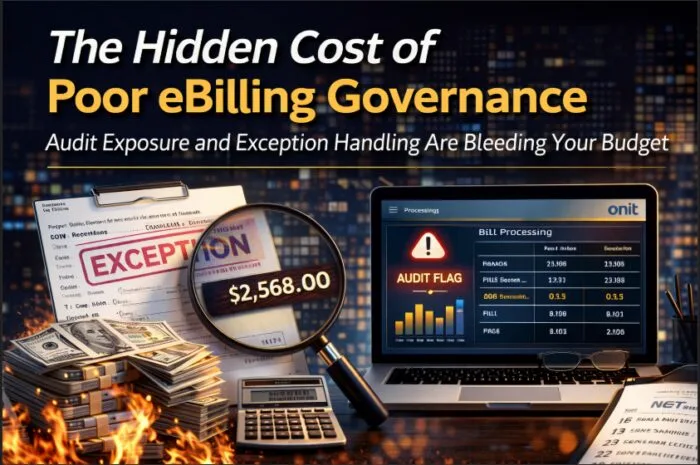

Billing governance is the set of rules, controls, and enforcement processes that determine how outside counsel invoices are submitted, reviewed, validated against billing guidelines, and approved for payment. It is the operational layer that sits between a legal department’s billing policies and what actually gets paid.
Good eBilling governance is visible in the rules, flags, alerts, and reports it produces. Poor eBilling governance is invisible, felt only in budget overruns that arrive without warning, rate negotiations that produce no lasting benefit, and spend data that cannot be trusted.
What poor eBilling governance costs a legal department:
- Direct overbilling that passes undetected through insufficient review
- Rate non-compliance by timekeepers billing above agreed rates without system enforcement
- Guideline violations absorbed silently because manual review cannot catch them at scale
- Spend data degraded by inconsistent coding, making analytics unreliable
- Negotiating leverage lost because billing performance data does not exist in a usable form
Why is poor eBilling governance hard to see?
Poor eBilling governance is sometimes hard to catch as it gets masked by the sophistication of eBilling tools, frameworks and processes.
The 2025 LegalBillReview.com survey, conducted with in-house legal executives across companies with outside counsel spend ranging from $2 million to over $50 million annually, found that 50% of legal departments believe they are being overbilled. The same survey found that 87% of those departments spend four hours or less per month reviewing invoices.
Those two numbers together describe the governance problem precisely. The belief that overbilling is occurring is widespread. The infrastructure to find and correct it is absent. Four hours per month of manual review across a portfolio of dozens or hundreds of matters is not a governance program. It is a check-in.
LegalBillReview.com’s own review of bills from mid-market to Fortune 500 companies found that approximately 56% of outside counsel bills contain some form of error or non-compliance, including duplicate billing, vague time entries, or guideline violations. Most legal departments believe their overbilling exposure is below 10% of invoices. The actual figure, based on reviewed invoice data, is more than five times higher.
Running an ELM or eBilling implementation?
Swiftwater has three Level 4 Onit-certified practitioners. If you are evaluating, implementing, or rescuing an ELM program, let us talk about what that actually takes.
See ELM ServicesWhat does poor eBilling governance cost in practice?
The cost falls into three categories, each invisible without the right infrastructure.
Direct billing errors Block billing, vague time entries, duplicate charges, and billing for administrative tasks at attorney rates are the most common error types. They are also the most preventable. A well-configured eBilling system catches them at submission before they reach human review. A poorly configured one or a manual process catches the obvious ones and absorbs the rest. Corporate Counsel data indicates that third-party legal bill review services reduce legal spend by 8% to 15% on average. That reduction is not a negotiated saving. It is recovery of amounts that should not have been billed in the first place.
Rate non-compliance Negotiated rates have no value if they are not enforced at invoice submission. When agreed timekeeper rates are not embedded in the eBilling system and enforced automatically, firms bill at higher rates and the variance passes through review undetected. For a full analysis of how rate enforcement connects to outside counsel negotiation outcomes, see Swiftwater’s guide to outside counsel rate negotiations.
Data degradation Poor eBilling governance degrades spend data in ways that compound over time. When invoices are submitted without consistent task codes, approved without matter-level budget tracking, and processed without enforced guideline rules, the data they generate is unreliable. Analytics built on that data produce unreliable outputs. Rate benchmarking built on that data produces unreliable comparisons. Matter budget performance tracked on that data produces unreliable variance reports. The governance failure is not just the invoice cost. It is the cost of every decision made on data that cannot be trusted.
Why do most eBilling programs fail to prevent these costs?
Three reasons that compound each other.
The system is configured as a payment processor, not a governance tool Most eBilling implementations are set up to digitize invoice submission and approval. The billing rules, rate enforcement, guideline validation, and matter budget integration that make eBilling a governance tool are configured after the fact, incompletely, or not at all. Onit’s eBilling platform describes the distinction clearly: a well-configured system enforces outside counsel guidelines automatically and makes budgeting more predictable and accurate. A system configured only for invoice routing does neither. Implementation quality determines whether the platform functions as a control or a conduit.
Billing guidelines are absent or unenforced The 2025 LegalBillReview.com and In-House Connect survey found that nearly 60% of legal departments do not have formal outside counsel guidelines in place. Of those that do, 87% report enforcement is light. A billing guideline that exists in a document but is not enforced in the eBilling system is not a control. For a full analysis of why enforcement breaks down and how to fix it, see Swiftwater’s guide to outside counsel billing guidelines.
Manual review cannot scale Even well-intentioned manual review breaks down at volume. As the 2025 Thomson Reuters State of the Corporate Law Department Report confirms, controlling outside counsel costs is the top strategic priority for law departments, yet most departments still lack the processes to systematically track and quantify savings from review. Manual review catches what the reviewer has time and expertise to catch. System-enforced governance catches everything the rules are configured to find, every time, without consuming attorney bandwidth.
What does good eBilling governance actually look like?
Good eBilling governance is both an art and a science. At its core, it is a configured and maintained set of operational rules embedded in the platform. However, it is also not one size fits all.
Before implementing matter-level rate enforcement, a department needs to confirm it has the process infrastructure to manage it: a matter setup workflow that loads rate cards consistently at opening, a review process for rate change requests, and a defined owner for rate card maintenance over time. Deploying rate enforcement without that infrastructure creates a system that flags everything and resolves nothing.
Five operational components of good eBilling governance:
Published and current billing guidelines Guidelines must specify approved rates, billing increment rules, expense policies, prohibited billing practices, and staffing expectations. They must be embedded in the eBilling system as enforceable rules, not advisory documents, and updated when terms change.
Rate cards embedded at the matter level Agreed timekeeper rates must be loaded at matter setup and enforced automatically at invoice submission. Any line billing above the agreed rate should be flagged and returned before approval, not after.
Want the review function run for you?
Every outside counsel invoice checked against your guidelines, rates, and matter context, inside the eBilling platform you already own, with the exception handling, vendor coaching, and savings reporting that separate a review program from invoice processing.
See Bill Review ServicesAutomated rule enforcement at submission The system should validate each invoice against billing guidelines before it reaches human review. Block billing, vague entries, unapproved timekeepers, rate violations, and budget exceedances should all be flagged automatically. Human review should focus on judgment calls, not rule enforcement.
Matter budget integration Invoices should be validated against approved matter budgets, not just billing guidelines. When cumulative spend approaches the approved ceiling, an escalation alert should fire before costs are incurred. For full implementation guidance, see Swiftwater’s article on matter budgets in legal.
Regular governance audits eBilling governance degrades if it is not maintained. Billing rules, rate cards, and matter type coverage all need periodic review. A quarterly audit identifies enforcement gaps before they become costly patterns.
Swiftwater’s eBilling implementation services cover the system configuration, governance rule-building, and ongoing maintenance that convert an eBilling platform from a payment processor into a spend control system. Swiftwater holds three Level 4 certified Onit practitioners and works across TeamConnect, SimpleLegal, and LexisNexis CounselLink implementations.
What is the honest limit of AI in eBilling today?
AI cannot currently determine whether the work reflected in a billing entry was actually worth what was billed. That is the limit, and it matters.
Matching a line item to the activity that produced it, understanding its legal context within the matter, and judging whether the time spent was reasonable given what was accomplished requires human effort. A timekeeper who bills two hours for a call that lasted 45 minutes is not detectable by AI unless the billing entry itself contains inconsistent information. The invoice says two hours. AI has no independent view of the call.
The more interesting question is where AI in eBilling is heading. The logical evolution is a system that does not just audit invoices against rules, but assesses the value of timekeeper activity against matter outcomes. If a timekeeper bills 40 hours on a pre-trial motion that was subsequently denied, a future AI system could flag that not just as a billing entry but as a value question: what did those 40 hours produce, and how does that compare to similar motions by similar timekeepers at similar firms? That capability would combine billing data with matter outcome data, external benchmarks, and value assessment logic. It would shift eBilling from a compliance function to a value governance function.
That system does not exist at scale today. Current AI in eBilling remains a more sophisticated rules engine: faster and better at pattern detection than rule-based automation, but still anchored to the invoice as its primary data source. eBilling is the mechanism, not the destination. A well-governed eBilling program feeds data into dashboards and reporting systems that become the actual financial control layer. The invoice processing itself should eventually be invisible. The insight it generates should not be.
For the broader spend management framework these tools support, see Swiftwater’s legal spend management resources.
Bottom line
Poor eBilling governance does not announce itself. It is not a vendor failure or a technology problem. It is the cumulative cost of billing errors that were never caught, rates that were never enforced, and data that was never reliable enough to act on.
eBilling systems will eventually become back-office infrastructure, as routine and invisible as accounts payable. They are not there yet. Right now, how a department configures and governs its eBilling platform is a direct determinant of how much it overpays and how much spend intelligence it can actually use. That makes eBilling governance an active management priority, beyond a technology implementation task.
Is your legal spend data telling you the full story?
We help legal departments build the analytics, rate governance, and reporting infrastructure to move from invoice processing to strategic spend management.
See Legal Spend ServicesThe question is not whether poor eBilling governance is costing your department money. It is how much, and whether you have the infrastructure to find out.
If you are ready to convert your eBilling platform from a payment processor into a governance tool, explore how Swiftwater’s legal spend management services approach eBilling configuration, billing guideline enforcement, and ongoing spend governance.
Frequently Asked Questions
What is eBilling governance in legal?
eBilling governance is the operating framework that controls how outside counsel invoices are submitted, reviewed, validated, approved, and reported. It connects billing guidelines, rate cards, matter budgets, invoice review rules, and reporting so the legal department can manage spend consistently.
Why does eBilling governance matter for legal departments?
eBilling governance matters because it determines whether the department’s billing rules are actually applied before invoices are paid. A well-governed process supports cleaner invoice review, stronger rate enforcement, better matter budget tracking, and more reliable legal spend data.
What costs should legal teams monitor in eBilling governance?
Legal teams should monitor billing errors, rate variances, guideline exceptions, duplicate charges, vague time entries, administrative billing, budget overruns, and inconsistent matter coding. These areas help show whether the eBilling process is supporting real spend control.
How does eBilling governance improve legal spend analytics?
eBilling governance improves legal spend analytics by making the underlying invoice data more consistent and reliable. When rates, task codes, matter types, budgets, and guideline rules are applied consistently, the department can trust the data it uses for reporting, benchmarking, budgeting, and outside counsel decisions.
What should good eBilling governance include?
Good eBilling governance should include current billing guidelines, approved rate cards, system-level invoice rules, matter budget integration, escalation alerts, reviewer workflows, and regular governance audits. These controls help the legal department manage invoices before payment and maintain cleaner data over time.
How should rate cards be managed in an eBilling system?
Rate cards should be loaded into the eBilling system at matter setup or firm approval and reviewed whenever rate changes are requested. The system should compare invoice line items against the approved rates so variances can be flagged before invoices move through approval.
Why are matter budgets important in eBilling governance?
Matter budgets help connect invoice review to the approved financial plan for each matter. When budgets are integrated into the eBilling workflow, the legal department can see when spend is approaching an agreed threshold and review scope, strategy, or approval needs before costs move further.
How often should eBilling governance be reviewed?
eBilling governance should usually be reviewed quarterly. A quarterly review can check whether billing rules are current, rate cards are accurate, matter budgets are being tracked, invoice exceptions are being handled consistently, and reporting outputs are still reliable.
What role does human review play in eBilling governance?
Human review remains important for issues that require matter context, legal judgment, or business understanding. The strongest model uses system rules for routine enforcement and human reviewers for exceptions, judgment calls, and matters where the invoice alone does not tell the full story.
What is the first step to improving eBilling governance?
The first step is to compare the written billing rules against what the eBilling system actually enforces today. Legal teams should identify which rules are automated, which are handled manually, which rate cards are current, which budgets are tracked, and which invoice issues appear repeatedly.
Disclaimer: This article is provided for educational and informational purposes only. Neither Swiftwater and Company nor the author provides legal advice. This content does not constitute professional legal, financial, or operational advice and should not be relied upon as such. Readers are encouraged to consult a qualified professional before making decisions based on the information provided. External links are included for reference only and reflect the views of their respective authors. Swiftwater and Company takes no responsibility for third-party content.