
Legal spend management software is the technology layer that automates invoice processing, enforces billing guidelines, tracks matter budgets, and generates spend analytics for corporate legal departments managing outside counsel costs.
The market is crowded and the sales process is convincing. Every platform demonstrates well. The failure mode is almost never the platform. It is the gap between what the platform can do and what the department has configured it to do, combined with the gap between what the department has configured and what it has the process maturity to govern.
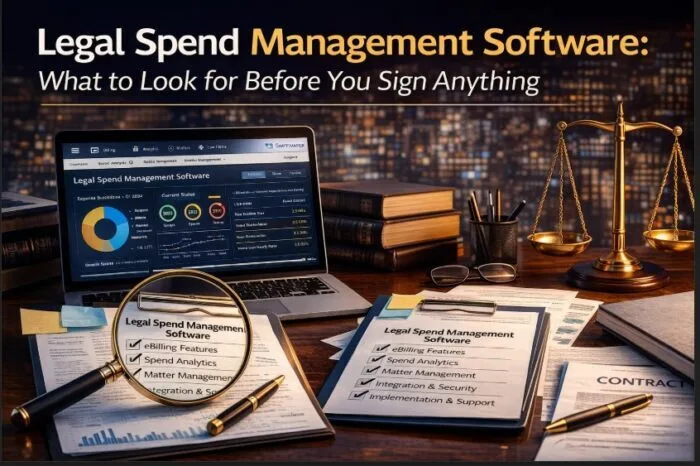
What to evaluate before selecting legal spend management software:
- Process readiness – whether your billing guidelines, matter workflows, and governance rules exist in a form the system can enforce
- eBilling enforcement capability – how the platform validates invoices against rules at submission, not after approval
- Matter budget integration – whether budgets are tracked at the matter level in real time or only in aggregate after the fact
- Spend analytics – whether the platform produces data that supports decisions or reports that document history
- AI capability – what AI actually does in the platform versus what is marketed
- Implementation model – who configures the governance rules and what happens when they need to change
- Integration – ERP, matter management, CLM, and financial systems
Why do most software evaluations ask the wrong questions?
Most evaluations are built around feature demonstrations. The vendor shows maximum configuration. The buyer checks features against requirements. The contract is signed.
The failure emerges six to twelve months later. Billing rules are generic. Rate cards have not been loaded. Budget alerts do not reflect the department’s actual matter mix. Dashboards generate reports that no one acts on.
The 2025 Blickstein Group Law Department Operations Survey found that most legal departments face persistent pressure to reduce costs while struggling to find budget and push change management simultaneously. Technology not paired with process design and governance configuration does not solve that problem. It adds a system to an unchanged process, producing data without producing control.
The right evaluation question is not what the platform does. It is what it needs to do for your specific situation, and whether your department has the infrastructure and support to make it work.
Is your legal spend data telling you the full story?
We help legal departments build the analytics, rate governance, and reporting infrastructure to move from invoice processing to strategic spend management.
See Legal Spend ServicesWhat platforms are in the market?
The table below covers major platforms evaluated by mid-to-large enterprise legal departments. It is not a ranking or endorsement. Platform fit depends on department size, matter volume, existing technology stack, and implementation capability. Contact Swiftwater if you want to discuss which platform may be right for your situation.
| Platform | Description |
|---|---|
| Brightflag (Wolters Kluwer) | AI-powered eBilling and matter management with strong invoice line-item auditing and spend analytics. Acquired by Wolters Kluwer, combining Brightflag’s AI capabilities with Wolters Kluwer’s LegalVIEW dataset of over $200 billion in invoice data and rate benchmarking capability. |
| DiliTrust / Ascent ELM | Paris-based DiliTrust acquired U.S.-based doeLEGAL in 2024, bringing Ascent ELM into the DiliTrust Legal Cloud. Covers matter management, eBilling, spend analytics, and AI-driven insights within a broader governance suite that includes contract management and entity management. Strong presence across North America and Europe. |
| LawVu | AI-powered legal workspace combining intake, matter management, and reporting. Suited to departments that need a unified productivity layer alongside spend visibility. |
| LexisNexis CounselLink+ | ELM solution integrating eBilling, matter management, and CLM in a unified platform. AI-powered invoice review and anomaly detection. Part of the broader LexisNexis ecosystem. |
| Litify | Cloud-based ELM built on Salesforce, combining intake, matter management, eBilling, and document management in a single configurable platform. Strong on workflow automation and cross-departmental collaboration. Suited to departments already in the Salesforce ecosystem or that require high configurability without custom development. |
| Mitratech TeamConnect | Widely deployed enterprise ELM combining matter management, eBilling, and spend analytics. Suited to complex, high-volume legal departments with significant outside counsel spend. |
| Onit / Unity | Enterprise ELM platform with configurable eBilling, matter management, and workflow automation. Strong rules engine for billing guideline enforcement. Onit also acquired SimpleLegal, extending its reach into the mid-market. Unity is Onit’s emerging next-generation platform. |
| SimpleLegal (Onit) | Mid-market ELM with eBilling, matter budgeting, and vendor management. Faster implementation than enterprise platforms; suited to departments building their first structured program. Now part of the Onit family. |
| Thomson Reuters Legal Tracker | Enterprise-grade eBilling and spend management with UTBMS compliance and AI-driven anomaly detection. Integrates with other Thomson Reuters tools and ERP systems. |
If you want implementation-grade help running this evaluation, Swiftwater’s legal spend management consulting covers selection through governance configuration.
What should you evaluate in eBilling enforcement capability?
A platform that processes invoices and a platform that enforces billing governance are not the same thing, even if they share the same product name. Four questions to ask:
Does the system flag violations at submission or after approval? Prevention, not documentation, is the value. A system that flags violations after approval is an audit tool. A system that returns non-compliant invoices to the firm before payment is a governance tool.
How are billing rules configured and who maintains them? Powerful rule configuration that no one maintains degrades into no effective enforcement within twelve to eighteen months. Confirm who owns this and what the update process is when guidelines change.
Does the platform support LEDES and UTBMS coding? All major platforms in the table above support LEDES and UTBMS. Confirm your outside counsel firms can submit in the required format and that the platform enforces task code completeness at invoice validation. This is the data foundation that makes spend analytics reliable.
How does the platform handle rate card enforcement? Agreed timekeeper rates must be loaded at matter setup and enforced automatically at submission. Confirm the platform flags above-rate billing before human review, not after. For a full discussion, see Swiftwater’s article on eBilling governance.
What should you evaluate in matter budget capability?
Three questions that determine whether matter budget support is operational or nominal:
Are budgets tracked at the matter level in real time? Aggregate reporting tells you what was paid. Matter-level real-time tracking tells you what is being spent against what was approved as it happens. Confirm the platform surfaces variance at the matter level without manual extraction.
Does the platform support phased budgeting? For litigation and complex matters where total scope cannot be defined upfront, phased budgeting is essential. Confirm phase-level tracking and escalation alerts at the phase level, not just the matter level.
What escalation capability does the platform provide? A budget without an escalation mechanism is a number, not a control. Confirm alerts route automatically to a defined decision-maker when spend approaches the approved ceiling. For full implementation guidance, see Swiftwater’s article on matter budgets in legal.
What should you evaluate in spend analytics?
Most platforms provide dashboards. Both useful and nominal dashboards look identical in a demonstration. Two criteria that determine actual analytics quality:
Data quality controls at invoice entry Analytics are only as reliable as the data feeding them. Evaluate data quality controls at invoice submission before evaluating the dashboard. If non-compliant invoices are passing through uncorrected, the analytics layer is reporting on bad data.
Want the review function run for you?
Every outside counsel invoice checked against your guidelines, rates, and matter context, inside the eBilling platform you already own, with the exception handling, vendor coaching, and savings reporting that separate a review program from invoice processing.
See Bill Review ServicesDecision-linked reporting vs historical reporting Useful outputs link spend to decisions: which matters are running over budget, which firms have the highest non-compliance rates, which practice areas show the widest variance. Reporting that only shows what was spent is historical documentation. For a full guide to what analytics should produce, see Swiftwater’s article on legal spend analytics vs reporting.
What should you evaluate in AI capability?
AI features are now standard in legal spend software marketing. The question is not whether a platform has AI. It is what it is actually doing.
Most AI in legal spend platforms operates at the invoice level: detecting billing anomalies, flagging non-compliant line items, and identifying patterns across invoices from the same firm. Evaluate it on specificity. Does it flag actionable items or generate noise the team learns to ignore?
Most vendors are adding some form of AI bill review capability. The critical evaluation question is whether the AI is extending rule enforcement and audit capability, identifying violations against defined billing guideline rules faster and at greater scale, or whether it is genuinely providing lawyer-level context in reviewing the substance of a bill. The former is a better version of what good eBilling systems already do. The latter, assessing whether the work was actually worth what was billed in the context of that specific matter, has not yet been credibly delivered at scale.
The harder boundary is what eBilling AI cannot do today. It cannot determine whether the work reflected in a billing entry was worth what was billed. That requires matching a line item to the activity that produced it, understanding its legal context, and judging whether the time spent was reasonable given the outcome. That is human judgment, not pattern recognition.
There are emerging tools and methodologies that attempt to bridge this gap, assessing billing value against matter outcomes rather than just invoice rules. Swiftwater uses a combination of proprietary methodology and select partner tools to support this kind of analysis. It sits outside the eBilling platform itself and requires human oversight, but it represents where the real value conversation in legal billing is heading.
When evaluating AI claims, ask three questions: what data does the AI draw on, what does it output, and what is the false positive rate. Treat current AI in legal spend software as a tool that reduces administrative burden on invoice review, not a substitute for governance design and human oversight.
What should you evaluate in implementation and ongoing support?
Implementation quality is the single greatest determinant of whether legal spend management software produces value. A well-configured mid-tier platform will consistently outperform a poorly configured premium one.
Two primary implementation models exist.
DIY with vendor support means the department leads configuration with vendor guidance. Vendors know their platforms well, but their teams are oriented around answering the questions you ask rather than asking the questions you have not thought of yet. This works for experienced teams who have implemented legal billing systems before and know what governance configuration requires.
Implementation partner plus vendor means an independent specialist leads process design, governance configuration, change management, and go-live support alongside the vendor team. This model is recommended regardless of organization size. Implementing a legal billing system is not part of your day job. The implementation partner’s job is to ensure it is done well and that you can run it after they leave.
Vendors consistently indicate they have thousands of law firms on their platform and that onboarding is straightforward. In practice, every implementation requires deliberate thought, particularly around change management with outside counsel. One client chose to lead all firm communications and documentation directly with the vendor. The process stalled when several of their key firms used the onboarding window as an opportunity to raise their rates. Resolving that added several weeks to the timeline. A second client migrated from a legacy system to a new platform. What they did not realize until after go-live was that the new vendor handled multiple law firm office locations differently than their legacy system. With a large panel, the data cleanup and stabilization effort was substantial. Swiftwater was brought in to resolve both situations. Neither failure was the platform’s fault. Both were change management and process gaps that an implementation partner would have anticipated before they became problems.
Three questions to ask regardless of model:
Who configures the governance rules after go-live? Billing rule maintenance, rate card updates, and matter type coverage reviews are ongoing. Confirm ownership and the update process before signing.
What is the change management plan for outside counsel? Without structured firm communication, training, and submission error handling, adoption degrades and governance value erodes from the outside in.
What does ongoing support actually cover? Distinguish between technical support and governance maintenance support. Most departments need both. Confirm which the vendor and implementation partner each cover.
Swiftwater’s eBilling and legal technology implementation services cover governance configuration, outside counsel onboarding, and ongoing platform maintenance across Onit, TeamConnect, SimpleLegal, and LexisNexis CounselLink. For the broader spend management framework, see Swiftwater’s legal spend management resources.
Struggling to control outside counsel spend?
We help legal departments build the governance, billing guidelines, panel structure, and rate programs that take back control of what outside counsel costs.
See Legal Spend ServicesBottom line
Legal spend management software is a facilitation tool. It facilitates the exchange of eBilling and automates management tasks. However, true legal spend management is dependent on the people using it and the processes implemented around it. The platform provides the mechanism. Governance rules, matter budgets, billing guideline enforcement, and analytics configuration determine whether that mechanism produces control or produces reports.
The evaluation focusing on just the feature set will rarely yield to a differentiated outcome. It is which platform your department can implement well, configure for your specific governance requirements, and maintain over time.
Buy the platform that suits your department’s business operating model, which you can implement and govern over a sustained period of time. If the tool you are buying is supposed to provide the business operating model, then take a step back and assess readiness. Leveraging an implementation partner helps with three things – improves readiness, prevents gotchas, and brings industry best practices to advance operational maturity.
If you are evaluating legal spend management software and want to understand what implementation and configuration actually requires, explore how Swiftwater’s legal spend management services approach platform selection, governance configuration, and ongoing spend oversight.
Frequently Asked Questions
What is legal spend management software?
Legal spend management software helps corporate legal departments manage outside counsel costs by supporting invoice review, billing guideline enforcement, matter budgets, rate management, approvals, and spend analytics. Its value depends on how well the system is configured around the department’s actual governance rules and workflows.
What should legal departments evaluate before selecting legal spend management software?
Legal departments should evaluate process readiness, eBilling enforcement, matter budget tracking, spend analytics, rate management, integration needs, AI capability, implementation support, and reporting requirements. The goal is to understand whether the platform can support the department’s operating model, not just whether it has a long feature list.
Why does process readiness matter before buying legal spend software?
Process readiness matters because software can only enforce rules that the department has clearly defined. Before selecting a platform, legal teams should confirm that billing guidelines, matter workflows, approval rules, budget thresholds, rate cards, and reporting expectations are clear enough to be configured into the system.
How should legal teams evaluate eBilling enforcement?
Legal teams should evaluate whether the platform can apply billing rules at invoice submission, validate approved rates, flag guideline exceptions, support required invoice fields, and route exceptions to the right reviewer. Strong eBilling enforcement helps the department manage compliance before invoices are approved for payment.
What should legal teams look for in matter budget functionality?
Legal teams should look for matter-level budget tracking, phased budgeting, budget variance alerts, escalation workflows, and reporting that compares approved budget to actual spend. The most useful systems make budgets active controls during the life of the matter, not static numbers reviewed after the fact.
How should legal teams evaluate spend analytics?
Legal teams should evaluate whether the software turns spend data into management insight. Useful analytics should show spend by matter type, firm, business unit, practice area, budget status, invoice adjustment pattern, and rate performance. The best analytics support decisions about budgets, firms, matters, and controls.
How should legal teams evaluate AI bill review capability?
Legal teams should evaluate AI bill review based on what it actually does inside the invoice workflow. Useful AI capability may help identify billing guideline issues, duplicate entries, vague descriptions, rate variances, or unusual patterns. It should support governance and reviewer judgment rather than replace the need for clear rules and oversight.
What integrations matter for legal spend management software?
Important integrations may include ERP, finance, matter management, contract management, CLM, document management, SSO, and reporting tools. The right integrations depend on where the department’s invoice, matter, budget, vendor, and financial data already live.
When should legal teams use an implementation partner?
Legal teams should consider an implementation partner when the project involves complex workflows, multiple systems, billing rule configuration, rate card setup, change management, data migration, or legal operations redesign. A strong implementation partner helps translate the department’s governance model into a working system.
Who should be involved in evaluating legal spend management software?
The evaluation should usually include legal operations, the GC or legal leadership, finance, IT, invoice reviewers, matter owners, and procurement where relevant. Each group sees a different part of the workflow, and their input helps ensure the selected platform supports both legal decision-making and operational execution.
What is the first step before evaluating legal spend management software?
The first step is to document the department’s current legal spend process. Legal teams should map how matters are opened, how budgets are approved, how rates are managed, how invoices are reviewed, how exceptions are handled, and what reports leadership actually uses. This creates the evaluation criteria before vendor demos begin.
Disclaimer: This article is provided for educational and informational purposes only. Neither Swiftwater and Company nor the author provides legal advice. This content does not constitute professional legal, financial, or operational advice and should not be relied upon as such. Readers are encouraged to consult a qualified professional before making decisions based on the information provided. External links are included for reference only and reflect the views of their respective authors. Swiftwater and Company takes no responsibility for third-party content.