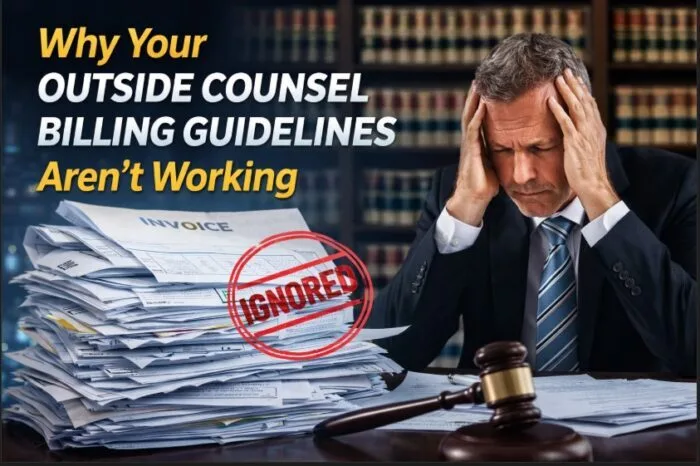

Outside counsel billing guidelines are the documented standards a legal department requires its law firms to follow when billing for legal services, covering timekeeper rates, billing increments, expense policies, and invoice formatting requirements. Failure refers to the inability of the OC billing guidelines to help you achieve the operational goals you set for the legal department, which may include cost management, legal spend savings, operating model adherence, etc.
Most legal departments have them; the level of effective enforcement may vary. That gap is where outside counsel costs quietly expand.
The core problem: drafting billing guidelines feels like control. Circulating them feels like governance. Neither is true unless those guidelines are embedded into your eBilling workflow and applied consistently to every invoice.
What Distinction Do Most Legal Departments Miss?
Most outside counsel billing guidelines do not fail because they are poorly written. They fail because of multiple reasons, in some instances they are purely written to support e-billing, in other cases the goals are not clear of what needs to be achieved and another reason is when they are not enforced in a manner where they produce results.
The 2024 ACC Chief Legal Officers Survey found that 58% of legal departments faced significant law firm rate increases while 42% received mandates to cut costs. Billing discipline is where that pressure should be absorbed. Many departments use the set and forget approach with the OCG guideline document.
Why Do Most Outside Counsel Billing Guidelines Fail?
Because they exist as static documents rather than operational controls.
In most organizations, billing guidelines are shared once, stored as PDFs, and rarely referenced during invoice review. They are not embedded into the eBilling workflow and are not tied to enforcement rules. Without integration into the eBilling system, they remain passive, describing expectations rather than enforcing them.
Is your legal spend data telling you the full story?
We help legal departments build the analytics, rate governance, and reporting infrastructure to move from invoice processing to strategic spend management.
See Legal Spend ServicesThis problem is compounded by fragmented spend data. When invoices, matter data, and financial records live in separate systems, consistent enforcement becomes operationally impossible. For a full breakdown of how data fragmentation undermines billing control, see Swiftwater’s legal spend management framework.
As the Association of Corporate Counsel notes, billing guidelines are only truly effective when they are enforced, and achieving that requires all members of the in-house legal team, including lawyers, to be familiar with the guidelines, especially if they are invoice approvers.
What Happens When Billing Guidelines Are Not Enforced?
You get the appearance of control without the reality of it. Invoices are reviewed inconsistently. Standards vary by reviewer. Outside counsel quickly learn what will and will not be challenged, and bill accordingly. For a moment let us imagine the plight of the billing coordinator at your partner law firm. Each billing coordinator is managing hundreds of client billing guidelines simultaneously. When a guideline is not actively enforced, it naturally falls lower in priority. Over time, that drift erodes cost discipline and affects your legal spend analytics, because the underlying data no longer reflects consistent standards.
Legal Dive reports that almost 45% of CLOs planned to increase outside counsel spend in 2025, a 17-percentage-point jump from the prior year, driven by rising litigation complexity. Departments without billing enforcement give up a reliable mechanism to evaluate whether that spend is justified.
Should Outside Counsel Billing Guidelines Be Formally Signed by Law Firms?
Yes, and in most departments they are not. If your law firms have not formally agreed to your billing guidelines, those guidelines are not enforceable. They are advisory. That distinction matters: advisory guidelines can be negotiated around. Contractual guidelines can be enforced. Without formal agreement, the partners handling your matters may not even be aware the guidelines exist, or they may not receive the attention they deserve from the firm’s billing team. Guidelines that are not formally acknowledged are treated as advisory at best.
What Does Real Billing Guideline Enforcement Look Like?
It is not manual. And it is not discretionary. Real enforcement means billing rules are embedded directly into your eBilling system, whether that is Onit, SimpleLegal, TeamConnect, Brightflag, or another platform, and applied consistently across every invoice at the point of entry, before human review begins. Rules fire automatically. Non-compliant line items are flagged or rejected without relying on a reviewer to recall the guidelines from memory.
This is where legal spend analytics becomes genuinely actionable: when enforcement is systematic, the underlying data is consistent, and insights derived from it are reliable.
Why Do eBilling Systems Fail to Enforce Billing Guidelines?
Because they are implemented as workflow tools, not control systems. In most deployments, the rules that are actually configured in the system are mechanical by design. They catch things the system can evaluate objectively: billing for a prohibited task or expense code, amounts above or below a defined threshold, flagged words like “admin” or “clerical,” a timekeeper billing across matters they are not approved for. These are useful controls, but they represent a fraction of what genuine billing governance requires.
Current AI tools go somewhat further, attempting to read and infer meaning from line items rather than just pattern-matching against rules. But they are still largely limited to what is visible on the invoice itself: the description, the code, the amount, the timekeeper. What they cannot see is what a human reviewer carries in their head: the current status of the matter, what phase the work is in, whether the activity described is actually relevant to where the matter stands, whether the staffing profile makes sense given what happened last week.
That context gap is why eBilling systems, even well-configured ones, still rely heavily on human judgment to function as genuine governance. The system processes the invoice. It does not understand it.
Why Is Human Review Still Doing the Work eBilling Systems Should?
Because most eBilling systems today are not truly automated control systems. They are workflow tools that require human input to function as governance.
The practical reality is this: an attorney reviewing invoices is not going to argue with a partner over a single block-billed entry when they need that partner to pick up the phone on Monday morning. That is not a failure of process. It is a failure of system design. When enforcement depends on a human making an uncomfortable call, enforcement is inconsistent by definition.
This is exactly why legal departments using managed bill review consistently outperform those relying on internal attorney review. When a dedicated team handles invoice review rather than the attorneys who instructed the work, two things happen. First, the review is objective. There is no relationship tension, no reluctance to push back, no competing priority pulling the reviewer’s attention. Second, the attorneys get their time back. Legal teams are busy doing their day jobs. Reviewing invoice line items is not a high-value use of a lawyer’s time, and when it competes with everything else on their desk, it loses.
Want the review function run for you?
Every outside counsel invoice checked against your guidelines, rates, and matter context, inside the eBilling platform you already own, with the exception handling, vendor coaching, and savings reporting that separate a review program from invoice processing.
See Bill Review ServicesSwiftwater’s managed bill review service operates on exactly this principle: experienced practitioners handle the invoice review and enforcement work so your attorneys do not have to. The savings identified through that process consistently fund the cost of the program, often many times over.
But even managed bill review is not the final answer. The honest position is that eBilling systems should be back-office infrastructure, working quietly in the background, surfacing only the exceptions that genuinely require human judgment. In that model, the system handles compliance enforcement automatically, flags true edge cases for review, and keeps attorneys and legal operations teams focused on work that actually requires their expertise.
AI is moving this in the right direction. The next generation of eBilling governance will not ask a human to decide whether a block-billed entry is compliant. It will know, flag it, and route only the genuinely ambiguous cases to a reviewer. We are not fully there yet. But the gap between where eBilling systems are today and where they need to be is exactly where the largest recoverable savings in outside counsel spend currently sit.
The question is not whether your eBilling system is live. It is whether it is actually doing the work.
How Do You Fix Broken Outside Counsel Billing Governance?
You start by converting guidelines into enforceable rules embedded in your eBilling system, not stored in a PDF.
That means:
- Translating billing expectations into system-level rejection and flagging criteria
- Defining which violations trigger automatic rejection versus manual review
- Requiring formal firm sign-off on guidelines before matter assignment
- Running a quarterly compliance review against rejection and adjustment rates
- Connecting enforcement rules directly to your legal spend analytics so insights reflect actual billing behavior
This is the shift from documentation to governance. It is where most legal departments stall, and where the largest recoverable cost sits.
For broader context on building spend control infrastructure, see Swiftwater’s legal spend management resources.
Bottom Line
Billing guidelines need the enforcement layer to provide effective control.
If your guidelines are not embedded into your eBilling system and applied consistently across every invoice, they are not governing spend. They are describing intent. And without enforcement, your legal spend analytics reflects what outside counsel billed. And without governance, you forgo the opportunity of savings or redeploying that spend in a different manner.
Struggling to control outside counsel spend?
We help legal departments build the governance, billing guidelines, panel structure, and rate programs that take back control of what outside counsel costs.
See Legal Spend ServicesThe gap between those two is where the cost control opportunity lives.
If you are ready to move beyond documentation and build a billing governance program that actually controls outside counsel costs, Swiftwater’s Outside Counsel Optimization Program provides a structured approach across Diagnose, Govern, and Optimize.
Frequently Asked Questions
What are outside counsel billing guidelines?
Outside counsel billing guidelines are the standards a legal department gives to its law firms for billing legal work. They typically cover approved rates, billing increments, staffing expectations, expense rules, invoice format, and activities that require prior approval. Their value comes from turning those standards into a repeatable review process.
Why do billing guidelines need to be connected to invoice review?
Billing guidelines need to be connected to invoice review so the standards are applied at the moment invoices are submitted. When the review process uses the same rules every time, legal departments create cleaner billing behavior, better spend data, and more consistent decisions across firms and matters.
Should law firms formally acknowledge billing guidelines?
Yes. Formal acknowledgment creates a shared operating standard between the legal department and outside counsel. It helps partners, billing teams, and matter teams understand the rules before work begins, which makes invoice review more predictable and reduces avoidable back-and-forth later.
What should strong billing guidelines include?
Strong billing guidelines should include approved rates, billing increments, staffing rules, expense policies, block billing rules, travel rules, administrative task rules, matter budget expectations, invoice narrative requirements, and escalation procedures. They should also explain which items may be adjusted automatically and which items require reviewer judgment.
How should eBilling systems support billing guideline enforcement?
An eBilling system should translate billing guidelines into practical controls. This can include automatic flags, rejection rules, required fields, budget checks, rate validation, task-code review, and exception routing. The system should make routine compliance easier while reserving human review for issues that require context or judgment.
Why is human review still important in billing governance?
Human review is important because invoices do not always show the full matter context. A reviewer may need to understand the current phase of the matter, the staffing model, prior approvals, the business risk, or the reason a specific task was performed. Good governance combines system controls with informed reviewer judgment.
How can managed bill review improve the billing process?
Managed bill review gives legal departments a dedicated review layer focused on invoice quality, guideline compliance, and consistent adjustment logic. It helps attorneys stay focused on legal strategy while trained reviewers handle detailed line-item review, exception handling, and reporting. This makes the billing process more structured and easier to manage.
How often should billing guidelines be reviewed?
Billing guidelines should be reviewed at least annually, with additional updates when rates, matter types, systems, or outside counsel arrangements change. A quarterly review of invoice adjustments, common exceptions, and firm billing patterns can also show where the guidelines need clarification or stronger workflow support.
Who should own outside counsel billing guideline enforcement?
Ownership should usually sit with legal operations or the legal department function responsible for outside counsel management, with input from finance and in-house attorneys. The best model gives one team clear responsibility for rule maintenance, system configuration, invoice review standards, and reporting back to the GC.
What is the first step to improving billing guideline enforcement?
The first step is to compare the written guidelines against how invoices are actually reviewed today. Legal teams should identify which rules are already enforced, which rules are handled manually, which rules are not configured in the eBilling system, and which recurring invoice issues should become formal review controls.
Disclaimer: This article is provided for educational and informational purposes only. Neither Swiftwater and Company nor the author provides legal advice. This content does not constitute professional legal, financial, or operational advice and should not be relied upon as such. Readers are encouraged to consult a qualified professional before making decisions based on the information provided. External links are included for reference only and reflect the views of their respective authors. Swiftwater and Company takes no responsibility for third-party content.