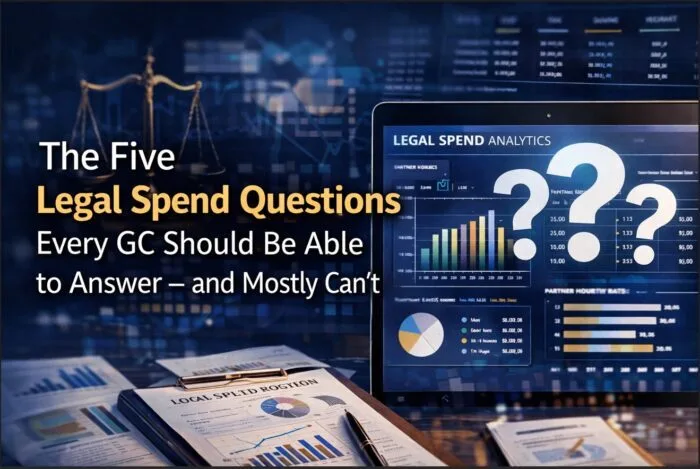

Legal spend analytics is the practice of connecting invoice, matter, budget, and firm data into one structured view that a general counsel can use to make forward-looking decisions about legal cost and value.
Everything turns on the word connected. Invoice totals by themselves report history. Once spend is tied to matter type, business unit, firm, and an approved budget, and can be pulled on demand, the same data starts answering questions that change what the department does next quarter.
The five questions every General Counsel should be able to answer about their legal spend:
- What did you spend on outside counsel last quarter, broken down by matter type?
- Which outside counsel relationships are delivering the best value and how do you know?
- What percentage of outside counsel invoices were rejected or adjusted last year?
- How many active matters currently have an approved budget?
- If you had to cut outside counsel spend by 15% next year, where would you start?
Most cannot answer these without involving finance, pulling custom reports, or approximating. Here is what that gap reveals and what to do about it.
What Distinction Do Most Legal Departments Miss?
Most legal teams think they are doing legal spend analytics. What they actually have is reporting and reporting does not control costs.
The 2024 ACC Chief Legal Officers Survey found that 42% of legal departments received a mandate to cut costs, 58% faced significant law firm rate hikes, and 59% of CLOs reported their workload increased year over year. More pressure, less budget, higher rates. That combination is not survivable without genuine spend visibility.
Drafting billing guidelines is not governance. Approving invoices is not spend management. Until financial data is connected to matter context and used to make forward-looking decisions, a legal department is managing invoices, not spend.
Is your legal spend data telling you the full story?
We help legal departments build the analytics, rate governance, and reporting infrastructure to move from invoice processing to strategic spend management.
See Legal Spend ServicesWhat Does Good Legal Spend Visibility Actually Look Like?
Legal spend visibility means a single, consolidated view of all legal expenditure, inside and outside counsel, broken down by matter type, practice area, business unit, and firm. Available on demand. Reflecting current data, not last quarter’s invoice run.
Most legal departments do not have this. Spend data is fragmented across eBilling systems, spreadsheets, finance reports, and email approvals, making meaningful analysis impossible without a manual consolidation exercise.
For a structured approach to building that view, see Swiftwater’s legal spend management framework.
What Are the Five Legal Spend Questions Every GC Should Answer?
1. What did you spend on outside counsel last quarter, broken down by matter type?
Not total spend. Not by firm. By matter type: litigation, M&A, employment, IP, commercial contracts. If you can answer this in under 24 hours without involving finance, you have basic spend visibility. If you need to pull invoices manually or request a custom report, you have a data problem.
What it reveals: Whether your spend data is structured for insight or buried across systems.
2. Which of your outside counsel relationships is delivering the best value and how do you know?
Value in outside counsel management is not the lowest hourly rate. It is outcomes relative to cost: matter results per dollar spent, measured consistently across your panel. The CLOC 2026 State of the Industry Report shows that outside counsel and vendor management has become a key focus area for 62% of legal operations teams, precisely because most departments manage these relationships on instinct rather than data.
What it reveals: Whether you are managing outside counsel relationships or simply maintaining them.
3. What percentage of your outside counsel invoices were rejected or adjusted last year?
If this number is near zero, one of two things is true: your outside counsel are billing perfectly, or your billing guidelines are not being enforced. The second explanation is almost always correct. A healthy rejection rate with consistent, documented reasons is a sign that governance is working. Near-zero rejection is usually a sign that no one is looking closely enough.
What it reveals: Whether your eBilling system is a control mechanism or just a payment processor.
4. How many active matters currently have an approved budget?
A matter budget is an agreed spend cap established before work begins. It is the single most effective proactive legal spend control available to in-house legal teams and the foundational mechanism for financial management in any mature legal operations function. Survey’s also highlight that financial management has become a key priority for 72% of legal operations teams.
What it reveals: Whether you have proactive spend control or just retrospective reporting.
5. If you had to cut your outside counsel spend by 15% next year, where would you start?
This is the strategy question. Legal Dive reports that almost 45% of CLOs plan to increase outside counsel spend in 2025, a 17-percentage-point jump from the previous year, driven by rising litigation complexity. If you are in that group, you need to know exactly what that additional spend is buying before you can defend it to your CFO.
What it reveals: Whether legal spend management is a finance function or a strategic leadership function in your department.
Want the review function run for you?
Every outside counsel invoice checked against your guidelines, rates, and matter context, inside the eBilling platform you already own, with the exception handling, vendor coaching, and savings reporting that separate a review program from invoice processing.
See Bill Review ServicesWhy Can’t Most Legal Departments Answer These Questions?
The barrier is rarely the absence of tools. Most departments already run eBilling systems, matter management platforms, and financial reporting tools. The problem is that these systems do not talk to each other.
The result is structural fragmentation:
- Billing data lives in the eBilling system
- Matter data lives in a separate system, a spreadsheet, or nowhere
- Budget data, if it exists, lives with individual attorneys
- Finance has invoice-level data but no matter context
- Legal has matter context but no consolidated spend view
The CLOC 2025 State of the Industry Report found that 63% of legal departments identify workload and resource bandwidth as their top challenge. Fragmented data infrastructure is a direct multiplier of that burden.
For broader context on building spend control infrastructure, see Swiftwater’s legal spend management resources.
How Do You Build Legal Spend Analytics From Zero?
Start with the baseline, not the technology. Before evaluating any platform, spend two to four weeks consolidating existing data into a single view, even a rough one:
- Pull invoices from the last 12 months
- Categorize by matter type: litigation, M&A, employment, IP, commercial contracts
- Map spend against your current outside counsel panel
- Identify which matters had an approved budget before work began
- Flag your five highest-spend relationships and pull their rejection and adjustment rate
The exercise surfaces more insight than most technology implementations deliver in year one, because it forces the governance conversation that software alone never does.
Once you have the baseline, these five questions become your quarterly governance framework.
Bottom Line
These five questions are not a sophisticated legal operations assessment. They are the minimum standard for financial accountability in a modern legal department.
If you can answer all five confidently and on demand, you have the foundation for genuine legal spend analytics. If you cannot, the gap is not a technology gap. It is a data and process governance gap.
Struggling to control outside counsel spend?
We help legal departments build the governance, billing guidelines, panel structure, and rate programs that take back control of what outside counsel costs.
See Legal Spend ServicesThe process and data governance gap is the right place to start. The software helps in codifying and operationalizing the analytics.
If you are ready to move beyond reporting and build a real legal spend analytics capability, Swiftwater’s Outside Counsel Optimization Program provides a structured approach across Diagnose, Govern, and Optimize to help you take control of your legal spend.
Frequently Asked Questions
What is legal spend analytics?
Legal spend analytics is the use of structured legal cost data to support better decisions about budgets, outside counsel, matter planning, and financial control. For a GC, the value is not only seeing where money went, but understanding which work, firms, matters, and business units are driving spend and where stronger controls should be applied.
Why should a GC review legal spend by matter type?
Reviewing legal spend by matter type helps a GC understand what kind of legal work is consuming the budget. A firm-level view shows who was paid, but a matter-type view shows why the spend occurred. This makes it easier to compare litigation, employment, IP, M&A, and commercial contract costs in a way that supports planning and prioritization.
What does outside counsel value mean in legal spend management?
Outside counsel value means the relationship between cost, quality, responsiveness, outcomes, and predictability. The best-value firm is not always the lowest-rate firm. A GC should assess whether the firm delivers the right result at the right level of effort, with clear budgets, clean billing behavior, and reliable matter management.
How should a GC use invoice adjustment data?
Invoice adjustment data should be used as a governance signal. Consistent adjustment reasons can show where billing guidelines need clarification, where firms need coaching, or where internal review standards should be improved. The goal is not simply to reduce invoices, but to create a more predictable and disciplined billing process.
Why are matter budgets important for legal spend control?
Matter budgets give legal departments a financial control point before work begins. They help align expectations between in-house teams and outside counsel, create a benchmark for monitoring progress, and make budget conversations more concrete. For material matters, approved budgets also help the GC explain legal spend clearly to finance and business leadership.
What is the first step in improving legal spend visibility?
The first step is to create a clean baseline from existing data. A legal team can start by collecting the last 12 months of invoices, grouping spend by matter type, identifying top firms, reviewing which matters had budgets, and checking invoice adjustment patterns. This gives the department a practical starting point before selecting new tools or redesigning processes.
How often should legal spend analytics be reviewed?
Legal spend analytics should be reviewed at least quarterly. A quarterly review gives the GC enough time to spot trends, compare matter activity, review outside counsel performance, and adjust budgets before issues become year-end surprises. High-spend or high-risk matters may need more frequent review.
What should a GC be able to explain to the CFO about legal spend?
A GC should be able to explain what was spent, why it was spent, which matters or firms drove the spend, what controls were in place, and what actions are being taken next. This turns legal spend from a reactive finance discussion into a leadership conversation about risk, value, and operating discipline.
Disclaimer: This article is provided for educational and informational purposes only. Neither Swiftwater and Company nor the author provides legal advice. This content does not constitute professional legal, financial, or operational advice and should not be relied upon as such. Readers are encouraged to consult a qualified professional before making decisions based on the information provided. External links are included for reference only and reflect the views of their respective authors. Swiftwater and Company takes no responsibility for third-party content.