

Legal cost management is the set of internal controls, processes, and governance structures a legal department uses to plan, monitor, and constrain what it spends on outside counsel, vendors, and internal resources, before costs are incurred rather than after.
Most legal departments attribute rising spend to external factors: law firm rate increases, rising litigation complexity, or expanding regulatory requirements. The primary driver is almost always internal: missing matter budgets, undefined scope, and absent escalation processes that allow costs to accumulate without oversight.
The three internal controls that determine whether legal spend is managed or reactive:
- Matter budgets – agreed cost ceilings established before work begins
- Scope discipline – defined deliverables and controlled expansion
- Escalation processes – structured approval gates when spend exceeds thresholds
Why Do Internal Factors Drive Legal Spend Increase?
Outside counsel bills for work that is authorized. The authorization decisions, scope approvals, budget sign-offs, and matter escalations are internal.
When internal legal cost management lacks structure, spend escalates through three predictable mechanisms:
- Unclear scope – outside counsel continues working beyond the original agreement because no defined boundary triggers a review
- Inconsistent budgeting – matters proceed without approved cost ceilings, leaving no mechanism to flag overruns before they compound
- Reactive decision-making – spend is reviewed after invoices arrive rather than controlled before work begins
The 2025 Thomson Reuters State of the Corporate Law Department Report confirms that controlling outside counsel costs is the top strategic priority for law departments, with the C-Suite identifying operational efficiency and cost reduction among their leading business goals. The 2024 ACC Chief Legal Officers Survey found that 58% of legal departments faced significant law firm rate increases while 42% received mandates to cut costs simultaneously.
Rate increases alone do not explain spend creep. PERSUIT reports that law firm rates averaged 9.2% increases in early 2025, and Thomson Reuters data shows Big Law rates continued to increase through Q2 2025 with no slowdown projected. That is significant external pressure. But a department with matter budgets, scope discipline, and escalation controls can absorb rate pressure without losing control of total spend. A department without those controls cannot, regardless of how hard it negotiates on rates.
Is your legal spend data telling you the full story?
We help legal departments build the analytics, rate governance, and reporting infrastructure to move from invoice processing to strategic spend management.
See Legal Spend ServicesThis pattern is most visible in litigation and M&A, where matter complexity compounds quickly and unchecked scope becomes expensive fast.
What Role Do Matter Budgets Play in Preventing Spend Creep?
Matter budgets are the single most effective proactive legal spend control available to an in-house legal team. They are also the most commonly absent one.
Without a matter budget, outside counsel has no defined upper limit. As Xakia observes, billing creep is invisible until it is too late when there is no system tracking cumulative spend against original engagement terms. A firm quotes a rate for an engagement. Six months later invoices are 40% over the original estimate, and nobody caught it because each individual invoice looked reasonable in isolation. Multiply that across five or ten matters and the budget variance reaches six figures before anyone sees it coming.
The CLOC 2026 State of the Industry Report found that financial management has become a key priority for 72% of legal operations teams. Matter budgets are the foundational mechanism for delivering on that priority. Without them, financial management is retrospective reporting, not proactive control.
For a full implementation guide, see Swiftwater’s article on matter budgets in legal.
What About Alternative Fee Arrangements and Competitive Bidding?
AFAs and competitive bidding are frequently proposed as the answer to rising outside counsel costs. A Thomson Reuters survey found that 52% of in-house legal departments are looking to secure alternative fee arrangements and 80% said law firm willingness to offer AFAs was a key selection factor. The appetite is there. The execution is where most departments struggle.
The definitional problem is real. Put two lawyers in a room and ask them to define a flat fee and you will not get agreement. Each AFA model carries a different risk allocation, a different scope assumption, and a different monitoring requirement. Without continuous real-time tracking against the agreed structure, an AFA is not cost certainty. It is a different kind of unpredictability. Scope creep can blow up a fixed-fee arrangement just as effectively as an hourly one.
Competitive bidding has genuine value for higher-spend matters where structured competition drives pricing discipline. But building a comparable RFP, evaluating responses on substance rather than price alone, and managing the relationship dynamics of competitive sourcing all require legal operations capacity that many departments do not have.
The sequencing matters. Matter budgets, scope definition, and escalation controls are the foundation. AFAs and competitive sourcing are the next layer. Implementing AFAs before the governance fundamentals are in place is building on sand.
What About Rate Discounts?
A Thomson Reuters survey found that 67% of in-house legal departments are seeking rate discounts from their firms. That instinct is understandable. Securing a 10% discount from a partner billing at $1,000 per hour gives you a documented rate position, a reference point for future negotiations, and a signal to the firm that the department is paying attention.
But rates are only one part of the cost equation. A discounted rate applied to more hours, more timekeepers, or more phases than originally anticipated does not produce savings. It produces a lower unit cost attached to higher volume. The other variables: scope, staffing, matter duration, and billing discipline, determine whether the discount delivers any net savings at all. Rate discounts are a defensive baseline. They should not be confused with spend management.
Want the review function run for you?
Every outside counsel invoice checked against your guidelines, rates, and matter context, inside the eBilling platform you already own, with the exception handling, vendor coaching, and savings reporting that separate a review program from invoice processing.
See Bill Review ServicesWhy Is Scope Discipline Essential to Legal Cost Management?
Ambiguous scope is an open billing authorization.
When deliverables are not defined at matter inception, outside counsel defaults to continuing work until instructed to stop. That is not firm inefficiency. It is a governance gap. The scope definition responsibility sits with the in-house team, not the firm.
Effective scope discipline requires three elements at matter opening:
- Defined deliverables – a specific description of what the engagement covers and what it does not, documented before billing begins
- Agreed timelines – milestone dates that create natural review points before additional spend is authorized
- Controlled expansion – a documented process for approving scope changes rather than absorbing them silently into ongoing billing
Without these elements, even well-managed outside counsel will generate costs that were never planned, because no one defined the boundary.
Scope creep is particularly difficult to catch in litigation and regulatory matters where the scope is genuinely uncertain at inception. This is where phased budgeting, setting a budget for each defined phase of a matter rather than the full matter at once, provides control without requiring impossible upfront certainty.
What Is a Legal Spend Escalation Process and Why Does It Matter?
A legal spend escalation process is a defined approval step that triggers when a matter’s costs approach or exceed its approved budget, requiring a deliberate decision to authorize additional spend rather than allowing it to continue by default.
Without an escalation process, budget overruns are self-authorizing. Outside counsel continues billing. The in-house team continues approving. Costs accumulate until the invoice arrives and the overrun is discovered retrospectively.
The 2025 Thomson Reuters State of the Corporate Law Department Report found that many departments still fail to consistently track or quantify savings achieved post-review, reinforcing the perception of legal as a cost center when not paired with broader controls. Escalation processes are how that tracking becomes systematic rather than occasional. Without them, overrun management competes for bandwidth that legal operations teams do not have. The alert has to find the decision-maker. The decision-maker should not have to go looking for the overrun.
How Do You Stop Legal Spend Creep?
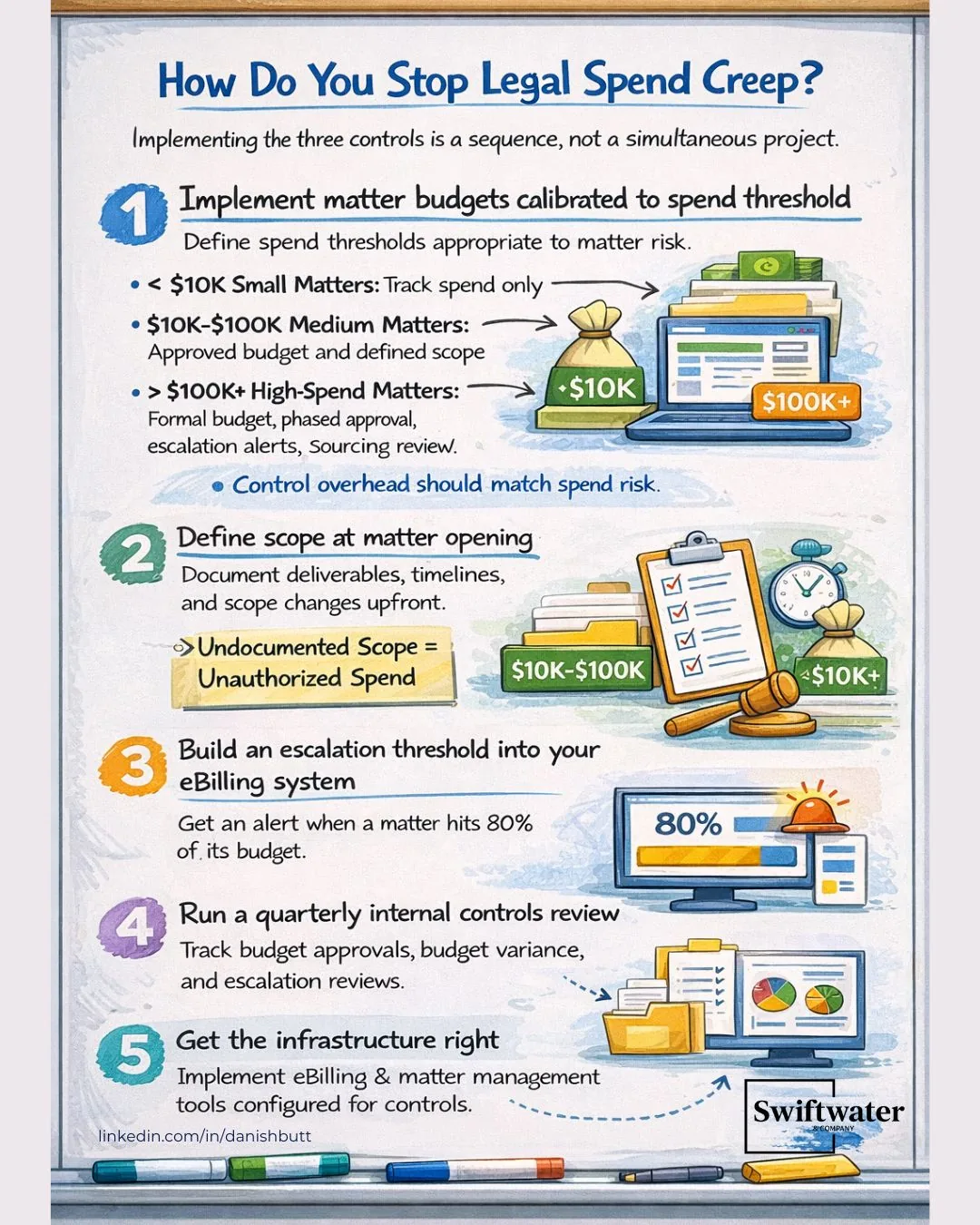
Implementing the three controls is a sequence, not a simultaneous project.
Step 1: Implement matter budgets calibrated to spend threshold Not every matter needs the same level of controls. A practical framework for most departments:
- Small matters below a defined threshold, typically $10,000, may not warrant a formal budget. Track spend but avoid creating administrative overhead that costs more than the matter itself
- Medium matters between $10,000 and $100,000 warrant an approved budget and basic scope definition before work begins
- High-spend matters above $100,000 trigger the full control set: formal budget, phased approval, escalation thresholds, and consideration of competitive sourcing or AFA structures for the engagement
Define your own thresholds based on your department’s matter mix. The principle is that control overhead should be proportionate to spend risk.
Step 2: Define scope at matter opening Document deliverables, timelines, and scope change authorization processes in the matter instruction to outside counsel. Treat undocumented scope as unauthorized spend. For complex matters where full scope cannot be defined upfront, use phased budgets tied to defined phases rather than attempting to budget the full matter at inception.
Step 3: Build an escalation threshold into your eBilling system Set an automatic alert when a matter reaches 80% of its approved budget. That alert triggers a review decision, not an automatic approval. The review is where cost control actually happens.
Step 4: Run a quarterly internal controls review Track three metrics across your active matter portfolio: percentage of active matters with approved budgets, average budget variance, and percentage of matters that triggered an escalation review. These numbers tell you whether your legal cost management controls are functioning or nominal.
Step 5: Get the infrastructure right Matter budgets, escalation alerts, and spend tracking all depend on having the right eBilling and matter management infrastructure configured to support them. Swiftwater’s eBilling implementation services cover system selection, configuration, and the governance rule-building that most implementations leave unfinished. Dashboards and reporting infrastructure are equally critical. The controls only produce value when the data they generate reaches the decision-makers who need to act on it, in a format they can use without a manual extraction exercise.
Struggling to control outside counsel spend?
We help legal departments build the governance, billing guidelines, panel structure, and rate programs that take back control of what outside counsel costs.
See Legal Spend ServicesFor context on how billing enforcement connects to these controls, see Swiftwater’s guide to outside counsel billing guidelines. For the broader spend management framework these controls sit within, see Swiftwater’s legal spend management resources.
Bottom Line
Legal spend creep is an internal governance problem, not an external billing problem. Law firms bill for authorized work. The authorization decisions are yours.
Matter budgets, scope discipline, and escalation processes are basic legal operations interventions. They help a law department manage legal spend – beyond managing invoices.
The difference between managing spend and managing invoices is where the cost control opportunity sits.
If you are ready to implement the internal controls that stop legal spend from creeping, explore how Swiftwater’s legal cost management services approach spend governance, from matter budget implementation through to ongoing spend oversight.
Disclaimer: This article is provided for educational and informational purposes only. Neither Swiftwater and Company nor the author provides legal advice. This content does not constitute professional legal, financial, or operational advice and should not be relied upon as such. Readers are encouraged to consult a qualified professional before making decisions based on the information provided. External links are included for reference only and reflect the views of their respective authors. Swiftwater and Company takes no responsibility for third-party content.