

A matter budget is an agreed spend ceiling established before legal work begins, defining the expected cost of a specific matter, creating accountability for both in-house counsel and outside firms, and providing the mechanism for monitoring spend as the matter progresses.
Matter budgets are the single most effective proactive legal spend control available to in-house legal teams. They are also the most commonly absent one.
What a functioning matter budget requires:
- A defined scope of work agreed at matter inception
- An approved cost ceiling documented before outside counsel begins billing
- A tracking mechanism in an eBilling system, not a spreadsheet, that surfaces budget variance in real time
- An escalation threshold that triggers a review when spend approaches the ceiling
- A documented process for authorizing scope or budget changes
Why are matter budgets so effective at controlling spend?
Matter budgets shift cost management from retrospective to proactive, from reviewing what was spent to authorizing what will be spent.
The 2024 Bloomberg Law Legal Operations and Technology Survey found that tracking outside legal counsel spend is the most common activity in in-house legal operations, reported by 72% of departments. Yet tracking spend and controlling it are different disciplines. Tracking produces a number after the fact. Matter budgets produce a ceiling before the fact. Most departments are doing the first and missing the second.
The 2025 Blickstein Group Law Department Operations Survey found that legal departments are fighting persistent pressure to reduce costs while workloads and complexity are rising simultaneously. The 2025 Thomson Reuters State of the Corporate Law Department Report confirms that controlling outside counsel costs is the top strategic priority for law departments globally. That pressure cannot be managed through rate negotiations alone. A discounted hourly rate applied to uncontrolled hours, uncontrolled timekeepers, and uncontrolled scope does not produce savings. A matter budget controls the total, not just the unit cost.
A matter budget forces three decisions at matter inception that would otherwise default to assumption:
Is your legal spend data telling you the full story?
We help legal departments build the analytics, rate governance, and reporting infrastructure to move from invoice processing to strategic spend management.
See Legal Spend Services- Scope definition – what the engagement covers and what it does not, documented before billing begins
- Cost expectation – a specific figure that outside counsel is aware of and accountable to
- Review cadence – defined checkpoints where spend-to-budget variance is assessed and scope changes are formally authorized
Legal departments without matter budgets are not managing spend. They are managing invoices, which is a retrospective activity with no control mechanism attached to it.
What Role Does Legal Budgeting Software Play?
Legal budgeting tools convert matter budgets from verbal promises and documents into operational controls.
A matter budget tracked in a spreadsheet is an audit record. A matter budget tracked in an integrated eBilling platform is a live control, one that surfaces variance in real time, triggers alerts when spend approaches the ceiling, and creates an auditable record of every budget authorization decision.
For example, Onit’s eBilling platform describes the practical impact clearly: real-time data makes budgeting more predictable and accurate, automated routing reduces delays, and built-in rules enforce compliance automatically. That is what a budget tracking system should do. A spreadsheet does none of it.
The distinction matters because spreadsheet-based tracking breaks down at scale. When a legal department is managing dozens of active matters simultaneously, manual budget monitoring is the first process to slip, and slippage is where cost creep begins. Mitratech reports that organizations using integrated matter management and eBilling solutions achieve annual cost reductions of 15% or more, driven primarily by the combination of budget visibility and billing compliance that integrated systems enable.
Platforms such as Onit, LexisNexis CounselLink, and Mitratech TeamConnect integrate eBilling and matter management into a single environment, allowing matter budgets to be set, tracked, and enforced within the same system that processes invoices. That integration eliminates the lag between billing activity and budget visibility that manual tracking creates.
For context on how eBilling governance connects to matter budget enforcement, see Swiftwater’s guide to eBilling governance.
How Do Matter Budgets Prevent Legal Spend Increase?
Matter budgets close the three gaps that allow spend to accumulate without authorization.
Gap 1: No cost ceiling Without a matter budget, outside counsel has no defined upper limit. Work continues until instructed to stop. The invoice is the first signal that costs have exceeded what was planned, by which point the spend has already occurred. As Xakia observes, even when matter budgets are initially exceeded on a regular basis, the act of setting them helps departments understand whether spend expectations are realistic and forces the governance conversation that unbudgeted matters never trigger.
Gap 2: No accountability trigger A matter budget creates a number that both parties track against. When spend approaches the ceiling, it triggers a review, not an automatic approval. That review is where cost control actually happens. Without a budget, there is no trigger and no review.
Gap 3: No scope change discipline Scope creep and budget creep are the same problem. When a matter budget requires formal authorization for scope changes, undocumented expansion becomes visible. Without a budget, scope changes are absorbed silently and billed without review.
For a broader view of how matter budgets connect to the full spend creep problem, see Swiftwater’s article on why legal spend keeps creeping up.
Want the review function run for you?
Every outside counsel invoice checked against your guidelines, rates, and matter context, inside the eBilling platform you already own, with the exception handling, vendor coaching, and savings reporting that separate a review program from invoice processing.
See Bill Review ServicesWhy Do Most Legal Departments Not Use Matter Budgets?
The three main reasons, why most legal teams lack budget discipline are:
The estimation problem Legal matters are genuinely hard to scope in advance, particularly litigation, regulatory investigations, and complex transactions. Many departments avoid matter budgets because they assume a useful budget requires certainty they do not have. It does not. A phased budget, set for each defined phase of a matter rather than the full matter at once, provides control without requiring impossible upfront certainty. An approximate budget with an escalation threshold is materially better than no budget at all.
The technology gap Legal.io’s analysis of managing legal budgets in 2025 notes that under half of legal departments use basic technologies like eBilling. Without an eBilling system configured to track matter budgets, the administrative overhead of maintaining budgets manually across dozens of active matters is genuinely prohibitive. The technology gap creates the manual process problem, which creates the bandwidth problem, which creates the decision to skip budgets entirely.
The cultural barrier In-house attorneys often feel matter budgets are onerous or even an implicit constraint on their ability to serve the business. The framing matters here. A matter budget is not a cap on quality. It is a shared visibility tool that lets in-house counsel have an informed conversation with finance and the business before costs escalate, rather than an uncomfortable conversation after they do.
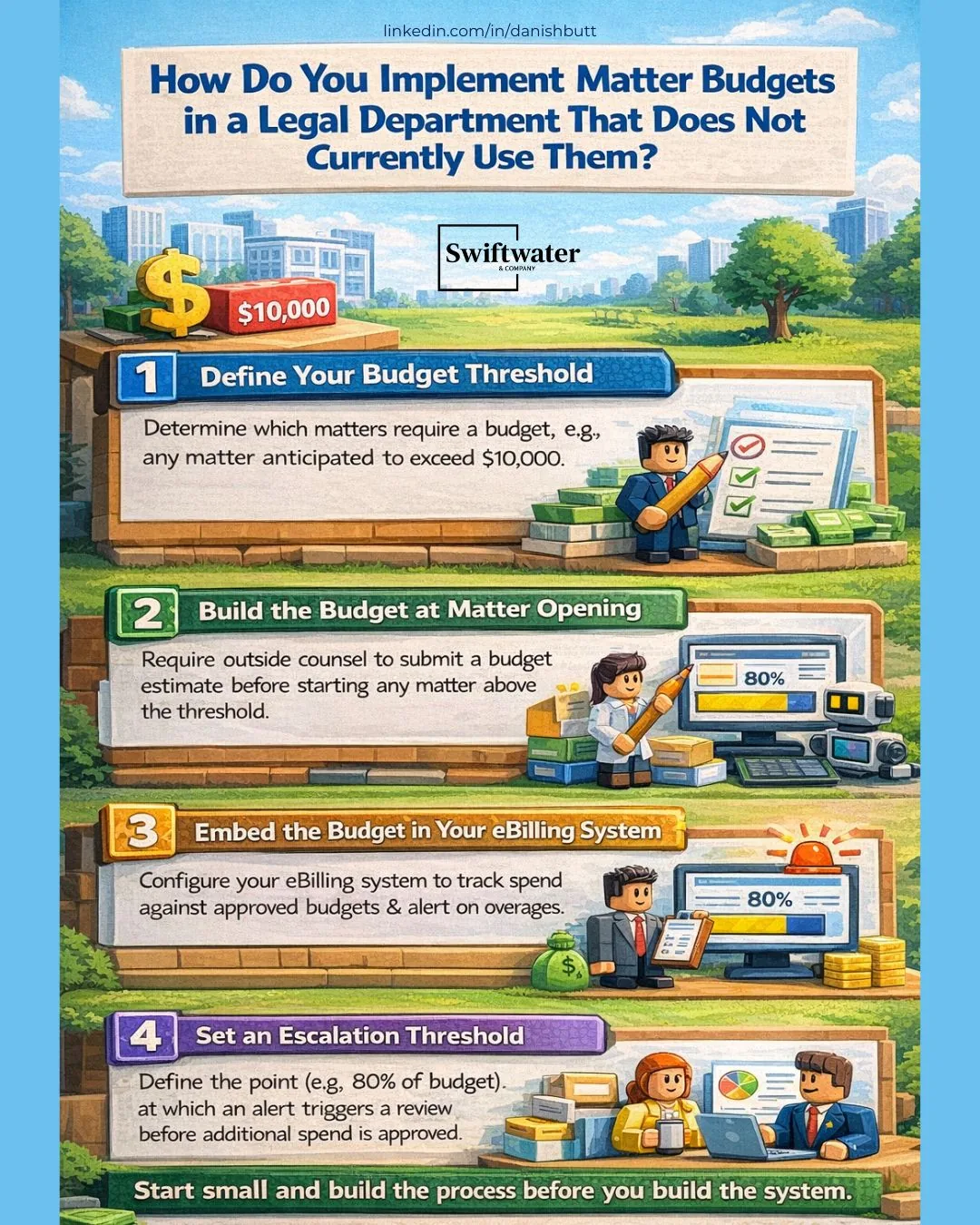
How Do You Implement Matter Budgets From Scratch?
Start small and build the process before you implement matter budgets in a system.
Step 1: Define your budget threshold Determine which matters require a budget. A practical starting point: any matter where anticipated outside counsel spend exceeds $10,000. Apply the threshold consistently across all practice areas to start. Refine it as you collect data on your actual matter mix.
Step 2: Build the budget at matter opening Require outside counsel to submit a budget estimate before beginning work on any matter above the threshold. That estimate becomes the basis for the approved budget, with a defined variance tolerance, typically 10% to 15%, before escalation is required. For complex matters where full scope cannot be defined upfront, set a budget for Phase 1 and require a new budget submission before Phase 2 begins.
Step 3: Embed the budget in your eBilling system A budget that exists outside your eBilling platform is not an operational control. Configure your eBilling system to track spend against the approved budget for each matter and surface variance alerts automatically.
Step 4: Set an escalation threshold Define the point, typically 80% of approved budget, at which an alert fires and a review is required before additional spend is authorized. The escalation should route to a defined decision-maker, not sit in a queue.
Step 5: Review budget performance quarterly Track three metrics across your active matter portfolio: percentage of matters with approved budgets, average budget variance, and percentage of matters that triggered an escalation review. These three numbers tell you whether your matter budget program is functioning or nominal.
Swiftwater’s eBilling implementation services cover the system configuration, governance rule-building, and reporting infrastructure that make matter budgets operational rather than theoretical. For the broader spend management framework, see Swiftwater’s legal spend management resources.
Bottom Line
Matter budgets are not a sophisticated legal operations intervention. They are a basic control, the minimum governance structure required for spend management to exist at all. However, if a legal team is not used to it and complicated processes are introduced matter budgeting can quickly become a painful process.
Without matter budgets, cost ceilings are absent, accountability is informal, and overruns are discovered retrospectively. With them, spend is authorized before it is incurred, variance is visible in real time, and cost control is a process rather than a reaction.
Every legal department that wants predictable spend needs matter budgets in some form. At a basic level, set a high-level fee and expense budget for matters expected to exceed a defined threshold. For larger matters, add more detail such as phase-level, task-level, or timekeeper-level budgets. Clear thresholds, ownership, and enforcement help legal staff understand when budgets are required, what detail is expected, and how the information will be used. Done well, matter budgeting becomes an operating discipline that makes spend more predictable, accountable, and easier to manage.
If you are ready to implement matter budgets and build the infrastructure to make them operational, explore how Swiftwater’s legal spend management services approach matter budget design, eBilling configuration, and ongoing spend governance.
Struggling to control outside counsel spend?
We help legal departments build the governance, billing guidelines, panel structure, and rate programs that take back control of what outside counsel costs.
See Legal Spend ServicesFrequently Asked Questions
What is a matter budget in legal?
A matter budget is an agreed cost plan for a specific legal matter before substantial outside counsel work begins. It defines expected spend, scope, assumptions, timing, and review points so the legal department and outside counsel have a shared financial framework for managing the matter.
Why are matter budgets important for legal spend management?
Matter budgets help legal departments manage spend before costs are incurred. They create a clear cost expectation, support better conversations with outside counsel, and give the GC a practical way to monitor legal work against approved financial expectations during the life of the matter.
What should a matter budget include?
A strong matter budget should include the matter scope, expected phases of work, estimated fees, expected expenses, staffing assumptions, billing rates, key milestones, budget review dates, and escalation thresholds. It should also explain how scope changes or additional work will be approved.
When should a legal department require a matter budget?
A legal department should require a matter budget for matters that exceed a defined spend threshold, involve higher business risk, require outside counsel, or are likely to run over multiple phases. Many departments start with a practical threshold and refine it as they build more spend data.
How do phased matter budgets work?
Phased matter budgets divide a legal matter into stages, such as investigation, pleadings, discovery, negotiation, trial preparation, or closing. Each phase has its own cost estimate and approval point. This helps legal teams manage complex or uncertain matters without requiring a perfect full-matter estimate at the beginning.
How does eBilling software support matter budgets?
eBilling software helps matter budgets become active controls instead of static documents. It can track actual spend against approved budgets, surface variance alerts, route escalation approvals, and create a clear record of budget changes. This gives the legal team better visibility while the matter is still active.
What is a matter budget escalation threshold?
A matter budget escalation threshold is the point where the legal team reviews spend before more work is authorized. For example, a department may require review when a matter reaches 80% of the approved budget. This creates a timely checkpoint for scope, strategy, timing, and expected cost.
Who should own the matter budget process?
Legal operations usually owns the matter budget process, with input from the responsible in-house attorney, finance, and outside counsel. Legal operations can manage the workflow, finance can support budget discipline, and attorneys can provide the legal and matter-specific judgment needed for approval decisions.
How should outside counsel participate in matter budgeting?
Outside counsel should provide realistic budget estimates, explain assumptions, identify key cost drivers, and flag when scope or strategy changes may affect spend. The best process treats budgeting as a shared planning exercise, not a one-time administrative request.
What is the first step to implementing matter budgets?
The first step is to choose a clear budget threshold and apply it consistently. From there, the department can require budgets at matter opening, track spend against approved amounts, set escalation alerts, and review budget performance each quarter.
Disclaimer: This article is provided for educational and informational purposes only. Neither Swiftwater and Company nor the author provides legal advice. This content does not constitute professional legal, financial, or operational advice and should not be relied upon as such. Readers are encouraged to consult a qualified professional before making decisions based on the information provided. External links are included for reference only and reflect the views of their respective authors. Swiftwater and Company takes no responsibility for third-party content.