


Monetizing intellectual property is the act of generating real revenue from your company’s intangible assets: patents, trademarks, and copyrights. It’s a strategic shift that turns these legal protections from a simple cost center into a proactive revenue-generating engine, creating new income streams that go far beyond traditional product sales.
This guide walks through how to audit an IP portfolio, choose the right monetization model, get assets market ready, and manage deals after they close. It is part of our legal operations insights hub.
Why Monetizing Your IP Is a Game Changer

For most corporate legal teams, I’ve found that intellectual property often feels like an expensive insurance policy, a defensive shield you pay a small fortune to maintain. But looking at it this way completely overlooks a massive opportunity. Your IP portfolio is frequently one of your company’s most significant yet undervalued assets, and it can be a powerful driver of direct financial returns.
Shifting your mindset from protection to profit is the first and most crucial step. Monetizing IP means making your existing assets work harder for the business while your core operations carry on. This strategic move can unlock significant value, give your company’s valuation a serious boost, and carve out a sharper competitive edge.
The Core IP Monetization Pathways at a Glance
Thinking about how to turn your IP into cash can feel a bit abstract, so let’s ground it in practical terms. Based on my experience, companies typically explore three primary avenues, each serving a different strategic purpose. Getting a firm grip on these core options is the foundation for building any successful IP monetization program.
To make this crystal clear, here’s a quick breakdown of the main strategies you can deploy.
Building the legal operations function from scratch?
Assessment, roadmap, and delivery for the operational side of the department: spend, technology, process, vendors, and the data that proves what legal delivers. Advice from operators who ran the function.
See Legal Ops Consulting| Monetization Strategy | Core Mechanism | Best For | Potential Outcome |
|---|---|---|---|
| Licensing | Granting rights to use your IP for royalties. | Generating recurring revenue from assets you aren’t fully using. | Steady, long-term income stream. |
| Asset Sale | Outright selling patents or trademarks. | Cashing in on non-core IP that no longer fits your strategy. | A significant one-time cash injection. |
| Strategic Alliance | Using IP as a bargaining chip for partnerships. | Gaining market access or technology without direct cash outlay. | Mutual growth and market expansion. |
Each path offers a distinct way to extract value, depending on what the asset is and what your business needs at the moment.
A Closer Look at the Main Strategies
Let’s unpack these a bit further.
- Licensing Your Technology: This is about granting another company the right to use your patented tech or copyrighted material in exchange for recurring royalties. It’s a fantastic option for generating steady income from assets that are valuable to your industry but perhaps not central to your direct business focus.
- Selling Non-Core Assets: This means an outright sale of patents or trademarks that no longer align with where your company is headed. The one-time cash infusion you get can be a game-changer, funding critical R&D, new corporate initiatives, or other high-priority business needs.
- Forming Strategic Alliances: Here, you use your IP as a powerful bargaining chip to enter joint ventures or cross-licensing agreements. It’s a savvy way to access another company’s technology or market reach without having to spend a dime.
The key takeaway is this: Every single piece of IP in your portfolio has potential value beyond its purely defensive purpose. The real goal is to identify that potential and match it with the right monetization strategy to maximize your returns.
Imagine a software company that holds a patent for a brilliant battery-saving algorithm. It’s a great piece of tech, but it’s not essential to their main B2B software product. Instead of letting it sit on a shelf collecting dust, they could license it to a smartphone manufacturer. Just like that, they’ve created a new, completely passive revenue stream.
This is a classic, real-world example of monetizing intellectual property in action: turning a dormant asset into a profitable one.
This initial reframing, viewing your IP as a value creator, is the most critical part of the entire process. It sets the stage for a more detailed, strategic approach where every patent, trademark, and copyright is assessed for its earning potential as well as its protective power.
Many companies choose to do this methodically; it’s called creating an outbound licensing program. This can start from conducting a strategic audit of your intellectual assets to creating a mechanism for finding buyers.
Once you decide to pursue it, designate some time or resources and create a project with a defined scope that is staffed with PMO resources along with subject matter experts.
How to Conduct a Strategic IP Portfolio Audit
Before you can even think about monetizing your intellectual property, you need a crystal-clear picture of what you actually own. I’ve seen too many companies skip this step, and it’s like trying to navigate a minefield blindfolded. A strategic IP audit goes well beyond an inventory check. It is the foundational data-gathering mission that shapes every decision that follows.
Without this deep dive, you can’t distinguish the high-value assets from the costly dead weight. The whole point is to take a critical look at each patent, trademark, and copyright, not just for its legal soundness, but for its commercial potential and how it fits with where your business is heading. Think of it as creating a strategic map of your company’s innovation landscape.
Categorizing Your IP Assets
The first practical step is to sort your entire IP portfolio into logical, strategic buckets. Beyond organizing patents by technology class, the goal is to assign a strategic value to each asset. This classification is what starts to build a real monetization playbook.
A method I’ve found to be incredibly effective is to categorize assets into three main groups:
- Core Assets: These are your crown jewels. This IP directly protects your main products, services, and brand identity. You’ll want to be cautious about monetizing these, maybe through highly selective licensing, since they’re fundamental to your competitive edge.
- Non-Core Assets: This bucket holds IP that’s valuable but doesn’t directly support your primary business lines. It could be technology from a pivoted business unit or patents with applications outside your key markets. These are often prime candidates for an outright sale or broader licensing programs.
- Defensive Assets: Some IP exists purely to give you the freedom to operate or to deter litigation from competitors. While their value isn’t about direct revenue, understanding their strategic importance is key to avoiding costly mistakes down the road.
This sorting process has to be a team sport. It requires collaboration between the legal team, R&D, and business unit leaders to make sure the strategic context of each asset is fully understood.
A common mistake I see is a legal team conducting an audit in isolation. Without input from product and strategy teams, a patent for a seemingly obscure algorithm might be misclassified as “non-core”, when it’s actually planned as the backbone for a future product launch.
Similarly, it’s hard to do this work without external help, especially if your portfolio is large. Swiftwater’s IP management practice brings the people, process, and technology to gather the data these decisions require.
Evaluating Commercial and Legal Strength
Once you have your categories, it’s time to put each asset under the microscope. This evaluation goes way beyond just checking if maintenance fees are paid. You’re essentially stress-testing each piece of IP to see if it’s truly market-ready.
For every significant asset, you need to be asking some tough questions:
- Legal Robustness: How strong are the claims in this patent? Is the trademark registration broad enough? Are there any potential challenges to its validity or ownership history that could blow up a deal?
- Market Relevance: Is there a real, tangible market need for this technology? Who would be a potential licensee or buyer? This is where you need to map your IP to market trends and what your competitors are doing.
- Evidence of Use: Can you actually show that the patented technology is being used in the market, either by your company or others? Proving use can dramatically increase an asset’s value and make it much more attractive to potential licensees.
This evaluation phase is an essential part of the broader legal function’s responsibility. It’s an activity that fits squarely within your team’s strategic work, linking IP management directly to business outcomes.
Need the function run, not just advised on?
Swiftwater embeds senior practitioners directly into legal operations, handling bill review, matter management, and program delivery on your behalf.
See Managed ServicesThe result of this audit shouldn’t be a static list collecting dust. It should be a dynamic, actionable database. It must clearly highlight your top monetization candidates, identify underperforming assets that are just draining resources, and reveal strategic gaps or new opportunities. This data-driven foundation is what transforms an IP portfolio from a simple collection of legal documents into a powerful tool for generating revenue.
Choosing the Right Monetization Model
You’ve completed your IP portfolio audit and now you’re holding a strategic map of your assets. The critical question becomes: what do you do with it? Applying a one-size-fits-all approach to monetizing intellectual property is a surefire way to leave significant value on the table. The real art lies in matching the right monetization model to the right asset, based on its strategic importance and market potential.
This is where your audit’s insights become incredibly powerful. A “non-core” patent might be a perfect candidate for an outright sale, providing a quick cash injection for R&D. In contrast, a foundational technology patent is likely better suited for a carefully structured licensing program that generates long-term, recurring revenue.
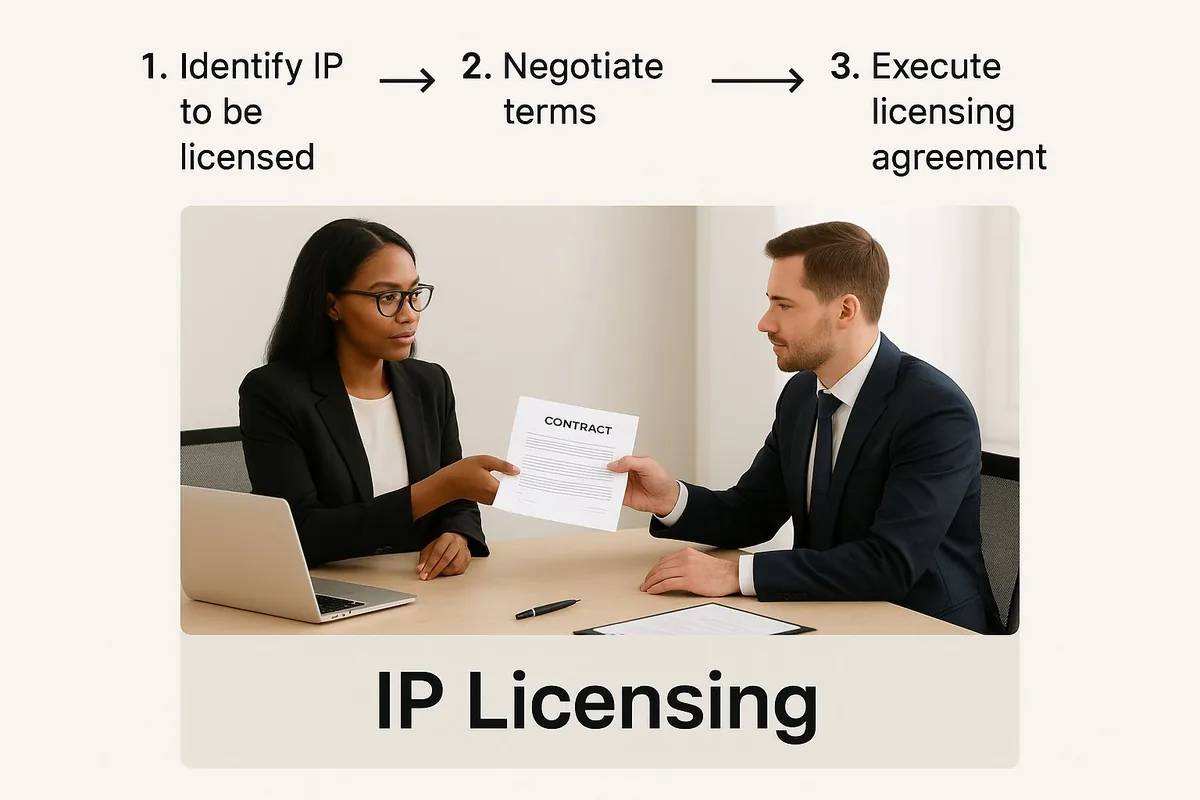
It really captures the essence of a licensing deal. One entity grants rights to another, unlocking an innovation’s commercial potential through a formal agreement. This highlights the collaborative and strategic nature of successful IP monetization.
Licensing Your Intellectual Property
Licensing is often the go-to model for monetizing IP, and for good reason. It lets you keep ownership of your asset while generating income from it. One of the most effective ways to do this is by establishing solid licensing agreements.
This path is only getting more important as companies look to turn static IP into dynamic revenue streams.
Within licensing, you have several options, each serving a different purpose:
- Exclusive Licensing: You grant rights to a single licensee, often for a specific field of use or territory. This is ideal for high-value IP where a dedicated partner can maximize market penetration.
- Non-Exclusive Licensing: You can grant licenses to multiple parties at the same time. This strategy works well for technologies with broad applications across different industries, creating diverse revenue streams.
- Cross-Licensing: This involves two companies granting licenses to each other. It’s a powerful way to get access to a competitor’s technology, settle disputes, or ensure freedom to operate without any cash changing hands.
The Outright Sale of IP Assets
Sometimes, the most sensible move is just to sell an asset. This is especially true for patents or trademarks your audit flagged as “non-core.” Maybe they protect tech from a business unit you sold off, or they just don’t fit with where the company is headed.
An IP sale gives you a clean break and a significant, one-time influx of cash that can be invaluable for funding more critical projects. The key, however, is an accurate valuation and sharp negotiation. You need a crystal-clear understanding of the asset’s market value, its legal strength, and how badly a potential buyer needs it.
Expert Tip: Before you even think about starting sales negotiations, put together a comprehensive “deal package.” This should include more than just the patent itself. Think evidence of use, claim charts, and a clear story about its commercial value. This kind of preparation significantly strengthens your negotiating position.
An experienced Chief IP Counsel I worked with had a mantra that he used to repeat multiple times a day, “Know what’s in your patents!”
Advanced Monetization Strategies
Beyond simple licensing and sales, there are more sophisticated models that can unlock even greater value, though they often come with more complexity. These strategies require careful planning and a deep understanding of both your IP and your business goals.
Consider these advanced options:
- Joint Ventures (JVs): You can contribute IP as your stake in a joint venture. This lets you partner with another company to develop and commercialize a new product or enter a new market, sharing both the risks and the rewards.
- Patent Pools: In some industries, companies pool their essential patents related to a specific standard (like 5G or Wi-Fi). Members can then license the entire pool, simplifying access to necessary technology and creating a collective revenue stream.
- IP-Backed Financing: Your intellectual property can be used as collateral to secure loans. This is an excellent way for asset-rich, cash-poor companies to fund growth without diluting equity.
Choosing the right model means taking a holistic view, blending the data from your IP audit with your company’s overarching business goals. The complexity of these agreements, especially with licensing and JVs, highlights the need for meticulous contract management.
To get a better handle on contracts, you might be interested in our article on understanding the benefits of contract lifecycle management. Effectively managing these contracts is essential to realizing the full financial benefit of your monetization efforts.
Getting Your Intellectual Property Market Ready
Once you’ve locked in a monetization strategy, the focus shifts from planning to pure preparation. It’s time to package your intellectual property assets, making them not just attractive but genuinely irresistible to potential partners or buyers. It means building a bulletproof “deal package” that anticipates every question and shows value from day one.
I’ve seen it time and time again: how well you prepare directly impacts the outcome. Meticulous prep work smooths out negotiations, builds immediate trust, and drastically boosts your odds of closing a lucrative deal. Rushing in with a half-baked package? That’s a recipe for delays, lowball offers, and deals that crumble under the slightest scrutiny.
Evaluating legal technology but not sure where to start?
We help legal departments cut through the vendor noise, mapping technology to process maturity and building a roadmap that actually gets adopted.
See Legal TechnologyAssembling the Complete Deal Package
Think of this as creating a prospectus for your IP. The goal is to hand a potential licensee or buyer everything they need to make a fast, confident decision. This level of organization signals that you are a serious, professional partner.
Your deal package needs to be a robust collection of documents and hard evidence. Here’s what it absolutely must include:
- Patent Claim Charts: These are non-negotiable. A claim chart is a detailed map that lays your patent’s claims directly over a competitor’s infringing product or a key industry standard. It’s the most powerful proof of your patent’s relevance and strength.
- Evidence of Use (EoU): This is the documentation proving your patented technology is actually being used out in the wild. Think product teardowns, marketing collateral, or technical manuals. A solid EoU dramatically increases an asset’s worth.
- Documented Trademark History: For trademarks, you need to compile a comprehensive history. This includes dates of first use, examples from advertising campaigns, and any evidence of brand recognition and goodwill in the marketplace.
- Copyright Registrations and Works: If you’re dealing with software or creative content, have your copyright registration documents ready and a clean, accessible copy of the work itself.
As you get your IP ready for the market, it helps to understand the full lifecycle. This perspective shifts your thinking from seeing IP as just a legal asset to viewing it as a marketable product with its own distinct value proposition.
Performing Due Diligence on Yourself
One of the most powerful moves you can make is to run due diligence on your own assets before anyone else gets the chance. It’s all about finding and fixing the weak spots before they can be used as leverage against you in a negotiation. This is a critical stress test that builds internal confidence and protects the asset’s value.
A potential licensee’s legal team will absolutely scrutinize your chain of title. If they find a gap – like a missing inventor assignment from a former employee – it can derail the entire deal. Finding and fixing this issue internally first is a non-negotiable step.
During this self-audit, zoom in on these areas:
- Chain of Title: Confirm that ownership of the IP has been flawlessly transferred and documented at every single stage, from the original inventor all the way to your company. Any broken link in that chain is a massive red flag.
- Maintenance and Fees: Double-check that all maintenance fees and annuities are paid up and current in all relevant jurisdictions. A lapsed patent has exactly zero monetization value.
- Encumbrances: Are there any existing licenses, liens, or other legal obligations tied to the asset? You have to identify and disclose these, as they directly impact the IP’s value and how it can be commercialized.
Maintenance lapses happen even at the largest companies. In one widely reported case, a global drug manufacturer’s core patent in Canada lapsed after a CAD 450 maintenance fee went unpaid in 2019, opening the door to generic competition as early as 2026. Maintaining intellectual property requires focus, and many legal and IP teams tell us they struggle to work across jurisdictions while fees and payments keep rising. Swiftwater recently announced a partnership with Prokurio to help teams manage budgets and forecasting for a growing IP portfolio. Learn more about the future of IP budgeting and forecasting.
Crafting a Powerful Value Proposition
Finally, all this prep work must come together in a sharp, clear value proposition. The data and legal documents are the foundation, but you need a compelling story built on top. You must be able to articulate exactly why your IP is valuable to a specific partner.
Skip the generic sales pitch. Build a targeted message that highlights clear commercial advantages. Does your patent portfolio offer a shortcut into a new market? Does it provide a defensive shield against a litigious competitor? Does licensing your technology offer a 30% reduction in manufacturing costs?
Be specific. Be quantitative. And tie your IP directly to a business outcome your potential partner genuinely cares about. This groundwork is what transforms your IP from a complex legal asset into an undeniable business solution.
Executing the Deal and Managing the Outcome

This is it. The moment where all your hard work, the audits, valuations, and market analysis, finally translates into real revenue. Executing an IP deal is a delicate dance of sharp negotiation, airtight legal work, and smart, forward-thinking management.
Getting this part right is what separates a decent outcome from a truly game-changing one.
Making that first move is a critical step. When you approach a potential licensee or buyer, your pitch needs to be more than a list of patent numbers. You have to tell a compelling business story, framing your IP as the solution to one of their problems or the key to a new opportunity.
It shows you’ve done your homework and see them as a genuine strategic partner. This immediately builds credibility and sets the stage for a productive negotiation.
Navigating the Negotiation and Closing Process
Once you’ve got an interested party at the table, the real horse-trading begins. It usually starts with a term sheet, which lays out the high-level business terms of the deal. While it’s non-binding, it’s the foundation everything else is built on.
Every point on that sheet, from royalty rates to exclusivity, is a potential negotiation point. This process takes time, so be prepared for a lot of back-and-forth.
For a licensing deal, the conversation will revolve around a few key areas:
- Royalty Structure: Are you looking for a percentage of sales, a flat fee per unit sold, or a one-time lump sum?
- Exclusivity: Will this license be exclusive to one company, or can you offer it to others in different markets or fields?
- Field of Use: In what specific products or services is the licensee allowed to use your IP?
- Territory: Are the rights global, or are they restricted to certain countries or regions?
If you’re pursuing an outright sale, the focus shifts to the purchase price, the precise scope of assets being sold, and the representations and warranties from both sides. This is where all that self-diligence you did earlier pays off in a big way. A clean chain of title and organized documentation prevent last-minute surprises that can torpedo the deal or drive down the price.
To make sure your agreements are solid, it’s worth exploring AI-powered legal contract analysis tools such as Onit ReviewAI and Clearlaw.ai (both Swiftwater partners). They can be incredibly helpful for spotting potential risks or unfavorable clauses that are easy to miss.
Post-Transaction Management: The Real Work Begins
Getting the agreement signed feels like crossing the finish line, but in many ways, it’s just the starting gun. If you don’t manage the deal effectively after it’s closed, you’re leaving money on the table. It’s like building a revenue-generating machine and then forgetting to plug it in.
The value of corporate intangible assets worldwide, which include intellectual property, crossed USD 97 trillion in 2025, according to WIPO and Brand Finance. That makes IP a significant financial instrument as well as a legal asset, and it frames post-deal management as a crucial function for protecting and growing that value.
With licensing deals, the single most important post-deal activity is royalty tracking and auditing. You need a reliable system to monitor the licensee’s sales reports and ensure you’re getting paid correctly and on time. Your agreement should always include audit rights. That is simply good business.
For an asset sale, the priority is ensuring a smooth and complete transfer. This means working with the relevant patent and trademark offices to officially record the change in ownership and giving the buyer everything they need to take full control of the assets.
Ultimately, strong contract management ties all these post-deal activities together. Having a central system to track dates, obligations, and performance is non-negotiable. For a deeper dive into this, check out our guide on contract lifecycle management best practices.
A well-managed outcome not only secures the financial wins from the current deal but also cements your company’s reputation as a professional and trustworthy partner, opening doors for future opportunities.
Technology for Managing IP After the Deal
When it comes to monetizing your intellectual property, trying to juggle everything with disconnected spreadsheets and manual tracking is inefficient and a massive risk. In my experience, the corporate legal teams getting a real competitive advantage are the ones who’ve embraced a dedicated tech stack built for IP management. Faster data entry is the least of it. The bigger gain is strategic intelligence you can’t get any other way.
Old-school docketing systems no longer cut it. Modern IP management software platforms give you a single, real-time command center for your entire portfolio. Think about it: they can automate messy royalty calculations, keep you on top of license agreement milestones, and, most importantly, flag those underperforming assets that could be your next big monetization win. This gets your team out of the administrative weeds and focused on the high-stakes strategic work that actually moves the needle.
Swiftwater’s IP management team also helps implement and maintain off-the-shelf Intellectual Asset Management Systems. These are critical to managing intellectual assets across the lifecycle whether they are fully owned, licensed, jointly-owned or otherwise. There is no single system that “completely” manages the cycle. This is where we help implement best practices and integrations to ensure the business is in full control of its IP at any given time; not only for protection but also supporting the commercialization and monetization efforts.
Supercharging Your Strategy with AI
The real game-changer, though, is the infusion of artificial intelligence into these platforms. AI tools can chew through a massive patent landscape analysis in a fraction of the time it would take a human team. They’re incredible at finding the “white space” for your next innovation, sniffing out potential infringement across the globe, and even helping predict a patent family’s commercial potential based on live market trends.
For example, I’ve seen AI tools analyze technical documents and product manuals – it can be used to build out compelling Evidence of Use (EoU) charts. Anyone who’s done this manually knows it’s a tedious but critical part of preparing for a licensing negotiation. AI can possibly take that grind and turn it into a strategic accelerator, getting you ready for a deal much, much faster.
Demand for these tools is growing fast. The global intellectual property software market is projected to grow by USD 7.96 billion between 2025 and 2029. That’s a compound annual growth rate of nearly 19.6%, driven by companies realizing they need these tools to be more efficient and to get an edge with AI. You can dig into the numbers yourself on prnewswire.com.
The Right Tools for the Job
Bringing this kind of technology in-house is a strategic investment in the success of your entire monetization program. It equips you with the deep, data-driven insights needed to make smarter, faster, and ultimately more profitable decisions with your IP assets.
So, what do you really get out of it?
- Total Visibility: A single dashboard gives you a complete, up-to-the-minute picture of all your IP assets, their status, and how they’re performing. No more hunting through spreadsheets.
- Smarter Workflows: By automating everything from royalty reporting to deadline tracking, you slash human error and make your entire operation run smoother.
- Data-Backed Decisions: Powerful analytics help you pinpoint your most valuable monetization opportunities and walk into every negotiation from a position of undeniable strength.
When legal departments and IP teams embrace these tools, they become proactive value creators, fully equipped to capitalize on the company’s most valuable assets: its ideas.
Bottom Line
Monetizing intellectual property starts with knowing what you own. A strategic audit sorts assets into core, non-core, and defensive groups, and the right model follows from that: licensing, an outright sale, or an advanced structure such as a joint venture, patent pool, or IP-backed financing.
Deals then succeed on preparation, with a complete deal package, a clean chain of title, and current maintenance fees. After signing, royalty tracking, audit rights, and a system that manages obligations protect the value you negotiated. The companies that earn the most from their IP run monetization as an ongoing business program, with the data, systems, and ownership to sustain it.
Swiftwater and Company helps corporate legal and IP teams build that program, from portfolio audits and IP cost rationalization to implementing the IP management systems that track assets, deadlines, and deals. If you are ready to put your portfolio to work, our IP management services are the place to start.
Frequently Asked Questions
What is IP monetization?
IP monetization is the practice of generating revenue from a company’s intellectual property, including patents, trademarks, and copyrights. It treats IP as a revenue-generating asset in addition to a legal protection. The most common approaches are licensing, where another company pays royalties for the right to use your IP; the outright sale of non-core assets for a one-time payment; and strategic alliances such as cross-licensing or joint ventures. Advanced options include patent pools and IP-backed financing. A structured program usually starts with a strategic audit of the portfolio, so each asset can be matched to the model that fits its value and its role in the business.
What are the main IP monetization models?
The main models are licensing, outright sale, and strategic alliances. Licensing grants rights to use your IP in exchange for royalties while you keep ownership, and it can be exclusive, non-exclusive, or structured as cross-licensing. An outright sale transfers ownership of non-core patents or trademarks for a significant one-time payment. Strategic alliances use IP as a bargaining chip in joint ventures or cross-licensing agreements, providing market access or technology without direct cash outlay. More advanced models include contributing IP to a joint venture, patent pools built around industry standards such as 5G or Wi-Fi, and IP-backed financing that uses the portfolio as loan collateral.
How do you monetize and license an intellectual property portfolio?
Start with a strategic audit that sorts assets into core, non-core, and defensive groups and tests each one for legal strength, market relevance, and evidence of use. Match each asset to a model, such as selective licensing for core technology and a sale or broad licensing for non-core assets. Next, build a deal package with claim charts, evidence of use, and supporting documentation, and run due diligence on your own chain of title, maintenance fees, and encumbrances. Negotiate royalty structure, exclusivity, field of use, and territory, then manage the deal with royalty tracking, audit rights, and a contract management system. Many companies run this as an outbound licensing program with a defined project scope.
How can you estimate what a patent is worth without a formal valuation?
You can build a solid working estimate with a market approach. Research licensing deals for similar technologies in your industry through public filings and market research reports, and use that data to build a reasonable royalty rate range. Then weigh the asset’s legal robustness, market relevance, and evidence of use, since proven use in the market can dramatically increase value. A formal valuation still has its place for major transactions, but this data-driven estimate gives you a credible foundation for starting a negotiation.
What are the biggest risks of licensing core technology?
The biggest risk is losing control. If a licensee creates a poor-quality product or otherwise misuses your IP, your brand’s reputation is on the line. Protect against this by building safeguards directly into the licensing agreement: strong quality control clauses, audit rights, and clear conditions for termination. Define exclusivity, field of use, and territory carefully so the license covers only what you intend. For core assets, highly selective licensing is usually the safer approach, because those assets protect your main products, services, and competitive edge.
How long does an IP licensing deal take?
It depends on complexity. A straightforward, non-exclusive license with a partner eager to move forward might take three to six months from the first conversation to the final signature. A complex, exclusive deal for core technology can easily stretch to a year or more, because negotiations over royalty structures and field-of-use restrictions take time to get right. Preparation shortens the process: a complete deal package and clean self-diligence on chain of title and maintenance fees prevent the last-minute surprises that delay or derail deals.
When should a company bring in an IP monetization or IP management partner?
Consider outside help when the portfolio is large, the data needed for decisions is scattered, or the team lacks the capacity to run an audit and an outbound licensing program alongside day-to-day work. A partner can run portfolio audits that identify renewal spend to eliminate and jurisdictions to prune, implement or upgrade an IP management system, and set up analytics that show portfolio composition, renewal exposure, and cost per right. Swiftwater’s IP management practice supports these needs across the full IP lifecycle, from IP operations management to strategic process consulting.
Disclaimer: This article is provided for educational and information purposes only. Neither Swiftwater & Co. nor the author provide legal advice. External links are the responsibility of their respective authors, reflect their thinking, and are provided for informational purposes only.