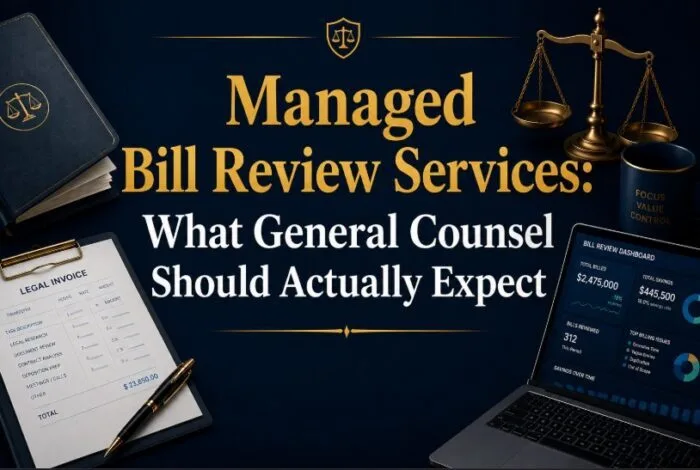

Managed bill review is the ongoing outsourced operation of reviewing, analyzing, and approving outside counsel invoices against billing guidelines, typically delivered through an eBilling platform with practitioner oversight, billing rule enforcement, savings reporting, and vendor coordination.
The function exists because it frees up attorney time for more substantive work while bringing the discipline and extra hands needed to enforce the rules, guidelines, engagement letters, and negotiated rates that legal teams have worked hard to put in place. The 2025 LegalBillReview.com and In-House Connect survey found that 55% of legal departments still handle bill review entirely in-house without third-party services or tools, while 60% have no formal Outside Counsel Guidelines (OCGs) in place. Of the departments that do have guidelines, 87% report enforcement is light and addresses only the most egregious issues. The 2025 CLOC State of the Industry Report adds the operational context: 63% of legal departments cite bandwidth and workload as their top operational challenge. The gap between rising outside counsel rates and shrinking internal capacity to enforce the structures that contain them is the gap that managed bill review fills.
Outside counsel rate inflation makes the math sharper. The 2024 Brightflag Am Law 100 Rate Report found rates at the top 50 firms increased by 12.1% year over year, with average M&A partner rates at the top 25 firms reaching $1,680 per hour. Industry coverage has separately reported senior partners at certain firms now billing as high as $3,000 per hour. The cost of letting invoices pass without scrutiny grows with every annual rate adjustment. The cost of running a structured review program is fixed. The break-even on managed bill review has moved meaningfully in the buyer’s favor over the last three years.
This article covers what general counsel should expect from a managed bill review service: the scope of the function, the three delivery models on the market, the questions to ask before signing, where the savings come from, and how to model expected return.
What managed bill review services do
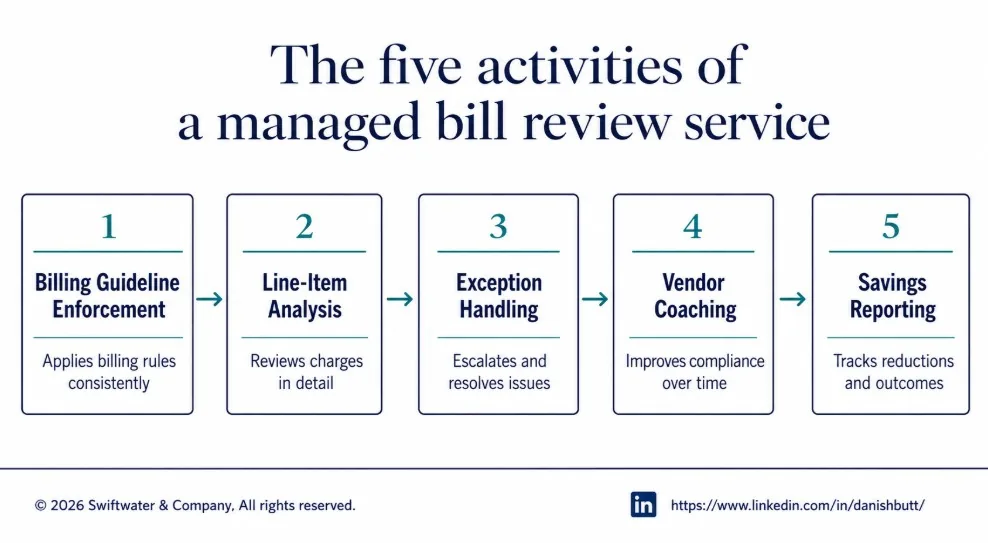
The function is broader than line-by-line invoice review. A complete managed bill review service operates five activities on an ongoing basis.
| Activity | What it covers |
|---|---|
| Billing guideline enforcement | Application of the client’s OCGs to every invoice, with rules on staffing levels, rates, block billing, vague time entries, and unauthorized work |
| Line-item analysis | Review of timekeeper rates, hours, descriptions, expense entries, and disbursements against guidelines and the matter context |
| Exception handling | Documentation of disputed entries, structured dispute correspondence with the law firm, defensibility evidence retained for audit |
| Vendor coaching | Periodic structured feedback to outside counsel firms on billing patterns, supporting better invoice quality over time |
| Savings reporting | Documented savings against billed amount, broken down by reason code, firm, matter, and practice area, with trend analysis |
A service that delivers only the first two is invoice processing, not managed bill review. The exception handling, vendor coaching, and savings reporting layers are where ongoing operational value sits and where the difference between providers shows up most.
The three delivery models on the market
Managed bill review reaches the in-house buyer through three distinct delivery models, each with different economics and different operational characteristics.
Want the review function run for you?
Every outside counsel invoice checked against your guidelines, rates, and matter context, inside the eBilling platform you already own, with the exception handling, vendor coaching, and savings reporting that separate a review program from invoice processing.
See Bill Review ServicesVendor-managed bill review (delivered by the ELM platform provider)
The eBilling and ELM platform providers offer managed bill review as an extension of their software. Wolters Kluwer’s LegalView BillAnalyzer, Mitratech’s Quovant, LexisNexis’s CounselLink services, and Onit’s partner-delivered offerings all sit in this category. The platform provider supplies both the technology and the review service through a single contract.
The strength of this model is integration depth: the review service sits inside the platform the client already uses, with no separate workflow. The structural reality is that this is an add-on service offered by a software company, and the focus of the review tends to sit on what surfaces inside the bill screen rather than on the contextual layer around the invoice (matter complexity, firm relationship, panel dynamics, budget context). A pure-play software company offering a service alongside its product is structurally similar to a service company launching a product: some have been doing it for years and do it well, but the center of gravity remains the original business. Pricing is typically bundled with platform licensing, which makes it difficult to isolate the cost of the review service from the cost of the technology.
The upside of this model is also bounded. The focus is typically OCG enforcement and line-item compliance, which on its own delivers real value: attorneys recover the time they would have spent on first-level review, and that alone is enough to justify the spend for many departments. What this model does not typically extend into is the operating model side of the function (panel dynamics, budget context, matter staffing pattern), which is where the deeper savings and the strategic decisions usually sit.
This model fits clients whose primary buying motion is the ELM platform, with managed review as a connected add-on inside the platform contract.
ALSP-managed bill review (delivered by alternative legal service providers)
Pure-play ALSPs and attorney-led review services such as LegalBillReview.com, UnitedLex, Sterling Analytics, and various boutique providers deliver bill review as a stand-alone service. The provider is independent of the ELM platform and brings its own review methodology, attorney-led or paralegal-led, working inside whatever eBilling system the client operates.
The strength of this model is independence from the platform and the depth of legal review training that comes with attorney-led delivery. Attorney-led review is most effective in specialized contexts: insurance defense, regulated industries, specialized government responses, or other practice areas where the sequence of business activity and the involvement of third parties require working knowledge of the underlying work. Outside those specialized contexts, the depth of attorney credentials on review can outpace what the bill review function requires.
Many ALSPs work on a cost-plus model, taking a contracted FTE and marking up the rate to the client. The structural challenge that comes with that arrangement is that the in-house team is paying for borrowed contract resources who are then trained to apply OCGs and review bills, which in practice resembles the same mechanical work that a vendor-managed review provides. Several of these providers offer performance guarantees: total adjusted invoices plus the provider’s fee will not exceed the original billed amount for the review period. The trade-off is that the upside is bounded by the mechanical savings from errors-and-omissions correction and OCG enforcement, similar in scope to the vendor-managed model. The review service sits independent of the broader operational stack: the provider reviews invoices but does not typically administer the eBilling platform, manage vendor onboarding, or run the broader spend management function, so the in-house team retains responsibility for everything around the review itself.
This model fits clients who want deep legal review on invoices and have separate capability to operate the surrounding spend program.
Operations-led managed bill review (delivered by managed services firms)
Operations-led managed services firms deliver bill review as one component of a broader managed spend management function. Swiftwater’s managed services arm sits in this model, alongside the smaller set of operations-led firms that combine bill review with eBilling administration, vendor onboarding, matter setup, financial approvals, and reporting.
The strength of this model is integration across the spend management function. The same firm that reviews invoices also has the ability to operate the eBilling platform itself, looking across budgets, vendors, matter health, and panel performance rather than only at the line items inside a single invoice. The visibility extends past the eBilling screen: eDiscovery invoices (a substantial portion of what many ALSPs and vendors send) can be cross-referenced against actual platform activity in the eDiscovery system to confirm the work being billed matches the work being done. Bill review sits inside an operating model rather than as a stand-alone service, which means the savings findings, the vendor coaching, the data quality, and the platform configuration all reinforce each other. The trade-off is that this model assumes the client wants outsourced operation of the broader spend function, not only invoice review.
This model fits clients building or operating a structured legal spend management program where bill review is one of several functions running together.
What general counsel should ask before signing
A managed bill review evaluation has its own set of buyer questions, distinct from the broader managed services evaluation framework. Six questions get at the operational substance of the offer.
- What is your review volume capacity, and how does it flex against my peak billing cycles? Bill review volume is uneven. End-of-quarter and end-of-year invoice surges can be three to five times average monthly volume. A provider without flex capacity will either delay reviews during surges, weakening dispute defensibility, or accept low review depth to keep up with volume.
- What is your platform fluency on the eBilling system I currently use, or plan to use? Review and platform administration are coupled in practice. A provider that knows the platform configuration, the timekeeper rate library, and the billing rule engine can keep the rules current as the program evolves. A provider without that fluency reviews invoices against rules someone else is responsible for maintaining, which creates a coordination overhead the buyer absorbs.
- How is the review handled, who does it, and what credentials do they hold? Attorney-led review, paralegal-led review, and AI-augmented review produce different quality and cost profiles. The buyer should understand the staffing mix on their account, whether reviewers rotate or are dedicated, and what training and certification the reviewers have on the client’s specific OCGs.
- What is your escalation handling protocol when a firm disputes a finding? Dispute defensibility is the operational layer that protects savings from being given back. Providers that cannot document the reasoning, retain the supporting evidence, and structure escalation correspondence professionally will see savings erode when firms push back. The audit trail is part of the service.
- How do you calculate and report savings? Savings methodology varies meaningfully across providers. Some report gross adjustments before firm dispute and recovery, others report net realized savings after dispute resolution. The buyer should understand the methodology before the engagement begins, and the contract should specify which figure governs SLAs.
- What is your performance guarantee and how is it structured? Several providers offer performance guarantees, typically capping the provider fee plus adjusted invoices against the original billed amount. The mechanics of these guarantees vary, and the buyer should understand exactly what is guaranteed, against what baseline, and how disputes between provider and client on the guarantee are resolved.
Where the savings come from, and how to model expected return
Savings on managed bill review come from four mechanical sources anchored in the invoice itself, one baseline outcome that any managed review delivers, and one strategic layer that only an operations-led model is positioned to deliver. Understanding which of these a given delivery model captures is what makes return modeling honest.
Reviewing defense counsel invoices at claims volume?
Claims litigation and staff counsel programs run within the same five-activity review model, adapted to defense-counsel guidelines, high invoice volumes, and claims-system coordination, with reviewers who understand the sequence of litigation activity.
See Bill Review ServicesThe four mechanical sources of legal spend savings
Billing guideline violations. Block billing entries, vague time descriptions, unauthorized staffing levels, unapproved rates, work performed outside the scope of the matter, and expenses outside the approved categories. This is the largest and most consistent source of savings on a guideline-rich review. In one client engagement documented by LegalBillReview.com, structured bill review surfaced $700,000 in adjustments on a single set of bills.
Rate compliance. Timekeeper rates that exceed approved rates, rates applied without the approval process specified in the OCGs, or rates applied to timekeepers not approved on the matter. On a department running straight hourly rates with no exceptions, rate compliance is a contained review. The moment the rate structure introduces alternative fee arrangements, negotiated discounts, partner exception rates, separate litigation rates, or volume-based scaling, rate compliance becomes a full-time operational effort. With Am Law 100 rates rising 10% year over year, partner rates at the top 50 firms now reaching $1,680 per hour for M&A work, and senior partner rates at certain firms reaching as high as $3,000 per hour, the savings exposure grows with every rate cycle.
Staffing efficiency and operating model alignment. The category often gets framed as duplicate or excessive time entries, but the underlying question is operational: are the right people, in the right capacity, delivering the right activities? Multiple timekeepers billing for the same activity (multiple attorneys at the same meeting, multiple attorneys reviewing the same document), associate work delegated up to partner rates, partner work performed at associate levels of depth, paralegal-appropriate tasks billed at attorney rates, and round-number entries that suggest estimation rather than recorded time all signal the same underlying issue: the operating model on the matter is not aligned to the activities being performed. Identifying this in invoice review is the surface signal. Fixing it requires coordination with the firm on staffing approach for similar matters going forward.
Disbursements and expenses. Photocopies, computer research, document delivery, travel, and meal charges that exceed OCG allowances or fall outside approved categories.
The baseline outcome that all delivery models share
Attorney time reclaimed from first-level review. Independent of the dollar savings surfaced from the invoices themselves, in-house attorneys recover the time they would otherwise spend doing first-level invoice review. This is inherent to every delivery model: vendor-managed, ALSP-managed, and operations-led services all produce this result the moment review work moves outside the in-house team. For most departments doing review internally before the engagement, this is the most consistent benefit of buying the service, and for many it is enough to justify the spend on its own.
The strategic layer unique to operations-led delivery
A managed bill review service sitting close enough to the broader spend function can do more than enforce the OCGs and surface errors. It can feed insights back to attorneys to support smarter operating model decisions: which firms consistently overstaff partners on matters that could be associate-led, which practice areas have rate structures starting to outpace the market, where flat-fee or capped-fee arrangements would produce better economics than hourly billing. Identifying the next negotiation opportunity from the data, and supporting attorneys with that intelligence at the point of decision, is where the upside above mechanical savings sits. This is the value layer that distinguishes operations-led delivery from add-on review services.
A useful model for expected savings is to assume managed bill review surfaces 5% to 10% of billed amount as guideline-non-compliant on a first-year program, with realized net savings (after firm dispute and recovery) typically falling in the 3% to 7% range. At that level, the program protects against typical rate inflation. Savings beyond that range, drawn from operating model adjustments and strategic decisions made with the data, create the capacity legal departments need to absorb growing workload without proportional growth in outside counsel spend. The exact figures depend heavily on the OCG specificity, the historical level of review the department was conducting, and the maturity of the law firm panel.
Swiftwater’s legaltechcalculator.com provides a more structured way to model the return on a managed bill review program against client-specific spend volume and current state. For a deeper look at the spend management context that bill review sits inside, see Swiftwater’s articles on building a legal spend baseline and building a legal spend management program.
Why bill review is the easiest managed service to start and the hardest to scale well
Bill review is the typical entry point into managed services for legal departments because the function is bounded, the inputs are well-defined, and the output (savings against billed amount) is measurable. A general counsel can pilot managed bill review on a subset of firms or a single practice area and evaluate results before committing to a broader scope. This makes it the most accessible managed service in the category.
What makes it harder to scale well is the operational depth required when the program matures. As more firms come into the program, OCG enforcement consistency becomes harder. As more matters come under review, dispute volume grows. As savings findings accumulate, vendor coaching becomes a meaningful workload. As reporting requirements deepen, the analytics function inside the program grows. A bill review service that performs well on a pilot can underdeliver at scale if the provider’s operational depth does not extend beyond the review activity itself.
This is why the delivery model matters more than the headline price. A vendor-managed bill review tied to the ELM platform may serve a contained pilot well. An operations-led managed services model handles scale better because the surrounding spend management function grows alongside the review function.
Where Swiftwater operates in managed bill review
Swiftwater’s managed services arm delivers bill review as one component of a broader legal spend management function. The firm currently helps operate the legal spend management function for a global company with millions of dollars in annual outside counsel spend. The engagement includes first-level invoice review across the full outside counsel portfolio, end-to-end eBilling platform administration and configuration, matter setup with financial approvals and budget allocations determined before work begins, review of global tax and payment nuances at intake, vendor onboarding into the eBilling system as the panel evolves, a dedicated reporting team delivering bespoke analysis, and real-time data cleansing as business conditions change. The service is described in full at legal bill review services.
Running the bill review function inside the broader spend management operation contributes materially to the client’s 20% legal spend savings target. Monthly invoice rejections have dropped by hundreds since the engagement began as vendor coaching reduces first-submission non-compliance. Results vary by client based on starting baseline, scope, OCG maturity, and engagement maturity.
On operational structure, Swiftwater holds three Onit Level 4 certifications on the senior team, with combined experience operating ELM and eBilling platforms across global in-house legal departments. Practitioners are typically badged employees of the firm. Swiftwater also maintains a deep roster managed by senior leaders who average more than 20 years in legal operations, allowing the firm to bring in a resource at the right level when an engagement calls for capability beyond the core team. Pricing is typically structured as fixed fee, fixed FTE, or outcome-tied arrangements; structure is matched to the function and the client’s procurement preferences.
As Jeannine Puello, who leads Swiftwater’s legal managed services practice, puts it: bill review is where most legal departments start outsourcing their operations work. The choice that determines whether the engagement keeps producing value over time is whether the bill review is sitting inside a broader operating function or operating alone next to it.
Is your legal spend data telling you the full story?
We help legal departments build the analytics, rate governance, and reporting infrastructure to move from invoice processing to strategic spend management.
See Legal Spend ServicesFor the broader context on how managed services fit alongside other outsourcing categories, see Swiftwater’s articles on what are legal managed services, how the legal outsourcing market is structured, and how to evaluate a managed services provider.
Bottom Line
Managed bill review is the most accessible entry point into legal managed services and the most consequential to get right. The five activities of a complete service (guideline enforcement, line-item analysis, exception handling, vendor coaching, savings reporting) are not delivered uniformly across the three market delivery models. Vendor-managed services bundle review with the ELM platform as an add-on alongside the software. ALSP-managed services deliver independent attorney-led or paralegal-led review separate from the platform. Operations-led managed services run review inside a broader spend management function that also operates the platform, the panel, and the reporting.
Match the delivery model to how deeply you want the review function integrated into your spend operation, and the right choice becomes clearer than the price comparison.
If your legal department is building or operating a structured spend management program and managed bill review is part of that picture, explore how Swiftwater’s legal bill review services operates bill review, eBilling administration, matter intake, vendor coordination, and spend reporting as integrated functions for in-house teams through trained operations and legal project management practitioners and outcome-tied engagement structures.
Frequently asked questions
What is managed bill review?
Managed bill review is the ongoing outsourced operation of reviewing, analyzing, and approving outside counsel invoices against billing guidelines. A complete service includes billing guideline enforcement, line-item analysis, exception handling and dispute defensibility, vendor coaching, and structured savings reporting. The function typically runs through the client’s eBilling platform with the review service operating either inside the platform provider’s offering, through an independent ALSP, or as part of a broader operations-led managed spend function.
How much do managed bill review services save?
Savings range typically from 5% to 10% of billed amount surfaced as guideline-non-compliant in the first year of a program, with realized net savings (after firm dispute and recovery) typically in the 3% to 7% range. At that level, the program protects against typical outside counsel rate inflation. Every managed review delivery model also produces a baseline benefit that is hard to value but consistently the most appreciated: attorney time reclaimed from first-level invoice review. The savings layer that sits above all of this, available only when the review service is part of a broader operations-led model, comes from operating model adjustments and forward-looking strategic decisions made with the data. That layer is what creates the capacity legal departments need to absorb growing workload without proportional growth in outside counsel spend. Actual results depend on the specificity of the Outside Counsel Guidelines, the level of internal review the department was conducting previously, and the maturity of the law firm panel.
What are the main delivery models for managed bill review?
Three delivery models dominate the market. Vendor-managed bill review is delivered by ELM platform providers such as Wolters Kluwer, Mitratech, LexisNexis, and Onit through their managed services arms or partner networks, integrated with the eBilling platform. ALSP-managed bill review is delivered by independent providers such as LegalBillReview.com, UnitedLex, and Sterling Analytics as a stand-alone attorney-led or paralegal-led service. Operations-led managed bill review is delivered by managed services firms as one component of a broader spend management function that also covers eBilling administration, matter setup, vendor onboarding, and reporting.
What should a general counsel ask before signing a managed bill review contract?
Six questions get at operational substance: review volume capacity and flex against peak billing cycles, platform fluency on the client’s eBilling system, who performs the review and what credentials they hold, escalation handling and dispute defensibility, savings calculation methodology and reporting cadence, and the structure of any performance guarantee. The buyer should also evaluate the broader operational fit, whether the provider can extend beyond review into eBilling administration, vendor coaching, and reporting as the program matures.
Is managed bill review worth the cost?
The math is direct at most legal departments with meaningful outside counsel spend. With Am Law 100 rate inflation running at 10% year over year, partner rates at the top 50 firms now reaching $1,680 per hour for M&A work, and senior partner rates at certain firms reported as high as $3,000 per hour, the cost of unreviewed invoices grows with every rate cycle. A managed bill review service at 3% to 7% net realized savings typically pays for itself several times over against the provider fee. In one client engagement documented by LegalBillReview.com, structured bill review surfaced $700,000 in adjustments on a single set of bills.
When should a legal department upgrade from in-house to managed bill review?
The signals are operational rather than financial. When the in-house team consistently misses billing irregularities due to workload pressure, when enforcement of OCGs is uneven across matters, when dispute defensibility is weak when firms push back, when savings cannot be quantified or reported, or when the eBilling platform is producing data the team does not have time to use, the function has outgrown internal-only review. The 2025 LegalBillReview.com survey found 55% of legal departments still handle bill review entirely in-house, with most acknowledging the gap between what they review and what they should be reviewing.
Disclaimer: This article is provided for educational and informational purposes only. Neither Swiftwater and Company nor the author provides legal advice. External links are included for reference only and reflect the views of their respective authors. Swiftwater and Company takes no responsibility for third-party content.