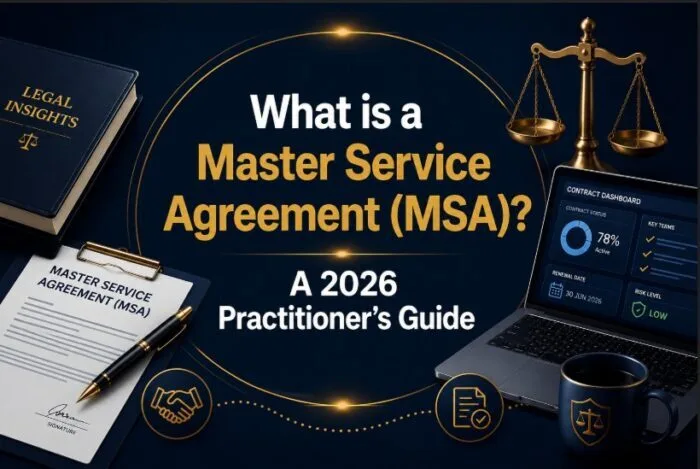

A Master Service Agreement, also called an MSA, MSA contract, or master services agreement, is a foundational legal document that establishes the terms and conditions governing all current and future business activities between two parties. The MSA sets the framework. Project-specific details, deliverables, pricing, and timelines live in attached Statements of Work (SOWs), Purchase Orders (POs), or work orders that reference the MSA. One signed MSA can support dozens of SOWs and many years of business.
That structure exists because the alternative is unworkable. Without an MSA, every new project requires renegotiating limitation of liability, indemnification, IP ownership, confidentiality, and a dozen other foundational terms. The MSA pulls that work forward into a single negotiation. Subsequent engagements then focus on what is actually different: scope, deliverables, and price.
This article covers what goes in an MSA, how MSAs differ from SOWs and other contract types, how AI is changing the MSA workflow in 2026, the clauses that get negotiated hardest in practice, and how to operationalize MSAs across a vendor portfolio.
Key Takeaways
- What an MSA is. A foundational contract that establishes the legal and commercial terms governing all current and future engagements between two parties, with project-specific details handled in attached SOWs, POs, or work orders.
- What goes in one. Twelve clauses matter most: scope, term, pricing, IP, confidentiality, indemnification, limitation of liability, warranties, termination, dispute resolution, governing law, and data security. Three priority tiers separate the clauses that get negotiated hardest from the boilerplate.
- MSA vs SOW. The MSA sets the framework; the SOW specifies what gets done on each project. One MSA can support dozens of SOWs over many years.
- AI is changing the workflow. As of April 2026, Anthropic’s Claude for Word and Microsoft Copilot in Word both produce native tracked changes for MSA redlines, alongside CLM-native AI from Onit ReviewAI, Ironclad, Sirion, Spellbook, and others.
- The negotiation focus areas matter. Five clauses get the hardest scrutiny in practice: limitation of liability, indemnification, IP ownership, termination, and data security. Documented preferred and fallback positions on each are what separates a fast review from a stuck negotiation.
- Operationalizing at scale. A single MSA is a Word problem. Hundreds of MSAs across a vendor portfolio are a CLM problem. The shift from the first to the second is what most legal departments are working through right now.

What is a Master Service Agreement?
A Master Service Agreement is the foundational contract between two parties that sets out the legal and commercial framework for an ongoing relationship. The acronym MSA can refer to other things in other contexts, but in business and legal contexts, MSA almost always means Master Service Agreement or Master Services Agreement. The two terms are used interchangeably. So is the phrase “MSA contract.”
The defining feature of an MSA is that it covers the relationship, not any single transaction. Where a one-off contract handles a specific deliverable, an MSA establishes the terms that will govern every engagement between the parties going forward. Subsequent SOWs, POs, change orders, and work orders incorporate the MSA by reference and only need to address what is unique to each project: scope, deliverables, schedule, and price.
This structure is well-established across software, professional services, IT, consulting, healthcare, energy, and most B2B industries. Wikipedia’s encyclopedic entry on Master Service Agreement notes the same convention: an MSA is the umbrella, and individual engagements live underneath it.
The benefits show up in three places. Faster time-to-deal on new engagements because the foundational terms are already negotiated. Consistency across the relationship because every SOW inherits the same legal framework. Lower transactional cost because the parties stop renegotiating the same boilerplate every time.
Evaluating or implementing a CLM platform?
We have guided legal departments through selection, implementation, and adoption, without the vendor bias. Let us talk about where you are and what you actually need.
See CLM Services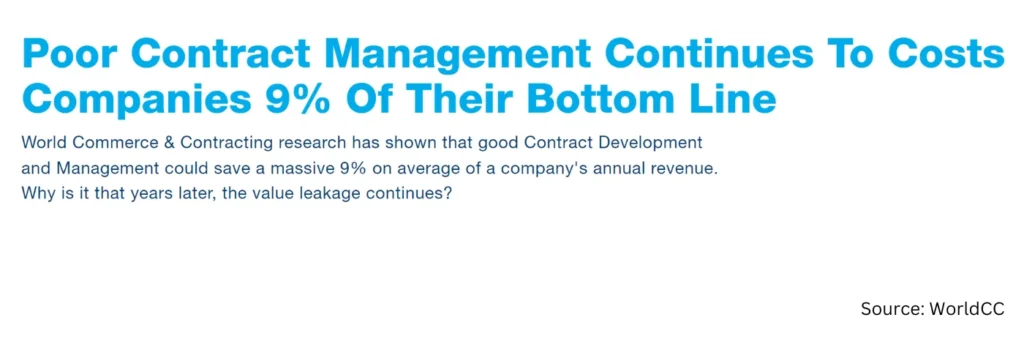
Why MSAs matter (and what poor MSA management costs)
The financial case for taking MSAs seriously is documented. The 2024 World Commerce & Contracting and Deloitte report, The Purpose of Contracts, found that 76 percent of legal and contract professionals report inefficiencies in their contract processes, with poor contracting practices costing organizations approximately 9 percent of annual revenue and complex industries losing 15 percent or more.
“Poor contracting practices cost organizations approximately 9 percent of annual revenue.” World Commerce & Contracting and Deloitte, 2024 Purpose of Contracts report
MSAs are where that erosion concentrates. They are typically high-value, multi-year, and high-volume across a vendor portfolio, which means small drafting weaknesses compound. A limitation-of-liability cap that is too generous on one MSA becomes a precedent the counterparty cites on the next ten. An IP ownership clause that says “work product” instead of “deliverables” creates a different risk profile across thousands of SOWs that incorporate it.
The negotiation effort is also concentrated. Coverage from Ironclad’s contracting reference work cites the 2025 Contracting Benchmark Report finding that MSAs are negotiated approximately 70 percent of the time and require legal team involvement in 85 percent of cases. The implication is that MSAs are where general counsel and legal operations leaders should focus their playbook investment, because that is where the negotiation actually happens.

What goes in a Master Service Agreement: 12 clauses that matter most
The clauses below are the ones that show up in essentially every MSA across software, professional services, IT, consulting, and most B2B contexts. They divide cleanly into three priority tiers. The Critical tier is where most of the negotiation time is spent. The Standard tier is where playbook fallbacks matter. The Boilerplate tier is where review-then-accept is usually fine unless something is unusual.
For reference on what a real MSA looks like in the wild, an example MSA filing on SEC Edgar shows a public-company commercial MSA with most of the clauses below.
Critical clauses (heaviest negotiation)
| Clause | What it does | Why it matters |
|---|---|---|
| Limitation of Liability | Caps the financial exposure each party faces in the event of breach, negligence, or other failure. | Without a cap, a single failure on a low-value project can expose the entire enterprise. The cap is almost always negotiated, often multiple times. |
| Indemnification | Allocates responsibility for third-party claims (IP infringement, personal injury, regulatory action). | Indemnification is where most material disputes between the parties resolve. The scope, the carve-outs, and the procedural terms each matter. |
| Intellectual Property Ownership | Defines who owns deliverables, work product, derivative works, and pre-existing IP. | Default IP allocation rules vary by jurisdiction. Without explicit allocation, ownership disputes are common and expensive. |
| Termination and Exit | Specifies grounds for termination, notice periods, transition obligations, and post-termination duties. | Most MSAs are multi-year, and most are eventually terminated. The exit terms matter at least as much as the entry terms. |
| Data Security and Privacy | Specifies the security framework, breach notification obligations, and regulatory compliance posture. | High-stakes for any vendor handling PII, PHI, or regulated data. Many enterprises now reference the NIST Cybersecurity Framework as the standard. |
Standard clauses (negotiate with playbook fallbacks)
| Clause | What it does | Why it matters |
|---|---|---|
| Scope of Services | Describes the categories of services covered by the MSA, with project-specific details deferred to SOWs. | The scope clause is the gateway to every future engagement. Too narrow forces a new MSA. Too broad creates risk. |
| Pricing and Payment Terms | Establishes the payment structure, invoicing cadence, late fees, and dispute mechanisms. | Net-30 vs. Net-60 vs. Net-90 is real money over time. Late-fee provisions matter on long-running engagements. |
| Term and Renewal | Specifies the initial term, auto-renewal provisions, and notice requirements. | Auto-renewal traps are common and expensive. The notice window is where most renewal disputes start. |
| Warranties and Service Levels | Sets quality standards, performance metrics, and remedies for failure. | Often partially handled in the MSA and partially in SOWs. The MSA establishes the floor. |
| Confidentiality | Defines confidential information, permitted uses, and survival of obligations after termination. | An MSA confidentiality clause typically survives the agreement. For more on confidentiality structures, see Swiftwater’s Confidentiality Agreement vs NDA guide. |
Boilerplate clauses (review, then accept unless unusual)
| Clause | What it does | Why it matters |
|---|---|---|
| Governing Law and Jurisdiction | Specifies which state or country’s law applies and where disputes are heard. | Counterparties usually have a strong preference. Worth checking but rarely the deal-breaker. |
| Dispute Resolution | Specifies whether disputes go to arbitration, mediation, or litigation, and where. | Standard arbitration provisions are common. The carve-outs (e.g., IP and equitable relief) are where attention goes. |
Many MSAs include additional clauses that do not appear in the table above: geography, venue, work standards, employee injury, property damage, missed deadlines, failure to pay, unsatisfactory performance, and product defects, among others. Most of those fold into the 12 above (warranties, scope, indemnification, and termination cover the substantive ground). Where they appear as standalone clauses in industry-specific MSAs (oil and gas, construction, healthcare), the same priority logic applies: the high-dollar exposure clauses get the negotiation time.

Master Service Agreement vs. Statement of Work (and the rest of the contract stack)
The MSA is not the only document in a typical commercial relationship. Five document types show up regularly, and confusion between them creates real problems in practice.
| Document | Purpose | Typical lifespan | Project-specific? | Sits where? |
|---|---|---|---|---|
| Master Service Agreement (MSA) | Sets the legal and commercial framework for an ongoing relationship | Multi-year, often perpetual until terminated | No | The umbrella |
| Statement of Work (SOW) | Defines a specific project, deliverables, schedule, and price under an MSA | Bounded by the project | Yes | Under an MSA |
| Service Level Agreement (SLA) | Defines service performance metrics and consequences for failure | Often part of an MSA, sometimes standalone | Service-specific | Inside or alongside an MSA |
| Framework Agreement | The EU/UK term broadly equivalent to an MSA, common in public procurement | Multi-year | No | The umbrella |
| Purchase Order (PO) | Authorizes a specific transaction, often within an MSA framework | Single transaction | Yes | Under an MSA, often more transactional than a SOW |
For a deeper treatment of how SOWs work and what to put in one, see Swiftwater’s Statement of Work guide. The shorthand: the MSA is the contract that says “here is how we will do business together.” The SOW is the document that says “here is what we are doing right now.”
Evaluating legal technology but not sure where to start?
We help legal departments cut through the vendor noise, mapping technology to process maturity and building a roadmap that actually gets adopted.
See Legal TechnologyThe relationship is hierarchical, not horizontal. An SOW that conflicts with the MSA defaults to the MSA’s terms unless the SOW explicitly amends them. This is why MSA negotiation matters more than SOW negotiation for the same dollar value, and why the MSA review process should never be rushed to fit a project deadline.

The 8 challenges of managing MSAs at scale
MSAs are instrumental in establishing structured business relationships, but eight specific challenges show up in implementations across mid-to-large enterprises:
- Complex negotiations. Negotiating limitation of liability, indemnification, IP ownership, and data security often takes months and involves multiple stakeholders on both sides. The clauses that matter most are the ones that take the longest.
- Legal complexity. MSAs need precise drafting because the language compounds across every SOW that incorporates them. A small ambiguity in the MSA becomes a recurring ambiguity across hundreds of engagements.
- Implementation and compliance. Ensuring ongoing compliance with MSA terms over a multi-year duration requires sustained monitoring. Most legal departments lack the operational infrastructure to do this manually.
- Scope management. The MSA scope clause is the gateway to future engagements. Scope creep across SOWs, or scope drift between the MSA’s intent and the work actually performed, is one of the most common sources of dispute.
- Risk assessment and mitigation. Each MSA carries performance, data security, IP, and contractual risk. Identifying and tracking those risks across an entire MSA portfolio is a discipline most legal departments are still building.
- Lack of standardization. When different business units, regions, or practice groups each have their own MSA template, the company ends up with inconsistent risk allocations and no playbook. Standardization is foundational to any AI or CLM workflow downstream.
- Limited visibility and control. Without a central repository, no one can answer “have we agreed to this language before?” or “what is our standard position on indemnification?” The MSAs sit in inboxes and shared drives, and the institutional memory dies when the people who negotiated them leave.
- Renewal and termination. Most MSAs auto-renew. Most enterprises do not have systematic visibility into which MSAs are renewing when, on what terms, with what notice obligations. Missed renewal deadlines and unwanted auto-renewals are routine.

How AI is changing MSA workflows in 2026
Two product releases in April 2026 changed the practical answer to “how do we redline an MSA.”
Claude for Word. On April 10, 2026, Anthropic released Claude for Word in public beta as a native sidebar add-in available through the Microsoft AppSource marketplace. Anthropic positioned legal contract review as the flagship use case, and the example prompts on the product page read like a contract attorney’s job description: summarize key commercial terms, flag provisions that deviate from market position ranked by severity, make indemnification mutual and insert standard fallback language, work through reviewer comments as tracked changes. Every Claude edit surfaces as a Word tracked change that can be accepted or rejected individually.
Microsoft Copilot in Word with Track Changes integration. Microsoft followed shortly after. The technical foundation was laid in an early April Microsoft Tech Community announcement introducing word-level Track Changes precision for Copilot in Word, contextual comments anchored to text, and progress messages for multi-step edits. Microsoft CEO Satya Nadella amplified the message on April 14, 2026, and the broader marketing rollout has continued through early May. The capability is currently available through the Frontier program on the Office Insiders Beta Channel.
For the full step-by-step on how AI redlining inside Word actually works, see Swiftwater’s companion How to Redline in Word in 2026 guide.
“MSAs are negotiated approximately 70 percent of the time, with legal team involvement in 85 percent of cases.” Ironclad, 2025 Contracting Benchmark Report
CLM-native AI platforms have offered MSA-specific redlining for years and continue to differentiate on depth. Onit ReviewAI sits inside Onit’s CLM stack and applies a configured playbook to incoming counterparty paper. Ironclad AI Assist, Sirion, Agiloft, Spellbook, and DocJuris all offer comparable capabilities at varying levels of depth.
The practical implication for MSA workflows: AI-assisted redlining inside Word is now table stakes. The remaining decisions are about which platform to deploy, how to govern it, and how to integrate it with the contract repository and playbook a serious legal department needs anyway. For a deeper treatment of how AI contract review fits into the broader legal department, see Swiftwater’s AI Contract Review guide.
The governance point matters specifically for MSAs because the stakes are high. AI redlining tools, including the major Word integrations, can produce fluent-sounding suggestions that misstate contract terms, miss carve-outs, or reference clauses that do not exist in the document. MSAs are the wrong place to skip the human review step. They are the right place to use AI for triage, deviation flagging, and first-pass markup, with the senior reviewer focusing on the Critical-tier clauses where AI is most likely to miss commercial nuance.

Negotiating an MSA: industry-typical positions on the clauses that matter
The clauses below are the ones where the negotiation actually happens. The positions described are industry-typical. Consult your legal advisor for situation-specific guidance. Each clause includes a standard preferred position, a common fallback range, and a typical counterparty objection.
Limitation of Liability. Industry-typical positions cap liability at fees paid in the prior 12 months, with carve-outs for IP infringement indemnification, breach of confidentiality, gross negligence, and willful misconduct. Common fallback ranges run from 1x to 3x annual fees. The most common counterparty objection from suppliers is that any cap above fees paid prevents pricing the work. The most common pushback from customers is that a fees-paid cap leaves data breach exposure unallocated.
Indemnification. Industry-typical positions are mutual indemnification for third-party claims arising from each party’s breach, negligence, or willful misconduct. Customers typically push for unlimited indemnification on IP infringement and data breach. Suppliers typically push to subject indemnification to the limitation of liability cap. The defense-and-control terms (who controls defense, who chooses counsel, who approves settlement) are negotiated almost as often as the substantive scope.
Not ready to pick a CLM platform yet?
A four to six week diagnostic that maps your current contract lifecycle, sets requirements themes, and tells you what to buy before you sit through another vendor demo.
See the CLM Discovery SprintIntellectual Property Ownership. Industry-typical positions allocate ownership based on the type of work. Customer-specific deliverables go to the customer. Pre-existing IP stays with whoever brought it. Tools and methodologies developed by the supplier stay with the supplier with a license to the customer. The hardest negotiations are around derivative works and improvements, where market positions vary widely by industry.
Termination. Industry-typical positions allow termination for cause with a cure period (often 30 days) and termination for convenience with a longer notice period (often 60-90 days). Transition assistance obligations, data return obligations, and post-termination IP licenses are typically negotiated separately. The fight is usually about whether termination for convenience is allowed at all, and what transition assistance must continue post-termination.
Data Security. Industry-typical positions reference an established framework like NIST CSF, ISO 27001, or SOC 2 Type II as the standard. Breach notification windows are typically 24-72 hours. The hardest negotiations are about audit rights, the right to require security improvements, and liability for breaches caused by sub-processors.
For any of these clauses, the difference between a fast review and a stuck negotiation is whether the legal department has documented preferred and fallback positions before the redline arrives. For the broader playbook discipline that supports this work, see Swiftwater’s Clause Libraries, Contract Templates, and Playbooks guide.

How different business functions use MSAs
MSAs are used across most B2B functions to govern structured engagements:
- Procurement and vendor management. Long-term supplier and vendor relationships, with POs and SOWs handling individual transactions under the MSA’s framework.
- Sales and client services. Customer-facing MSAs for ongoing service delivery, often paired with SLAs.
- IT and technology services. Software licensing, SaaS, hosting, maintenance, support, and managed services contracts.
- Consulting and professional services. Engagement frameworks where the MSA covers the relationship and SOWs cover specific projects.
- Real estate and facilities. Commercial leases, property management, and facilities services agreements.
- Marketing and advertising. Agency relationships covering campaign development, media buying, and performance metrics.
- Human resources. Staffing agency relationships, HR outsourcing, and contingent workforce agreements.
- Healthcare and life sciences. Clinical research, vendor services, and regulated supplier relationships.
The same MSA structure applies across all of these. What varies is the clause-level emphasis. Healthcare MSAs put more weight on data security and HIPAA compliance. Marketing MSAs put more weight on IP ownership of creative work. Construction MSAs add geography, employee injury, and property damage clauses. The 12-clause framework above is the common core; industry-specific clauses sit alongside it.

Operationalizing MSAs across hundreds of vendors
A single MSA negotiation is a Word problem. Hundreds of MSAs across a vendor portfolio is a Contract Lifecycle Management problem. The shift from one to the other is what most legal departments are working through right now.
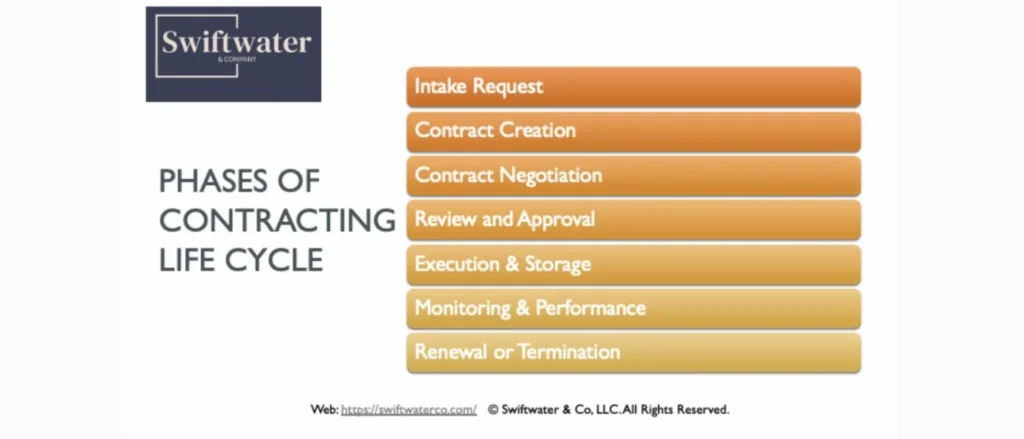 The CLM-led workflow for MSAs differs from the Word-led workflow in five places that matter at scale:
Repository. Every MSA, every SOW, every amendment is stored in one place with structured metadata. The repository answers questions like “which MSAs are renewing in the next 90 days,” “which MSAs reference the 2022 version of our standard indemnification language,” and “which counterparties have we agreed to a fees-paid liability cap with.” None of those questions can be answered from a shared drive at scale.
Playbook enforcement. The legal department’s preferred and fallback positions are encoded as machine-readable rules. The CLM scores incoming counterparty paper against the playbook automatically, flags deviations, and tells reviewers what falls inside policy, what falls in the fallback range, and what is a redline-or-walk situation.
Workflow routing. The CLM routes the document to the right reviewer based on counterparty risk, value tier, or clause sensitivity. Word-based workflows route based on whoever happens to be online and willing to take the document.
Obligation tracking. Once the MSA is signed, the CLM extracts the obligations (renewal dates, notice windows, performance metrics, data security commitments) and tracks them automatically. The repository becomes a living source of truth, not a graveyard.
AI-assisted redlining at the platform level. CLM-native AI sees the playbook, the repository, and the workflow simultaneously, which is why CLM AI redlining typically goes deeper than Word-based AI redlining for high-volume MSA work.
For a fuller treatment of how CLM implementation actually works at the program level, see Swiftwater’s CLM Implementation Blueprint and the CLM hub. For the cost-of-inaction math on whether a CLM is justified for a given legal department’s volume, the Swiftwater Legal Tech Calculator lets teams model the savings, the implementation cost, and the cost of doing nothing using their own inputs. For how MSAs and other contract work flow into broader contract operations, see Contract Workflow Management.
The practical read in 2026: AI inside Word and CLM-native AI are complementary capabilities serving different layers of the problem. A legal department running on Word alone, even with Copilot and Claude, is still missing the routing, the repository, and the playbook governance that a CLM provides. A legal department running a CLM without AI inside Word is still asking lawyers to manually redline counterparty paper one document at a time.

MSA Checklist
The MSA Checklist below covers the lifecycle stages of the most common activities. It is structured to follow the actual sequence of a real MSA negotiation, from pre-drafting to post-execution monitoring.
Pre-drafting considerations
▢ Identify the parties. Confirm the accurate legal entity names, signing authority, and jurisdiction of incorporation for both parties.
▢ Define the relationship objectives. What ongoing engagements does this MSA need to support? What’s in scope vs. out of scope?
▢ Review legal and regulatory requirements. Industry-specific compliance (HIPAA, GDPR, FedRAMP, ISO 27001), export controls, data residency.
▢ Determine the term. Initial term, renewal mechanism, notice obligations.
▢ Assess the risk profile. What is the worst case if this relationship goes wrong, and what clauses need to allocate that risk?
Drafting the MSA
▢ Define scope of services. Categories covered, work that requires separate agreement, exclusions.
▢ Specify pricing and payment terms. Structure (T&M, fixed-fee, retainer), invoicing cadence, late fees, dispute mechanism.
▢ Address confidentiality. What is confidential, permitted uses, survival, return or destruction obligations.
▢ Allocate IP rights. Customer-specific deliverables, pre-existing IP, tools and methodologies, derivative works, improvements.
▢ Set responsibilities and obligations. Customer obligations, supplier obligations, performance metrics where applicable.
▢ Establish dispute resolution. Arbitration vs. litigation, location, carve-outs for IP and equitable relief.
▢ Include indemnification. Mutual indemnification for third-party claims, IP indemnity scope, defense and control.
▢ Address termination and renewal. Termination for cause, termination for convenience, transition obligations, post-termination IP licenses.
▢ Determine governing law and jurisdiction. State or country law, courts of competent jurisdiction, sovereign immunity carve-outs where applicable.
Review and negotiation
▢ Review draft against the playbook. Is every clause inside the preferred or fallback range?
▢ Collaborate with stakeholders. Procurement, finance, security, the business sponsor.
▢ Negotiate from documented positions, not from scratch. Use the playbook fallbacks as the negotiation perimeter.
Finalization and execution
▢ Obtain signatures from authorized signatories. Verify signing authority for both parties.
▢ Distribute executed copies. Provide to all signatories, the contract repository, and any internal stakeholders who need access.
▢ Implement monitoring and compliance. Renewal dates, notice windows, obligation tracking.
Post-agreement actions
▢ Establish the communication channels. Who is the day-to-day contact for each party, and who escalates when things go wrong.
▢ Monitor performance and obligations. SLAs, commitments, renewal dates.
▢ Manage changes through amendment. Anything that materially changes the MSA goes through formal amendment, not informal email.
Regular review and updates
▢ Schedule periodic MSA reviews. Even MSAs that are not renewing benefit from annual review for relevance and risk.
▢ Track regulatory and market changes. Evolving data security requirements, AI governance requirements, and industry-specific regulations may require MSA updates ahead of renewal.
Bottom Line
A Master Service Agreement is the most leveraged document in any ongoing commercial relationship. It governs not one transaction but potentially every transaction the parties will do together, often for many years. The clauses inside it set the risk allocation, the IP allocation, the termination rights, and the data security posture across hundreds of downstream engagements. As of April 2026, AI-assisted redlining inside Microsoft Word is table stakes for the negotiation phase, and CLM-native AI is the operational standard for managing MSAs at scale across a vendor portfolio.
The MSA is a critical document as it can serve as the backbone for deals and business relationships. Establishing an MSA between two parties can facilitate and speed-up transactional activities through SOWs as those SOWs inherit what is in the MSA.
Frequently asked questions
What is a Master Service Agreement (MSA)?
A Master Service Agreement (MSA), also called an MSA contract or master services agreement, is a foundational legal document that establishes the terms and conditions governing all current and future business activities between two parties. The MSA sets the legal and commercial framework for the relationship, while project-specific details, deliverables, schedules, and pricing are handled in attached Statements of Work (SOWs), Purchase Orders (POs), or work orders that reference the MSA. One signed MSA can support dozens of SOWs and many years of business between the same two parties. The structure is standard across software, professional services, IT, consulting, healthcare, and most B2B industries.
What is the difference between an MSA and a Statement of Work (SOW)?
The MSA sets the framework for the ongoing relationship. The SOW specifies what gets done on a particular project. The MSA covers limitation of liability, indemnification, IP ownership, confidentiality, termination, governing law, and other foundational legal terms that apply to every engagement. The SOW covers the specific scope, deliverables, timeline, milestones, and price for one project. The relationship is hierarchical: an SOW that conflicts with the MSA defaults to the MSA’s terms unless the SOW explicitly amends them. One MSA typically supports dozens of SOWs over multi-year relationships. SOWs incorporate the MSA by reference rather than restating its terms.
What clauses are most important in an MSA?
Five clauses get the heaviest negotiation in practice and matter most for risk allocation. Limitation of liability caps the financial exposure each party faces. Indemnification allocates responsibility for third-party claims, especially IP infringement and data breach. Intellectual property ownership defines who owns deliverables, pre-existing IP, and derivative works. Termination and exit specifies the grounds for ending the relationship and the post-termination obligations. Data security and privacy specifies the security framework and breach notification obligations, often referencing NIST CSF, ISO 27001, or SOC 2 Type II as the standard. These five typically consume 80 percent of the negotiation time, with the remaining clauses (scope, pricing, term, warranties, confidentiality, governing law, dispute resolution) handled with playbook fallbacks.
What is a Master Service Agreement used for?
A Master Service Agreement is used to establish a structured, ongoing business relationship between two parties without requiring renegotiation of foundational terms for each new engagement. Companies use MSAs whenever they expect multiple projects, transactions, or service deliveries between the same parties over an extended period. Common scenarios include long-term vendor relationships in procurement, ongoing client engagements in professional services, multi-year IT and SaaS contracts, consulting and advisory relationships, marketing agency arrangements, and staffing or HR outsourcing relationships. The MSA front-loads the legal negotiation, so subsequent engagements through SOWs or POs focus only on what is actually different: scope, deliverables, schedule, and price.
Can AI redline a Master Service Agreement?
Yes. As of April 2026, Anthropic’s Claude for Word and Microsoft Copilot in Word both produce native Word tracked changes for AI-generated edits to MSAs, with every change reviewable, accept-or-rejectable, and audit-ready. CLM-native platforms including Onit ReviewAI, Ironclad, Sirion, Agiloft, Spellbook, and DocJuris have offered AI-assisted MSA redlining for several years, typically with deeper integration with the contract playbook and repository than the standalone Word add-ins provide. The right governance applies. AI is well-suited to first-pass redlining, deviation flagging against a playbook, and clause-level analysis. AI is not a substitute for human review on the Critical-tier clauses (limitation of liability, indemnification, IP, termination, data security) where commercial nuance matters and AI is most likely to miss carve-outs.
When should I use an MSA instead of a one-off contract?
Use an MSA whenever the parties expect more than a single transaction or project together, especially when those engagements will span more than one quarter or share common legal terms. The break-even point is roughly two to three engagements expected within twelve months, or any engagement that will require multiple SOWs over its lifecycle. A one-off contract is appropriate when the parties have no expectation of repeat business and the single engagement covers all the foundational legal terms in one document. The MSA approach pays off because the foundational legal negotiation happens once, and every subsequent SOW or work order under the MSA inherits the same framework. For long-term vendor, supplier, customer, or service relationships, the MSA is almost always the right structure.
Related Swiftwater insights
- How to Redline in Word in 2026
- What is AI Contract Review?
- Confidentiality Agreement vs NDA: The Practical Difference
- Clause Libraries, Contract Templates, and Playbooks
- How to Draft a Statement of Work for Professional Services Contracts
- Contract Workflow Management
- CLM Implementation Blueprint
- Manage Contracts at Scale (Swiftwater Contract Management)
- CLM Hub
Disclaimer: This article is provided for educational and informational purposes only. Swiftwater & Company and the author do not provide legal advice. External links and product references reflect publicly available information from the respective vendors and authorities and are provided for reference. Microsoft, Microsoft 365, Microsoft Copilot, and Microsoft Word are trademarks of Microsoft Corporation. Claude is a trademark of Anthropic, PBC. Onit and ReviewAI are trademarks of Onit, Inc. All other product names referenced are the property of their respective owners.